Is A Room with a View Hard to Read? Reading Difficulty & Study Guide (E. M. Forster)
For many first-time readers entering the world of British classics, E. M. Forster’s A Room with a View (1908) is a breath of fresh air. Shorter, lighter, and more sparkling with comic dialogue than the Victorian epics of Charles Dickens, George Eliot, or Thomas Hardy, Forster’s romantic comedy is often considered his most accessible and immediately delightful novel.
However, readers unfamiliar with Edwardian social conventions, early twentieth-century British class markers, and the subtle ironies of Forster’s narrator can easily miss the novel’s biting social satire and philosophical depth. Behind the sun-drenched Tuscan vistas and witty drawing-room banter lies a rigorous critique of Victorian emotional repression and aesthetic elitism.
This comprehensive reading difficulty guide evaluates the linguistic complexity, cultural context, and vocabulary demands of A Room with a View, providing a structured 4-week reading schedule and essential discussion questions for students, educators, and book club members.
| Reading Metric | Measurement / Level | Context & Benchmark |
|---|---|---|
| Lexile Measure | 980L – 1050L | Accessible high school / adult general readership; significantly lighter than Middlemarch (1250L) or Jane Eyre (1150L). |
| Page / Word Count | ~68,000 words (~210–240 pages) | Concise and brisk; easily read in 1 to 2 weeks of leisure reading. |
| Sentence Structure | Fluid, conversational, satirical | Forster blends crisp comic dialogue with philosophical narration and interior monologue. |
| Primary Hurdle | Edwardian social codes & irony | Understanding why exchanging a hotel room or kissing without an introduction caused intense moral panic. |
| Historical Knowledge | Moderate | Basic awareness of Baedeker tourism, early Italian Renaissance art, and the Edwardian class system. |
| Recommended Pacing | 5 chapters per week (4-week plan) | Allows deep appreciation of character development, symbolic motifs, and comic nuance. |
📊 Quantitative Difficulty Analysis
To evaluate how demanding A Room with a View is compared to other classic works of English fiction, consider standard educational and linguistic benchmarks:
CLASSIC NOVEL READING DIFFICULTY COMPARISON (LEXILE SCORE)
┌──────────────────────────────────────────────────────────┐
│ James Joyce: Ulysses (1340L)                             │
├──────────────────────────────────────────────────────────┤
│ George Eliot: Middlemarch (1250L)                         │
├──────────────────────────────────────────────────────────┤
│ Charlotte Brontë: Jane Eyre (1150L)                      │
├──────────────────────────────────────────────────────────┤
│ Thomas Hardy: Tess of the d'Urbervilles (1110L)          │
├──────────────────────────────────────────────────────────┤
│ E. M. Forster: A Room with a View (1010L)  ◄── Accessible│
├──────────────────────────────────────────────────────────┤
│ Jane Austen: Pride and Prejudice (1010L)                 │
├──────────────────────────────────────────────────────────┤
│ F. Scott Fitzgerald: The Great Gatsby (1010L)            │
└──────────────────────────────────────────────────────────┘
At roughly 68,000 words, A Room with a View is approximately one-fourth the length of Middlemarch and half the length of Bleak House. Forster deliberately abandoned the multi-plot, serialized sprawl of the high Victorian novel in favor of a tightly focused, two-act comedic structure:
- Part I (Florence, Chapters 1–7): The external awakening; foreign setting; physical action.
- Part II (Surrey, Chapters 8–20): The internal crisis; English country house domesticity; psychological resolution.
Forster’s prose is modern in its psychological transparency and economy, avoiding the dense Latinate syntax and labyrinthine subordinate clauses characteristic of eighteenth- and early nineteenth-century prose.
🔍 The True Challenges: Navigating Edwardian Nuance
While the syntax of A Room with a View is clear and pleasurable, modern readers encounter specific contextual and structural hurdles that require attentive reading.
1. The Proportions of the “Moral Panic”
The primary obstacle for contemporary readers is understanding why the novel’s central conflicts exist at all:
- Why is exchanging rooms with a view such a grave breach of etiquette?
- Why is a single kiss on a hillside treated like an irredeemable social catastrophe that requires immediate flight to Rome?
- Why is Lucy terrified that her family will disown her if she marries George Emerson?
In 1908, the English upper-middle class governed itself through strict, unspoken codes of class boundary and gender decorum. Unmarried young women were chaperoned at all times to prevent any taint of sexual impropriety. Accepting a favor from a lower-middle-class man without an introduction was seen as inviting intimate familiarities. To enjoy reading the novel, modern readers must tune into this delicate frequency: the stakes are not physical survival, but spiritual authenticity versus social annihilation.
2. Forster’s Double-Edged Satirical Irony
Forster’s narrator rarely tells the reader directly who is wise and who is foolish. Instead, he speaks in a voice of polite, deadpan irony:
- When the narrator describes Charlotte Bartlett’s self-sacrificing generosity, he is subtly exposing her passive-aggressive emotional tyranny.
- When Cecil Vyse delivers high-minded monologues about aesthetic taste, the narrator is mocking his emotional sterility.
- Even Lucy Honeychurch is gently satirized: she believes she is being fiercely modern and rational when she is actually terrified of her own feelings.
Readers who take every narrator comment literally risk missing Forster’s wicked sense of humor.
FORSTERIAN IRONY IN ACTION
Spoken / Surface Layer:    "Miss Bartlett was generous to a fault..."
Subtext / Real Meaning:    Charlotte uses self-pity to guilt-trip everyone around her.
Spoken / Surface Layer:    "Cecil was a medieval ascetic..."
Subtext / Real Meaning:    Cecil is a socially inept, emotionally stunted snob.
3. Italian Renaissance & Aesthetic References
The characters continually evaluate each other based on their reactions to Italian art and landscape:
- Baedeker Guidebooks: Karl Baedeker’s red tourist guidebooks dictated every sight, hotel, and reaction for middle-class English travelers. Going into Santa Croce “without a Baedeker” symbolizes experiencing life directly rather than through prefabricated formulas.
- Giotto vs. the Renaissance: Giotto represents medieval simplicity and direct emotional faith, while Botticelli and Michelangelo represent Renaissance vitality and bodily beauty. Cecil is trapped in the “Middle Ages,” whereas George and Lucy step into the “Renaissance.”
📚 Essential Vocabulary & Cultural Terms
Understanding these Edwardian terms will ensure a smooth, rewarding reading experience:
| Term | Meaning & Context in the Novel |
|---|---|
| Baedeker | The standard German travel guidebook used by wealthy tourists. To rely on a Baedeker meant viewing foreign cultures through rigid, unoriginal stereotypes. |
| Pensione | A European boarding house or family-run hotel where meals and lodging are provided (such as the Pensione Bertolini). |
| Pince-nez | Eyeglasses clipped directly onto the bridge of the nose without earpieces; worn by Cecil Vyse as a symbol of fastidious, detached observation. |
| The Muddle | Forster’s key philosophical concept: the confusing, dishonest state that occurs when human beings suppress their true passions to appease social convention. |
| Philistine | A person indifferent or hostile to cultural and artistic values; used arrogantly by Cecil Vyse to dismiss Mrs. Honeychurch and provincial society. |
| Pre-Raphaelite | A late Victorian artistic movement romanticizing medieval art; reflected in Cecil’s desire to treat Lucy as a framed, pale Dantean maiden. |
| C/o (Care of) | Forwarding address notation; used in the comic subplots involving the post and forwarding mail to the Miss Alans. |
| Socialist / Radical | Political label applied dismissively to Mr. Emerson because he questions the established church, hereditary privilege, and rigid class hierarchies. |
🗓️ 4-Week Structured Reading Plan
This four-week reading schedule breaks the novel’s 20 chapters into manageable, thematic reading chunks:
4-WEEK READING ROADMAP
Week 1 (Ch. 1–5):   Florence, Santa Croce, & the Piazza della Signoria
Week 2 (Ch. 6–10):  The Kiss at Fiesole & Arrival of Cecil Vyse
Week 3 (Ch. 11–15): The Sacred Lake, the Second Kiss, & Breaking the Engagement
Week 4 (Ch. 16–20): The Garden of Lies, Mr. Emerson's Study, & Florentine Coda
Week 1: Florence and the First Stirrings (Chapters 1–5)
- Reading Goal: Chapters 1 through 5 (~16,000 words).
- Focus Areas: The room exchange at Pensione Bertolini; Lucy’s piano playing; the Santa Croce visit; the sudden murder in the Piazza della Signoria; George’s philosophical shift (“I shall probably want to live”).
- Core Question: How does Italy challenge Lucy’s conventional Surrey upbringing even before romance begins?
Week 2: The View and the Middle Ages (Chapters 6–10)
- Reading Goal: Chapters 6 through 10 (~18,000 words).
- Focus Areas: The carriage ride to Fiesole; the kiss among the violets; Charlotte’s horrified reaction and hasty departure to Rome; the transition to Surrey; Cecil Vyse’s third proposal; the lease of Cissie Villa.
- Core Question: Why does Forster juxtapose George’s kiss on the hillside with Cecil’s formal kiss in the Surrey woods?
Week 3: Vitality vs. Aestheticism (Chapters 11–15)
- Reading Goal: Chapters 11 through 15 (~18,000 words).
- Focus Areas: Mrs. Vyse’s London flat; the joyous naked swim at the Sacred Lake; Cecil reading Miss Lavish’s romance novel; George’s second kiss in the shrubbery; Lucy and George’s confrontation on the terrace; breaking the engagement with Cecil.
- Core Question: What specific arguments does George make that open Lucy’s eyes to Cecil’s true nature?
Week 4: The Garden of Lies and the Awakening (Chapters 16–20)
- Reading Goal: Chapters 16 through 20 (~16,000 words).
- Focus Areas: Lucy’s deceit toward her family, Mr. Beebe, and herself; the planned flight to Greece; the climactic confrontation with Mr. Emerson in the rectory study; the resolution in Florence.
- Core Question: Why is Mr. Emerson the only character capable of breaking through Lucy’s emotional defense mechanisms?
💬 Discussion & Book Club Questions
- The Architecture of Class: How do the Emersons challenge the social expectations of the British upper-middle class? Why are characters like Charlotte Bartlett and Mr. Eager so threatened by their direct honesty?
- Music as Subconscious Desire: Forster frequently highlights Lucy’s piano playing. How does her musical expression foreshadow her romantic decisions, and why does Mr. Beebe find her playing both thrilling and frightening?
- The Complexity of Charlotte: Is Charlotte Bartlett purely a villainous, manipulative chaperone, or does Forster encourage sympathy for her economic and social plight? How does her final action at the rectory reframe her character?
- The Failure of the Clergy: Compare the characters of the Reverend Cuthbert Eager and the Reverend Arthur Beebe. How does Forster satirize institutional Christianity and clerical celibacy?
- Views in Modern Life: In what ways are modern readers still trapped in “rooms without a view”? How does Forster’s philosophy of emotional authenticity speak to contemporary relationships?
❓ Frequently Asked Questions
Is A Room with a View a good first book for reading E. M. Forster?
Yes. A Room with a View is widely considered the best entry point into Forster's works. It is shorter, lighter, and more optimistic than Howards End or A Passage to India, while showcasing his signature satirical wit, psychological depth, and radiant prose style.
How long does it take an average reader to finish the novel?
At approximately 68,000 words, the average adult reading at 250 words per minute can finish the novel in about 4.5 to 5 hours of total reading time. Following our recommended 4-week study plan requires roughly 70 minutes of reading per week.
Why did E. M. Forster choose Italy as the setting for the first half?
For British writers of the late 19th and early 20th centuries, Italy represented a cultural antithesis to England's repressed Victorian decorum. Its vibrant sunshine, historic art, and expressive population served as a literary catalyst that shattered northern European emotional inhibitions.
Are there any film adaptations that help with comprehension?
The acclaimed 1985 Merchant Ivory film adaptation directed by James Ivory, starring Helena Bonham Carter, Julian Sands, Daniel Day-Lewis, and Maggie Smith, is remarkably faithful to the novel's text and tone, serving as a brilliant visual accompaniment to study.
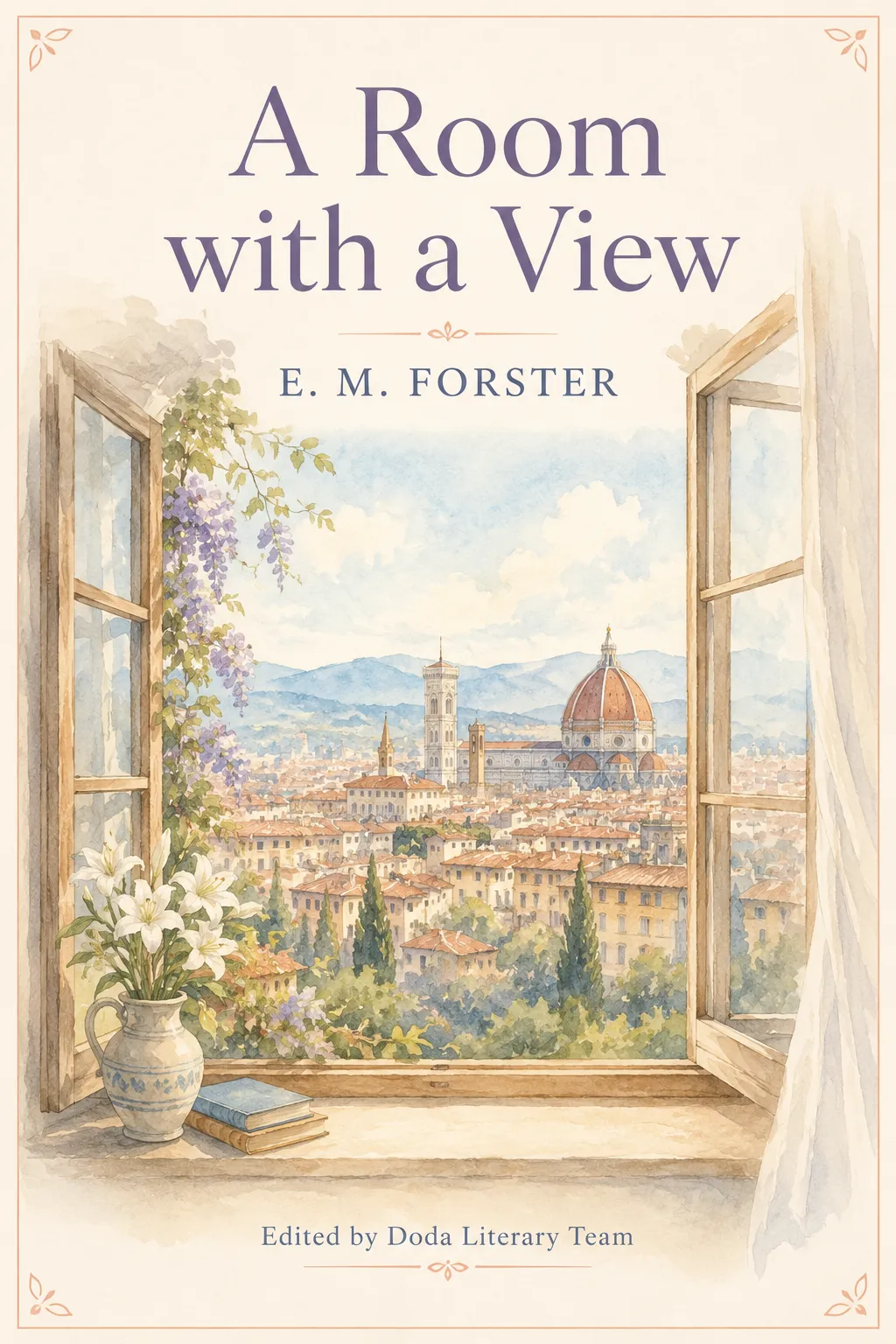
📖 Read Forster with Unrivaled Clarity & Context
Deepen your appreciation of A Room with a View with the definitive annotated edition from DodaBooks:
- 🎓 Comprehensive Historical & Literary Annotations — Explaining Baedeker guidebooks, Italian politics, and Edwardian social nuances
- 🗺️ Florentine & Surrey Maps & Artwork Guides — Visualizing Santa Croce, the Piazza della Signoria, and Fiesole
- 📱 Designed for Focused Study — Clean typography, custom formatting, and linked footnotes
- 🔓 100% DRM-Free — Read anywhere on Kindle, Kobo, iPad, or Android
👉 Get the Annotated Edition of A Room with a View at DodaBooks →