Is A Midsummer Night's Dream Hard to Read? Reading Level & Student Guide
For middle schoolers, high school freshmen, and adult readers exploring Shakespeare for the first time, William Shakespeare’s A Midsummer Night’s Dream (c. 1595–1596) is widely considered the friendliest, most delightful portal into Elizabethan theater. With its magical woodland fairies, hilarious artisanal actors, transformed donkey-headed protagonist, and joyous multiple marriages, the play offers an enchanting blend of high poetry and broad physical slapstick.
Yet, despite its reputation as an accessible comedy, modern readers approaching the original 1595 text still encounter four-hundred-year-old Early Modern English verse: classical mythological names from ancient Greece, intricate rhyming couplets, magical incantations, and Elizabethan sexual puns.
Is A Midsummer Night’s Dream genuinely hard to read? The short answer is no—compared to dense tragedies like Hamlet or King Lear, A Midsummer Night’s Dream is one of Shakespeare’s most approachable works. However, understanding its multiple poetic forms and mythological allusions transforms a confusing text into pure theatrical joy.
This comprehensive guide breaks down the quantitative reading metrics, poetic meters, linguistic obstacles, and thematic structures of A Midsummer Night’s Dream, complete with a structured 10-day reading plan.
| Metric | Score & Recommendation |
|---|---|
| Overall Difficulty Rating | 5.5 / 10 (Accessible Shakespearean Classic) |
| Lexile Measure | 1020L (Approx. Grade 7 to Grade 9 Level) |
| Poetic Variety | Blank Verse (~50%), Rhymed Couplets & Songs (~30%), Prose (~20%) |
| Total Lines & Length | 2,165 lines (approx. 16,500 words across 9 scenes) |
| Recommended Reading Age | 11–16 years old (Grades 6–10 and adult general readers) |
| Estimated Reading Time | 2.5 to 3.5 hours (Stage runtime approx. 2 hours) |
| Recommended Edition | DodaBooks Annotated Edition of A Midsummer Night’s Dream |
📊 Quantitative Metrics: Understanding the 1020L Lexile Score
Standardized reading formulas place A Midsummer Night’s Dream at a moderate secondary school reading level:
- Lexile Measure (1020L): Places the text directly within the range expected for 7th- to 9th-grade readers (ages 12–15). For comparison, J.R.R. Tolkien’s The Hobbit measures 1000L, while Shakespeare’s Hamlet measures 1390L.
- Short Dramatic Length: At just 2,165 lines across nine scenes, the play is roughly half the length of Hamlet (4,042 lines) and significantly shorter than Romeo and Juliet (3,007 lines).
- Rapid Scene Pacing: The plot moves briskly through five acts without extended, philosophical interior monologues, keeping readers engaged through physical comedy and rapid-fire dialogue.
🔍 The 4 Key Obstacles That Challenge First-Time Readers
Understanding the unique literary mechanics of A Midsummer Night’s Dream allows readers to navigate the text with complete clarity:
1. The Four Distinct Poetic Registers
Shakespeare did not write the entire play in a single verse form; instead, he assigned a distinct linguistic medium to each of the four social spheres:
- Courtly Blank Verse (Unrhymed Iambic Pentameter): Spoken by Duke Theseus and Hippolyta to convey regal dignity, civic order, and daylight authority (10 syllables: da-DUM da-DUM da-DUM da-DUM da-DUM):
“Now, fair Hippolyta, our nuptial hour / Draws on apace; four happy days bring in / Another moon…”
- Rhymed Iambic Couplets (The Language of Young Love): When the four young Athenian lovers enter the woods, their speech transitions into musical rhymed couplets, emphasizing their youthful emotional volatility and artificial romance:
“Love looks not with the eyes, but with the mind; / And therefore is wing’d Cupid painted blind.”
- Trochaic Tetrameter (The Supernatural Fairy Incantations): Oberon, Titania, and Puck cast magic spells using an incantatory, inverted meter consisting of seven or eight syllables following a stressed/unstressed rhythm (DUM-da DUM-da DUM-da DUM):
“What thou seest when thou dost wake, / Do it for thy true-love take; / Love and languish for his sake…”
- Colloquial Earthy Prose: The working-class mechanicals (Bottom, Quince, Flute, Snug) speak in natural, unrhymed everyday prose, reflecting their practical artisan status.
2. Classical Greek Myth Blended with British Country Folklore
Shakespeare brilliantly mashes together two completely different cultural worlds:
- Classical Antiquity: Duke Theseus of Athens, his Amazonian bride Hippolyta, the Law of Athens, and references to Ovid’s Metamorphoses (Cupid, Venus, Apollo, Daphne, and the myth of Pyramus and Thisbe).
- English-Celtic Rural Folklore: Robin Goodfellow (Puck), domestic hobgoblins, changeling children, milk-skimming brownies, and May Day flower festivals.
Without explanatory footnotes, modern students often struggle to understand why an ancient Greek duke is celebrating British May Day rites in an English oak forest.
3. Comic Malapropisms and Puns
Nick Bottom and the mechanicals frequently misapply elaborate vocabulary to sound educated, creating hilarious malapropisms (unintentional comedic word substitutions):
- Bottom speaks of “flowers of odious savours sweet” (meaning odorous / fragrant).
- Bottom boasts that he will “aggravate” his voice (meaning moderate or soften his roar).
- Quince declares their play is a “lamentable comedy” (a self-canceling paradox).
Recognizing that Shakespeare intended these lines as deliberate jokes prevents students from assuming the text is incomprehensible.
4. Symmetrical Quadrangle Plot Confusion
In Act III, Scene 2, the four young lovers engage in a chaotic forest argument where loyalties shift repeatedly due to the magic flower:
- Originally: Lysander loves Hermia; Demetrius loves Hermia; Helena loves Demetrius; Hermia loves Lysander.
- Mid-forest crisis: Lysander loves Helena; Demetrius loves Helena; Hermia is rejected by both; Helena believes all three are mocking her.
Keeping a visual chart of who loves whom at each stage of the night prevents readers from getting dizzy in the woods.
📚 Comparative Difficulty: Shakespeare’s Major Plays
| Shakespeare Play | Difficulty Rating (1–10) | Lexile Score | Dominant Language Style | Best Audience |
|---|---|---|---|---|
| A Midsummer Night’s Dream | 5.5 / 10 | 1020L | Lyrical rhyming verse, physical comedy, rustic prose | Grades 6–9 (Ages 11–15) |
| Romeo and Juliet | 6.5 / 10 | 1040L | Petrarchan sonnets, fast-paced street slang | Grades 8–10 (Ages 13–16) |
| Julius Caesar | 7.0 / 10 | 1080L | Formal Roman rhetoric, political oratory | Grades 9–11 |
| Macbeth | 7.5 / 10 | 1090L | Dense poetic brevity, Scottish witchcraft imagery | Grades 10–12 |
| Hamlet | 8.5 / 10 | 1390L | Extended philosophical soliloquies, dense wordplay | Grades 11–College |
Because A Midsummer Night’s Dream emphasizes physical slapstick, musical poetry, and magical humor, it is universally recognized as the easiest and most entertaining Shakespeare play for first-time readers.
🗓️ The 10-Day Midsummer Reading Plan
Dividing the nine scenes across ten manageable daily reading sessions makes the play effortless and rewarding:
Week 1: Athenian Law, The Fairy Feud, and The Crossed Lovers
Day 1:  Act I, Scene 1   (Theseus's Court; Egeus's Ultimatum; Hermia & Lysander Escape Plot)
Day 2:  Act I, Scene 2   (The Mechanicals Meet; Bottom Claims Every Part; Rehearsal Planned)
Day 3:  Act II, Scene 1  (Puck & the Fairy; Oberon & Titania's Quarrel; The Magic Purple Flower)
Day 4:  Act II, Scene 2  (Titania's Lullaby; Puck Enchants Lysander; Lysander Awakens Loving Helena)
Day 5:  Act III, Scene 1 (The Forest Rehearsal; Bottom's Ass Head; Titania Falls in Love)

Week 2: Erotic Chaos, The Morning Hunt, and The Royal Wedding
Day 6:  Act III, Scene 2a (Oberon Enchants Demetrius; Both Men Pursue Helena; Four Lovers Brawl)
Day 7:  Act III, Scene 2b (Puck Mimics Voices in the Fog; Herbal Antidote Applied to Lysander)
Day 8:  Act IV, Scene 1  (Titania Released; Duke's Hunt Awakens Lovers; Bottom's Dream Soliloquy)
Day 9:  Act IV, Scene 2 & Act V, Sc. 1a (Mechanicals Reunited; Theseus on "The Lunatic, Lover, & Poet")
Day 10: Act V, Scene 1b  ("Pyramus & Thisbe" Performance; Bergomask Dance; Fairy Midnight Blessing & Epilogue)
For comprehensive plot summaries and scene analyses, refer to our complete A Midsummer Night’s Dream Summary Act by Act.
💡 4 Essential Tips for Reading A Midsummer Night’s Dream with Ease
- Listen to the Rhythm of the Verse: Notice how the beat shifts when Puck and Oberon speak in bouncy trochaic rhymes (“Up and down, up and down, / I will lead them up and down”), compared to Theseus’s steady, dignified ten-syllable blank verse.
- Enjoy the Comedy of Bottom’s Blunders: When Bottom uses words incorrectly, smile and recognize that Shakespeare wrote him as a lovable, earnest clown meant to generate loud laughter.
- Keep a Character Map Nearby: Track the four realms (Athens, Lovers, Fairies, Mechanicals) to keep characters straight. Check our complete guide on A Midsummer Night’s Dream Characters Explained.
- Choose an Annotated Edition with Inline Glosses: Having instant explanations for Elizabethan words like votaress, love-in-idleness, and bergomask eliminates 95% of reading obstacles. Check our reviews in Best Editions of A Midsummer Night’s Dream.
❓ Frequently Asked Questions
Why is A Midsummer Night's Dream considered the best play to start reading Shakespeare?
The play contains Shakespeare's most joyous physical comedy, clear narrative symmetry, and magical folklore elements. With fewer archaic legal debates and violent deaths than the tragedies or histories, it provides a fun, low-stress entry point into Shakespeare's language.
What does "love-in-idleness" mean?
"Love-in-idleness" was an Elizabethan folk name for the wild pansy (*Viola tricolor*). In the play, Oberon claims the flower was originally milk-white until hit by a stray arrow from Cupid's bow, turning it purple with the magical power to make sleeping eyelids dote on the first creature seen upon waking.
How long does it take an average reader to read the entire play?
At approximately 16,500 words across nine scenes, an average reader reading at 200 words per minute will complete the script in 2.5 to 3.5 hours. Following our 10-day study plan requires only 15 to 20 minutes of daily reading.
Is A Midsummer Night's Dream suitable for family reading or classroom read-alouds?
Yes. The play makes an exceptional family read-aloud and classroom drama project. While it contains subtle Elizabethan double entendres that amuse adults, its visual slapstick, fairy enchantments, and animal transformations delight children as young as nine or ten.
Which edition is best for someone reading the play for the first time?
The DodaBooks Annotated Edition features line-by-line modern glosses for Elizabethan terms, explanatory notes on fairy folklore, and clear scene summaries, making it the most accessible digital edition available.
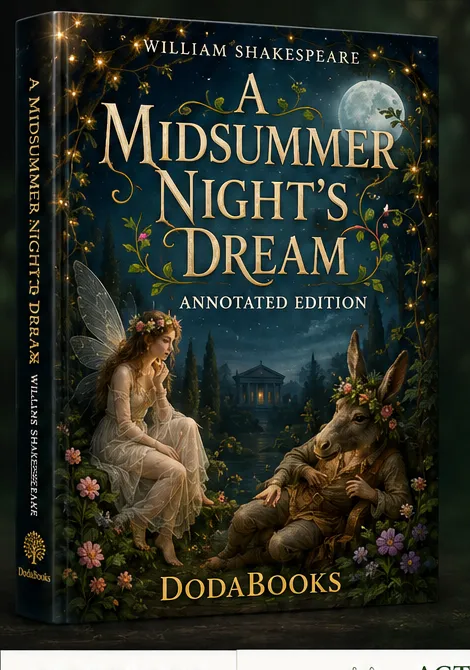
🌙 Experience Shakespeare’s Most Joyous Comedy
Eliminate archaic language barriers, explore fairy folklore, and enjoy Shakespeare’s magical comedy with the DodaBooks Annotated Edition of A Midsummer Night’s Dream.
- 🔍 Over 800 Line-by-Line Glosses — Instant explanations of Early Modern words and puns
- 🧚 Fairy Lore & Folk Commentary — Context on Robin Goodfellow, Cupid’s flower, and May Day rites
- 📖 Complete Uncut Text — Beautifully typeset preserving authentic blank verse rhythm
- 🔒 100% DRM-Free Ownership — Yours forever on Kindle, Kobo, iPad, and desktop
- ⚡ Instant Download — High-resolution EPUB delivered directly to your device
Explore our master Midsummer Guide for complete analysis of setting, themes, and Shakespeare’s pastoral vision.