Is A Journey into the Interior of the Earth Hard to Read? Reading Difficulty Guide
Jules Verne’s 1864 classic A Journey into the Interior of the Earth (Voyage au centre de la Terre) is celebrated across the globe as the quintessential subterranean adventure. Yet prospective readers frequently wonder: how difficult is it to read Jules Verne today? Does the nineteenth-century prose feel dry, dense, and archaic, or does the pulse-pounding adventure carry modern readers effortlessly through the pages?
The short answer is that A Journey into the Interior of the Earth is moderately accessible, earning an overall difficulty rating of 5.0 out of 10. While its fast-moving narrative, first-person narrator, and cinematic action sequences make it significantly easier to read than dense Victorian novels like Herman Melville’s Moby-Dick or Victor Hugo’s Les Misérables, it does feature specialized nineteenth-century geological terminology and scientific debates that can slow down unassisted readers.
This comprehensive guide analyzes the Lexile reading level, vocabulary hurdles, sentence structures, and pacing of Verne’s masterpiece, providing a practical 14-day reading plan and actionable strategies for mastering the novel with ease.
| Metric | Rating / Value | Analysis & Comparison |
|---|---|---|
| Overall Difficulty | 5.0 / 10 (Moderate) | Highly engaging; accessible to high schoolers and adults |
| Lexile Reading Measure | 1010L – 1080L | Equivalent to H.G. Wells’s The Time Machine (1070L) |
| Average Reading Time | 6 to 8 Hours | Short novel (~60,000–65,000 words across 44 chapters) |
| Primary Challenge | Geological & Mineral Jargon | 19th-century petrology, stratigraphy, and paleontology |
| Primary Strength | Fast First-Person Pacing | Axel’s relatable terror, rapid dialogue, and intense action |
| Recommended Edition | Annotated Edition | Clarifies scientific concepts without disrupting the plot |
📊 Reading Difficulty Breakdown by Category
To evaluate what makes A Journey into the Interior of the Earth uniquely challenging or accessible, we must dissect the novel into five primary reading dimensions:
1. Vocabulary & Scientific Terminology (Rating: 6.5 / 10)
Vocabulary represents the single largest hurdle in the novel. Jules Verne was not writing fantasy; he was writing what was considered “hard science fiction” in 1864. Consequently, Professor Otto Lidenbrock and Axel discuss geology with academic precision.
Readers will regularly encounter technical nineteenth-century scientific terms:
- Petrology & Mineralogy: Gneiss, mica-schist, trachyte, basalt, feldspar, porphyry, cryptocrystalline, syenite.
- Geological Epochs: Silurian, Devonian, Carboniferous, Permian, Secondary and Tertiary strata.
- Prehistoric Biology: Ichthyosaurus, Plesiosaurus, mastodon, megatherium, pterodactyl, belemnite, ammonite.
- Scientific Instrumentation: Ruhmkorff electric induction coil, manometer, centigrade thermometer, pocket chronometer.
While an unassisted reader might find these paragraphs dense, the context usually makes their narrative function obvious: Lidenbrock is cataloging the descending rock layers to estimate their depth beneath the Earth’s crust.
2. Sentence Structure & Syntax (Rating: 4.5 / 10)
Unlike the labyrinthine, multi-clause periodic sentences of Victor Hugo or Henry James, Verne’s prose (especially in high-quality modern translations) is crisp, energetic, and dialogue-driven. Sentences during action scenes are short, punchy, and urgent.
Verne uses exclamation marks, rapid-fire questions, and staccato exchanges between Axel and Professor Lidenbrock to convey panic and adrenaline:
“The raft stopped! The mast shook violently! A terrible shock threw us to the deck! What was it? Was it a rock? No—a monster! A colossal sea serpent? No, worse—two monsters locked in mortal combat!”
3. Pacing & Narrative Structure (Rating: 3.5 / 10)
Verne was a master of narrative suspense. The novel is structured into 44 relatively short chapters, each averaging around 1,400 to 1,600 words. This makes the book extraordinarily well-suited to episodic reading.
Each chapter ends on an effective cliffhanger or scientific revelation: a deciphered rune, the exhaustion of the water supply, Axel’s terrifying separation in the dark, or the sudden appearance of prehistoric monsters on the horizon. The novel never lingers in one location long enough to grow stagnant.
4. Cultural & Historical Context (Rating: 4.0 / 10)
The narrative begins in May 1863 in Hamburg, Germany, moves across Denmark to Iceland, and descends through Snæfellsjökull before emerging at the volcanic island of Stromboli off Sicily.
Readers unfamiliar with Icelandic geography, Norse mythology (Snorri Sturluson’s Heimskringla), or 1860s European scientific academies will benefit from brief footnotes. However, the emotional core—human curiosity vs. the terrifying unknown—is universal and timeless.
📈 Verne vs. Other 19th-Century Classics
To put the reading level into perspective, here is how A Journey into the Interior of the Earth compares against other classic adventure and nineteenth-century works:
| Work | Author | Lexile Level | Difficulty Rating | Typical Challenges |
|---|---|---|---|---|
| Treasure Island | Robert Louis Stevenson | 1070L | 4.0 / 10 | 18th-century nautical slang and pirate dialect |
| Journey into the Interior of the Earth | Jules Verne | 1040L | 5.0 / 10 | Geological terminology, Icelandic geography |
| The Time Machine | H.G. Wells | 1070L | 5.5 / 10 | Victorian social commentary, philosophical musings |
| Frankenstein | Mary Shelley | 1170L | 6.5 / 10 | Romantic philosophical rhetoric, complex framing |
| Dracula | Bram Stoker | 1070L | 6.5 / 10 | Epistolary format, dialect phonetics, slow middle acts |
| Moby-Dick | Herman Melville | 1200L | 8.5 / 10 | Cetological essays, Shakespearean soliloquies |
🗓️ The 14-Day Reading Plan: 3 to 4 Chapters per Day
Because A Journey into the Interior of the Earth is compact (around 60,000 words), it can be comfortably finished in two weeks by reading just 15 to 25 minutes per day:
| Day | Chapters | Key Narrative Milestone | Focus Areas |
|---|---|---|---|
| Day 1 | Chapters 1–3 | The Hamburg House & The Runic Parchment | Lidenbrock’s character, Arne Saknussemm’s cipher |
| Day 2 | Chapters 4–6 | Deciphering the Secret & Axel’s Panic | Axel’s skepticism, preparation for the trek |
| Day 3 | Chapters 7–9 | Arrival in Iceland & Meeting Hans Bjelke | Reykjavik hospitality, hiring their stoic guide |
| Day 4 | Chapters 10–13 | The Trek Across Iceland to Snæfellsjökull | Volcanic landscapes, geysers, ascending the glacier |
| Day 5 | Chapters 14–16 | Descending into the Crater of Scartaris | Shadow of Scartaris, entering the central chimney |
| Day 6 | Chapters 17–19 | Entering the Deep Strata & The Wrong Turn | Coal formations, Carboniferous fossils, dead ends |
| Day 7 | Chapters 20–23 | Dehydration Crisis & The Hansbach | Agony of thirst, Hans’s miraculous discovery of water |
| Day 8 | Chapters 24–26 | The Great Descent & Deep Acoustic Wells | Calculating subterranean depth, acoustic phenomena |
| Day 9 | Chapters 27–30 | Axel Lost in the Abyss & Sensory Terror | Psychological horror, acoustic reunion with the party |
| Day 10 | Chapters 31–33 | The Lidenbrock Sea & Giant Fungal Forests | Subterranean phosphorescence, Carboniferous flora |
| Day 11 | Chapters 34–36 | Battle of the Monsters & Electric Ball Lightning | Ichthyosaurus vs. Plesiosaurus, electrical storm |
| Day 12 | Chapters 37–39 | The Ossuary & The Prehistoric Humanoid Giant | Quaternary human fossils, mastodons, giant shepherd |
| Day 13 | Chapters 40–42 | Saknussemm’s Carving & The Gunpowder Blast | Finding the initialed tunnel, the granite blockage |
| Day 14 | Chapters 43–44 | Eruption of Stromboli & Triumphant Return | Volcanic ejection, return to Hamburg, Axel’s wedding |
For a deeper dive into the characters you will encounter along this journey, explore our detailed Guide to the Characters of A Journey into the Interior of the Earth.
💡 5 Pro Tips for Reading Verne Effortlessly
- Don’t Let Geological Terms Stall You: When Professor Lidenbrock recites a list of rock types (gneiss, trachyte, granite), remember that his primary goal is simply determining what geological era the rock belongs to. You do not need a degree in geology to appreciate the scene; understand that they are descending through deep planetary history.
- Choose an Unabridged, Modern Edition: As explained in our Where to Buy & Translations Guide, avoid Victorian public-domain translations that mangle character names and delete science. An annotated edition with footnotes will effortlessly explain 19th-century instruments like the Ruhmkorff lamp.
- Visualize the Subterranean Landscape: Verne’s descriptions of the subterranean world are vivid and cinematic. Picture the giant white mushroom forests, the silent subterranean ocean illuminated by electrical aurorae, and the enormous cavern roof towering miles overhead.
- Appreciate Axel’s Humor and Fear: Axel is one of the funniest, most human narrators in 19th-century fiction. His sarcastic internal commentary regarding his uncle’s madcap schemes provides delightful comic relief amidst terrifying circumstances.
- Read 3 Chapters in a Sitting: Because chapters are brief and episodic, reading them in batches of three maintains narrative momentum and makes the journey feel fast-paced.
❓ Frequently Asked Questions
Is A Journey into the Interior of the Earth suitable for younger readers?
Yes. The novel is appropriate for middle school and high school readers (ages 11 and up). There is no explicit content, graphic violence, or profanity. The primary challenge for younger readers is nineteenth-century scientific vocabulary, which can be easily managed by choosing a high-quality annotated edition.
How long does it take to read the entire novel?
The unabridged novel contains approximately 60,000 to 65,000 words across 44 chapters. At an average adult reading speed of 250 words per minute, the entire book can be read in roughly 4 to 5 hours of continuous reading, or spread out across 14 days at 20 minutes per day.
Is Verne's French original harder to read than the English translation?
Verne's French prose is remarkably clean, modern, and direct compared to contemporaries like Victor Hugo or Gustave Flaubert. French high school students routinely read Verne with ease. A modern, faithful English translation captures Verne's lively French syntax without adding archaic Victorian filler.
Do I need to understand geology before reading the book?
Not at all. While Professor Lidenbrock is a mineralogist, Verne wrote for a general reading audience in the 1860s and explains the concepts as the characters encounter them. High-quality annotated editions provide brief explanatory notes that clarify any unfamiliar terms.
Which translation should I choose to ensure the easiest reading experience?
We recommend avoiding Victorian public-domain reprints (which rename the characters "Hardwigg" and "Harry"). The DodaBooks Annotated Edition features the complete unabridged text with authentic names, beautiful digital typography, and helpful annotations that make reading seamless and enjoyable.
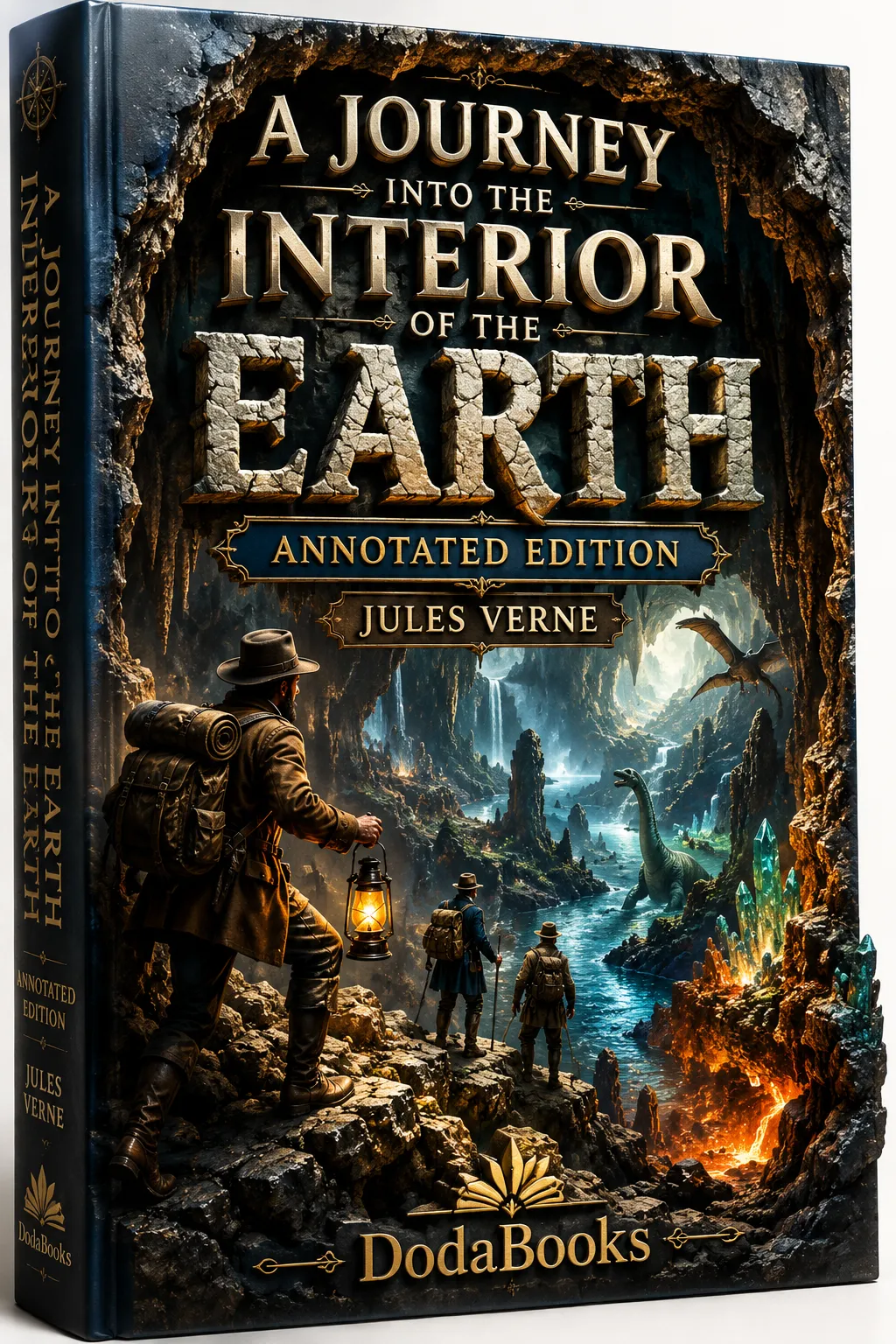
🌋 Experience Jules Verne with Complete Clarity
Conquer Verne’s geological classic with ease. The DodaBooks Annotated Edition of A Journey into the Interior of the Earth delivers:
- ✅ Complete Unabridged 44-Chapter Text — Restored authentic German and Icelandic character names
- 📜 Helpful Geological & Historical Notes — Explaining deep time, Ruhmkorff lamps, and prehistoric fauna
- ✒️ Distraction-Free Formatting — Optimized typography designed for comfortable reading
- 🔒 100% DRM-Free Ownership — Yours permanently across Kindle, Kobo, and Apple Books
- 📥 Instant EPUB Delivery — Download directly to your device and start your descent today