Is A Doll's House Hard to Read? Reading Difficulty & Study Guide
For students, theatre enthusiasts, and classic literature newcomers picking up Henrik Ibsen’s 1879 masterpiece A Doll’s House (Et dukkehjem), a natural question arises: how difficult is it to read Henrik Ibsen today? Does reading a 19th-century Norwegian dramatic script feel archaic and daunting like Shakespeare, or is it fast-paced, conversational, and accessible to the modern reader?
The reassuring answer is that A Doll’s House is remarkably accessible, earning an overall difficulty rating of 4.5 out of 10 (Moderate). Unlike Elizabethan verse drama, Ibsen wrote in crisp, realistic conversational prose. The play unfolds in real time across three compact acts, reading more like a gripping psychological courtroom thriller than a dry academic classic.
However, while the language itself is straightforward, readers must navigate the unique conventions of reading a play script, decode subtle psychological subtext, and understand 19th-century European legal and financial concepts.
This comprehensive guide analyzes the Lexile reading level, vocabulary hurdles, dramatic conventions, and themes of A Doll’s House, providing a practical 7-day study plan and actionable strategies for reading Ibsen with complete confidence.
| Metric | Rating / Value | Analysis & Comparison |
|---|---|---|
| Overall Difficulty | 4.5 / 10 (Moderate) | Highly accessible; reads like a modern psychological thriller |
| Lexile Reading Measure | 940L – 1020L | Equivalent to Arthur Miller’s The Crucible (1010L) |
| Average Reading Time | 2 to 3 Hours | Short dramatic text (~24,000 words across 3 acts) |
| Primary Challenge | Dramatic Subtext & Legal Concepts | Decoding Victorian financial laws, forgery, and repressed desires |
| Primary Strength | Fast-Paced Realistic Dialogue | Realistic, conversational prose; high emotional tension |
| Recommended Edition | Annotated Edition | Clarifies 19th-century legal codes and stage directions |
📊 Reading Difficulty Breakdown by Category
To evaluate what makes A Doll’s House accessible and where unassisted readers might stumble, we examine the text across five primary dimensions:
1. Language and Vocabulary (Rating: 3.5 / 10)
Ibsen was the pioneer of modern realism. He deliberately rejected the elevated poetic verse, grand soliloquies, and formal rhetoric that dominated nineteenth-century theatre. Instead, he made his characters speak in the natural, everyday idiom of a middle-class drawing room.
Consequently, the vocabulary in A Doll’s House is straightforward. You will not find archaic Elizabethan terms like “wherefore,” “forsooth,” or “anon.” The few specialized terms that do appear are related to nineteenth-century legal and financial procedures:
- Financial & Legal Terms: Promissory note, bond, co-signer, guarantor, quarterly interest, security, legal minority, liquidation.
- Cultural & Domestic Items: Macaroons, tarantella, Neapolitan fisher-girl costume, Joint Stock Bank, fancy-dress ball.
Once a reader understands that Nora committed forgery to secure a loan because married women were legally prohibited from borrowing money, the entire plot mechanism becomes clear.
2. Reading a Dramatic Script vs. a Novel (Rating: 5.5 / 10)
For readers accustomed to traditional novels—where an omniscient narrator describes characters’ inner thoughts, physical appearances, and backstories in descriptive paragraphs—reading a dramatic script requires an active adjustment of imagination.
In A Doll’s House, there is no narrator. Everything must be inferred through dialogue, stage directions, and subtext:
- Stage Directions as Character Clues: When Nora eats macaroons and hastily wipes her mouth, or when Torvald inspects his letters, Ibsen is providing vital psychological directions. Readers must train themselves not to skip the italicized stage directions.
- Decoding Subtext: Characters in Ibsen rarely say exactly what they mean. When Torvald playfully scolds Nora as his “little spendthrift,” he is establishing patriarchal dominance. When Nora begs Torvald to teach her the tarantella, she is desperately trying to prevent him from opening his mailbox. The drama lives between the spoken lines.
3. Pacing and Structural Tension (Rating: 2.5 / 10)
Pacing is one of the play’s greatest strengths. The entire story takes place within a single room—the Helmers’ drawing room—over approximately sixty hours from Christmas Eve to Boxing Day night.
The plot follows the tight, escalating structure of a ticking-clock thriller:
- Act I: The crime is revealed and the blackmailer makes his demand.
- Act II: The deadline approaches; Nora’s options vanish; the letter is dropped in the locked box.
- Act III: The letter is opened; the truth explodes; the marriage is dissolved.
Because the play never wanders into extraneous subplots or side locations, readers remain glued to the escalating confrontation.
4. Historical and Legal Context (Rating: 6.0 / 10)
Historical context represents the primary hurdle for modern readers. In the 21st century, a woman opening a bank account, signing a contract, or walking away from an unhappy marriage is routine.
To appreciate why Nora’s actions were considered shocking in 1879, modern readers must understand the legal realities of Victorian Scandinavia:
- Legal Minority of Married Women: Under 19th-century law, an unmarried woman had legal autonomy, but upon marriage, her legal identity was subsumed by her husband. She could not borrow money, conduct business, or sign a binding legal document without her husband’s authorization.
- Strict Forgery Laws: Forgery was treated not as a civil dispute, but as a severe felony punishable by hard labor, social ruin, and public disgrace.
- Custody of Children: In a divorce, fathers were virtually guaranteed sole legal custody of all children. Nora knew that leaving Torvald meant sacrificing daily contact with her sons and daughter.
An annotated edition that explains these legal realities ensures that Nora’s desperation feels genuinely harrowing rather than melodramatic.
📈 Ibsen vs. Other Classic Dramatists
To see where A Doll’s House fits in the dramatic canon, compare its reading difficulty with other classic plays taught in schools and universities:
| Play | Playwright | Era / Form | Difficulty Rating | Typical Hurdles |
|---|---|---|---|---|
| An Inspector Calls | J.B. Priestley | 1945 Realism | 3.5 / 10 | Straightforward dialogue, moral allegory |
| A Doll’s House | Henrik Ibsen | 1879 Realism | 4.5 / 10 | Dramatic subtext, Victorian legal codes |
| The Crucible | Arthur Miller | 1953 Historical Drama | 5.0 / 10 | 17th-century Puritan phrasing and cadence |
| The Importance of Being Earnest | Oscar Wilde | 1895 Victorian Comedy | 5.5 / 10 | Rapid satirical paradoxes, Victorian wit |
| Death of a Salesman | Arthur Miller | 1949 Expressionism | 6.0 / 10 | Shifting timeframes, stream-of-consciousness |
| Romeo and Juliet | William Shakespeare | c. 1595 Elizabethan Tragedy | 6.5 / 10 | Elizabethan blank verse, puns, archaic syntax |
| Hamlet | William Shakespeare | c. 1601 Renaissance Tragedy | 8.5 / 10 | Dense theological verse, philosophical soliloquies |
🗓️ The 7-Day Study Plan: One Act Every Two Days
Because A Doll’s House is concise (around 24,000 words), it can be thoroughly read, analyzed, and mastered in one week by reading just 20 to 30 minutes per day:
| Day | Focus Section | Key Dramatic Events | Analysis Objectives |
|---|---|---|---|
| Day 1 | Act I (Part 1) | Nora’s arrival; macaroons; Torvald’s pet names; Kristine Linde arrives | Analyze the financial dynamics of the Helmer marriage and Nora’s performance |
| Day 2 | Act I (Part 2) | Nora reveals her secret to Kristine; Krogstad arrives; the forgery revealed | Examine Nora’s motives for the forgery and Krogstad’s blackmail threat |
| Day 3 | Act II (Part 1) | Christmas Day; the tarantella dress; Nora begs Torvald to spare Krogstad | Notice Torvald’s petty pride and the dispatch of the dismissal letter |
| Day 4 | Act II (Part 2) | Dr. Rank’s confession of love; Krogstad drops the letter; the wild tarantella | Analyze the tarantella as a physical manifestation of repressed panic |
| Day 5 | Act III (Part 1) | Kristine and Krogstad’s reunion; Torvald’s fantasies; Dr. Rank’s black cards | Contrast Kristine & Krogstad’s honest union with the Helmers’ false marriage |
| Day 6 | Act III (Part 2) | Torvald reads the letter; his narcissistic fury; the second letter arrives | Examine Torvald’s hypocrisy and the death of Nora’s romantic illusions |
| Day 7 | Act III (Part 3) & Review | Nora’s great awakening; the final confrontation; the slammed door | Synthesize the central themes of female selfhood, legal hypocrisy, and the ending |
For a deeper dive into the characters you will encounter, explore our Guide to A Doll’s House Characters.
💡 5 Pro Strategies for Reading Ibsen with Ease
- Read Aloud or Listen to Audio: Plays are written to be spoken, not silently read. Reading key dialogues aloud—especially the final confrontation between Nora and Torvald—makes the pacing, emotional escalation, and sarcasm immediately apparent.
- Pay Close Attention to Props: Ibsen uses physical props with surgical symbolic precision:
- Macaroons: Nora’s hidden rebellion, childish secrecy, and Torvald’s control.
- The Christmas Tree: The false ornamental facade of the household (fresh in Act I, stripped and burned down in Act II).
- The Tarantella Dress: Nora’s performance as Torvald’s decorative plaything.
- The Mailbox Key: Torvald’s exclusive control over information and truth.
- Visualize the Drawing Room: Keep in mind that all three acts take place in a single room. Notice how characters enter from the outside world (bringing harsh economic reality with them) and how the room gradually transforms from a cozy sanctuary into a suffocating prison.
- Choose an Edition with Legal Annotations: As outlined in our Where to Buy Guide, choose an annotated edition that clarifies 19th-century Scandinavian debt laws, promissory notes, and the famous German alternate ending.
- Track Nora’s Tone Shifts: Contrast Nora’s high-pitched, childish chirping in Act I with her cold, analytical, and authoritative voice in Act III. Her linguistic shift marks her transformation from doll to human being.
❓ Frequently Asked Questions
Is A Doll's House suitable for high school students?
Yes, absolutely. The play is universally taught in Grade 11 and Grade 12 English curricula, Advanced Placement (AP) Literature, and International Baccalaureate (IB) courses worldwide. There is no graphic violence or explicit sexual content. The play’s themes of identity, social pressure, and integrity resonate strongly with young adults.
How long does it take to read the entire play?
An average adult reading at 200 to 250 words per minute can read the entire unabridged text of A Doll's House in roughly 2 to 2.5 hours. For an analytical study reading, spreading the three acts across 3 to 7 days is ideal.
Why is the play considered the birth of modern drama?
Prior to Ibsen, European theatre was dominated by romantic verse dramas, historical spectacles, and formulaic farces. Ibsen brought contemporary, everyday domestic life onto the stage, using realistic dialogue to examine urgent social, ethical, and psychological problems without offering easy moral answers. This approach founded the modern realist theatrical movement.
Why does the ending still resonate so strongly today?
While women’s legal status has vastly improved since 1879, Nora’s struggle—the challenge of balancing societal expectations, family obligations, and authentic self-realization—remains a universal human dilemma. Nora’s refusal to sacrifice her conscience to please others continues to inspire readers across the world.
Which translation provides the easiest reading experience?
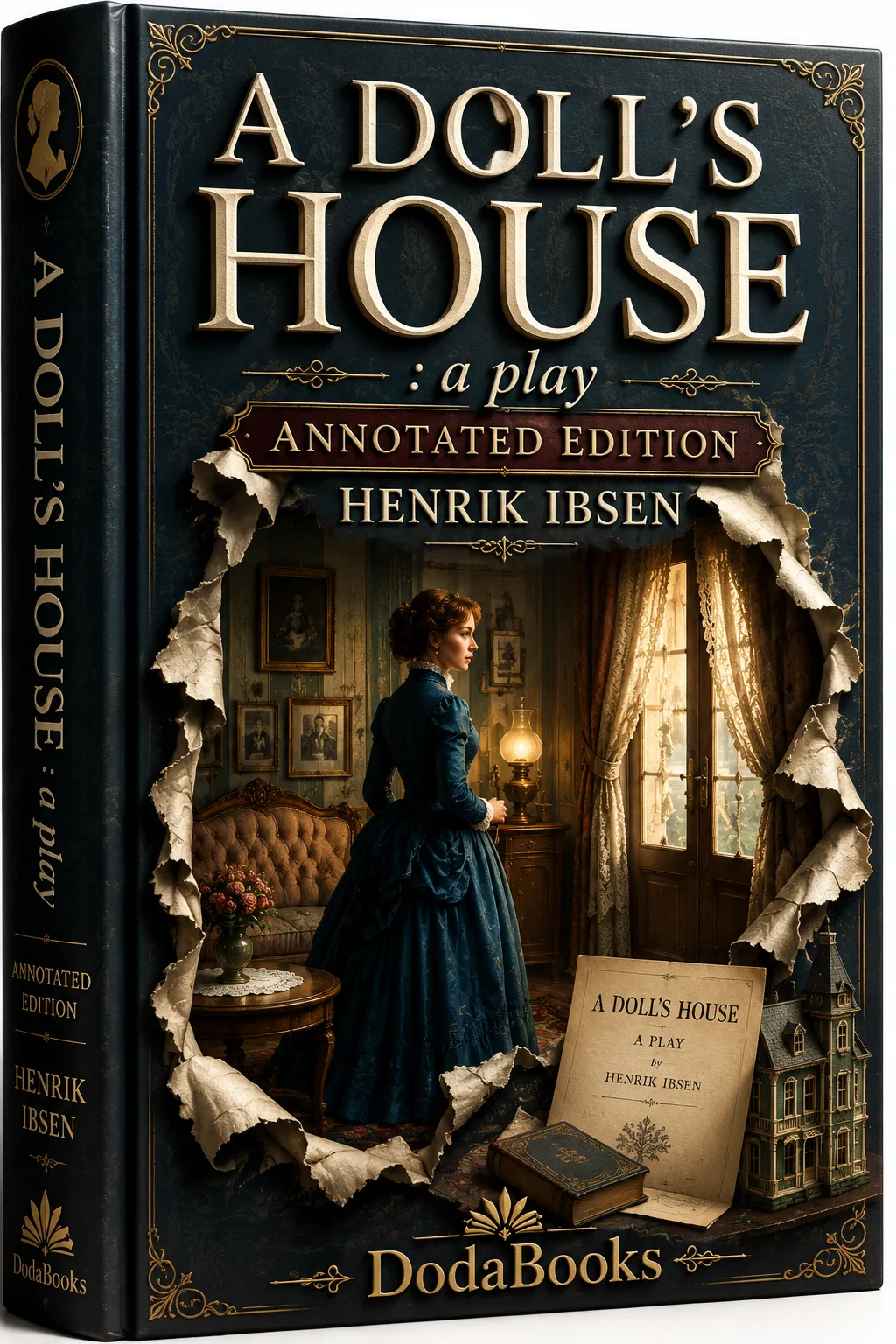
We recommend avoiding archaic 1890s Victorian translations. The DodaBooks Annotated Edition features a clean, modern English translation, rich historical annotations on Victorian marriage laws, the complete text of the German alternate ending, and 100% DRM-free open EPUB ownership.
🚪 Master Ibsen’s Revolutionary Masterpiece with Ease
Read A Doll’s House in the definitive student and reader edition. The DodaBooks Annotated Edition delivers:
- ✅ Complete Unabridged 3-Act Drama — Fresh, modern translation formatted for effortless reading
- 📜 Historical & Legal Annotations — Explaining Victorian marriage laws, promissory notes, and social context
- 🎭 Bonus Material — Full text of the notorious German alternate ending and theatrical commentary
- 🔒 100% DRM-Free Open Ownership — Permanent access on Kindle, Kobo, and Apple Books
- 📥 Instant EPUB Delivery — Download directly to your device and start reading today