Is A Connecticut Yankee in King Arthur's Court Hard to Read? Reading Difficulty Guide
Many readers pick up Mark Twain’s A Connecticut Yankee in King Arthur’s Court expecting a breezy, lighthearted comic romp—a Victorian slapstick comedy about a 19th-century mechanic dazzling superstitious knights with matches and fireworks. While the novel contains some of the funniest physical comedy in American literature, readers are often blindsided by its real linguistic texture: pages of unpunctuated 15th-century Arthurian prose, dense Gilded Age debates on monetary policy and protective tariffs, and a shocking descent into apocalyptic violence.
So, how hard is A Connecticut Yankee in King Arthur’s Court to read?
The short answer: Moderately challenging, but immensely rewarding. While Hank Morgan’s conversational American voice is engaging, witty, and direct, navigating Twain’s three distinct linguistic registers and sudden tonal shifts requires patience and contextual guidance.
This comprehensive reading difficulty guide breaks down the novel’s readability metrics, analyzes its primary linguistic hurdles, and provides an actionable 14-day reading schedule to help you read with total confidence.
| Metric | Measurement / Level | Context & Explanation |
|---|---|---|
| Lexile Measure | 1040L–1080L | Equivalent to 9th–11th grade high school reading levels |
| Total Word Count | ~118,000 words | 44 Chapters + Framing Prologue & Epilogue; ~350–400 printed pages |
| Flesch-Kincaid Grade Level | Grade 9.2 | Accessible sentence structures balanced by dense archaic vocabulary |
| Estimated Reading Time | 8–10 hours | Average pace of 200–250 words per minute across 14 days |
| Primary Challenge | Linguistic Dualism | Constant shifts between 19th-century American slang and 15th-century Malory English |
| Recommended Age | 14+ (High School to Adult) | Mature themes of slavery, smallpox, torture, and mechanized mass casualties |
🔍 The Three Linguistic Layers of Mark Twain’s Novel
The primary difficulty readers encounter in A Connecticut Yankee is not plot complexity, but linguistic polyphony. Mark Twain deliberately weaves three entirely distinct linguistic registers into the narrative fabric:
┌─────────────────────────────────────────────────────────────┐
│  Layer 1: Hank's 19th-Century American Vernacular            │
│  Fast-paced, satirical, colloquial, pragmatic, funny         │
├─────────────────────────────────────────────────────────────┤
│  Layer 2: Sir Thomas Malory's Archaic Arthurian Middle Prose │
│  Endless run-on clauses, archaic verbs, courtly syntax       │
├─────────────────────────────────────────────────────────────┤
│  Layer 3: Twain's Gilded Age Political Economy Disquisitions│
│  Wages vs. purchasing power, institutional church history    │
└─────────────────────────────────────────────────────────────┘
1. Hank Morgan’s Colloquial Yankee Vernacular
The vast majority of the book is narrated in the first person by Hank Morgan. This prose is vigorous, muscular, and quintessentially American. Hank speaks with the dry, understated humor of a New England mechanic:
“I was just an engineer, full of fight, that was all. I could make anything a body wanted—anything in the world, it didn’t make no difference what.”
This voice is remarkably modern and accessible. Any reader comfortable with Adventures of Huckleberry Finn or modern popular fiction will feel immediately at home in Hank’s voice.
2. Malory’s Pseudo-Archaic Arthurian Prose
The biggest hurdle for first-time readers occurs when medieval characters speak—most notoriously Sandy (Alisande la Carteloise). Twain parodies Sir Thomas Malory’s 1485 Le Morte d’Arthur by lifting entire pages of medieval syntax without modern punctuation:
“And so they rode forth together till they came to a fountain, and there beside sat a knight all armed on horseback, and his spear in his rest, and he said, Sir knight, ye may not pass this way without ye joust with me…”
In Chapter 15, Sandy delivers a monologued tale that spans four uninterrupted pages without paragraph breaks. Readers who try to parse every archaic pronoun and knightly family tree get bogged down.
Pro-Tip: Treat Sandy’s speeches as comedic soundscapes. Twain wrote them to sound like an avalanche of courtly gossip. Read them aloud or skim for the comedic punchline; Sandy’s babble is meant to annoy Hank, and the humor lies in his mounting exasperation!
3. Gilded Age Political & Economic Philosophy
In the middle third of the novel (notably Chapters 29 to 33), Twain steps to the front of the stage to settle scores with Gilded Age economic theorists. Hank engages Dowley the blacksmith in a protracted debate over protective tariffs, nominal daily wages, and real purchasing power. For modern readers unaccustomed to 19th-century labor economics, these passages can feel dry unless anchored by historical annotations.
⚠️ The Four Major Reading Obstacles & How to Beat Them
Obstacle 1: The Abrupt Tonal Darkening
Many readers are shocked by how dark the novel becomes. Chapters 1 through 20 are filled with hilarious burlesque: Hank blowing up Merlin’s tower with gunpowder, knights wearing Persimmon Soap advertisements, and Sandy mistaking pigs for enchanted princesses.
However, in Chapter 25, when Hank and Arthur travel disguised as peasants, the comedy vanishes. Readers are confronted with horrific descriptions of medieval feudal cruelty: smallpox-infected mothers watching their children starve, innocent teenagers executed on the gallows, and human beings marched in chains in the dead of winter. The climax features the slaughter of twenty-five thousand knights by electric shock and machine guns.
Strategy: Understand that Twain was writing serious social criticism disguised as a comedy. The novel is an anatomy of how human societies descend into violence when superstition and absolute power prevail.
Obstacle 2: Archaic Medieval & Armor Terminology
Twain revels in authentic medieval military vocabulary. You will encounter terms like:
- Hauberk: A long tunic of chainmail armor.
- Greaves & Vambraces: Armored plates protecting the shins and forearms.
- Destrier: A heavy, powerful medieval warhorse.
- Seneschal: An administrative officer in a royal castle (Sir Kay’s post).
- Interdict: An ecclesiastical decree from the Pope cutting an entire nation off from all religious sacraments, church bells, and Christian burial.
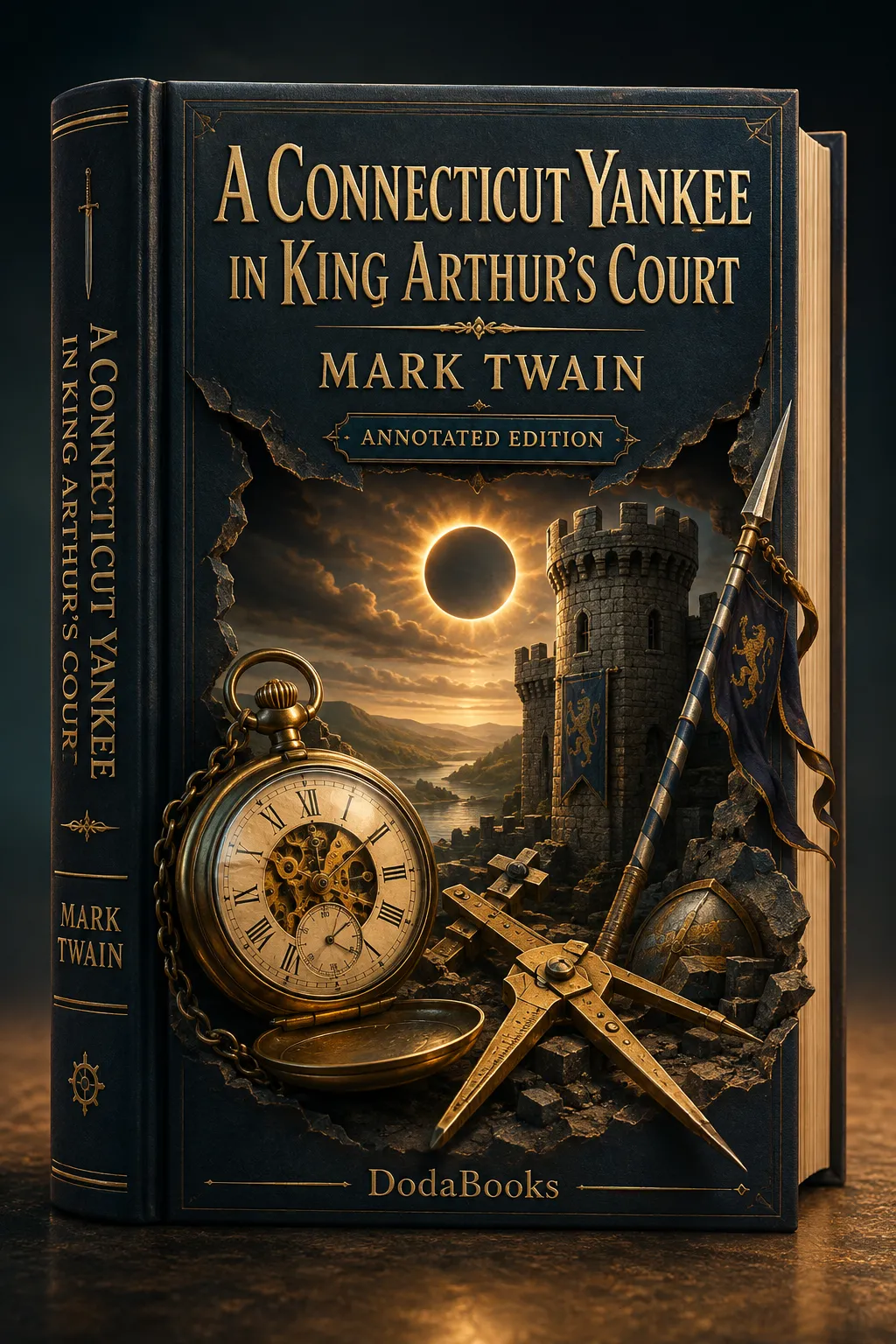
Strategy: Read an annotated edition—such as the DodaBooks Annotated Edition—that provides instant vocabulary pop-ups so you never need to stop reading to consult a dictionary.
Conquer Mark Twain's challenging vocabulary with comprehensive, on-page footnotes.
📖 Get the Annotated Edition at DodaBooks →Obstacle 3: Understanding Gilded Age Allusions
Twain packed the novel with references that were razor-sharp to readers in 1889, but obscure today:
- The Knights of Labor: Hank’s secret cadre of trained boys mirrors the rising 19th-century American trade union movement.
- The Telephone Central: Hank naming his daughter “Hello-Central” is a nod to the novelty of telephone switchboard operators in 1880s Hartford.
- The Greenback & Currency Debates: Hank’s monetary reforms mirror the fierce post-Civil War American debate between hard gold and fiat paper money.
📅 The 14-Day Reading Plan (Master the Novel in Two Weeks)
At 118,000 words across 44 chapters, A Connecticut Yankee is best read in a structured two-week schedule, averaging about 25–30 minutes (3 chapters) per day:
| Day | Chapters | Key Episodes & Milestones | Reading Focus |
|---|---|---|---|
| Day 1 | Frame & Ch. 1–3 | Warwick Castle, Colt factory brawl, Sir Kay’s capture, Camelot Great Hall | Appreciate Hank’s pragmatic Yankee voice |
| Day 2 | Ch. 4–7 | Sir Dinadan, the solar eclipse miracle, the blowing up of Merlin’s tower | Watch how knowledge transforms into political power |
| Day 3 | Ch. 8–10 | Hank becomes “The Boss”; secret underground factories; soap ads | Notice Twain’s satire of advertising |
| Day 4 | Ch. 11–14 | Hank armors up; hilarious physical torment; Sandy’s arrival and quest | Enjoy the peak slapstick comedy of medieval armor |
| Day 5 | Ch. 15–17 | Sandy’s endless Malory monologue; arrival at the Valley of Holiness | Don’t panic during Sandy’s speeches—skim the names! |
| Day 6 | Ch. 18–20 | The miracle of the Holy Fountain; telegraph scoop; the “enchanted” hogs | Reflect on Sandy’s psychological conditioning |
| Day 7 | Ch. 21–24 | Royal banquet; the hermit anchorites; navy examination board | Observe how royal caste deforms natural merit |
| Day 8 | Ch. 25–28 | Arthur disguised as a commoner; the smallpox hut; peasant taxation | Notice the sudden, profound darkening of tone |
| Day 9 | Ch. 29–33 | The tragedy of the manor house; Marco’s dinner; Dowley’s wage debate | Pay attention to Hank’s economic argument |
| Day 10 | Ch. 34–36 | Captured by bandits; sold into slavery; the brutal London slave march | Compare Arthur’s suffering to American chattel slavery |
| Day 11 | Ch. 37–39 | The gallows rescue by knights on bicycles; duel with Sir Sagramor | Enjoy the triumph of the cowboy lasso and revolvers |
| Day 12 | Ch. 40–41 | Three years of the Republic; baby Hello-Central; the Papal Interdict | Notice how quickly superstition reclaims society |
| Day 13 | Ch. 42–43 | The Battle of the Sand-Belt; Gatling guns, electric wire, and landmines | Reflect on Twain’s prophecy of World War I |
| Day 14 | Ch. 44 & P.S. | Merlin’s sleep curse; awakening in the 19th century; Hank’s death | Ponder the tragic conclusion of Hank’s life |
Lexile 1050L Demystified
Understand why the novel's Lexile score fluctuates between accessible 600L American dialogue and dense 1400L Malory monologues.
Armor Vocabulary Cheat-Sheet
Quick reference definitions for cuishes, gorgets, bascinets, and the grueling weight of plate armor.
How to Read Sandy's Speeches
Read them aloud with comic inflection rather than parsing grammar; Sandy represents courtly romantic chatter.
Dowley's Wage Debate Explained
A simple breakdown of Hank's economic lesson: why high nominal wages mean nothing if goods cost four times more.
The Sand-Belt Transition
Prepare emotionally for the final five chapters: the hilarious bicycle comedy gives way to grim military reality.
High School & College Guide
Key thematic questions for essays on technology, imperialism, American democracy, and Gilded Age satire.
❓ Frequently Asked Questions
Is A Connecticut Yankee harder to read than Adventures of Huckleberry Finn?
Yes. While *Huckleberry Finn* is written entirely in Huck's consistent, phonetic Missouri dialect, *A Connecticut Yankee* shifts between three distinct styles: Hank's 19th-century American vernacular, Sir Thomas Malory's archaic 15th-century prose, and complex Victorian economic debates. The variety of styles makes *Connecticut Yankee* linguistically more demanding.
At what age is A Connecticut Yankee in King Arthur's Court appropriate?
The novel is best suited for readers aged 14 and older (high school freshmen through adults). While the opening chapters read like a lighthearted middle-grade fantasy, the second half deals with grim themes of chattel slavery, torture, disease, and the graphic slaughter of twenty-five thousand men at the Sand-Belt.
Can I skip Sandy's long speeches about knights?
You can safely skim them. Sandy's four-page run-on speeches are deliberate parodies of medieval romances designed to show how boring and repetitive chivalric gossip was. Skimming them will not cause you to miss any vital plot information.
Why is an annotated edition essential for this book?
Because Mark Twain wrote for an 1889 audience intimately familiar with Sir Walter Scott, Malory's *Morte d'Arthur*, Gilded Age monopolies, and contemporary labor strikes, modern readers miss over half the satire without footnotes explaining the cultural and political context.
How long does it take an average reader to finish the novel?
At approximately 118,000 words, an average adult reading at 250 words per minute will complete the book in roughly 8 to 10 hours. Following our 14-day schedule requires just 30 to 40 minutes of reading per day.
⚡ Read Mark Twain’s Satire with Total Confidence
Don’t let archaic medieval prose or Gilded Age references slow you down. The DodaBooks Annotated Edition of A Connecticut Yankee in King Arthur’s Court gives you:
- ✅ Complete Unabridged 1889 First Edition — All 44 chapters in authoritative, original form
- 📜 Instant Vocabulary & Historical Footnotes — Decoded Malory terms, astronomical facts, and political context
- ✒️ Clear Formatting & Typography — Formatted specifically for seamless digital e-reading
- 🔒 100% DRM-Free Ownership — Yours forever across Kindle, Kobo, iPad, and desktop
- 📥 Instant EPUB Delivery — Download your digital copy immediately