Irene Iddesleigh by Amanda McKittrick Ros: Sublime Melodrama & Alliterative Art
The Inimitable 1897 Cult Masterpiece That Captivated Mark Twain, Aldous Huxley, and the Inklings: A Whirlwind of Aristocratic Passion, Unbridled Rhetoric, and Unforgettable Stylistic Bravura
In the annals of English literature, few novels occupy so singular, bewildering, and perennially fascinating a place as Irene Iddesleigh (1897) by the eccentric Northern Irish schoolteacher and author Amanda McKittrick Ros (1860–1939). Published privately in Belfast as a tenth-anniversary gift funded by her stationmaster husband, the novel burst into Victorian literary circles like an explosive linguistic comet. Rather than sinking into regional obscurity, Irene Iddesleigh became one of the most celebrated cult phenomena in literary history—lauded, recited, and parodied by some of the twentieth century’s greatest writers.
To approach Irene Iddesleigh merely as a conventional Victorian melodrama of aristocratic intrigue, adopted orphans, and marital betrayal is to miss the entire essence of the work. What makes the novel utterly hypnotic is its jaw-dropping, incandescent prose style: a torrential cascade of compound alliterations, polysyllabic verbal gymnastics, and operatic hyperbole that defies every standard rule of conventional syntax. It is a work of pure, uninhibited stylistic conviction that transforms the mundane conventions of Victorian romance into a mesmerizing linguistic spectacle.
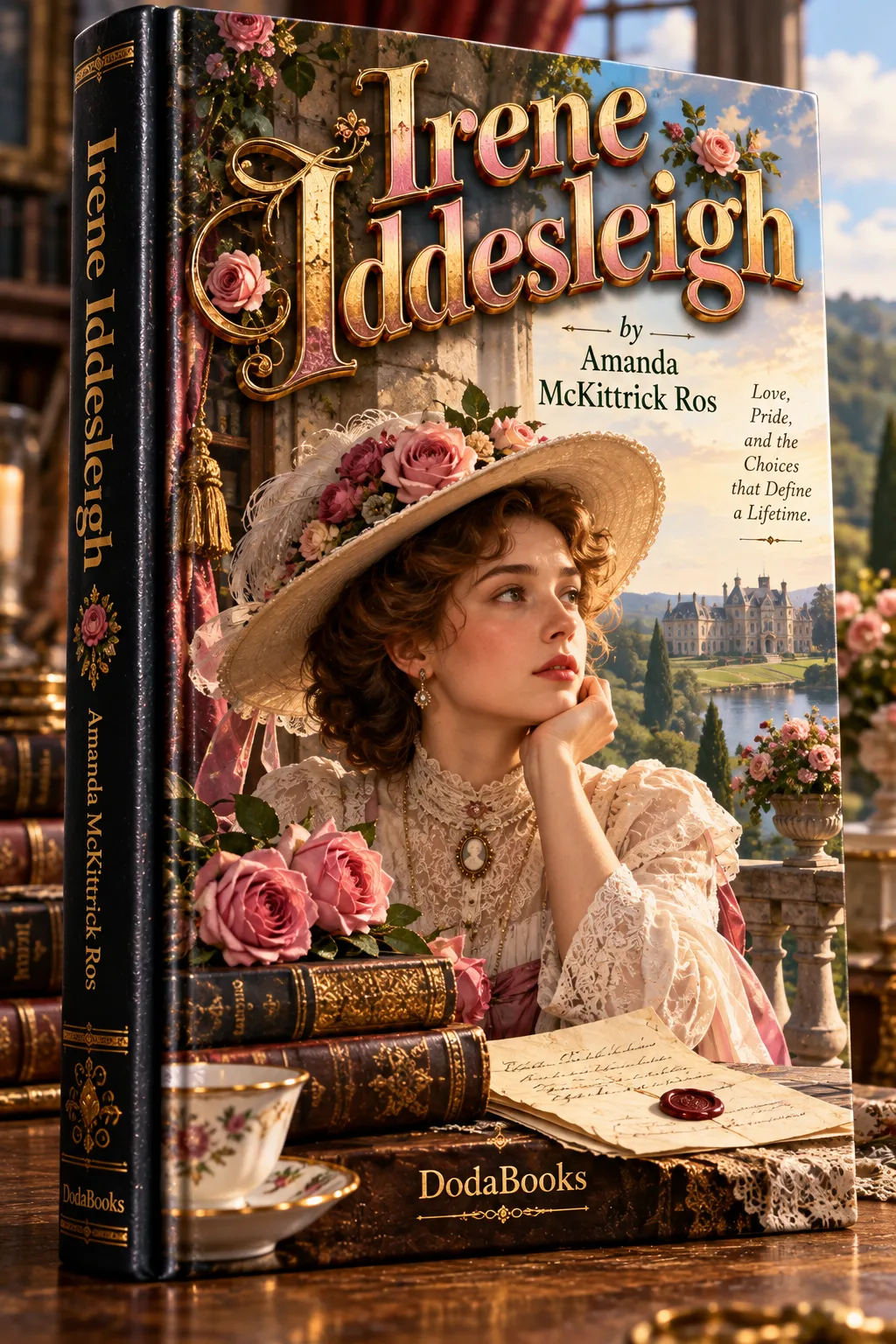
Step Inside the Unparalleled Prose of Amanda McKittrick Ros
Experience the legendary Victorian cult classic Irene Iddesleigh in its authoritative complete text, annotated with linguistic commentary, Inklings history, and biographical notes.
Read Irene Iddesleigh NowThe Story of Irene: Aristocratic Pride, Forged Letters, and Tragic Nemesis
Beneath Ros’s astonishing verbal fireworks lies a plot drawn directly from the most fervent traditions of high-Victorian sensationalism and gothic melodrama.
The narrative centers on Irene, a young woman of obscure parentage adopted by the benevolent Lord John Dunfern into the luxurious splendor of Dunfern Hall. As Irene grows into womanhood, Lord Dunfern falls deeply in love with her and offers her marriage. Though her heart secretly belongs to her dashing tutor, Oscar Otwell, Irene accepts the wealthy nobleman’s hand:
- The Stifled Heart: Unhappy in her glittering marriage, Irene pines in secret seclusion, seeking solace in illicit correspondence with Otwell.
- The Discovery and the Tower: Lord Dunfern discovers the betrayal through intercepted letters. Consumed by noble agony, he imprisons Irene within a high stone tower on the Dunfern estate to ponder her ingratitude.
- The Midnight Flight to America: Aided by a loyal maid, Irene escapes the tower and flees across the Atlantic to New York with Oscar Otwell. Yet their overseas life quickly curdles into financial ruin, drunkenness, and despair.
- The Inexorable Fall: After Otwell takes his own life in a fit of alcoholic frenzy, Irene returns destitute to England, only to find Dunfern Hall in the hands of her estranged son, who mercilessly casts her out into the bitter winter night.
While the skeleton of the plot echoes contemporary Victorian shockers by Mrs. Henry Wood or Mary Elizabeth Braddon, Ros’s execution transforms every standard narrative beat into an epic of sheer stylistic delirium.
The Style of Amanda McKittrick Ros: Alliteration Unleashed
What has kept Irene Iddesleigh continuously in print for over a century is its completely unique, unmistakable authorial voice. Amanda McKittrick Ros did not write prose; she unleashed a verbal avalanche.
Literary scholars identify several trademark hallmarks that define Ros’s unforgettable technique:
Consider one of the most famous opening sentences in English literature, which has delighted connoisseurs of the curious since 1897:
"Sympathise with me, indeed! Ah, no! Cast your sympathy
on the chill mantle of a December snowdrift, or drop it
in the burning crater of a volcano; but offer it not
to one whose bosom has been made the battlefield of bleeding hearts!"
— Amanda McKittrick Ros, Irene Iddesleigh
Another immortal description introduces the villainous gossipers of high society: “Speak! Strive not to hide the hideous, haughty, hellish hatred of your heart!” Ros wrote with absolute, unironic sincerity, genuinely convinced that she was composing the pinnacle of tragic English literature. It is precisely this absolute earnestness that gives her writing its enduring magic.
The Inklings and the Cult of Amanda McKittrick Ros
In the 1920s and 1930s, Irene Iddesleigh was discovered by the elite literary salons of Oxford and London. Rather than dismissing it, leading modernists and academics embraced the book with fanatical admiration.
Among her most ardent admirers were the Inklings—the legendary Oxford literary discussion society that met at the Eagle and Child pub, featuring C. S. Lewis, J. R. R. Tolkien, and Hugo Dyson:
- The Reading Contests: Lewis and Tolkien held famous parlor competitions wherein members took turns reading passages from Irene Iddesleigh aloud. The goal was to read for as long as possible with a completely straight face; whoever broke into laughter first was declared the loser.
- Aldous Huxley’s Tribute: In his celebrated 1920 essay Euphues Redivivus, Aldous Huxley wrote a serious critical appreciation of Ros, arguing that her dense, ornate figures of speech represented a modern, uninhibited rebirth of sixteenth-century Elizabethan Euphuism: “Mrs. Ros is a creator; she has invented a language of her own.”
- The Nonesuch Press Revival: The prestigious Nonesuch Press honored Irene Iddesleigh with a luxurious limited edition in 1927, cementing its status as an elite collector’s piece and literary curiosity of the highest order.
Mark Twain famously pronounced Irene Iddesleigh “one of the greatest and most fascinating books ever printed,” keeping a copy by his bedside table.
Explore the Complete Cult Classic with Scholarly Footnotes
The DodaBooks annotated edition decodes Amanda's exuberant vocabulary, recounts the famous Inklings reading battles, and explores the history of literary kitsch.
Get the Complete Ebook for $0.99The Psychology of Unintentional Genius: Camp, Sincerity, and Art
In modern critical theory, Irene Iddesleigh is frequently studied as the supreme historical embodiment of what Susan Sontag defined in 1964 as Camp: art that is so extravagantly passionate and devoid of cynical irony that its sheer excess transforms it into something magnificent.
Amanda McKittrick Ros despised professional critics—whom she famously denounced in her prefaces as “clay-brained critics,” “scurrilous scribblers,” and “donkey-eared denizens of Grub Street.” When reviewers mocked her prose, she doubled down, publishing further volumes like Delina Delaney and Poems of Puncture that pushed her rhetorical fireworks to even greater extremes. Her total artistic fearlessness and utter refusal to compromise her idiosyncratic vision make her a true outsider artist whose voice remains completely unquenchable.
Interlinking with Related Curiosities and Classic Works
Readers captivated by Amanda McKittrick Ros’s bravura style and late-Victorian publishing history will enjoy discovering complementary titles within our catalog:
- Victorian Melodrama & Bohemian Song: Contrast Ros’s extravagant aristocratic fantasy with Grant Allen’s grounded portrait of independent female vocal genius in our Linnet by Grant Allen Guide.
- Romantic Obsession & Royal Drama: Explore the genuine epistolary passions that drove royal monarchs by reading our in-depth Love Letters of Henry VIII Guide.
- Eccentric Geniuses & Literary Outsiders: To explore the broader social context of Victorian nonconformists and bizarre historical figures, explore John Timbs’s fascinating chronicle of British eccentricity.
Why Read the DodaBooks Edition of Irene Iddesleigh?
Reading Irene Iddesleigh in a carelessly digitized public-domain scan ruins the delicate rhythmic cadence of Ros’s extraordinary sentences. The DodaBooks Edition provides a meticulously prepared digital edition:
- Linguistic Annotations: Includes explanations for rare Victorian idioms, archaic legal terminology, and Ros’s uniquely coined neologisms.
- Historical Introduction on the Inklings: Features an engaging historical essay detailing the Oxford reading competitions and Aldous Huxley’s critical analysis.
- Clean, Verified Typography: Preserves the original 1897 Belfast punctuation and cadence, designed for seamless reading across all mobile and e-ink displays.
Experience the World's Most Inimitable Novel
Indulge in the breathtaking rhetoric, furious alliterations, and unyielding drama that made Amanda McKittrick Ros the queen of cult Victorian literature.
Download the Complete EbookFrequently Asked Questions
Who was Amanda McKittrick Ros?
Amanda McKittrick Ros (1860–1939) was a Northern Irish schoolteacher, poet, and novelist from Larne, County Antrim. She became an international cult sensation for her astonishingly ornate, alliterative, and melodramatic writing style in novels like Irene Iddesleigh and Delina Delaney.
Why did C. S. Lewis and J. R. R. Tolkien read this book?
Lewis, Tolkien, and other members of the Inklings literary group at Oxford held legendary competitions where they read chapters of Irene Iddesleigh aloud to see who could read the longest without bursting into laughter. They admired Ros's boundless imaginative energy and uninhibited prose.
What makes the writing style of Irene Iddesleigh so unique?
The novel is celebrated for its dense alliteration, compound adjectives, polysyllabic vocabulary, and grand rhetorical flourishes. Ros avoided simple phrases, preferring grandiose descriptions such as 'the chastened moon' or 'the wandering waifs of wicked whim.'
Is Irene Iddesleigh a comedy or a serious melodrama?
Amanda McKittrick Ros wrote the novel in absolute, deadly seriousness as a tragic romance. While modern audiences and twentieth-century critics read it with immense humor and delight, its hypnotic charm stems entirely from the author's complete lack of cynical irony.
Where can I get the complete digital edition?
The complete, annotated digital edition of Irene Iddesleigh is available for immediate download directly from DodaBooks at https://dodabooks.com/ebook/irene-iddesleigh-by-amanda-mckittrick-ros/.