In Jeopardy by Van Tassel Sutphen: The Anatomy of a Locked-Room Nightmare
Inherited Mansions, Invisible Killers, and Lethal Domestic Traps: How Sutphen Transformed Architectural Paranoia and Secret-Service Deduction into an Unforgettable 1920s Mystery
In the transition between the gaslit Victorian detective stories of Arthur Conan Doyle and the formal Golden Age puzzles of John Dickson Carr and Agatha Christie, Van Tassel Sutphen (1861–1945) crafted one of the most ingenious, nerve-shredding locked-room thrillers of the early 1920s. An accomplished Harper & Brothers literary editor, novelist, and keen sportsman, Sutphen brought precision, architectural fascination, and deep psychological tension to his 1922 suspense classic, In Jeopardy.
At its core, In Jeopardy interrogates a terrifying premise: What if the greatest danger to your life is not a shadowy assassin lurking in the street, but the very house you inhabit? When a young heir inherits an eccentric uncle’s isolated estate—along with a legacy of bizarre deaths that struck down previous occupants—he finds himself trapped in a deadly game of wits against an unseen mechanism of murder. Sutphen’s masterwork combines the rigorous logic of the locked-room mystery with the paranoid atmosphere of post-Great War secret-service intrigue.
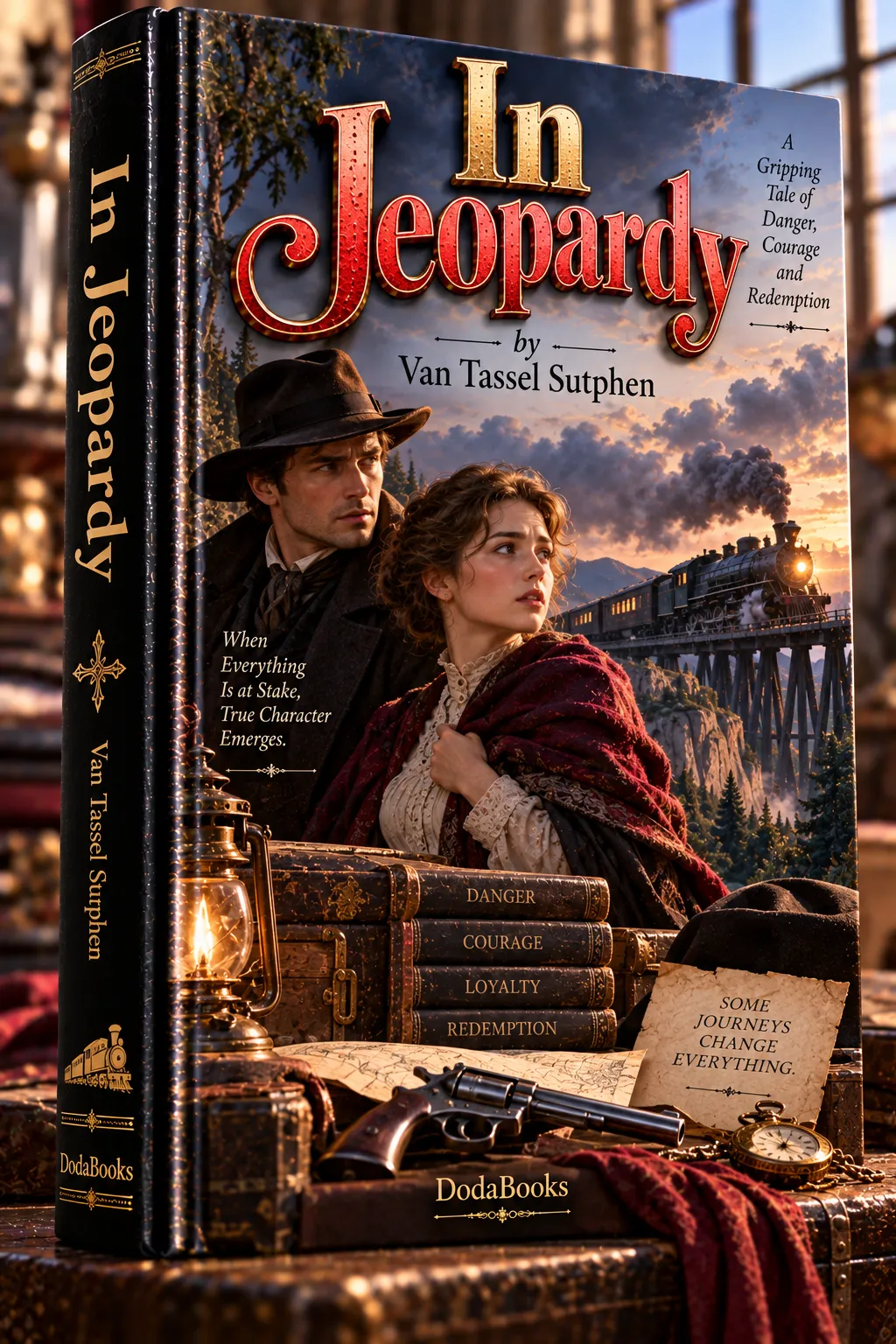
Step Inside the Deadly Riddle of Hawk's Nest
Read Van Tassel Sutphen's locked-room thriller In Jeopardy, complete with architectural floor plans, historical context on 1920s espionage, and detective fiction analysis.
Read In Jeopardy TodayThe Macabre Inheritance: The Legacy of Hawk’s Nest
The novel opens with an irresistible hook that immediately seizes the mystery lover’s imagination. Sebastian Hazeltine, a thoughtful young gentleman of modest means, learns that he has inherited Hawk’s Nest, a sprawling, secluded country estate perched high on a rugged bluff. However, the bequest comes with a chilling condition and a terrifying history:
- The Curse of the Study: Every successive master of Hawk’s Nest has died suddenly, mysteriously, and violently while seated alone in the estate’s heavy oak-paneled library.
- The Sealed Chamber: The room appears impenetrable: the heavy leaded windows are bolted securely from the inside, the heavy doors locked, and the chimneys guarded by iron grates. Yet, at precise intervals, death strikes without leaving a single bullet hole, trace of poison, or footprint behind.
- The Will’s Mandate: To claim the vast Hazeltine fortune, Sebastian is legally required to reside in the mansion and spend his evenings in the fatal room, testing whether he can survive the unseen doom that claimed his predecessors.
Rather than fleeing from the sinister challenge, Sebastian accepts the terms. Enlisting the aid of a sharp-eyed investigator and relying on his own powers of observation, he sets out to dismantle the mystery before the invisible trap closes around his own neck.
Architectural Paranoia: The House as Living Weapon
What elevates In Jeopardy above standard detective fiction of the 1920s is Sutphen’s brilliant exploitation of architectural suspense. In classic gothic literature, haunted castles rely on supernatural apparitions; in Sutphen’s modern mystery, the horror is entirely mechanical, rational, and claustrophobic.
Sutphen structures the investigation around three escalating layers of tension:
Every familiar object in the study—the grandfather clock, the Persian rug, the brass chandeliers, the high-backed leather armchair—becomes an object of agonizing suspicion. Sutphen masterfully induces the reader to scan every corner of the room alongside Sebastian, wondering which innocent piece of decor conceals the lethal trigger.
Post-War Paranoia and International Intrigue
While the immediate riddle is framed as a locked-room puzzle, Sutphen weaves a wider tapestry of early twentieth-century geopolitical intrigue into the narrative. Published in 1922 in the immediate wake of World War I, the novel vibrates with the anxieties of an era that had witnessed the collapse of empires, revolutionary conspiracies, and the rise of international espionage:
- The Shadow of Secret Diplomacy: As Sebastian digs into his uncle’s past, he discovers that the former master of Hawk’s Nest was deeply entangled in covert intelligence networks, stolen government blueprints, and secret treaties during the Great War.
- The Cold Professionalism of the Antagonist: Unlike the melodramatic, cackling villains of Victorian penny dreadfuls, Sutphen’s antagonist is a chillingly detached, scientific operative. The murders at Hawk’s Nest are not crimes of wild emotional passion, but cold, calculated executions designed to safeguard stolen geopolitical secrets.
- The Analytical Hero: Sebastian Hazeltine represents the modern rationalist hero. In the face of superstitious rumors of family curses and ancestral ghosts, he insists that every physical effect must have an intelligible physical cause, demonstrating the power of cool scientific induction over irrational panic.
"A man who enters a room knowing that three men before him
have died in that selfsame chair without a mark upon their flesh
does not fear ghosts; he fears the devilish ingenuity of human malice,
which is a thousand times more deadly."
— Van Tassel Sutphen, In Jeopardy
Experience One of the Greatest Locked-Room Puzzles of the 1920s
The DodaBooks annotated edition includes architectural diagrams, a history of locked-room mysteries from Poe to Carr, and notes on 1920s espionage culture.
Get In Jeopardy for Only $0.99Key Themes in Sutphen’s Suspense Fiction
1. The Domestic Sphere Turned Hostile
The central philosophical dread in In Jeopardy lies in the perversion of the home. In Anglo-American culture, the private library or study is traditionally the supreme sanctuary of peace, intellectual contemplation, and domestic security. By transforming this sanctuary into a mechanized abattoir, Sutphen taps into a deep, primal human anxiety: the sudden realization that one’s haven has been engineered for one’s destruction.
2. Science and Technology as Instruments of Murder
Writing in the dawn of the electronic and automated age, Sutphen was fascinated by how emerging technologies could be adapted for criminal purposes. In Jeopardy anticipates the techno-thrillers of later decades, illustrating how modern engineering, pneumatic tubes, and optical physics could be harnessed by ruthless criminal minds to commit seemingly impossible murders across vast distances.
3. The Aesthetics of the Fair-Play Mystery
Sutphen adheres strictly to the classic “fair-play” doctrine of the Golden Age of detective fiction. Every architectural anomaly, every discrepancy in time, and every mechanical clue is laid scrupulously before the reader. The brilliant resolution does not rely on sudden unmentioned twins or supernatural mumbo-jumbo, but on the elegant, satisfying realization that all the necessary clues were visible from the very beginning.
Interlinking with Related Thrillers and Literary Puzzles
Fans of suspense, historical intrigue, and atmospheric tension will find rich connections between In Jeopardy and other notable volumes in our catalog:
- Aviation Espionage & Aerial Thrillers: For another exhilarating early twentieth-century techno-thriller featuring secret aerial weapons and criminal masterminds, read our guide to Guy Thorne’s The Air Pirate Guide.
- Victorian Sci-Fi & Apocalyptic Conspiracies: Explore Robert Cromie’s prophetic 1895 thriller of secret scientific societies, etheric physics, and runaway atomic energy in The Crack of Doom Sci-Fi Guide.
- Feudal Tyranny & Gothic Suspense: To explore the medieval roots of castle intrigue, secret passages, and political assassination, read Marjorie Bowen’s masterwork in The Viper of Milan Guide.
- Aesthetic Romance & Rural Secrets: For a contrasting late-Victorian tale set amidst hidden alpine passions and artistic freedom, discover our Linnet by Grant Allen Guide.
Why the DodaBooks Edition of In Jeopardy Is a Must-Read
For decades, In Jeopardy was nearly impossible to find outside of crumbling antiquarian library stacks. The DodaBooks Annotated Edition revives this forgotten locked-room masterpiece with care:
- Floor Plans & Visual Annotations: Includes clear diagrams clarifying the layout of the library, window fastenings, and secret chambers described in the text.
- Historical & Contextual Notes: Explains early 1920s references to post-WWI espionage networks, wireless telegraphy, and period furnishings.
- Polished Digital Typesetting: Free of OCR scanning errors, featuring pristine typography, verified chapter links, and optimized readability across all digital platforms.
Can You Solve the Riddle Before Midnight?
Test your deductive powers against one of the most baffling locked-room murder puzzles in the history of American suspense fiction.
Download the Complete EbookFrequently Asked Questions
Who was Van Tassel Sutphen?
William Gilbert van Tassel Sutphen (1861–1945) was an American author, playwright, and longtime editor at Harper & Brothers. He was a pioneering figure in American golf writing and wrote numerous popular novels, including The Cardinal's Rose (1900) and In Jeopardy (1922).
What makes In Jeopardy a classic 'locked-room' mystery?
A locked-room mystery involves an apparent impossibility: a murder committed inside a room where all doors, windows, and potential escape routes are firmly secured from the inside. In Jeopardy is considered one of the finest early American examples of this genre due to its mechanical ingenuity and fair-play clues.
Is the mystery supernatural or rational?
While the local legends surrounding Hawk's Nest suggest a supernatural curse, the novel is entirely a work of rational detective fiction. Every uncanny event and lethal occurrence is ultimately explained through rigorous physical science, architecture, and human ingenuity.
How does In Jeopardy compare to John Dickson Carr's novels?
Published in 1922, In Jeopardy anticipates the atmospheric locked-room mysteries that John Dickson Carr popularized in the 1930s (such as The Hollow Man and The Judas Window). Sutphen creates a similar atmosphere of suffocating dread combined with scrupulously logical explanation.
Where can I get the complete digital edition?
The complete annotated digital edition of In Jeopardy is available for immediate download directly from DodaBooks at https://dodabooks.com/ebook/in-jeopardy-by-van-tassel-sutphen/.