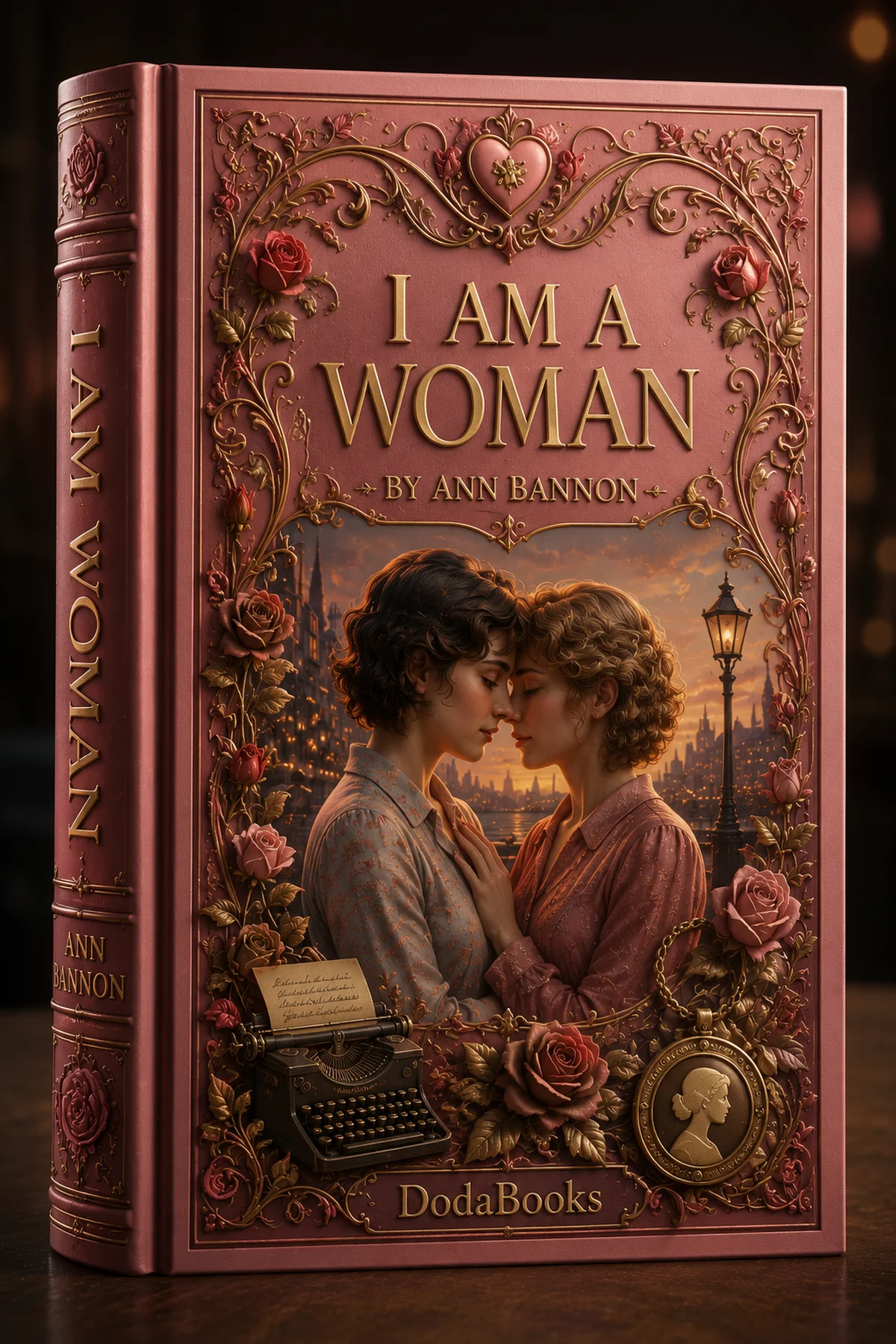
I Am a Woman is Ann Bannon’s second novel in her legendary Beebo Brinker series, originally published in 1959 as a Gold Medal paperback. One of the first mainstream lesbian novels to treat its subject with honesty and compassion, it remains a landmark of LGBTQ+ literature.
💕
I Am a Woman
A groundbreaking lesbian pulp novel from 1959. Laura Landon flees her harsh father and a painful past to start fresh in New York City's Greenwich Village, where she discovers unexpected feelings and a hidden world of love and longing.
| Author | Ann Bannon |
| Published | 1959 |
| Genre | Lesbian pulp fiction, romance |
| Series | Beebo Brinker (#2) |
| Chapters | 18 |
| Setting | Greenwich Village, New York City |
💕 The Story
Laura Landon arrives in Greenwich Village with little more than a suitcase and a desperate need to escape her overbearing father. She finds a roommate in the vivacious Marcie, who introduces her to the underground world of Village bars and the colourful characters who inhabit them. There she meets Jack, a gay man who becomes her closest friend, and the magnetic Beebo Brinker, a butch lesbian whose confidence and charm both attract and terrify her.
As Laura navigates her new life, she must confront the truth about her feelings and her past. Her growing attraction to women forces her to question everything she thought she knew about love, identity, and herself.
📖 Literary Significance
Ann Bannon’s Beebo Brinker series is legendary in LGBTQ+ literature. Written at a time when such stories were barely acknowledged, the novels offered a vivid portrait of a community finding joy, solidarity, and love in the shadows of pre-Stonewall America. I Am a Woman is remarkable for its unflinching portrayal of lesbian life — the underground bars, the coded language, the constant threat of exposure, and the fierce bonds of chosen family.
The character of Beebo Brinker became an icon — a confident, masculine-presenting lesbian who refused to apologize for who she was. At a time when mainstream culture offered lesbians no positive images, Beebo was a revelation.
✨ What Makes the DodaBooks Edition Special
This edition presents Bannon’s landmark novel in a clean, distraction-free format.
Zero Distractions
No ads, no license pages — just the complete text, clean and uninterrupted.
Smart Typography
Curly quotes, em-dashes, proper ellipsis — typeset with care for a premium reading experience.
Chapter Navigation
Full table of contents with navigation to each of the 18 chapters — easily jump between them.
Cleaned & Polished
All boilerplate stripped, consistent formatting throughout the text.
No DRM
You own your copy — read on any device, anytime, forever.
Instant Download
EPUB format included, delivered instantly after purchase.
📚 Where the Beebo Brinker Series Fits
I Am a Woman is, in publication order, the second of Bannon’s five novels, but the series is built to be entered anywhere. Each book centres a different woman and a different part of the same world, while Beebo Brinker runs through them as the connective thread. That loose structure means a first-time reader can begin here without homework — Laura, a newcomer to the story in this book, discovers Greenwich Village alongside you. If the series works on you, the other four novels — Odd Girl Out, Women in the Shadows, Journey to a Woman, and the 1962 prequel Beebo Brinker — fill in the corners of a community Bannon charted book by book. Because the novels share a world rather than a single continuous plot, nearly every one stands alone.
🏛️ The World of Lesbian Pulp Fiction
To understand what Bannon pulled off, it helps to know where the book was sold. In the 1950s the paperback revolution meant that small, cheap books reached every drugstore and newsstand in America, and publishers discovered that “sensation” titles sold in enormous numbers. Lesbian pulp — usually wrapped in lurid covers and marketed as a warning — became its own crowded rack. Most of those books were written quickly by authors who knew nothing of the world they described. A handful, like Bannon, wrote from inside it.
Bannon’s books looked like their neighbours on the rack but behaved differently on the page. Her characters have jobs, friendships, jokes, grudges, and longings the lurid covers never advertised. She describes the Village bars where lives were lived far from respectable sight, the careful, coded ways women found one another, and the cost of exposure in a society that treated the subject as a joke or a scandal. Working under the pressures of the era, she smuggled real interior lives past the censors by using the paperback conventions everyone expected — and then quietly refusing to condemn her characters.
💕 What the Book Is Really About
Under the adrenaline of the romance plot, I Am a Woman is about the struggle to name yourself honestly. Its title is an act of self-declaration — the sentence Laura must eventually be able to say the way other people say their own names casually. Bannon’s subject is identity at the moment it is discovered: Laura’s first sight of the Village’s secret social world, her slow recognition of her feelings, her terror and relief at being seen. The bars and the coded language are not decoration; they are the machinery of survival, and Bannon treats them with tenderness rather than pity.
Two things make the book feel contemporary decades on. One is chosen family — the bonds among Laura, Jack, and Beebo that matter more than the disapproving families they left behind. The other is the refusal to perform shame: Beebo, above all, moves through the world with a confidence the era told her she was not allowed to have. Readers who respond to those same notes in other classics will be on familiar ground with the flame of independence in Jane Eyre, the young woman who redraws her own life in The Blue Castle, and the fierce young heroine of That Girl Montana.
🕰️ Why It Still Matters
I Am a Woman matters as one of the few first-hand records of lesbian life in America before Stonewall. Written at a moment when the culture offered lesbians no positive images, it gave a generation of readers a mirror and a map. Its enormous popular success — sold by the million and passed hand-to-hand — proved that the audience for honest queer stories was vast long before that audience was allowed to say so. Modern readers come to it not as an antique but as a living book: urgent, emotionally direct, and aware that every chapter of Laura’s education was paid for in the era’s particular fears.
📖 How to Read It Today
Read it as the fast-moving pulp it is — short, driven chapters and a plot that keeps moving — but let the period register. The 1950s pressures Laura feels are not atmosphere; they are the story’s stakes. Expect the vocabulary and the social assumptions of its time, and read Bannon the way her original audience learned to: attentive to who the book cares about and why. It is a quick read at 18 chapters, and it rewards a second pass once you know where Laura is headed. For a change of key afterwards, the romance traditions of A Room with a View or the sisterly longing of Sense and Sensibility sit comfortably on the same reading list.
❓ Frequently Asked Questions
Do I need to read the first book in the series?
While I Am a Woman is the second book in the Beebo Brinker series, it works well as a standalone. The story follows a new character, Laura, and introduces Beebo from her perspective.
What is the Beebo Brinker series?
A series of five lesbian pulp novels published between 1957 and 1962: Odd Girl Out, I Am a Woman, Women in the Shadows, Journey to a Woman, and Beebo Brinker. They are considered foundational works of LGBTQ+ literature.
How groundbreaking was this novel for its time?
Extremely. In 1959, lesbian characters in popular culture were either invisible or portrayed as pathetic and predatory. Bannon’s characters were complex, sympathetic, and relatable. The novel sold millions of copies and was passed hand-to-hand by women across America.
How long does it take to read?
At 250 pages across 18 chapters, most readers finish in 5-7 hours. The fast-paced narrative and compelling characters make it a quick but unforgettable read.
Is the book explicit, or does it work by suggestion?
The feelings are explicit; the era’s language is not. Written under 1950s publishing conventions, the novel is frank about Laura’s emotions and restrained by the vocabulary of its time. What still reads as modern is the honesty of the book’s heart.
Does the book end on hope?
Without spoiling the closing scenes: the novel’s whole arc carries Laura toward self-acceptance rather than despair. Like the rest of Bannon’s series, it treats love and community as worth fighting for — which is exactly what made it so defiant for its time.
What should I read after this one?
The natural next step is the rest of the Beebo Brinker series, which fills in another corner of the same world in each book. If it is the romance you are after, the forbidden passion of Manon Lescaut, the epistolary longing of Eloisa, or the self-renewal of The Blue Castle continue the conversation nicely.
📚 Related Articles
💕 Read the Lesbian Pulp Classic
I Am a Woman is a landmark of LGBTQ+ literature — a groundbreaking novel that dared to tell the truth about lesbian life in 1950s America. The DodaBooks edition presents Bannon’s classic in a clean, distraction-free format:
- ✅ Complete 18-chapter text — every word of the 1959 original
- ✒️ Smart typography — curly quotes, em-dashes, proper ellipsis
- 📜 Full table of contents with chapter navigation
- 🔒 DRM-free — read on any device, anytime
- 📥 Instant download — EPUB format