Helen Vardon's Confession
R. Austin Freeman’s Ingenious 1922 Mystery of Blackmail, Forced Marriage, and Scientific Detection
In the golden pantheon of classic detective fiction, while Arthur Conan Doyle gave us the dazzling intuitive deduction of Sherlock Holmes, Dr. Richard Austin Freeman gave the world something radically different: genuine, rigorous scientific forensic detection. Long before CSI or modern television crime laboratories existed, Freeman created Dr. John Evelyn Thorndyke—a brilliant medical-legal jurist who solved impossible murders not through parlor tricks, but through microscopic pathology, chemical reagents, trace evidence, and ballistics.
Published in 1922, Helen Vardon’s Confession represents one of Freeman’s most daring and structurally fascinating novels. Departing from the standard third-person procedural format, the story is narrated in the first person by the heroine, Helen Vardon herself. Part psychological gothic confession, part financial thriller, and part forensic masterpiece, the novel demonstrates how Dr. Thorndyke untangles a monstrous conspiracy so quietly and legally executed that the police never even suspected a crime had occurred.
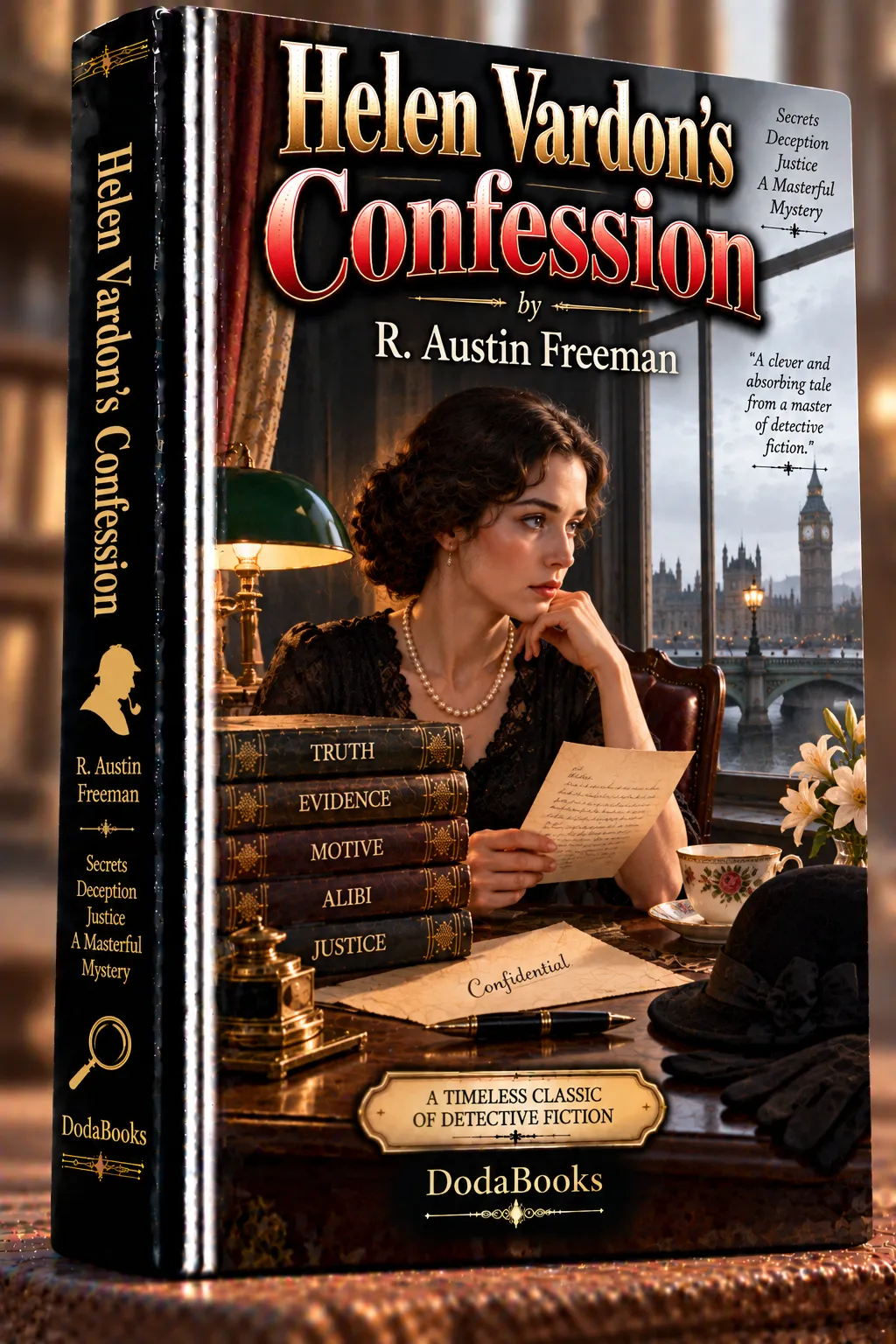
Step into the 1920s Forensic Laboratory with Dr. Thorndyke
Read R. Austin Freeman's ingenious 1922 mystery with annotations explaining early forensic pathology, cyanide chemistry, Edwardian marriage laws, and post-WWI London.
Get Helen Vardon's ConfessionThe Trap: A Forced Marriage and Financial Ruin
The novel begins as Helen Vardon, an artistic and spirited young woman, finds herself ensnared in an agonizing moral dilemma. Her father, an honorable but reckless pottery artist and manufacturer, faces imminent bankruptcy and criminal prosecution over unpaid financial notes held by an unscrupulous financier named Otway.
Taking ruthless advantage of their desperation, Otway offers Helen a chilling ultimatum: he will forgive her father’s catastrophic debts and save the family name only if Helen agrees to marry him. Bound by filial devotion and believing she has no alternative, Helen sacrifices her own happiness, breaking her secret engagement with the young explorer Ralph Bellingham, and submits to the loveless union.
Yet within days of the ceremony, Helen realizes that Otway’s home is a psychological prison. Otway is cold, secretive, and manipulative, surrounding their secluded country house with baffling security precautions. When strange accidents begin occurring and Ralph Bellingham mysteriously vanishes upon his return from abroad, Helen begins to suspect that her husband’s business dealings conceal a sinister criminal syndicate that will stop at nothing—including cold-blooded murder.
The Anatomy of Thorndyke's Investigation:
[Coerced Financial Marriage] ➔ [Atmospheric Gothic Secrets] ➔ [Suspicious Disappearance] ➔ [Microscopic Forensic Pathology] ➔ [Courtroom Vindication]
The Scientific Precision of Dr. John Thorndyke
When a mysterious corpse is discovered under perplexing circumstances, Scotland Yard is utterly baffled. Enter Dr. John Thorndyke and his faithful laboratory assistant, Polton. Unlike contemporary fictional detectives who relied on lucky coincidences or dramatic confessions, Thorndyke approaches the crime scene with his famous green canvas traveling research case, packed with:
- Portable dissection knives and tweezers
- Glass microscope slides and test tubes
- Reagent chemicals for detecting trace poisons
- Plaster of Paris for taking microscopic footprints and tyre tracks
Freeman was a certified medical doctor and Fellow of the Royal College of Surgeons, having served as a colonial physician in West Africa before illness forced him into writing. Because of Freeman’s authentic medical training, every chemical reaction, toxicology test, and physical autopsy described in Helen Vardon’s Confession is scientifically accurate. Thorndyke demonstrates how microscopic examination of dust particles, chemical analysis of cyanide vapors, and forensic examination of handwriting can unravel the most airtight alibis.
Pioneering Forensic Science
Experience the birth of authentic crime scene investigation, including trace evidence analysis, toxicological assays, and forensic pathology.
Gripping Gothic Atmosphere
A masterclass in domestic suspense, following a courageous young woman trapped inside a sinister mansion with a secretive husband.
First-Person Female Narrative
A rare and fascinating psychological perspective in Golden Age detective fiction, giving the heroine full emotional and narrative agency.
Uncut 1922 Text with Annotations
The complete original text restored with detailed notes explaining 1920s London geography, English legal statutes, and medical history.
The “Inverted” Mystery Pioneer and Fair-Play Clues
R. Austin Freeman is celebrated in literary history as the inventor of the “inverted detective story” (the story format popularized later by Columbo, where the reader witnesses the crime first and watches the detective reconstruct it). While Helen Vardon’s Confession employs a classic whodunit mystery structure, Freeman’s absolute commitment to “fair play” shines throughout.
Every physical clue that Thorndyke analyzes—every crumb of pottery clay, every peculiar stain on a linen cuff, every obscure financial clause—is presented openly to the reader. Freeman never cheats his audience with hidden evidence or last-minute revelations. If the reader possesses a sharp eye for physical detail and understands human psychology, they can follow Thorndyke’s deductions step by step until the electrifying climax.
To explore how Victorian and early 20th-century mystery fiction evolved from Arthur Conan Doyle into forensic science, compare this novel with our guide to The Memoirs of Sherlock Holmes and the Victorian suspense of A Pair of Blue Eyes Guide.
Discover the Forefather of Forensic Crime Fiction
Read the definitive digital edition of Helen Vardon's Confession on DodaBooks. Complete with forensic science notes, period London maps, and responsive digital typography.
Purchase Helen Vardon's Confession on DodaBooksWhy Read the DodaBooks Annotated Edition of Helen Vardon’s Confession?
While modern readers love classic detective stories, early 1920s legal contracts, British probate rules, and historical medical terminology can be difficult to interpret without context.
The DodaBooks Annotated Edition provides:
- Medical & Forensic Science Notes: Explains period toxicology, chemical reagents, and microscopic analysis used by Dr. Thorndyke.
- Post-WWI Legal Context: Clarifies period British marriage settlements, bankruptcy laws, and police jurisdiction rules.
- London & Country Topography: Footnotes mapping out historical locations across London, the Temple legal district, and rural Sussex.
- Optimized Digital Typesetting: Pristine font formatting, crisp dialogue margins, and seamless footnote integration designed for Kindle, iPad, Kobo, and smartphones.
Domestic Gothic Suspense Meets Forensic Legal Realism
What elevates Helen Vardon’s Confession above typical Golden Age detective puzzles is R. Austin Freeman’s masterful fusion of Victorian domestic gothic suspense with hard-edged 20th-century forensic realism. In conventional detective fiction, the murder victim or the threatened heroine is often treated merely as an abstract plot device to showcase the detective’s cleverness. Freeman, however, invests deeply in Helen Vardon’s psychological interiority.
The narrative captures the suffocating claustrophobia of a young woman trapped in an isolated country house with a secretive husband whom she increasingly fears. The physical details of the manor—its soundproofed rooms, locked laboratory doors, mysterious visitors arriving under the cover of night, and chilling atmospheric tension—echo the great gothic traditions of Charlotte Brontë’s Jane Eyre and Wilkie Collins’ The Woman in White.
Freeman's Narrative Synthesis:
[Atmospheric Domestic Gothic Suspense] + [Rigorous Laboratory Forensic Chemistry] ➔ [The Modern Psychological Mystery]
Yet just as the gothic dread threatens to overwhelm the narrative, Freeman introduces the razor-sharp rationalism of Dr. John Thorndyke. Thorndyke does not rely on gothic intuition or melodramatic heroics; he arrives with microscopes, chemical reagents, and forensic legal statutes. By using empirical science to penetrate the darkness of human deception, Thorndyke demystifies the horror, proving that no matter how cunningly a crime is concealed, the physical laws of nature will invariably leave an indelible trail of evidence pointing toward the truth.
The Legacy of Dr. Thorndyke in Modern Crime Fiction
The enduring influence of R. Austin Freeman on the crime fiction genre cannot be overstated. Before Dr. Thorndyke, literary detectives operated largely as romantic magicians who concealed their methods until the final chapter. Freeman completely revolutionized this dynamic by positioning forensic science itself as the true protagonist of the story. Authors such as Dorothy L. Sayers, Agatha Christie, and John Dickson Carr frequently cited Freeman as an indispensable influence who established the rigorous standards of the British Detection Club. In Helen Vardon’s Confession, modern readers can witness the exact historical moment when forensic investigation emerged from obscure medical journals into thrilling, mainstream popular art.
Frequently Asked Questions
Who is Dr. John Thorndyke in detective fiction?
Dr. John Thorndyke is the famous fictional sleuth created by R. Austin Freeman, recognized by mystery historians as the first true scientific and forensic detective in world literature.
Why is Helen Vardon's Confession unique among Thorndyke novels?
Unlike most Thorndyke mysteries narrated by his colleague Dr. Jervis, this novel is narrated entirely by the heroine Helen Vardon herself, combining domestic psychological suspense with rigorous medical detection.
Was author R. Austin Freeman a real physician?
Yes. R. Austin Freeman was a qualified physician and surgeon who served in the colonial medical service. His real-world medical knowledge ensured that every forensic autopsy and toxicology test in his books was scientifically accurate.
Is this book a 'fair play' mystery?
Yes. Freeman pioneered fair-play detective fiction, ensuring that every trace of physical evidence, chemical reaction, and legal document is presented to the reader before Thorndyke reveals his deductions.
Where can I purchase and download Helen Vardon's Confession?
You can purchase and immediately download the DodaBooks annotated edition directly from the DodaBooks online bookstore for all modern reading devices.
Related Articles
Readers captivated by fair-play Golden Age deduction, forensic ballistics, and isolated country house murder puzzles will also enjoy Arthur J. Rees’s The Hand in the Dark Guide.