Hamlet Characters Explained: Prince Hamlet, Claudius, Ophelia, Polonius & Elsinore Court
William Shakespeare’s The Tragedy of Hamlet, Prince of Denmark (c. 1600–1601) contains the most psychologically complex and endlessly analyzed cast of characters in world dramatic literature. Departing radically from the two-dimensional archetypes of traditional Elizabethan revenge drama, Shakespeare endowed his figures with profound inner lives, tortuous moral ambiguities, and agonizing psychological contradictions.
From the paralyzing intellectual melancholia of Prince Hamlet to the smooth, Machiavellian pragmatism of King Claudius and the heartbreaking, shattered innocence of Ophelia, the residents of Elsinore Castle exist in an intricate web of surveillance, deception, and existential rot. This comprehensive guide provides exhaustive character profiles, psychological explorations, dramatic foil analyses, and thematic breakdowns for every major figure in Shakespeare’s supreme tragedy.
| Character | Role & Archetype | Key Psychological Traits | Thematic Significance |
|---|---|---|---|
| Prince Hamlet | Protagonist; Melancholic Avenger | Philosophical, hyper-intellectual, disillusioned, indecisive | The tragedy of human consciousness; paralysis of thought vs. moral action |
| King Claudius | Antagonist; Machiavellian Usurper | Charming, politically astute, manipulative, spiritually tormented | Political corruption; the rot of illegitimate power; fratricide |
| Ophelia | Tragic Heroine; Innocent Victim | Dutiful, submissive, vulnerable, emotionally shattered | The destruction of innocence under patriarchal tyranny; genuine madness |
| Polonius | Lord Chamberlain; Court Spymaster | Pedantic, windbag, manipulative, obsessively surveillance-oriented | The comic yet lethal corruption of political sycophancy |
| Queen Gertrude | Queen of Denmark; Flawed Mother | Affectionate, sensually frail, politically compliant, guilt-stricken | The ambiguity of female agency; the carnal frailty of moral compromise |
| Horatio | Trusted Friend; Wittenberg Scholar | Stoic, skeptical, intellectually grounded, fiercely loyal | The rational, moral anchor of the drama; the preservation of historical truth |
| Laertes | Hamlet’s Foil; Impetuous Avenger | Hot-headed, chivalric, easily manipulated, honorable in death | Revenge driven by pure passion devoid of moral contemplation |
| Young Fortinbras | Political Foil; Norwegian Prince | Resolute, ambitious, militaristic, pragmatic | The restoration of external political order after domestic decay |
👑 Prince Hamlet: The Anatomy of Modern Consciousness
The Melancholy Prince and the Crisis of Intellect
Prince Hamlet of Denmark is the quintessential modern figure in Renaissance literature. When the play opens, Hamlet is not merely mourning the sudden death of his father; he is suffering from profound existential alienation and disgust with human nature. The hasty remarriage of his mother Gertrude to his uncle Claudius within a single month has shattered his faith in the moral order of the cosmos:
“Frailty, thy name is woman!— / A little month, or ere those shoes were old / With which she followed my poor father’s body… married with my uncle, / My father’s brother, but no more like my father / Than I to Hercules.”
For Hamlet, the court of Elsinore is “an unweeded garden / That grows to seed; things rank and gross in nature / Possess it merely.” His university education at Wittenberg—the cradle of Protestant humanism—has equipped him with an extraordinary intellect that analyzes every motive, dissects every word, and questions the fundamental reality of human virtue.
The Problem of Revenge and Intellectual Paralysis
When the Ghost commands Hamlet to avenge his murder, Hamlet accepts the sacred obligation, yet his intellect immediately intervenes to delay the deed. This delay is not cowardice; it is the inevitable consequence of a philosophical mind trapped in a primitive revenge code:
- The Epistemological Dilemma: Hamlet recognizes that spirits may be deceptive (“The spirit that I have seen / May be the devil”). He refuses to commit regicide and endanger his immortal soul without forensic empirical proof, which leads him to stage the “Mousetrap” play.
- The Moral Paradox of Action: In his celebrated “To be, or not to be” soliloquy, Hamlet realizes that thought inherently subverts action: “Thus conscience does make cowards of us all, / And thus the native hue of resolution / Is sicklied o’er with the pale cast of thought.”
- The Refusal of Partial Revenge: In Act III, Scene 3, when presented with the perfect opportunity to assassinate Claudius while praying, Hamlet stays his hand. His theological calculation demands total retribution: killing Claudius in prayer would send the murderer’s soul to heaven, which would be hire and salary, not revenge.
Feigned Madness vs. Real Psychological Trauma
To navigate the dangerous surveillance of the Danish court, Hamlet adopts an “antic disposition”—a calculated performance of lunacy that allows him to speak dangerous political truths under the guise of nonsense. Yet Shakespeare deliberately blurs the boundary between calculated performance and emotional collapse. The trauma of his father’s murder, the betrayal of his schoolfellows Rosencrantz and Guildenstern, and Ophelia’s participation in Polonius’s spying drive Hamlet into genuine emotional hysteria, particularly during the brutal “Nunnery Scene” and the bedroom confrontation with his mother.
The Transformation: “The Readiness Is All”
Returning from his interrupted voyage to England in Act V, Hamlet emerges fundamentally altered. The feverish, indecisive youth of Acts I–IV has matured into a calm, fatalistic philosopher. Confronted with the human dust of Yorick, Alexander, and Caesar in the graveyard, Hamlet relinquishes his desperate desire to control events, surrendering to the overarching hand of Providence:
“There is a special providence in the fall of a sparrow. If it be now, ’tis not to come; if it be not to come, it will be now; if it be not now, yet it will come: the readiness is all.”
Hamlet dies not as a bloodthirsty avenger, but as the sacrificial instrument of divine justice, cleansing Denmark of its corruption at the cost of his own life.
🐍 King Claudius: The Smiling Villain of Statecraft
The Machiavellian Politician
Claudius is one of Shakespeare’s most terrifying villains precisely because he is neither a snarling brute nor an unhinged sadist like Richard III. Claudius is a master statesman—suave, articulate, socially gracious, and exceptionally competent at maintaining political order. In Act I, Scene 2, his diplomatic management of the Norwegian crisis and his polite deference to the Danish council reveal a consummate ruler who masks regicide beneath smooth royal rhetoric.
Fratricide and Spiritual Anguish
Yet beneath Claudius’s velvet exterior lies the rot of fratricide—a crime bearing the primal eldest curse of Cain. Shakespeare endows Claudius with a burdened conscience that elevates him above a standard stage villain. In Act III, Scene 3, Claudius’s solitary prayer is one of the most agonizing confessions in dramatic literature:
“O, my offence is rank, it smells to heaven; / It hath the primal eldest curse upon’t, / A brother’s murder. Pray can I not, / Though inclination be as sharp as will… / May one be pardon’d and retain the offence?”
Claudius understands with tragic clarity that repentance without restitution is impossible. He cannot be forgiven by God while retaining the crowns, the queen, and the royal authority won by his crime.
The Desperate Descent into Treachery
Once Hamlet stages the Mousetrap and exposes his awareness of the murder, Claudius sheds his regal diplomacy and operates with ruthless survival instinct. He attempts to have Hamlet quietly decapitated in England, and when that fails, he masterminds the treacherous fencing conspiracy with Laertes, employing an unbated blade, fatal poison, and an envenomed chalice. In the end, Claudius’s intricate traps collapse upon himself: his poisoned cup kills his beloved wife Gertrude, and the venomous rapier ends his own usurped reign.
🥀 Ophelia: The Crushed Flower of Elsinore
The Victim of Patriarchal Surveillance
Ophelia is the most innocent and utterly powerless figure in the play. Living in a rigid patriarchal society, her entire identity is dictated by the men who control her life: her father Polonius, her brother Laertes, and her royal suitor Hamlet. When Laertes cautions her to guard her chaste treasure and Polonius commands her to reject Hamlet’s visits, Ophelia has no legal or social recourse but submission: “I shall obey, my lord.”
Tragically, Hamlet misinterprets her forced obedience as female betrayal. When Polonius uses her as bait to spy on Hamlet in Act III, Scene 1, Hamlet unloads his furious disgust with his mother onto the terrified Ophelia, commanding her to enter a nunnery to avoid breeding sinners.
The Descent into Genuine Madness
While Hamlet’s madness is an intellectual mask, Ophelia’s madness in Act IV is catastrophic and real. Shattered by the violent death of her father at the hands of the man she loves, and abandoned without family or protection, Ophelia’s psyche fractures completely.
In her madness, Ophelia finally finds an uncensored voice. Her fragmented folk songs and flower distributions reveal profound truths about court corruption:
- Rosemary: For remembrance, honoring her slain father.
- Pansies: For thoughts and grief.
- Fennel and Columbines: Given to Claudius and courtiers, symbolizing flattery, deceit, and marital infidelity.
- Rue: Herb of grace and bitter sorrow, shared between herself and Gertrude.
- Daisies and Violets: The daisy represents dissembling innocence, while the violets—symbolizing faithfulness—have all withered with her father’s demise.
The Watery Death and Tragic Legacy
Ophelia’s death—drowning in a weeping brook adorned with wildflower garlands—is recounted by Gertrude in one of Shakespeare’s most lyrical elegies. Weighed down by her saturated clothes, Ophelia dies singing snatches of old tunes, an innocent child reclaimed by nature from the poisonous decay of Elsinore.
📜 Polonius: The Pompous Architect of the Surveillance State
The Windbag Courtier
Polonius, Lord Chamberlain of Denmark, embodies the bureaucratic decay of the Danish court. Tedious, self-important, and enamored of his own rhetorical voice, Polonius mistakes wordy aphorisms for wisdom. Gertrude famously rebukes his endless linguistic preambles with the dry plea: “More matter, with less art.”
Espionage as Domestic Policy
Despite his comedic foolishness, Polonius represents a sinister culture of universal surveillance. He does not hesitate to dispatch Reynaldo to spy on his own son Laertes in Paris using slander and deceit (“Your bait of falsehood takes this carp of truth”), nor does he hesitate to sacrifice his daughter’s emotional wellbeing to eavesdrop on Hamlet.
Death Behind the Arras
Polonius’s obsessive reliance on concealment proves fatal. Hiding behind the arras in Gertrude’s private chamber to spy on Hamlet, Polonius cries out in fear and is instantly run through by Hamlet’s rapier. Hamlet’s callous epitaph captures the courtier’s fate: “Thou wretched, rash, intruding fool, farewell! / I took thee for thy better: take thy fortune; / Thou find’st to be too busy is some danger.” Polonius dies as he lived—trapped within the machinery of court surveillance.
🍷 Gertrude, Horatio, and the Foils
Queen Gertrude: The Enigma of Frailty
Gertrude is the emotional nexus of the tragedy. Shakespeare deliberately leaves her degree of complicity ambiguous: while the Ghost reveals Claudius murdered him, Gertrude appears genuinely shocked when Hamlet accuses Claudius of regicide in the closet scene. Gertrude’s primary flaw is moral passivity and sensual need; she requires security and affection, aligning herself with power rather than standing on principle. Yet her maternal love for Hamlet is authentic, and her final act—drinking from the cup to honor her son despite Claudius’s warning—makes her an unwitting martyr to her husband’s treachery.
Horatio: The Stoic Anchor
Horatio is Hamlet’s sole loyal confidant and the intellectual moral compass of the tragedy. A fellow scholar at Wittenberg, Horatio is a stoic who refuses to be ruled by emotional excess (“A man that Fortune’s buffets and rewards / Hast ta’en with equal thanks”). When the court descends into catastrophe, Horatio remains to bear witness, fulfill Hamlet’s dying request, and report his story truly to an unknowing world.
The Three Sons: Hamlet, Laertes, and Fortinbras
Shakespeare masterfully constructs a tripartite foil system around three young men seeking vengeance for dead fathers:
- Hamlet: Paralyzed by moral reflection and philosophical doubt.
- Laertes: An impetuous revenger who proclaims he would slit Hamlet’s throat in the church and dares damnation to achieve vengeance, allowing Claudius to manipulate his honorable grief into poisonous cowardice.
- Fortinbras: The pragmatic military commander who marches armies to reclaim honor, sweeping in at the final curtain to establish stable political order over the ruins of Elsinore.
⚖️ Character Dynamic & Conflict Matrix
| Dynamic | Nature of Conflict / Bond | Turning Point | Tragic Outcome |
|---|---|---|---|
| Hamlet & Claudius | Moral justice vs. Machiavellian usurpation | The Mousetrap play (Act III, Sc. 2) | Mutual destruction by poison |
| Hamlet & Gertrude | Filial adoration vs. disgust with maternal lust | The Closet Scene (Act III, Sc. 4) | Reconciliation in spirit; Gertrude poisoned |
| Hamlet & Ophelia | Romantic love ruined by distrust and surveillance | The Nunnery Scene (Act III, Sc. 1) | Ophelia’s madness and drowning; Hamlet’s grief |
| Hamlet & Polonius | Razor-sharp wit vs. pompous court surveillance | Polonius slain behind arras (Act III, Sc. 4) | Catalyst for Laertes’s rebellion and Ophelia’s fall |
| Hamlet & Horatio | Pure intellectual friendship and stoic trust | Battlements encounter (Act I, Sc. 2) | Horatio survives to clear Hamlet’s name |
| Hamlet & Laertes | Thoughtful revenger vs. passionate revenger | Fencing match duel (Act V, Sc. 2) | Death-bed forgiveness and mutual redemption |
❓ Frequently Asked Questions
Did Gertrude know that Claudius murdered King Hamlet?
Textual evidence in the Second Quarto and First Folio strongly suggests Gertrude had no prior knowledge of the murder. When Hamlet confronts her in the closet scene and refers to "as kill a king, and marry with his brother," Gertrude responds with bewilderment: "As kill a king?" Her guilt stems from her incestuous haste in remarrying Claudius, not from complicity in fratricide.
Why does Hamlet treat Ophelia so harshly during the Nunnery Scene?
Hamlet enters the lobby deeply disillusioned with female virtue due to his mother's hasty remarriage. When Ophelia attempts to return his past love tokens and lies about her father's whereabouts (*"At home, my lord"*), Hamlet realizes that she has allowed herself to be used as a surveillance decoy by Polonius and Claudius. Wounded by her betrayal, his rage explodes into bitter verbal cruelty.
How does Laertes serve as a dramatic foil to Hamlet?
Both young men are sons tasked with avenging a murdered father. While Hamlet delays for months, paralyzed by moral scruples, philosophical doubt, and spiritual consequences, Laertes returns from France instantly, raises an armed rebellion, and explicitly declares he will cut Hamlet's throat in a church and sacrifice his immortal soul to exact revenge. Laertes demonstrates the dangerous recklessness of action without thought.
What is the significance of Fortinbras at the end of the play?
Fortinbras represents the restoration of external political stability and martial virtue to a nation consumed by internal disease and court intrigue. By ordering that Hamlet receive a soldier's funeral with full honors, Fortinbras recognizes that Hamlet's intellectual struggle was its own heroic, tragic war.
Where can I find an annotated edition with in-depth character commentary?
The best edition of Hamlet is the DodaBooks Annotated Edition, featuring comprehensive character studies, historical context on Elizabethan revenge conventions, and line-by-line vocabulary glosses.
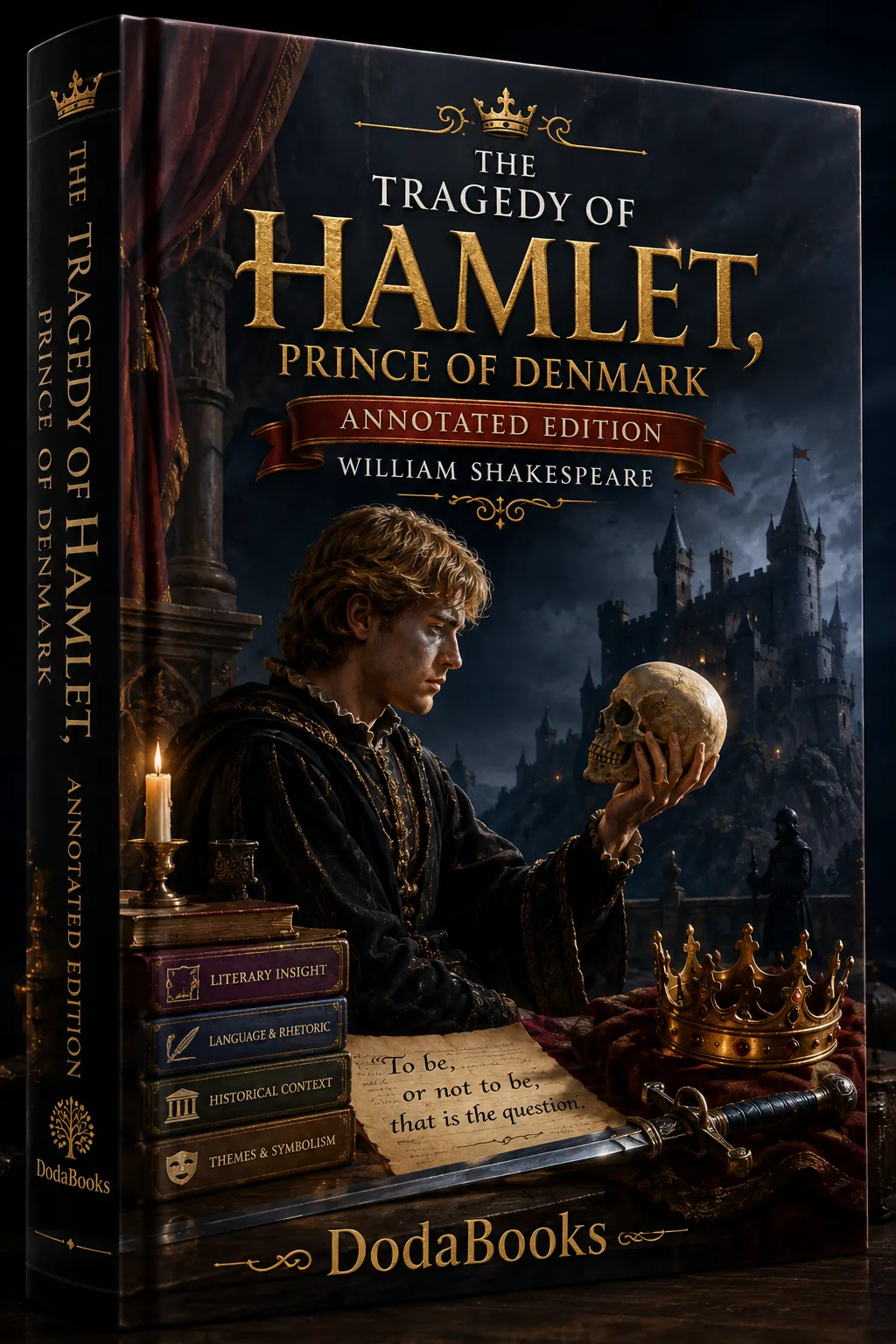
👑 Unlock the Psychological Depth of Shakespeare’s Characters
Explore the intricate minds, moral battles, and theatrical brilliance of Elsinore with the DodaBooks Annotated Edition of The Tragedy of Hamlet, Prince of Denmark.
- 📜 Line-by-Line Early Modern Glosses — Understand every pun, insult, and double entendre
- 🎭 Comprehensive Character Profiles — Exhaustive psychological and dramaturgical insights
- 🏛️ Historical Staging Context — Notes on Elizabethan performance conventions at the Globe
- 🔒 100% DRM-Free Ownership — Yours forever across Kindle, Kobo, iPad, and desktop
- ⚡ Instant Digital Delivery — High-resolution EPUB format available immediately
Continue your study with our master Hamlet Guide for complete analysis of themes, motifs, and historical background.