Gulliver's Travels
Jonathan Swift’s Savage 1726 Anatomy of Human Nature, Politics, and Reason
Published anonymously in 1726 under the title Travels into Several Remote Nations of the World by Lemuel Gulliver, Jonathan Swift’s Gulliver’s Travels is one of the most enduring and fiercely misunderstood works in English literature. Often reduced in popular culture to a cheerful children’s fairy tale about a giant tied down by tiny men on a beach, Swift’s actual masterpiece is a scorching, relentless, and psychologically devastating critique of human vanity, political corruption, imperialist greed, and intellectual hubris.
As Dean of St. Patrick’s Cathedral in Dublin and a veteran of bruising London political battles between Whigs and Tories, Swift famously declared that his purpose in writing was not to divert or amuse humanity, but to “vex the world rather than divert it.” Across four imaginative voyages, Swift strips away the flattering self-delusions of European civilization until Lemuel Gulliver—and the reader—is forced to confront the primal, beastly nature of humankind.
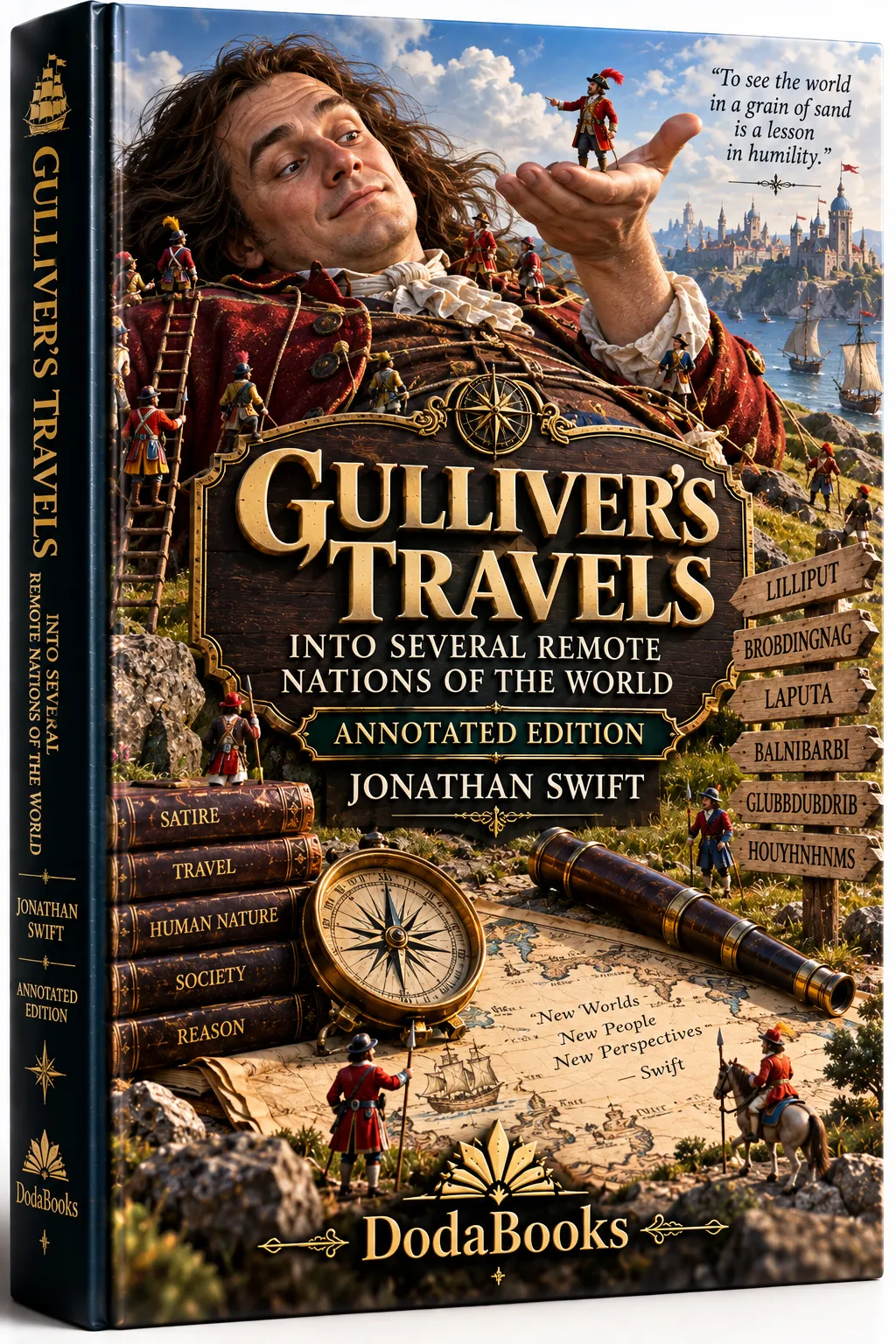
Experience Jonathan Swift's Uncensored Masterpiece
Read the complete four voyages of Gulliver's Travels with historical annotations decoding 18th-century British politics, the Royal Society parodies, and Swift's philosophical attacks.
Get Gulliver's Travels on DodaBooksThe Four Voyages: A Trajectory of Disillusionment
Unlike episodic travelogues, Gulliver’s Travels follows a deliberate psychological progression. Each voyage challenges Gulliver’s perspective from a different angle, systematically demolishing his confidence in European supremacy until his final psychological collapse.
Part I: A Voyage to Lilliput
Shipwrecked in the land of Lilliput, where the inhabitants stand a mere six inches tall, Gulliver finds himself an omnipotent giant. Yet the tiny Lilliputians view themselves as the pinnacle of cosmic importance. Swift uses this dramatic shift in scale to satirize the petty factionalism of 18th-century British politics:
- Political offices are won not through merit or wisdom, but by performing acrobatic tightrope dances before the Emperor (satirizing Robert Walpole and court patronage).
- Bitter sectarian wars between the Big-Endians and Little-Endians rage over which end of a boiled egg should be cracked (satirizing European religious conflicts between Catholics and Protestants).
- The political parties of Tramecksan and Slamecksan feud over wearing high heels versus low heels (satirizing Whigs and Tories).
Part II: A Voyage to Brobdingnag
In Brobdingnag, the scale inverts: Gulliver becomes the miniature insect in a land of sixty-foot giants. When Gulliver proudly explains the triumphs of British warfare, gunpowder, national debt, and parliament to the wise King of Brobdingnag, the monarch reacts with sheer horror. Examining Gulliver through a magnifying lens, the King delivers Swift’s famous verdict:
“The bulk of your natives appear to me to be the most pernicious race of little odious vermin that nature ever suffered to crawl upon the surface of the earth.”
Gulliver's Trajectory of Psychological Inversion:
[Lilliput: Physical Giant / Moral Pygmy] ➔ [Brobdingnag: Physical Pygmy / Moral Horror] ➔ [Laputa: Disembodied Intellect / Practical Ruin] ➔ [Houyhnhnms: Rational Beasts / Repulsive Humans]
Part III: A Voyage to Laputa, Balnibarbi, Luggnagg, Glubbdubdrib, and Japan
Part III shifts the satire from politics to Enlightenment science and abstract philosophy. On the flying island of Laputa, intellectuals live with their heads tilted in perpetual theoretical reverie, entirely blind to physical reality. In the Grand Academy of Lagado (Swift’s parody of the Royal Society), professors squander decades attempting to extract sunbeams from cucumbers, soften marble for pillows, and construct houses starting from the roof down. Swift warns against abstract intellectualism unmoored from practical human empathy.
Part IV: A Voyage to the Country of the Houyhnhnms
The final voyage represents Swift’s most radical philosophical provocation. Gulliver encounters a society governed by the Houyhnhnms—rational, virtuous, philosophical horses who possess no words for lying, deceit, or war. In stark contrast, their land is plagued by the Yahoos—savage, hairy, filthy, humanoid brutes driven entirely by greed, lust, and mindless violence.
To Gulliver’s mounting horror, he realizes that the Yahoos are physically identical to Europeans. Upon returning to England, Gulliver can no longer stomach the sight or smell of his own wife and children, choosing instead to spend his days conversing with horses in the stable.
Unabridged Four Voyages
Includes all four voyages in complete, unexpurgated form—including the biting philosophical satires of Laputa and the Houyhnhnms.
Political Decoding
Explanatory annotations revealing the real 18th-century figures behind Swift's allegories: Robert Walpole, King George I, and the South Sea Bubble.
Enlightenment Philosophy
Clear analysis of Swift's debates with John Locke, Thomas Hobbes, and the scientific rationalism of Isaac Newton's era.
Pristine Typography
Engineered with modern digital reading elegance, preserving Swift's capitalizations and typographical humor on all digital screens.
Swift’s Satirical Method: The Mask of Lemuel Gulliver
Jonathan Swift’s genius lies in his narrative persona. Lemuel Gulliver is not Swift; he is an ordinary, unimaginative, somewhat gullible ship’s surgeon who takes everything at face value. Gulliver records the most absurd and terrifying atrocities with the calm, matter-of-fact precision of an 18th-century maritime logbook.
This deadpan irony forces the reader to supply the moral judgment that the narrator lacks. When Gulliver eagerly offers to teach the King of Brobdingnag how to manufacture cannons that can blow up whole towns and tear bodies to pieces, Gulliver believes he is doing the king an immense favor. The king’s revulsion exposes the moral rot of European militarism far more effectively than any direct sermon ever could.
To trace how later 19th-century masters adopted Swiftian satire and social realism, examine our guides to Charles Dickens’ Oliver Twist Vol. 2 and Tobias Smollett’s The Adventures of Ferdinand Count Fathom.
Discover the True Depth of Swift's Savage Genius
Read the definitive annotated edition of Gulliver's Travels on DodaBooks. Navigate historical allusions, Latin puns, and political allegories with ease.
Purchase Gulliver's Travels on DodaBooksWhy Read the DodaBooks Annotated Edition of Gulliver’s Travels?
Because Swift loaded Gulliver’s Travels with topical references to English court politics, Whig foreign policy, and early Royal Society papers, reading the raw text without commentary leaves modern readers missing half the jokes.
The DodaBooks Annotated Edition provides:
- Immediate In-Line Footnotes: Instant explanations of 18th-century nautical terms, Latin phrases, and British monetary denominations directly on your screen.
- Historical Key to Lilliputian Court Politics: Clear guides identifying Flimnap as Prime Minister Robert Walpole, Skyresh Bolgolam as the Earl of Nottingham, and Blefuscu as France.
- Restored Original Frontispiece and Maps: Includes Swift’s original satirical maps placing Lilliput, Brobdingnag, and Houyhnhnmland on real colonial world geography.
- Clean, Device-Adaptive Typography: Designed specifically to prevent footnote clutter while providing immediate contextual clarity on Kindle, iPad, and smartphone reading apps.
The Linguistic Comedy of Gulliver’s Logbooks
Beyond its biting political allegories, Gulliver’s Travels is a triumph of deadpan linguistic parody. Swift meticulously mimics the dry, technical jargon of 18th-century nautical manuals, surveying instruments, and geographical treatises. When Gulliver describes the exact dimensions of a Lilliputian bowl or calculates the mathematical volume of meat required to sustain an English giant, Swift is lampooning the obsessive quantification of the early scientific revolution.
This mathematical absurdity serves a brilliant psychological function: it lulls the reader into treating the most outlandish satirical scenarios as sober, factual history. By making Gulliver obsess over rope tensions, wind knots, and nautical fathoms, Swift prevents the reader from dismissing the narrative as mere fantasy.
Swift's Satirical Architecture:
[Documentary Realism] + [Mathematical Absurdity] ➔ [Devastating Moral Indictment]
This contrast between clinical observation and catastrophic moral rot reaches its zenith in Part IV. When Gulliver explains the concept of European warfare to his equine Houyhnhnm master—describing thousands of men blown to pieces by cannons simply because two monarchs disagree over a patch of dirt—the master horse can barely comprehend why rational beings would construct engines for self-destruction. Swift’s satire remains as piercing today as it was in 1726, compelling us to interrogate our own unexamined social brutalities.
Frequently Asked Questions
Why is Gulliver's Travels often mistaken for a children's book?
Part I (Lilliput) and Part II (Brobdingnag) feature fantastical changes in physical scale that captivate young imaginations. Victorian publishers frequently sanitized and abridged these early voyages for children, cutting out the biting sexual, political, and philosophical satire.
What do the Houyhnhnms and Yahoos symbolize in Part IV?
The Houyhnhnms represent pure, dispassionate reason and natural virtue, while the Yahoos represent unrestrained human appetite, greed, and bestial savagery. Swift uses them to question whether humanity truly deserves to be called 'rational animals.'
Who was Jonathan Swift satirizing in the Grand Academy of Lagado?
Swift was mocking the Royal Society of London and early Enlightenment scientists who pursued theoretical experiments disconnected from the practical suffering and material needs of common people.
Is Gulliver's Travels an anti-human or misanthropic book?
While Swift called himself a misanthrope who loved individual people like John Arbuthnot and Alexander Pope but hated the collective abstraction of humanity, his satire is ultimately a plea for moral humility, sanity, and compassion.
Where can I buy the complete annotated digital edition?
The unabridged annotated edition is available directly on DodaBooks, featuring comprehensive commentary, historical maps, and seamless e-reader formatting.