Frankenstein Chapter-by-Chapter Summary: Complete Plot Overview
Mary Shelley’s Frankenstein; or, The Modern Prometheus (1818) remains one of the most misunderstood works in English literature. Popular culture often reduces it to a campy horror story about a mad scientist laughing amidst lightning bolts while a clumsy green brute grunts in chains. The actual novel is something vastly more sophisticated: an intricate epistolary tragedy composed of nested narratives exploring scientific overreach, moral culpability, societal alienation, and the desperate human need for love and recognition.
Whether you are reading the novel for a literature course, preparing a paper on Romanticism, or approaching Mary Shelley’s classic for personal pleasure, this complete chapter-by-chapter summary outlines every major movement of the plot, highlights key character motivations, and decodes the complex philosophical debates driving the narrative.
⚡ Frankenstein at a Glance
- Author: Mary Wollstonecraft Shelley (published anonymously in 1818; revised edition in 1831)
- Structure: Epistolary frame narrative (letters) enclosing Victor Frankenstein's oral confession, which in turn encloses the Creature's autobiography
- Setting: Geneva, Ingolstadt, the Swiss Alps, the British Isles, and the Arctic Ocean
- Core Themes: The dangers of unchecked scientific ambition, parental and societal abandonment, nature vs. nurture, the destructive hunger for vengeance
- Key Turning Point: The Creature's encounter with the blind cottager De Lacey in Chapter 15, shattering his hopes of human integration
📜 The Frame Narrative: Captain Walton’s Letters (Letters 1–4)
The novel begins far away from Geneva in the frigid waters of the Arctic Ocean. Captain Robert Walton writes a series of letters to his sister, Margaret Saville, in England, documenting his ambitious voyage of discovery.
Letters 1 & 2: The Voyage North
Walton reveals his obsessive ambition to discover a northern sea passage through the Arctic to the Pacific, or perhaps to uncover the secret of the Earth’s magnetic forces. Like Victor Frankenstein, Walton is driven by a desire for immortal glory, confessing that he prefers achieving greatness to living a life of ease and luxury. However, Walton also confesses a profound, aching loneliness: he lacks a friend of equal intellect and sensibility with whom to share his hopes and disappointments.
Letter 3: Setting Sail into the Ice
Walton’s ship sets sail into uncharted northern waters. His spirits are initially high as the vessel makes rapid progress, but ice floes begin to close in around them as temperatures plummet.
Letter 4: Two Strangers on the Ice
The ship becomes trapped in vast sheets of pack ice. Out on the frozen wasteland, Walton’s crew spots a strange apparition: a gigantic figure driving a dog sled across the distant ice at astonishing speed. The following morning, as the ice begins to break up, the crew discovers another sled adrift on an ice floe. Only one dog survives, and its driver is an emaciated, frozen European man on the verge of death.
Walton takes the stranger aboard. The man refuses to step onto the ship until Walton confirms that the vessel is headed north. Despite his harrowing physical condition, the stranger possesses exquisite manners, deep sorrow, and brilliant intelligence. As Walton nurses him back to health, a deep kinship forms between the two men. When Walton confides his willingness to sacrifice his crew, his fortune, and his very life in the pursuit of scientific glory, the stranger breaks into tears and vows to tell his harrowing life story as a warning against unchecked ambition. That stranger is Victor Frankenstein.
🔬 Volume I: The Ambition and Creation (Chapters 1–8)
Chapter 1: The Frankenstein Family Heritage
Victor begins his autobiography by recounting his noble Genevese heritage and idyllic childhood. His father, Alphonse Frankenstein, was a respected magistrate who married Caroline Beaufort after rescuing her from impoverished obscurity following her merchant father’s death. When Victor is five years old, his mother discovers an impoverished Italian orphan girl named Elizabeth Lavenza living with peasant foster parents in Lake Como. The Frankensteins adopt Elizabeth, and Caroline presents her to Victor as a cherished companion, planting the expectation that they will one day marry.
Chapter 2: The Thirst for Forbidden Knowledge
Victor grows up alongside Elizabeth and his closest childhood friend, Henry Clerval, the imaginative son of a Geneva merchant. While Elizabeth loves nature and Clerval writes chivalric romances, Victor becomes consumed by an obsessive desire to penetrate the physical secrets of the universe. He stumbles upon the archaic writings of medieval alchemists—Cornelius Agrippa, Paracelsus, and Albertus Magnus—and attempts their occult experiments. When he witnesses a magnificent lightning strike utterly shatter an oak tree near his home, he becomes fascinated by the power of electricity and natural philosophy.
Chapter 3: Departure for Ingolstadt and Caroline’s Death
At age seventeen, Victor prepares to enter the University of Ingolstadt in Germany. Just before his departure, Elizabeth contracts scarlet fever; Caroline nurses her back to health but catches the disease herself and dies, urging Victor and Elizabeth to marry in her dying breath. Grieving and isolated, Victor arrives at Ingolstadt, where he consults his professors. M. Krempe bluntly scorns his alchemical studies as useless nonsense, but M. Waldman delivers a stirring lecture praising modern chemistry as a discipline that gives mortals godlike power over the elements. Victor finds his life’s consuming calling.
Chapter 4: Unlocking the Secret of Animation
Victor immerses himself completely in natural science and chemistry, quickly outstripping his professors. Neglecting his health, his friends, and all correspondence with his family, he spends two years studying anatomy and the process of decay. He frequents charnel houses, slaughterhouses, and dissecting rooms, examining the transition from life to death. Suddenly, through an agonizing breakthrough, he discovers the spark of animation—the secret of infusing life into lifeless matter. Rather than creating a normal human form, he decides to construct a giant roughly eight feet tall, believing that larger proportions will make the microscopic biological structures easier to manipulate.
Chapter 5: The Creature Awakens
On a bleak November night amidst driving rain, Victor applies the vital spark to his patchwork creation:
“It was on a dreary night of November that I beheld the accomplishment of my toils. With an anxiety that almost amounted to agony, I collected the instruments of life around me, that I might infuse a spark of being into the lifeless thing that lay at my feet.”
The Creature’s yellow eye opens, its chest convulses, and it breathes with ragged gasps. But the moment life enters the frame, Victor is overcome by visceral horror and revulsion. The monster’s watery eyes, shriveled yellowish skin, and black lips look grotesque. Victor flees his laboratory and collapses onto his bed, where he is plagued by nightmares of kissing Elizabeth, only to watch her transform into his mother’s decomposing corpse. When he wakes, he finds the Creature standing by his bedside, holding back the bedcurtains, reaching out with an awkward smile, and muttering inarticulate sounds. Victor flees into the rainy night.
The next morning, wandering the streets of Ingolstadt in a panic, Victor encounters Henry Clerval, who has arrived to study languages. Victor takes Clerval back to his apartment, terrified of what they will find, but the Creature has escaped into the town. Overwhelmed by exhaustion, guilt, and terror, Victor collapses into a violent nervous fever that keeps him bedridden for months under Clerval’s devoted care.
Chapter 6: Recovery and Domestic Letters
As Victor slowly recovers his physical health, Clerval delivers a loving letter from Elizabeth describing domestic life in Geneva and introducing Justine Moritz, a beloved family servant treated like a daughter by the Frankensteins. Victor introduces Clerval to his professors and attempts to study Oriental literature alongside him to cleanse his mind of natural philosophy. Victor plans to return to Geneva, but winter delays his journey.
Chapter 7: The Murder of Little William
Victor receives an agonizing letter from his father: his youngest brother, five-year-old William, has been strangled to death while playing in the woods outside Geneva. A valuable miniature portrait of Caroline that William wore around his neck is missing. Horrified, Victor races back to Switzerland. Arriving at Geneva late at night after the city gates have locked, he visits the site of the murder during a violent thunderstorm. Amidst a flash of lightning, he sees the gigantic form of his Creature scaling the cliffs of Mont Salêve. Victor realizes with immediate certainty that the demon he animated has murdered his innocent little brother.
Chapter 8: The Trial and Execution of Justine
The following morning, Victor is stunned to learn that Justine Moritz has been arrested for William’s murder; the missing locket was discovered hidden in her dress pocket. Victor knows she is completely innocent, but he refuses to testify about his secret experiments, fearing that people will declare him insane. At the trial, Justine defends herself with dignity, explaining that she was searching for William and was framed by an unknown assailant. However, terrified by her confessor’s threats of excommunication and damnation, she signs a false confession. Despite Elizabeth’s emotional plea on her behalf, Justine is condemned and hanged. Victor is plunged into overwhelming remorse, realizing that his scientific pride has claimed the lives of two innocent loved ones.
🏔️ Volume II: The Creature’s Narrative (Chapters 9–16)
Chapter 9: The Descent into Despair
Following Justine’s execution, the Frankenstein household is gripped by grief. Victor is tormented by suicidal depression and wanders the house like an outcast, constantly fearing that the Creature will strike again. Seeking solace, he leaves Geneva and travels to the valley of Chamounix in the high Alps, hoping the sublime grandeur of towering peaks and rushing waterfalls will numb his inner agony.
Chapter 10: Meeting on the Mer de Glace
Victor hikes alone across the treacherous Mer de Glace (Sea of Ice) toward Montanvert. In the middle of the frozen glacier, he sees a figure approaching at superhuman speed, leaping effortlessly over massive crevasses. As the figure draws near, Victor recognizes the Creature. Boiling with rage, Victor curses the monster and threatens to destroy him:
“Devil, do you dare approach me? and do not you fear the fierce vengeance of my arm wreaked on your miserable head? Begone, vile insect! or rather, stay, that I may trample you to dust!”
The Creature responds with astonishing eloquence, dignified restraint, and philosophical weight:
“I expected this reception. All men hate the wretched; how, then, must I be hated, who am miserable beyond all living things! Yet you, my creator, detest and spurn me, thy creature, to whom thou art bound by ties only dissoluble by the annihilation of one of us.”
The Creature reminds Victor that he was born benevolent and virtuous, but abandonment and universal cruelty have twisted him into a fiend. He demands that Victor listen to his story before passing judgment, warning that if Victor fulfills his moral duty, he will leave mankind in peace; if Victor refuses, he will slaughter everything Victor holds dear. Victor reluctantly follows him into a rough ice cavern to hear his confession.
Chapter 11: The Creature’s Sensory Awakening
The Creature describes his first memories after fleeing Victor’s laboratory. He awoke into a world of overwhelming sensory confusion, blinded by light, chilled by cold, and tormented by hunger. He learned to distinguish heat from cold, light from dark, and gathered berries in the forest of Ingolstadt. When he discovered a smoldering campfire left by beggars, he learned that fire provides both soothing warmth and agonizing pain.
Driven by hunger, the Creature wandered into a village, where his appearance caused mass hysteria: children shrieked, women fainted, and villagers pelted him with stones and heavy weapons. Battered and terrified, he retreated into the countryside and found shelter in a low, abandoned hovel adjoining a small, secluded cottage.
Chapter 12: Observing the De Lacey Cottagers
From a small chink in the wood planks, the Creature spent months observing the inhabitants of the cottage: a blind old man named De Lacey, his son Felix, and his daughter Agatha. The Creature observed their gentle mutual affection and deep loyalty, but also discovered that they were desperately poor and frequently went hungry. Overcome by empathy, the Creature stopped stealing their food and instead secretly chopped cords of firewood at night and cleared snow from their pathway, which the bewildered family attributed to a benevolent “good spirit.” By watching the family speak, the Creature learned the sounds of language, associating words with visible objects like “fire,” “milk,” “bread,” and “wood.”
Chapter 13: Safie’s Arrival and Education
A beautiful foreign woman on horseback arrives at the cottage. She is Safie, an Arabian merchant’s daughter who has fled Constantinople to reunite with Felix, the man she loves. Felix teaches Safie French and history using Volney’s Ruins of Empires. Listening intently through the wall, the Creature receives an extraordinary education. He learns about the rise and fall of great civilizations, laws, religion, government, and the extremes of human cruelty and nobility. But this knowledge brings acute self-awareness: he realizes that he has no money, no noble lineage, no friends, and no form like other men. When he sees his own reflection in a pool of clear water, he recoils in horror, recognizing himself as a grotesque deformity.
Chapter 14: The History of the De Lacey Family
The Creature learns the back-story of his beloved protectors. The De Laceys were once wealthy, distinguished aristocrats in Paris. Felix had helped Safie’s father, an innocent Turkish merchant condemned to death through French religious prejudice, escape from prison. In revenge, the French government confiscated the De Lacey family estates, threw the blind father and Agatha into prison, and exiled the family into penniless obscurity in Germany. Safie defied her deceitful father and escaped to find Felix in his exile.
Chapter 15: Paradise Lost and the Fatal Rejection
While scavenging in the forest, the Creature discovers an abandoned leather portmanteau containing three books: Milton’s Paradise Lost, Plutarch’s Lives, and Goethe’s The Sorrows of Young Werther. These books become his moral and emotional foundation. Werther teaches him domestic emotion and deep depression; Plutarch inspires admiration for civic virtue; and Paradise Lost provides the mythic template for his existence. He compares himself to Adam, who came into the world blessed by a loving Creator, but concludes that his true counterpart is Satan:
“Like Adam, I was apparently united by no link to any other being in existence; but his state was far different from mine in every other respect. He had come forth from the hands of God a perfect creature… but I was wretched, helpless, and alone. Many times I considered Satan as the fitter emblem of my condition; for often, like him, when I viewed the bliss of my protectors, the bitter gall of envy rose within me.”
Crucially, the Creature also reads the laboratory notes he took from Victor’s pocket when he fled Ingolstadt. In these papers, Victor describes his disgust at creating the monster. Armed with spoken language, the Creature decides to introduce himself to the cottagers. Knowing the old man is blind, the Creature waits until Felix, Agatha, and Safie leave for a long walk, enters the cottage, and converses with De Lacey. The blind father receives him with warmth and kindness, declaring that the hearts of men are full of brotherly love when free from prejudice.
Just as the Creature falls to his knees weeping in gratitude, the young people return. Horrified by the monstrous figure clutching the old man’s knees, Agatha faints, Safie flees screaming into the woods, and Felix furiously beats the Creature with a heavy cane. Shattered by grief and unwilling to hurt his protectors, the Creature retreats to his hovel.
Chapter 16: Vengeance, William’s Death, and the Demand
That night, the Creature’s love curdles into volcanic rage. He burns the abandoned cottage to ashes in a ritual of fury and resolves to seek out his creator in Geneva.
On his journey, he saves a young girl from drowning in a swollen river, only to be shot by the girl’s companion, who assumes the monster was attacking her. Wounded and festering with hate, he reaches Geneva. While resting in the woods, he encounters young William Frankenstein. Hoping that an innocent child will be free of adult prejudice, the Creature attempts to befriend him. But William screams insults, calls him an ugly monster, and boasts that his father is M. Frankenstein, the syndic. Realizing the boy belongs to his hated enemy, the Creature chokes him to death. He takes Caroline’s miniature locket from William’s neck and slips it into the pocket of the sleeping Justine Moritz to ensure an innocent human suffers for his agony.
The Creature concludes his narrative back in the ice cave. He presents Victor with an ultimatum: he is malicious only because he is miserable. If Victor builds him a female companion of the same species and grotesque appearance, they will withdraw forever to the uninhabited wilds of South America, leaving humanity unmolested. If Victor refuses, the Creature promises to systematically destroy every person Victor loves.
🌊 Volume III: The Pursuit and Catastrophe (Chapters 17–24)
Chapter 17: Victor’s Reluctant Consent
Victor initially refuses with furious indignation, arguing that creating another monster will only double the threat to humanity. The Creature counters with devastating logic: his vices are the direct consequence of forced isolation. Moved partly by compassion for the Creature’s agony and terrified by his threats, Victor consents to build the female creature, extracting a solemn oath that the pair will leave Europe forever upon her animation.
Chapter 18: Journey to England with Clerval
Back in Geneva, Victor finds himself paralyzed by dread and procrastination. His father notices his declining spirits and suggests he marry Elizabeth immediately. Victor loves Elizabeth, but knows he cannot marry her while this horrific debt hangs over his head. Claiming he needs to consult English scientists on the latest discoveries, Victor departs for London with Henry Clerval as his companion.
Chapter 19: The Isolated Laboratory in the Orkneys
Victor and Clerval tour England and Scotland, visiting Oxford, Cumberland, and Edinburgh. While Clerval revels in the historical sights and scenery, Victor is tortured by paranoia, fearing the Creature is tracking them. In Scotland, Victor separates from Clerval, leaving him with friends while he travels to a desolate, wind-swept island in the remote Orkneys. In a barren, thatch-roofed stone hut overlooking the raging North Sea, Victor sets up his second laboratory and begins the foul work of constructing the female creature.
Chapter 20: Destruction of the Female and the Threat
Late one night, as he works on the nearly completed female form, Victor is seized by terrifying realizations:
- The female has made no pact; she might be far more violent and malevolent than the first.
- She might despise the male monster and reject him, driving him into even deeper rage.
- They might breed, spawning a race of devils that could eventually drive humanity to extinction.
Looking up at the window in the moonlight, Victor sees the Creature glaring in with a sickening grin of demonic anticipation. Overcome by moral horror, Victor tears the unfinished female body to shreds before the Creature’s eyes. The monster howls in agony and vanishes. Hours later, the Creature slips into Victor’s hut and delivers his most famous, bone-chilling curse:
“I go; but remember, I SHALL BE WITH YOU ON YOUR WEDDING-NIGHT.”
The next day, Victor receives a letter from Clerval urging him to return to London. Victor cleans his instruments, packs the remains of the female into a basket weighted with stones, rows out into the ocean at two in the morning, and drops the severed limbs into the dark water. A fierce squall sweeps his small skiff out into the open sea. By morning, he washes ashore in Ireland, where an angry mob immediately arrests him on suspicion of murder.
Chapter 21: The Death of Clerval and Victor’s Imprisonment
Victor is brought before the local magistrate, Mr. Kirwin. Witnesses testify that a gentleman’s strangled body was found washed ashore the previous night. When Kirwin takes Victor to identify the corpse, Victor is horrified to find the dead body of Henry Clerval, with the purple black finger-marks of the Creature clearly indented on his neck.
Victor collapses into violent convulsions and a delirious brain fever that lasts two months in a squalid Irish prison cell. Kirwin treats him with unexpected kindness, notifying Alphonse Frankenstein, who rushes to Ireland to nurse his son. When the court determines that Victor was on the Orkney Islands at the hour of the murder, he is acquitted. Physically shattered and heavily dependent on laudanum, Victor returns to Geneva with his father.
Chapter 22: The Wedding and Elizabeth’s Murder
In Paris on their return journey, Victor receives a tender letter from Elizabeth questioning whether he truly loves her or loves someone else. Victor writes back affirming his devotion and resolves to proceed with the marriage immediately. He completely misinterprets the Creature’s vow—“I shall be with you on your wedding-night”—believing that the monster intends to murder him, not Elizabeth. Victor decides that he will fight the monster to the death and end the torment once and for all.
Victor and Elizabeth are married in Geneva and depart across Lake Geneva to spend their wedding night at an inn in Evian. As night falls, a thunderstorm gathers. Victor, armed with pistols and a dagger, stalks the hallways of the inn in a state of high agitation, searching for his enemy. Hearing a blood-curdling shriek from the bedroom, Victor rushes in to find Elizabeth strangled across the bed, her pale body discarded like a broken doll, with the deadly marks of the Creature’s fingers bruised upon her throat. Looking up through the window, Victor sees the monster grinning in triumph before vanishing into the lake.
Chapter 23: Alphonse’s Death and the Vow of Vengeance
Victor returns to Geneva to deliver the horrific news. The shock and sorrow are too much for his elderly father; Alphonse suffers an apoplectic stroke and dies in Victor’s arms days later. Driven mad by grief, Victor is locked in an asylum for several months.
When he regains his sanity, Victor goes before a Genevese criminal magistrate and confesses his secret creation, demanding that the authorities hunt down the monster. The magistrate listens politely but gently dismisses the request, claiming that capturing a supernatural giant is physically impossible. Disillusioned with human justice, Victor visits the graves of his father, Elizabeth, and William. Kneeling on the cold earth, he swears an eternal oath by the sacred spirits of the night to pursue the monster across the globe until one of them is dead. A mocking, familiar laugh echoes in the darkness, and the Creature’s voice whispers: “I am satisfied: miserable wretch! you have determined to live.”
Chapter 24: The Arctic Chase, Walton’s Conclusion, and the Monster’s Lament
The narrative shifts back to Walton’s ship in the Arctic, completing the epic circle. Victor recounts his relentless pursuit of the Creature across the Mediterranean, the Black Sea, the steppes of Russia, and out onto the Arctic ice sheet. The Creature deliberately left insulting messages carved in trees and cliffs to keep Victor alive and feeding on hatred, leading him into the desolate polar north.
As Victor’s sled drew within a mile of the Creature, a sudden ocean swell shattered the ice floe, separating them and leaving Victor adrift on a small block of ice until Walton rescued him.
Victor’s health deteriorates rapidly aboard the ship. When Walton’s crew threatens mutiny unless Walton promises to turn back south if the ice opens, Victor summons his remaining strength to deliver a fiery speech rebuking the sailors, urging them not to return home as cowards but to behave like heroes who face death with courage. However, realizing the men will not obey, Walton sorrowfully agrees to turn the ship south.
On September 11, Victor dies aboard the vessel, warning Walton to seek happiness in tranquility and avoid ambition.
Later that night, Walton hears a voice of mingled grief and horror coming from the cabin where Victor’s corpse lies. Entering with a lantern, Walton discovers the Creature weeping over the body of his creator:
“That is also my victim!” he exclaimed: “in his murder my crimes are consummated; the miserable series of my being is wound to its close! Oh, Frankenstein! generous and self-devoted being! what does it avail that I now ask thee to pardon me?”
The Creature confesses his profound agony, self-loathing, and loneliness to Walton. He admits that killing Clerval and Elizabeth brought him no joy, only sickening torment. Now that his creator is dead, his tragic journey has reached its end. The Creature announces that he will build a funeral pyre at the northernmost point of the globe, throw himself into the flames, and consume his flesh to ashes so that no future scientist can ever reconstruct another being like him. Leaping from the cabin window onto an ice raft adrift in the sea, the Creature is borne away by the waves and lost in darkness and distance.
Experience Mary Shelley's original prose with full historical and philosophical context. The DodaBooks Annotated Edition includes chapter glossaries, biographical timelines, and textual variations between the 1818 and 1831 editions.
Get the Annotated Edition at DodaBooks⚖️ Victor Frankenstein vs. The Creature: A Parallel Analysis
The genius of Mary Shelley’s structure is that Victor and his creation are dark doubles of one another, mirroring each other’s emotional and psychological trajectory:
| Dramatic Dimension | Victor Frankenstein | The Creature |
|---|---|---|
| Origin & Privilege | Born into noble Geneva aristocracy; nurtured by devoted parents | Born on a laboratory slab; abandoned at the moment of awakening |
| Core Motive | Boundless intellectual ambition; desire for personal fame and godlike mastery | Desperate longing for companionate love, family, and acceptance |
| Education | Elite universities, modern natural philosophy, and ancient alchemy | Empirical observation, trial by fire, and classic literature (Paradise Lost) |
| Psychological Flaw | Cowardice and moral evasion; refuses to take responsibility for his acts | Extreme sensitivity curdling into violent, calculated vindictiveness |
| Tragic Fate | Dies emaciated and exhausted aboard an Arctic ship consumed by hate | Self-immolation on an Arctic funeral pyre to erase his existence |
❓ Frequently Asked Questions
Is the monster named Frankenstein in the book?
No. The scientist who creates the being is Victor Frankenstein. The created being is never given a name in the novel, being referred to as "the Creature," "the monster," "the demon," "wretch," or "fiend." In Chapter 10, the Creature compares himself to both Adam and the fallen angel Satan from Milton's Paradise Lost.
Why does Victor destroy the female creature in Chapter 20?
Victor destroys the female creature because he fears three things: first, that she never swore an oath of peace and might be inherently more violent than the male; second, that she might reject the male monster, causing him even greater anguish; and third, that the two might reproduce and spawn a new species that would compete with and eventually exterminate the human race.
What is the difference between the 1818 and 1831 editions?
The 1818 edition represents Mary Shelley's original radical, bold vision where Victor acts with free will and moral responsibility. In the 1831 revised edition, Shelley softened some elements, portrayed Victor as a helpless victim of fate and destiny, altered Elizabeth's origin from a blood cousin to an adopted orphan, and added an introductory preface detailing the famous ghost-story contest with Lord Byron and Percy Shelley.
Why is Captain Walton included in the novel?
Robert Walton serves as a crucial dramatic foil to Victor Frankenstein. Both men are obsessive explorers risking the lives of others to achieve scientific immortality. By hearing Victor's tragic story, Walton learns the cautionary lesson in time, choosing to spare his crew and turn his ship back toward safety rather than sacrificing his men for personal pride.
Why does the Creature kill Elizabeth instead of Victor on the wedding night?
The Creature wants Victor to suffer the exact same agony of absolute, irremediable isolation that Victor inflicted upon him by destroying his female mate. Killing Victor would have ended Victor's torment quickly; killing Elizabeth forced Victor to spend his remaining days wandering the earth completely alone, deprived of companionship.
📚 Related Reading Guides
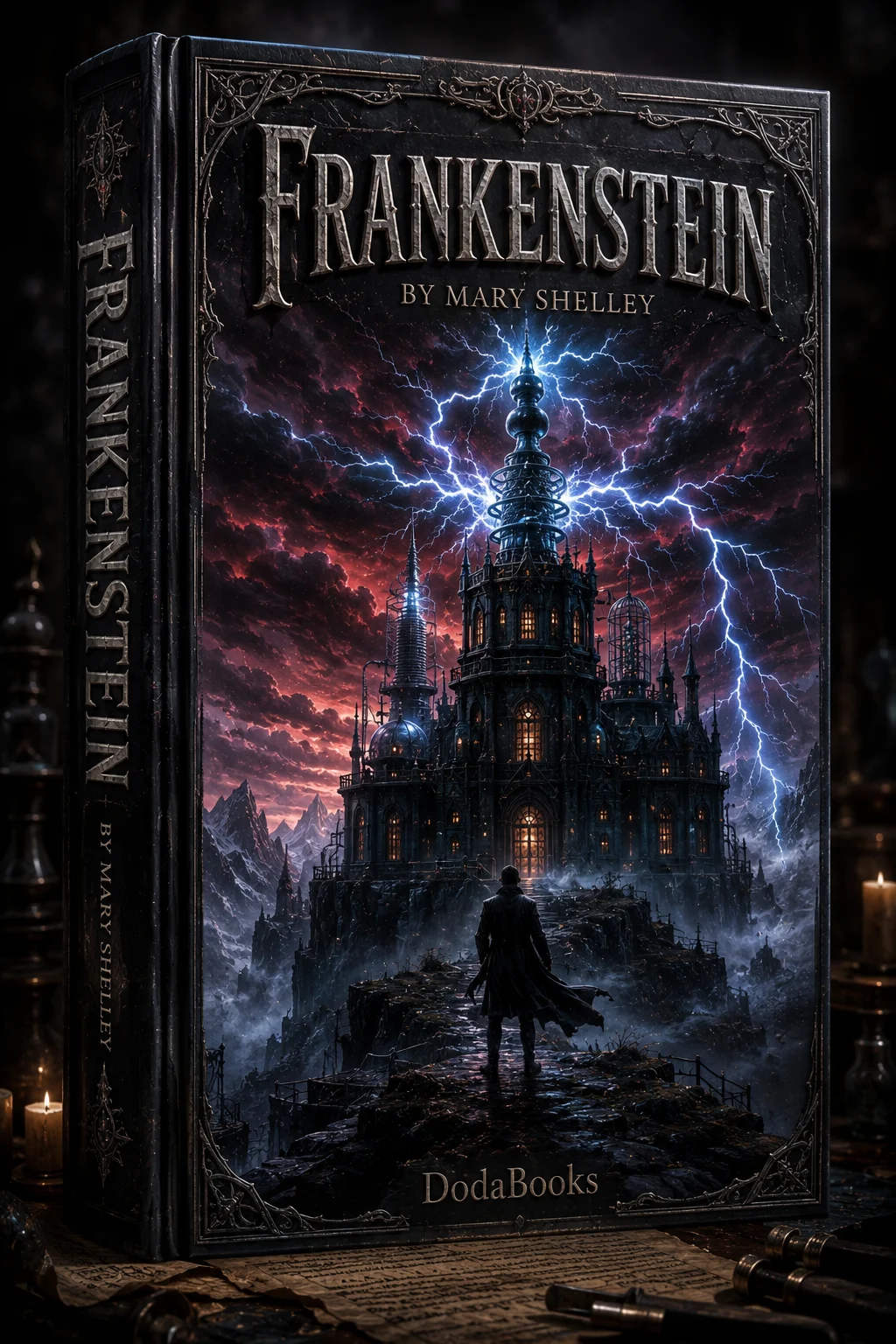
Read Mary Shelley's Masterpiece With Total Clarity
Discover why Frankenstein remains the undisputed foundation of science fiction. The DodaBooks Annotated Edition enriches your reading experience from start to finish:
- Complete, unabridged text formatted for Kindle, iPad, Kobo, and desktop
- Comprehensive chapter-by-chapter reading notes and historical context
- Biographical essays exploring Mary Shelley's circle and the 1816 "Year Without a Summer"
- Clean typography, active table of contents, and free lifetime digital updates