Frankenstein Characters Explained: Complete Analysis & Relationship Guide
The enduring power of Mary Shelley’s Frankenstein (1818) lies not in shocking laboratory spectacles, but in its deeply complex, psychological portrait of human relationships. In Shelley’s masterpiece, characters do not operate as simple archetypes of good and evil; instead, they function as psychological doubles, moral foils, and tragic mirrors of one another.
From the obsessive, hubristic scientist who abandons his parental duties to the articulate, heartbroken creature whose desperate longing for empathy curdles into calculated terror, each figure in the novel drives home Shelley’s warning about the consequences of unchecked egotism and emotional neglect.
Whether you are preparing a literary essay, studying character foils for an exam, or seeking a deeper appreciation of the novel, this comprehensive guide provides an exhaustive analysis of every major character, their thematic roles, and their complex interpersonal dynamics.
⚡ Frankenstein Character Guide: At a Glance
- The Creator: Victor Frankenstein — A brilliant but emotionally cowardly Genevese scientist driven by Faustian ambition and fatal moral evasion.
- The Creation: The Creature ("Adam" / "The Fiend") — A sensitive, highly articulate being born fundamentally benevolent, whose systematic rejection by humanity transforms him into an avenging monster.
- The Moral Mirror: Captain Robert Walton — An ambitious Arctic explorer whose parallel thirst for glory is checked in time by witnessing Victor’s tragic downfall.
- The Domestic Ideal: Elizabeth Lavenza — Victor's cousin/adopted sister and betrothed, embodying serene domesticity and emotional warmth, who pays the ultimate price for Victor's secrets.
- The Humanist Foil: Henry Clerval — Victor's devoted childhood friend who represents poetry, empathy, moral balance, and the restorative joy of human companionship.
- Key Dynamic: The Master-Slave Reversal — While Victor begins as the godlike master, his guilt and terror gradually invert their power dynamic until the Creature commands Victor's life entirely.
🔬 1. Victor Frankenstein: The Modern Prometheus
Victor Frankenstein is the tragic protagonist whose catastrophic pursuit of glory sets the entire nightmare in motion. Born into a privileged, loving Genevese family, Victor enjoys every advantage of wealth, education, and familial devotion. Yet, this idyllic upbringing fails to instill in him the essential moral virtue of humility.
The Anatomy of Victor’s Hubris
Victor’s intellectual path begins with the mystic alchemy of Cornelius Agrippa and Paracelsus before evolving into cutting-edge chemistry and galvanic electricity at the University of Ingolstadt. His defining psychological trait is not a dispassionate love of science, but an insatiable craving for immortal fame:
“A new species would bless me as its creator and source; many happy and excellent natures would owe their being to me. No father could claim the gratitude of his child so completely as I should deserve theirs.”
Victor imagines himself as a benevolent patriarch, a god figure worshipped by a brand-new race. However, the moment his dream becomes reality in Chapter 5, his delusions vanish. Faced with the reality of an eight-foot-tall, yellow-eyed, breathing being, Victor experiences visceral revulsion and flees.
The Fatal Flaw: Moral Evasion and Cowardice
Victor’s ultimate sin in the novel is not the act of scientific creation itself, but his total, immediate abandonment of his creation. He assumes godlike creative powers without accepting the fundamental parental and moral responsibilities that accompany them.
When little William is strangled and the innocent servant Justine Moritz is framed for the crime, Victor possesses the knowledge that could vindicate her. Yet, paralyzed by cowardice and terrified that society will declare him a lunatic, he remains silent:
“I, the true murderer, felt the never-dying worm alive in my bosom, which allowed of no hope or consolation… A thousand times would I have shed my own blood, drop by drop, to have saved their lives; but I could not, my father, indeed I could not.”
Victor repeatedly casts himself as a passive victim of “destiny” or “an irresistible hold,” refusing to take ownership of his choices. This persistent self-pity and evasion of responsibility directly lead to the slaughter of everyone he loves.
🧌 2. The Creature: The Forsaken “Adam of Labors”
The Creature is Mary Shelley’s greatest psychological achievement. Completely departing from Hollywood’s grunting brute with neck bolts, the novel’s Creature is a self-educated philosopher, profoundly sensitive, capable of immense love, and possessing a vocabulary richer and more persuasive than Victor’s own.
The Trajectory: From Innocence to Demonic Malice
The Creature’s life follows a tragic arc rooted in John Locke’s theory of the tabula rasa (blank slate) and Jean-Jacques Rousseau’s concept of natural human goodness:
- The State of Nature (Chapters 11–12): Awoken into sensory confusion, the Creature learns to survive through trial and error. He finds joy in birdsong, weeps with empathy when he observes the impoverished De Lacey cottagers, and secretly chops wood to lighten their daily burdens.
- The Intellectual Awakening (Chapters 13–15): By overhearing the De Lacey family’s history lessons and reading Milton’s Paradise Lost, Plutarch’s Lives, and Goethe’s The Sorrows of Young Werther, the Creature gains deep intellectual self-awareness. He compares himself to Adam:
“Like Adam, I was apparently united by no link to any other being in existence… but I was wretched, helpless, and alone. Many times I considered Satan as the fitter emblem of my condition.”
- The Catastrophic Rejection (Chapter 15): When the blind patriarch De Lacey receives him with compassion, the Creature believes he has found a home. But the moment the sighted family members enter, Felix attacks him with a walking stick, Agatha faints, and Safie flees. Visual prejudice utterly blinds humanity to his beautiful soul.
- The Descent into Terror (Chapters 16–24): After being shot for saving a drowning girl, the Creature’s benevolence curdles into active malice. If he cannot inspire love, he will inspire terror:
“I am malicious because I am miserable. Am I not shunned and hated by all mankind? You, my creator, would tear me to pieces and triumph; remember that, and tell me why I should pity man more than he pities me?”
The Master-Slave Reversal
The central philosophical core of the novel is the dramatic reversal of authority between Victor and his creation. When Victor destroys the half-finished female mate in the Orkneys, the Creature steps forward out of the shadows and delivers his famous declaration of dominance:
“Slave, I before reasoned with you, but you have proved yourself unworthy of my condescension. Remember that I have power; you believe yourself miserable, but I can make you so wretched that the light of day will be hateful to you. You are my creator, but I am your master; obey!”
By the conclusion of the novel, the Creature completely orchestrates Victor’s life, leading him on a leash of fury across the frozen steppes of Russia into the Arctic wastes.
🧭 3. Captain Robert Walton: The Double and the Rescued Soul
Captain Robert Walton frames the entire story through his letters to his sister, Margaret Saville. Walton is not merely a passive narrator; he is Victor’s crucial psychological double and moral foil.
The Parallel Ambition
Like Victor, Walton is an ambitious young man obsessed with achieving immortal glory. He abandons domestic comfort to lead a dangerous Arctic expedition, seeking a northern trade passage or the secrets of the Earth’s magnetic poles. Like Victor, Walton prioritizes personal fame above human connection:
“One man’s life or death were but a small price to pay for the acquirement of the knowledge which I sought, for the dominion I should acquire and transmit over the wild and mysterious elements.”
The Crucial Divergence
Where Victor had no one to check his madness, Walton finds in Victor a cautionary mirror. Victor’s confession exposes the horrific endpoint of unchecked ambition. When Walton’s ship is surrounded by pack ice and his crew threatens mutiny, Walton faces the exact choice Victor once faced: pursue personal glory at the expense of human lives, or humble himself and preserve his men.
Unlike Victor, Walton chooses life and humanity. He turns the ship south, proving that humanity can break free from destructive hubris through empathy and moral restraint.
🕊️ 4. Elizabeth Lavenza: The Idealized Angel of the Hearth
Elizabeth Lavenza embodies the 19th-century ideal of the “Angel in the House.” Introduced as an orphan rescued from poverty by Caroline Frankenstein, she is presented to the young Victor almost as a possession: “I have a pretty present for my Victor—to-morrow he shall have my companion.”
Character Strengths and Symbolic Role
- The Voice of Moral Clarity: When Justine is accused of murder, Elizabeth is the only person who boldly stands up in open court to defend Justine’s character and condemn institutional hypocrisy.
- The Calming Influence: Elizabeth possesses an intuitive, spiritual connection to nature that contrasts with Victor’s aggressive scientific desire to dissect and dominate it.
- The Victim of Victor’s Blindness: Elizabeth’s death on her wedding night is the direct result of Victor’s fatal self-absorption. When the Creature warned, “I shall be with you on your wedding-night,” Victor narcissistically assumed the monster intended to murder him. Victor leaves Elizabeth alone in the bedchamber while he patrols the halls with pistols, effectively delivering her into the hands of the monster.
🌿 5. Henry Clerval: The Humanist Companion
Henry Clerval is Victor’s closest childhood friend and the ultimate embodiment of Romantic humanism. Where Victor is analytical, solitary, and driven to conquer the physical sciences, Clerval is imaginative, sociable, and devoted to poetry, languages, and moral philosophy.
Clerval’s Function in the Novel
- The Moral Antidote: Whenever Victor collapses into psychological ruin, Clerval arrives as a devoted nurse. During Victor’s first fever in Ingolstadt and their tour through England, Clerval’s joy in companionship and landscape temporarily restores Victor’s fractured humanity.
- The Tragic Martyr: Clerval’s brutal murder in Ireland represents the complete death of Victor’s innocent past. By destroying Clerval, the Creature destroys Victor’s capacity for unselfish friendship, leaving him isolated in vengeful madness.
⚖️ 6. Secondary Characters & Their Thematic Significance
                     +---------------------------------------+
                     |       CAPTAIN ROBERT WALTON           |
                     |  (Arctic Frame Narrator & Foil)       |
                     +-------------------+-------------------+
                                         | Rescues & listens to
                                         v
                     +---------------------------------------+
                     |       VICTOR FRANKENSTEIN             |
                     |  (Obsessive Scientist / Creator)      |
                     +---------+-------------------+---------+
                               |                   |
            Abandons at birth  |                   | Cherished childhood bonds
                               v                   v
+------------------------------------+   +------------------------------------+
|           THE CREATURE             |   |         THE DOMESTIC SPHERE        |
|  (Articulate, Vengeful "Adam")     |   | - Elizabeth Lavenza (Betrothed)   |
|                                    |   | - Henry Clerval (Moral Foil)       |
| Targets & Strangles One-by-One:    |   | - Justine Moritz (Scapegoat)       |
| 1. William Frankenstein            |   | - Alphonse Frankenstein (Father)   |
| 2. Justine Moritz (Framed)         |   | - William Frankenstein (Brother)   |
| 3. Henry Clerval                   |   +------------------------------------+
| 4. Elizabeth Lavenza               |
+------------------------------------+
Justine Moritz: The Scapegoat of Institutional Corruption
Justine is a loyal, gentle servant treated as a daughter by the Frankenstein family. Her unjust trial and execution in Chapter 8 highlight Mary Shelley’s scathing critique of the legal and religious institutions of her era. Justine is coerced into a false confession by her Roman Catholic priest, who threatens her with hellfire and excommunication. Her death emphasizes that human society can be just as monstrous and unjust as the Creature roaming the woods.
The De Lacey Family: The Lost Golden Age
- M. De Lacey: The blind French aristocrat whose inability to see allows him to judge the Creature by the goodness of his words and spirit rather than his terrifying physical form.
- Felix & Agatha: The loving son and daughter whose impulsive terror and physical violence shatter the Creature’s faith in human companionship.
- Safie: The Turkish exile whose arrival prompts Felix’s language lessons, inadvertently providing the Creature with the gift of language and political consciousness.
📊 Character Foils and Parallels Matrix
| Character Pair | Core Contrast | Thematic Revelation |
|---|---|---|
| Victor Frankenstein vs. Robert Walton | Victor refuses to turn back until all are dead; Walton listens to reason and turns his ship home. | True courage lies in moral humility and protecting others, not sacrificing human lives for personal glory. |
| Victor Frankenstein vs. The Creature | Victor has loving family, wealth, and status, but turns inward; the Creature has nothing, yet desperately craves love. | Outward beauty can mask inner decay, while physical deformity can conceal a noble, yearning spirit. |
| Victor Frankenstein vs. Henry Clerval | Victor seeks to dominate and exploit the physical world; Clerval seeks to understand, write poetry, and appreciate humanity. | Science without humanistic values, literature, and empathy produces spiritual monstrosity. |
| Elizabeth Lavenza vs. The Creature | Elizabeth is universally loved and protected due to her angelic appearance; the Creature is universally attacked due to his hideousness. | Human sympathy is fundamentally flawed, shallow, and dictated by external visual aesthetics. |
Uncover every psychological nuance and character foil in Mary Shelley's masterpiece. The DodaBooks Annotated Edition includes comprehensive margin notes, character profiles, and historical context.
Get the Annotated Edition at DodaBooks❓ Frequently Asked Questions
Why does Victor Frankenstein refuse to give the Creature a name?
By denying the Creature a name, Victor symbolically denies him personhood, identity, and a place within the human family. Throughout the novel, Victor calls him "the demon," "fiend," "monster," or "wretch." This lack of a name reinforces the Creature's absolute social alienation and status as an unnatural outcast.
How does Henry Clerval serve as a foil to Victor?
Henry Clerval represents the humanities, emotional connection, and moral equilibrium. While Victor isolates himself in charnel houses to conquer physical matter, Clerval studies literature, loves companionship, and engages with culture. Clerval demonstrates what a balanced, healthy human life should look like, emphasizing how Victor's unchecked scientific obsession deranges his soul.
Why does the Creature compare himself to both Adam and Satan?
In Milton's Paradise Lost, Adam was created by a loving God who gave him a paradise and a companion (Eve). The Creature feels he should have been Victor's Adam, loved and protected. Instead, because Victor abandoned him into a hostile world, the Creature finds that his true condition mirrors Satan—cast out of happiness, burning with envy at human domestic bliss, and turning to vengeance as his only solace.
Is Victor Frankenstein an evil character or a tragic hero?
Victor is traditionally analyzed as a tragic hero afflicted by hubris (excessive pride). He does not create the monster out of malice, but out of a genuine desire to banish death and achieve intellectual glory. However, his moral cowardice, repeated refusal to accept responsibility for his actions, and abandonment of his offspring make him deeply complicit in the horrific tragedy that ensues.
What happens to the Creature at the end of the novel?
After mourning over Victor’s corpse aboard Walton’s ship, the Creature announces that his work is finished and his crimes are consummated. He vows to travel to the furthest northern reaches of the Arctic, build a massive funeral pyre, and burn himself to ashes so that his remains can never be used to recreate another being like him. He leaps from the ship onto an ice raft and disappears into darkness.
📚 Related Reading Guides
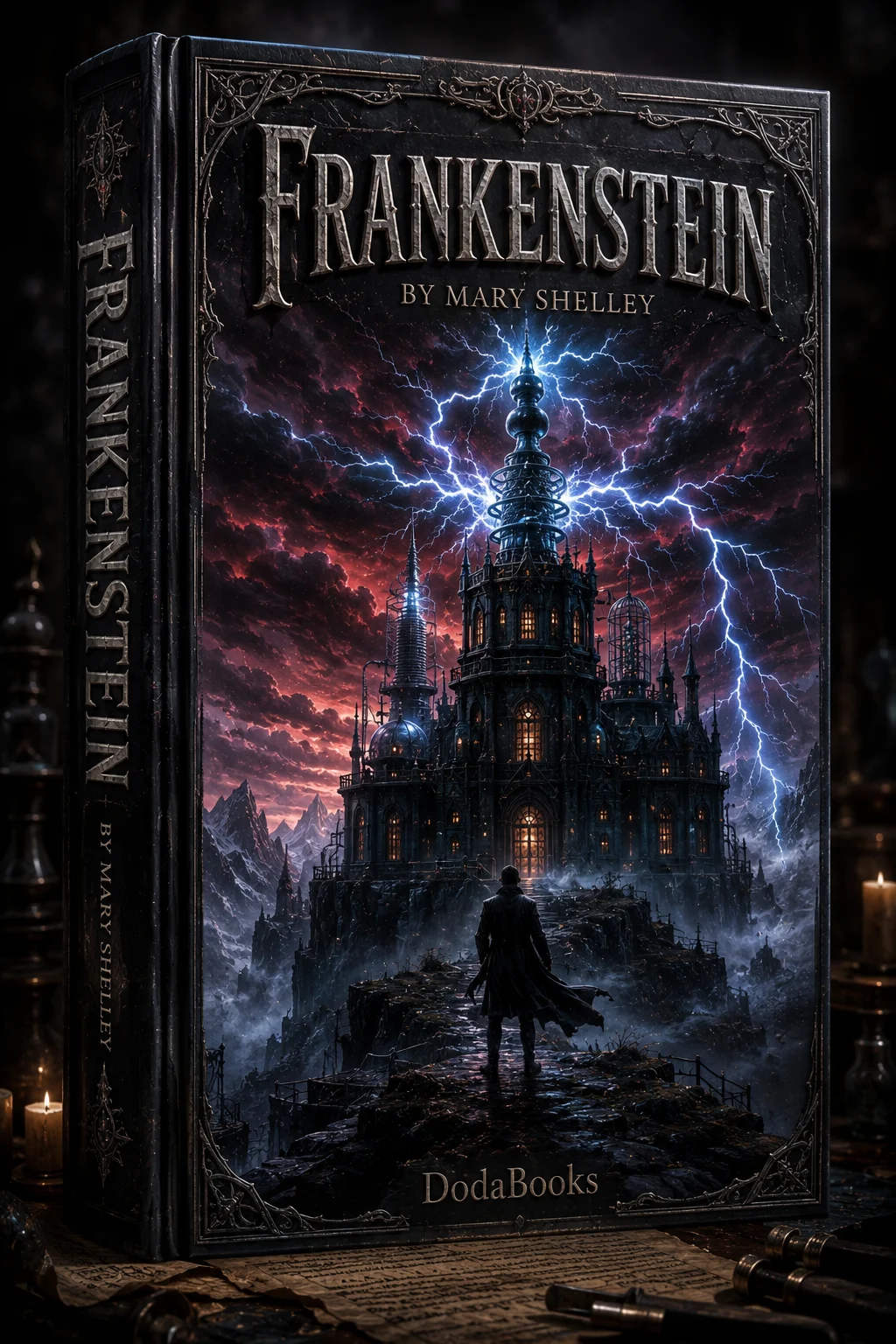
Master the Depths of Shelley's Characters
Read Frankenstein with expert character annotations, historical timelines, and textual analysis right beside the text:
- Exhaustive character profiles detailing foils, doubles, and psychological motifs
- Clear breakdowns of the philosophical debates between Locke, Rousseau, and Milton
- Instant digital delivery across EPUB, Kindle, and PDF formats
- Free lifetime updates and guaranteed typo-free classic typography