Fifty Years in Wall Street
Henry Clews’ Eyewitness Chronicle of Robber Barons, Market Panics, and Gilded Age Finance
There is no substitute for first-person historical testimony. While modern financial textbooks examine market crashes through statistical regressions and econometrics, Henry Clews’ monumental Fifty Years in Wall Street (originally published in 1888 as Twenty-Eight Years in Wall Street and expanded into its definitive form in 1908) offers an unparalleled, ringside seat to the birth of American industrial capitalism.
Arriving in Manhattan as an English immigrant youth in the 1850s, Clews established his own banking firm just before the catastrophic Panic of 1857. Over the next half-century, he advised President Abraham Lincoln and Secretary Salmon P. Chase during the financing of the Civil War, helped organize the national banking system, and personally engaged in financial duels alongside—and against—the most ruthless figures of the Gilded Age: Cornelius Vanderbilt, Jay Gould, Jim Fisk, Daniel Drew, and J. Pierpont Morgan.
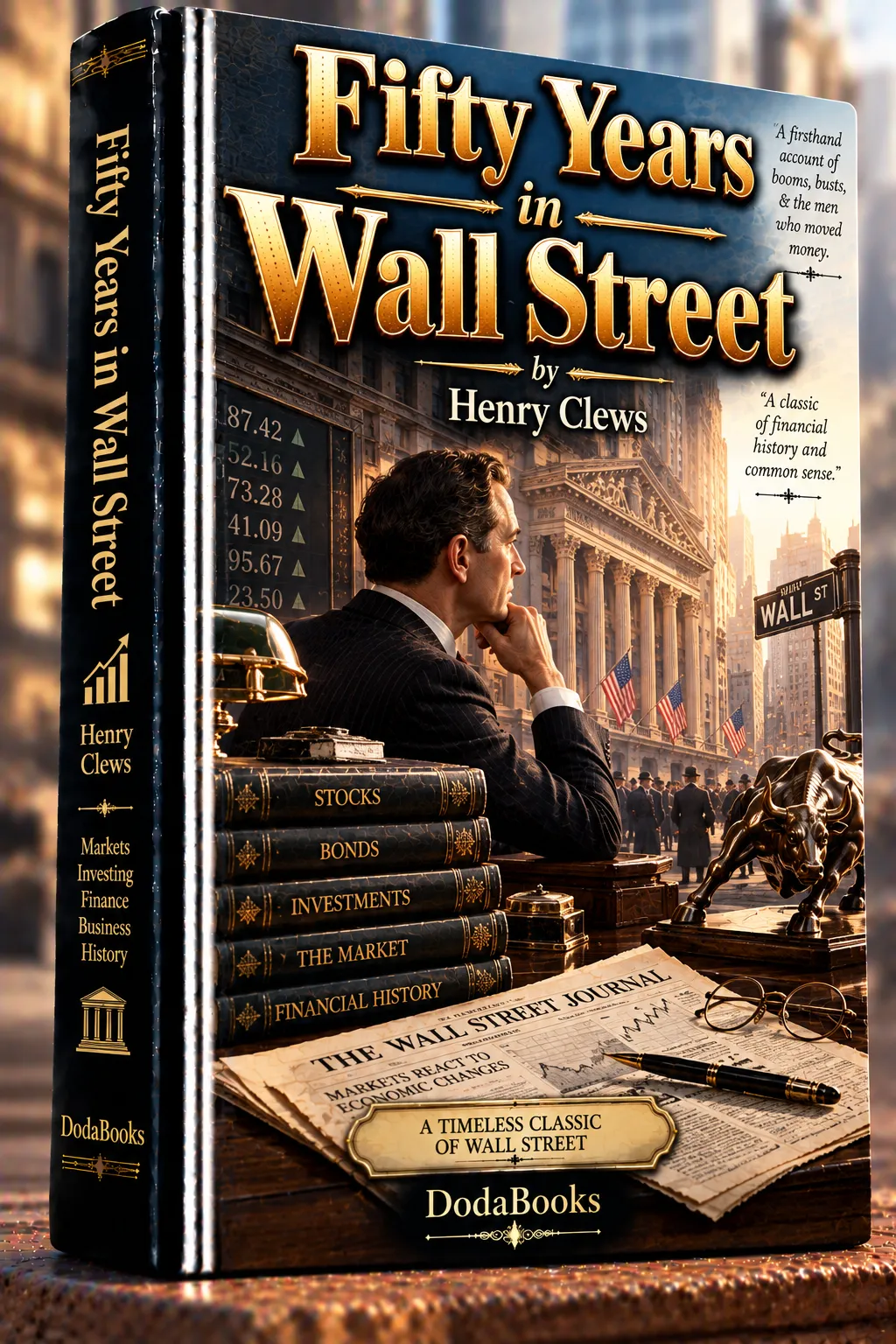
Step onto the Floor of Gilded Age Wall Street
Read Henry Clews' massive 1908 memoir with comprehensive annotations detailing the Erie Railroad Wars, Black Friday 1869, Civil War war bonds, and market syndicates.
Get Fifty Years in Wall StreetThe early unchecked monopolies of the Gilded Age laid the groundwork for international corporate combinations, a phenomenon later exposed in Wendell Berge’s antitrust classic.
The Wild West of Unregulated Speculation
Modern investors accustomed to the Securities and Exchange Commission (SEC), FINRA disclosures, and electronic trading often fail to grasp just how savage Wall Street was in the nineteenth century. Clews operated in an era completely devoid of federal securities regulation, insider trading statutes, or accounting standardization. Markets were driven by brazen pool operations, forged stock certificates, clandestine cornering schemes, and corrupt judicial patronage.
Clews provides microscopic, blow-by-blow accounts of legendary market battles. He documents how “Uncle” Daniel Drew, a cunning former cattle drover and Methodist church trustee, introduced “watered stock” to Wall Street by feeding salt to his cattle to make them drink massive quantities of water before weighing them at slaughter, subsequently applying the exact same deceptive inflation to Erie Railroad shares.
Clews details the scandalous Erie Railroad War of 1868, in which Cornelius “Commodore” Vanderbilt attempted to buy control of the Erie line, only for Drew, Jay Gould, and Jim Fisk to operate a clandestine printing press in a Manhattan basement, flooding the market with 50,000 newly printed, unauthorized shares every time Vanderbilt attempted to corner them. When Vanderbilt secured an arrest warrant from a corrupt judge, Gould and Fisk fled across the Hudson River to New Jersey under the cover of fog, carrying millions of dollars in cash stuffed into laundry bales, guarded by armed thugs.
Clews' Gilded Age Financial Ecosystem:
[Unregulated Bucket Shops & Pools] ➔ [Basement Printing of Watered Stock] ➔ [Bought Judges & Bribery] ➔ [Violent Market Corners & Panics]
Black Friday and the Great Gold Corner of 1869
Perhaps the most gripping chapters in Fifty Years in Wall Street detail the catastrophe of Black Friday on September 24, 1869. Jay Gould and the flamboyant Jim Fisk conceived a daring, sociopathic plot to corner the entire gold supply of the United States.
Recognizing that American farmers needed high gold prices to export wheat to Europe, Gould used family connections to insinuate himself into the inner social circle of President Ulysses S. Grant. Gould bribed federal officials and spread false rumors that the federal government would halt gold sales from the Treasury.
As gold prices were artificially bid up from 130 to 162 in a frenzy of panic, hundreds of legitimate import-export merchants and brokerage houses faced imminent ruin. Clews describes the pandemonium inside the Gold Room on Exchange Place: men tearing their clothes, shrieking in delirium, fainting on the trading floor, and preparing pistols to settle scores. The corner collapsed only when President Grant saw through the conspiracy and ordered Secretary George Boutwell to sell four million dollars in federal gold reserves, crashing the market in fifteen minutes.
Firsthand Robber Baron Portraits
Intimate psychological profiles of Cornelius Vanderbilt, Jay Gould, Jim Fisk, Daniel Drew, and Russell Sage from an insider who traded opposite them.
Civil War War Financing
The untold story of how Clews and Jay Cooke placed federal "five-twenty" war bonds to keep the Union armies clothed, armed, and victorious.
Five Major Panics Analyzed
Exhaustive eyewitness records and lessons from the Panics of 1857, 1873, 1884, 1893, and the Great Banker's Panic of 1907.
Timeless Rules of Speculation
Clews' foundational wisdom on leverage, liquidity buffers, patience, and surviving market euphoria that anticipated modern risk management.
The Psychology of Booms, Panics, and Human Folly
Beyond historical gossip and railroad litigation, Clews was an acute psychologist of financial crowd behavior. Preceding modern behavioral economics by a century, he analyzed why intelligent businessmen repeatedly abandon rational calculation during speculative bubbles:
“The propensity to gamble in stocks is an inherent weakness of human nature… The man who buys on margin without knowing the intrinsic worth of the security is merely playing cards against a stacked deck.”
Clews categorized market participants into distinct behavioral classes:
- The Operating Magnates: Men like Vanderbilt who built physical empires of rails and steamships and treated the stock market as a financing tool.
- The Parasitic Pool Operators: Manipulators like Gould who produced no economic wealth, extracting profits purely through short squeezes and disinformation.
- The Credulous Public (The Lambs): Outside retail investors who invariably entered the market at the dizzying peak of a speculative bull run and were systematically sheared during the panic collapse.
To contrast Clews’ Wall Street memoirs with individual speculative psychology, read our companion guide to Edwin Lefèvre’s Reminiscences of a Stock Operator and Benjamin Franklin’s foundational thoughts on enterprise in The Autobiography of Benjamin Franklin Guide.
Own the Ultimate Chronicle of American Capitalism
Read Henry Clews' complete 1908 edition on DodaBooks, meticulously formatted with comprehensive biographical footnotes, railroad maps, and historical monetary conversions.
Purchase Fifty Years in Wall StreetWhy Read the DodaBooks Annotated Edition of Fifty Years in Wall Street?
Clews’ massive memoir exceeds 800 pages in print, filled with hundreds of historical names, obsolete banking legalisms, and nineteenth-century bond issues. Reading unannotated public domain scans frequently leaves modern readers lost amidst long-forgotten railroad mergers and Civil War tax statutes.
The DodaBooks Annotated Edition delivers:
- Comprehensive Biographical Notes: Identifying every major financier, politician, and jurist mentioned across Clews’ extensive narrative.
- Historical Context & Financial Glossaries: Explaining period terms like greenbacks, 5-20 bonds, call loans, curb brokers, unlisted departments, and wash sales.
- Detailed Chronology of 19th-Century Wall Street: An integrated timeline charting major panics, railroad completions, and legislative turning points from 1857 to 1908.
- Flawless Digital Typesetting: Elegant, responsive chapter structuring optimized for modern Kindle, iPad, Kobo, and Android devices.
The Evolution of Corporate Transparency and Market Ethics
What makes Henry Clews’ writing uniquely compelling across modern financial history is his unwavering insistence that market efficiency is impossible without institutional integrity. Writing as an active participant rather than an academic observer, Clews witnessed the transition of Wall Street from an insular, local mercantile exchange into the financial nerve center of global capitalism.
Clews repeatedly condemned the practice of corporate directors exploiting asymmetric information to trade against their own shareholders. He argued that when railroad executives deliberately concealed quarterly deficits or fabricated balance sheet numbers to facilitate pool syndicates, they were undermining public trust in American democracy itself. His memoirs served as an urgent wake-up call to the financial community, warning that unless Wall Street reformed its internal ethics and instituted transparent reporting, the American voting public would eventually demand punitive federal intervention.
Clews' Institutional Analysis:
[Asymmetric Information Abuse] ➔ [Erosion of Public Confidence] ➔ [Capital Flight & Panics] ➔ [The Inevitability of Reform]
This moral clarity makes Fifty Years in Wall Street far more than a collection of colorful anecdotes. It is a foundational ethical treatise on capitalism, demonstrating that sustainable wealth creation requires fiduciary responsibility, honest bookkeeping, and respect for the broader public interest.
To see how sudden Gilded Age fortunes corrupted small-town New England families with biting comic irony, read our guide to Three Millions Guide.
To trace the broader intellectual and economic currents of American democracy across three centuries, read our study of Main Currents in American Thought Guide.
Frequently Asked Questions
Who was Henry Clews and why was he famous?
Henry Clews (1834–1923) was an English-born American financier, founder of the prominent Wall Street firm Henry Clews & Co., financial advisor to President Abraham Lincoln, and one of the most prolific and respected commentators on American capitalism.
How does Fifty Years in Wall Street compare to Reminiscences of a Stock Operator?
While Reminiscences focuses closely on the trading tactics and psychology of one legendary trader (Jesse Livermore), Clews' memoir provides a sweeping, panoramic history of the entire financial industry, institutional panics, and the political power struggles of the Gilded Age.
What was the 'Erie Railroad War' described by Clews?
The Erie War was a notorious 1868 conflict where Cornelius Vanderbilt attempted a hostile takeover of the Erie Railroad, while directors Daniel Drew, Jay Gould, and Jim Fisk issued illegal watered stock by the millions to defeat him, eventually fleeing to New Jersey with laundry baskets of cash.
Did Henry Clews support government regulation of Wall Street?
Clews held complex views: while an ardent defender of free enterprise and sound gold-standard currency, he repeatedly warned that fraudulent pool operators, dishonest accounting, and unbridled margin speculation would eventually force legislative intervention.
Where can I purchase the complete annotated digital edition?
You can purchase and immediately download the DodaBooks annotated edition directly from the DodaBooks online bookstore for all modern reading devices.