English Eccentrics and Eccentricities by John Timbs: The Art of Nonconformity
Misers Who Starved on Fortunes, Dandies Who Bet Millions on Fleas, and Visionaries Who Lived in Clocks: John Timbs’s Delightful 1866 Encyclopedia of British Idiosyncrasy
In the nineteenth century, foreign travelers commonly observed that while continental nations enforced rigid social uniformity through autocratic monarchies and strict etiquette, Great Britain was a fertile nursery of unbridled, glorious human peculiarity. As the philosopher John Stuart Mill famously argued in On Liberty (1859), the measure of a free society is directly proportional to its tolerance for eccentrics, asserting that “that so few now dare to be eccentric marks the chief danger of the time.”
No writer documented this golden age of British individuality with greater affection, encyclopedic breadth, and sparkling wit than John Timbs (1801–1875). A venerable London antiquarian, Fellow of the Society of Antiquaries, and long-time managing editor of the Illustrated London News, Timbs dedicated decades to compiling forgotten newspaper cuttings, court archives, and tavern gossip. In English Eccentrics and Eccentricities (1866), Timbs presented a sprawling, mesmerizing gallery of over two hundred of the most bizarre, brilliant, and stubbornly idiosyncratic men and women ever produced by Georgian and Victorian England.
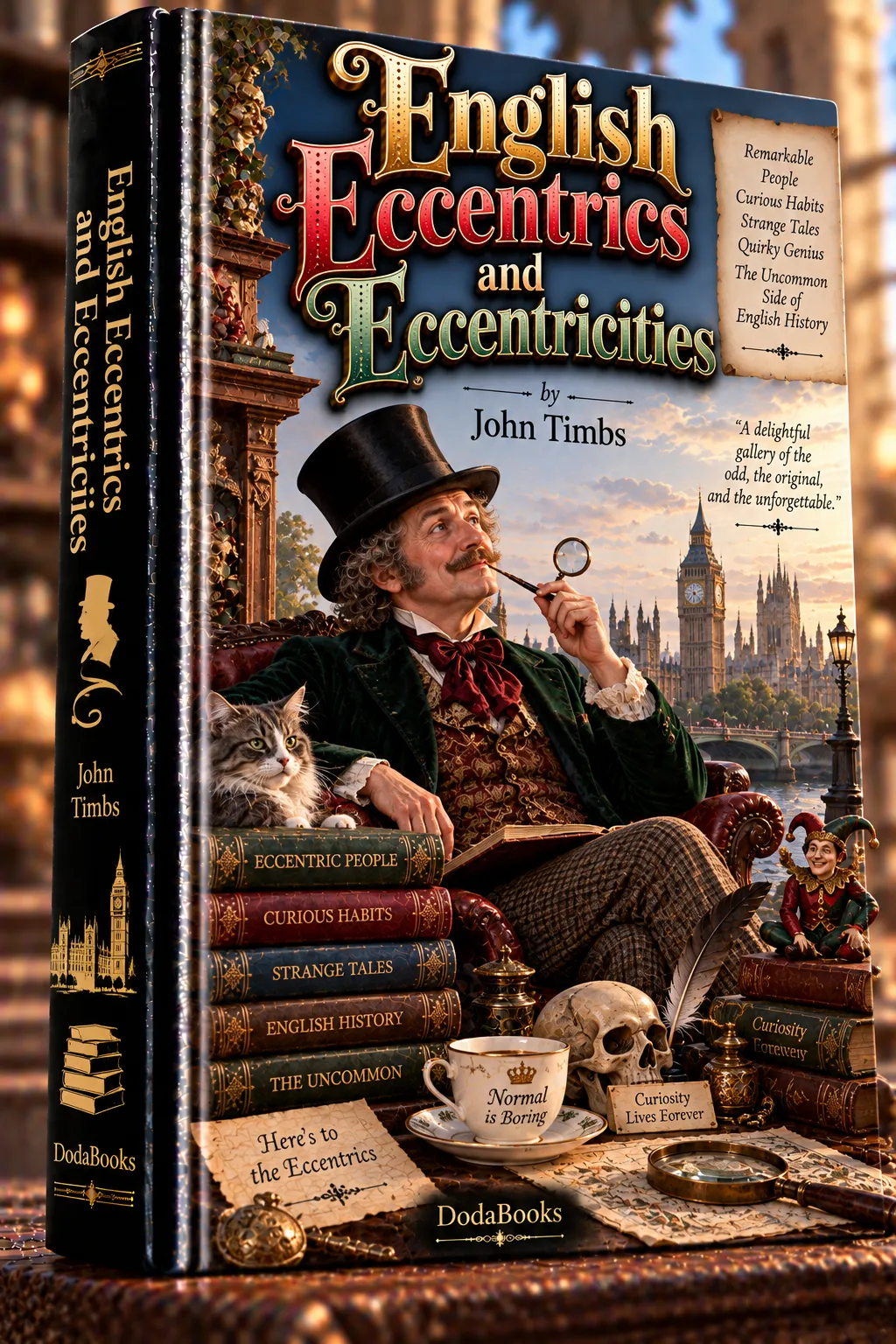
Step Inside London's Greatest Cabinet of Curiosities
Read John Timbs's complete, hilarious treasury of English eccentrics, fully annotated with historical context on Georgian coffee houses, Regency dandyism, and legendary misers.
Read English Eccentrics NowThe Great English Misers: Millions in Rags
Among the most captivating and psychologically astonishing sections of Timbs’s work is his exhaustive chronicle of England’s legendary monomaniacal misers. In eighteenth-century Britain, where vast fortunes were accumulating from global trade and imperial expansion, certain individuals developed an obsessive, pathological terror of poverty that defied all rational belief:
- John Elwes, the Millionaire in Rags: Perhaps the most famous miser in world history, John Elwes inherited astronomical fortunes totaling hundreds of thousands of pounds, was elected Member of Parliament for Berkshire, and owned vast tracts of prime London real estate. Yet he wore a rotting wig he pulled from a ditch, ate putrid meat rather than throw it away, and sat in cold, pitch-black rooms during winter to save sixpence on coal and candles.
- Daniel Dancer and His Hay Bands: Dancer lived in total filth on his extensive country estate, wrapping his legs with dried hay bands instead of stockings, locking his dog in a closet to prevent it from eating scraps, and burying gold sovereigns in dung heaps.
- The Philosophy of the Hoard: Timbs examines the dark comedy of these figures with compassionate curiosity rather than simple mockery. He demonstrates how these men were not simply greedy; they were ascetic monks of finance, willing to suffer cold, hunger, and public ridicule for the abstract, solitary ecstasy of hoarding gold.
The World of Regency Dandies and Reckless Gamblers
Contrasting sharply with the starving misers were the flamboyant aristocrats who treated life as an extravagant theatrical farce. Timbs takes the reader inside the exclusive clubs of St. James’s Street—White’s, Brooks’s, and Watier’s—where the fortunes of great landed dynasties were squandered on the roll of a die:
- “Romeo” Coates and the Cult of Bad Acting: Robert Coates, an immensely wealthy West Indian sugar heir, bought his way onto the London stage to play Romeo. Wearing a crimson cloak adorned with diamonds and arriving in a carriage shaped like a colossal gilded cockleshell, Coates died on stage three times per performance, responding enthusiastically to the audience’s mocking demands for encores.
- Lord Camelford, the aristocratic Brawler: A peer of the realm who roamed London alleys picking fistfights with watchmen, insulted prime ministers, and insisted on fighting lethal duels until he met his end in a field near Holland House.
- The Wagerers of White’s: Men who wagered thousands of guineas on which raindrop would reach the bottom of a club windowpane first, or bet fortunes on walking backwards from London to York.
"Englishmen have ever asserted their prerogative to be peculiar.
In an age of mechanical routine and social uniformity,
our eccentrics stand as glorious monuments to personal liberty,
proving that the human spirit will not be clipped into hedges
by the shears of conventional opinion."
— John Timbs, English Eccentrics and Eccentricities
Explore the Complete 590-Page Treasury with Contextual Footnotes
The DodaBooks annotated edition clarifies 18th-century monetary values, decodes Regency slang, and provides biographical registers for every eccentric.
Get English Eccentrics for $0.99The Sociological Meaning of Eccentricity in Britain
Why did England produce such an astonishing concentration of colorful eccentrics during the eighteenth and nineteenth centuries? Modern historians drawing on Timbs’s archives identify several underlying cultural catalysts:
- The Law of Primogeniture and Wealth: Wealthy British aristocratic younger sons and landed gentry were protected by immense inherited wealth and social standing. Unlike continental aristocrats who were subject to royal scrutiny, an English gentleman on his country estate was king of his own domain, free to indulge any bizarre whim without fear of interference.
- The Rise of Industrial Standardization: As the Industrial Revolution forced millions of ordinary workers into standardized factory schedules, clock-regulated discipline, and identical urban brick terraces, the public developed a voracious appetite for individuals who defied the machine and asserted their absolute, anarchic individuality.
- Eccentricity as Entertainment: In an era before radio, television, or cinema, the public antics of eccentrics served as vital popular entertainment. Their exploits were immortalized in satirical broadside ballads, copperplate caricatures by James Gillray and Thomas Rowlandson, and eager tavern gossip.
Interlinking with Related Folklore and Cult Curiosities
Readers who delight in historical oddities, regional folklore, and unique human personalities will find rich companion volumes in our catalog:
- West Country Folklore & Ghostly Oddities: Explore Sabine Baring-Gould’s magnificent treasury of smugglers, holy wells, and Cornish eccentrics in Cornish Characters and Strange Events Guide.
- The Queen of Cult Literature: Discover the uninhibited, alliterative Victorian genius who baffled the literary world in Amanda McKittrick Ros’s Irene Iddesleigh Guide.
- Victorian Intellectual Reformers: For an example of an eccentric genius who turned her fierce independence into world-changing sociological progress, read Harriet Martineau by Florence Fenwick Miller Guide.
Why Read the DodaBooks Edition of English Eccentrics?
Due to its vast length and episodic structure, nineteenth-century copies of Timbs’s masterpiece are often overwhelming and riddled with archaic references that confuse modern readers. The DodaBooks Annotated Edition makes this classic treasury an absolute joy:
- Monetary Conversions & Currency Footnotes: Automatically calculates what 18th-century guineas, sovereigns, and groats correspond to in modern purchasing power.
- Historical & Topographical Notes: Identifies historical London taverns, coffee houses, gaming hells, and country manors that have since disappeared.
- Flawless Organization: Features a comprehensive categorical index allowing readers to browse by misers, gamblers, artists, politicians, and scientific cranks.
Meet the Wildest Characters in British History
Indulge in John Timbs's delightful, laugh-out-loud cabinet of Victorian and Georgian oddities—the ultimate tribute to human individuality and nonconformity.
Download the Complete EbookFrequently Asked Questions
Who was John Timbs?
John Timbs (1801–1875) was a prominent British antiquarian, journalist, and author. He was a Fellow of the Society of Antiquaries and served as the working editor of the Illustrated London News for over fifteen years, publishing more than 150 volumes of historical anecdotes, popular science, and social curiosities.
What types of eccentrics are featured in the book?
The book includes a wide spectrum of historical oddities: legendary misers (like John Elwes and Daniel Dancer), flamboyant Regency dandies (like 'Romeo' Coates), reckless aristocratic gamblers, bizarre inventors, recluses, self-proclaimed prophets, and theatrical personalities from 1700 to 1860.
Are the stories in English Eccentrics true?
Yes. Timbs compiled his accounts from verified primary sources, including court records, parish registers, contemporary newspapers (such as The Times and The Gentleman's Magazine), and probate wills, giving the book solid documentary value alongside its entertainment.
Why was eccentricity so celebrated in 19th-century Britain?
Victorians viewed eccentricity as a hallmark of national character, reflecting British individual liberty, legal freedom, and the right of every citizen to live as they pleased without interference from state or church authorities.
Where can I get the complete digital edition?
The complete, annotated digital edition of English Eccentrics and Eccentricities is available for immediate download directly from DodaBooks at https://dodabooks.com/ebook/english-eccentrics-and-eccentricities-by-john-timbs/.