Doctor Cupid by Rhoda Broughton: Passion, Pretense, and Country-House Intrigue
The Sparkling 1886 Masterpiece of High-Spirited Wit, Clashing Temperaments, and Unsentimental Romance: Why Rhoda Broughton Shocked Victorian Moralists While Captivating a Generation
In the golden age of the three-decker Victorian novel, few authors possessed a sharper ear for dialogue, a defter touch for social comedy, or a more merciless eye for sentimental hypocrisy than Rhoda Broughton (1840–1920). While the circulating libraries of Charles Edward Mudie demanded pious, swooning heroines who conformed to the domestic ideal of Coventry Patmore’s “Angel in the House,” Broughton burst onto the literary scene with spirited, hot-tempered young women who spoke in colloquial present-tense sentences, flirted outrageously, climbed trees, and dared to express genuine physical desire and emotional impatience.
In her mature 1886 novel, Doctor Cupid, Broughton delivered one of her most polished, emotionally nuanced, and entertainingly acerbic romantic comedies. Set against the autumnal backdrop of an English country estate, the novel revolves around the well-intentioned but chaotic matchmaking schemes of its characters—examining how the capricious, invisible “doctor” of human love (Cupid) wreaks havoc upon social calculations, family expectations, and emotional vanity. By rejecting the formulaic moralism of contemporary domestic fiction, Broughton crafted a psychological portrait of romance that remains strikingly modern in its candor and bite.
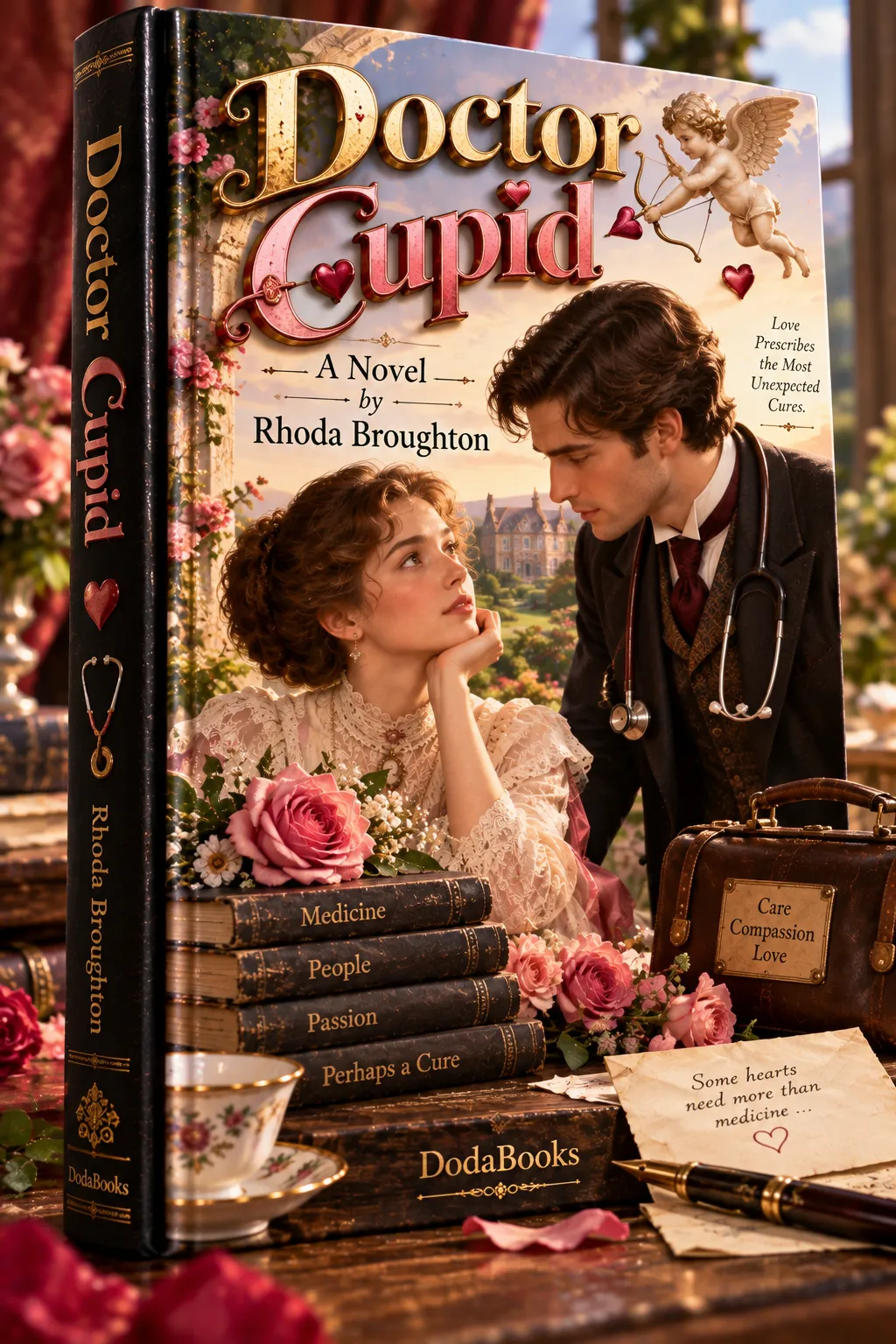
Immerse Yourself in Broughton's Sparkling Social Wit
Read the complete text of Rhoda Broughton's Doctor Cupid, enriched with explanatory footnotes on Victorian country-house etiquette, marriage settlements, and period slang.
Read Doctor Cupid TodayThe Country-House Theatre: Matchmaking and Misunderstandings
The plot of Doctor Cupid unfolds with the kinetic verve of a theatrical drawing-room farce, underpinned by Broughton’s trademark psychological realism. Far from an idyllic rural paradise, the Victorian country house in Broughton’s hands becomes a pressurized social arena where bored aristocrats and ambitious social climbers play dangerous emotional games.
The story takes place during an extended country-house gathering, bringing together an electric assortment of romantic combatants:
- The Reluctant Lovers: At the center of the emotional vortex are Margaret and Freddy—two proud, fiercely independent spirits whose genuine mutual attraction is continually derailed by social pride, defensive banter, and misconstrued flirtations. Rather than declaring their feelings openly, they mask their affection behind a shield of sarcastic humor and feigned indifference.
- The Amateur Matchmakers: As well-meaning hostesses and scheming relatives attempt to orchestrate marriages of financial convenience, their elaborate stratagems inevitably backfire, provoking jealousy and romantic rebellion. Every calculated dinner seating arrangement and afternoon excursion produces the exact opposite of its intended result.
- The Intrusion of Reality: Unlike conventional Victorian sentimental romances where love magically cures all difficulties, Broughton introduces the painful friction of economic anxiety, family illness, and the suffocating boredom of provincial domestic routine. Her characters worry about bank balances, inheritance laws, and the dreary reality of social obligations.
Broughton’s genius lies in her refusal to let her characters remain cardboard cutouts. Beneath their barbed repartee and teasing cynicism, they experience genuine, agonizing vulnerability. When tragedy threatens their circle, the superficial banter falls away, revealing the raw emotional depths that make their eventual romantic reconciliation profoundly moving.
Rhoda Broughton’s Style: The Present-Tense Revolution
What made Rhoda Broughton such a distinctive stylist in nineteenth-century fiction was her bold, innovative use of the narrative present tense and direct, colloquial speech. While contemporaries like George Eliot and Anthony Trollope narrated past events from an omniscient, moralizing distance, Broughton thrust the reader directly into the unfolding moment:
- Immediate Cinematic Pacing: By narrating in the continuous present (“She walks into the room; he glances up from his paper”), Broughton created a sense of electric, breathless immediacy that felt remarkably modern to Victorian readers. The reader feels less like a spectator hearing a tale retold and more like an eavesdropper standing behind the drawing-room curtain.
- Naturalistic Dialogue: Her dialogue captured the actual rhythms of educated Victorian speech—replete with interruptions, dry ironies, understated sarcasm, and youthful slang—dispensing with the stilted theatrical speeches common to popular melodramas. Characters stumble over words, talk over one another, and retreat into embarrassed silence.
- Astringent Humor: Broughton never sentimentalized her heroines. She allowed them to be vain, impatient, unreasonable, and deeply flawed, while maintaining their fundamental charm and moral vitality. Her narrator offers sharp, wry asides on the foolishness of human nature, puncturing romantic illusions with dry wit.
"Love is a disease that takes no account of our convenience;
it laughs at our bankbooks, mocks our prudence,
and strikes us down precisely when we have made
the most sensible arrangements to remain comfortable."
— Rhoda Broughton, Doctor Cupid
Explore Rhoda Broughton's Witty Classic with Explanatory Notes
The DodaBooks annotated edition clarifies 19th-century social customs, decodes country-house marriage law, and explores Broughton's feud with Victorian critics.
Get Doctor Cupid for Only $0.99The Controversy: Why Victorian Moralists Feared Broughton
When Rhoda Broughton published her earliest novels—such as Cometh Up as a Flower (1867) and Not Wisely, But Too Well (1867)—she ignited a moral panic among conservative critics. Reviewers for the Saturday Review and religious journals denounced her books as dangerous and vulgar, warning that no respectable father should allow his daughters to read her works:
- The Accusation of “Sensationalism”: Critics accused Broughton of introducing French realism and sensual frankness into the sacred English home. Her heroines did not merely fall spiritually in love; they openly blushed, shivered at an accidental touch, and suffered visceral, physical heartache.
- Defying Patriarchal Guardians: In Broughton’s novels, young women routinely questioned their parents’ authority, refused arranged matches with wealthy decrepit aristocrats, and insisted on choosing their own marital partners based on mutual affinity.
- A Precursor to the Modern Rom-Com: Far from being scandalous by modern standards, Broughton’s novels are the direct ancestors of modern romantic comedies like those of Nancy Mitford, Georgette Heyer, and Helen Fielding. She proved that romantic love could be treated with psychological realism, sparkling humor, and emotional honesty without collapsing into maudlin sentimentality.
Critical Reception and Literary Legacy
Despite the initial hostility of conservative reviewers, Broughton was championed by some of the most discerning literary figures of her era. Henry James was a lifelong friend and admirer, praising her sharp eye for social absurdity, while Oscar Wilde lauded her wit in his reviews for the Woman’s World. Her influence was felt across the late-Victorian publishing market:
- The Circulating Library Monopoly: Broughton’s enormous commercial success forced Mudie’s Select Library to stock her titles by the thousands, proving that ordinary Victorian readers craved authentic, lively heroines rather than pious instructional manuals.
- The Evolution Toward Realism: In her later works, including Doctor Cupid, Broughton mellowed the melodrama of her youth into subtle character studies. She demonstrated how social conventions trap women in economic dependency, prefiguring the New Woman debates of the 1890s.
- The Power of the Unvarnished Voice: While many of her contemporaries faded into sentimental obsolescence, Broughton’s sharp, unsparing dialogue continues to sparkle with genuine life, offering readers an authentic, unvarnished window into the Victorian upper-middle class.
Interlinking with Related Victorian Romances and Social Comedies
Readers who relish sharp dialogue, romantic friction, and vivid portraits of nineteenth-century society will find delightful companion titles in our collection:
- Aesthetic Romance & Bohemian Freedom: Discover another late-Victorian tale of an independent woman who challenges British social conventions in Grant Allen’s Linnet by Grant Allen Guide.
- The Extreme Melodrama Alternative: Contrast Broughton’s crisp, astringent realism with the outrageous, florid melodrama of Amanda McKittrick Ros in our Irene Iddesleigh Guide.
- Edwardian Passion & Marital Revolt: Explore H.G. Wells’s profound psychological study of romantic desire, social freedom, and marital compromise in The Passionate Friends by H.G. Wells Guide.
- High Diplomacy & Aristocratic Society: Step into genuine nineteenth-century European court intrigues and romantic maneuvers in Memoirs of the Duchesse de Dino Guide.
Why Read the DodaBooks Edition of Doctor Cupid?
Out of print in standard editions for nearly a century, Rhoda Broughton’s novels are overdue for rediscovery by lovers of classic English literature. The DodaBooks Edition presents Doctor Cupid in a flawless, accessible digital format:
- Contextual Annotations on Victorian Etiquette: Explains the unspoken rules governing country-house chaperonage, mourning protocols, calling cards, and marriage settlements.
- Biographical Introduction: Explores Broughton’s colorful personal life in Oxford and London, her friendships with Henry James and Oscar Wilde, and her battle against Victorian censorship.
- Pristine Digital Layout: Scrupulously edited text with smooth chapter transitions, clear typography, and complete cross-platform e-reading compatibility.
Step Into the Drawing Rooms of Victorian England
Experience the laughter, heartbreak, and unsparing wit of Rhoda Broughton's Doctor Cupid—a romantic comedy that remains as fresh and lively today as when it was written.
Download the Complete EbookFrequently Asked Questions
Who was Rhoda Broughton?
Rhoda Broughton (1840–1920) was a popular and prolific Victorian novelist from North Wales and Oxfordshire. Famous for her lively, unconventional heroines and present-tense narrative style, she published dozens of bestsellers including Cometh Up as a Flower (1867), Red as a Rose Is She (1870), and Doctor Cupid (1886).
What is the meaning of the title Doctor Cupid?
The title refers metaphorically to Cupid, the classical god of love, imagined as an erratic, unpredictable physician ('Doctor Cupid') whose emotional prescriptions cause turmoil, fever, and unexpected cures among the characters.
Why were Rhoda Broughton's novels considered controversial?
In the late 19th century, Broughton was criticized by conservative Victorian moralists for creating headstrong heroines who displayed emotional and physical passion, defied parental authority, and spoke in slang rather than conforming to passive, angelic ideals.
How does Doctor Cupid differ from typical Victorian romances?
Unlike typical sentimental melodramas of the era, Doctor Cupid is characterized by sharp irony, realistic dialogue, and a refusal to idealize relationships. Broughton shows that marriage and love involve daily compromises, financial anxieties, and clashes of temper.
Where can I get the complete digital edition?
The complete, annotated digital edition of Doctor Cupid is available for immediate download directly from DodaBooks at https://dodabooks.com/ebook/doctor-cupid-a-novel-by-rhoda-broughton/.