Democracy False or True?
Sir William Blake Richmond’s Fiery Post-Great War Manifesto on Civic Craftsmanship, Demagoguery, and the Soul of Free Citizens
In the shell-shocked aftermath of the First World War, as empires collapsed across Europe and parliamentary democracies struggled to absorb millions of returning soldiers amidst bitter labor strife, an unexpected voice intervened in the national conversation. Sir William Blake Richmond (1842–1921)—the celebrated Royal Academician, portraitist of Bismarck and Gladstone, master of the luminous Byzantine glass mosaics lining St. Paul’s Cathedral, and lifelong disciple of John Ruskin—published Democracy False or True? A Prologue and a Dream in 1920.
Rather than offering the dry statistical dissection typical of Westminster political economists, Richmond approached the crisis of modern statecraft with the impassioned moral eye of an artist. He asked a radical, uncomfortable question that remains startlingly urgent today: Has modern representative democracy actually liberated the human spirit, or has it merely substituted ancient aristocratic tyrannies for a far grayer, more soul-crushing despotism of party whips, commercial hucksters, and industrial mechanization?
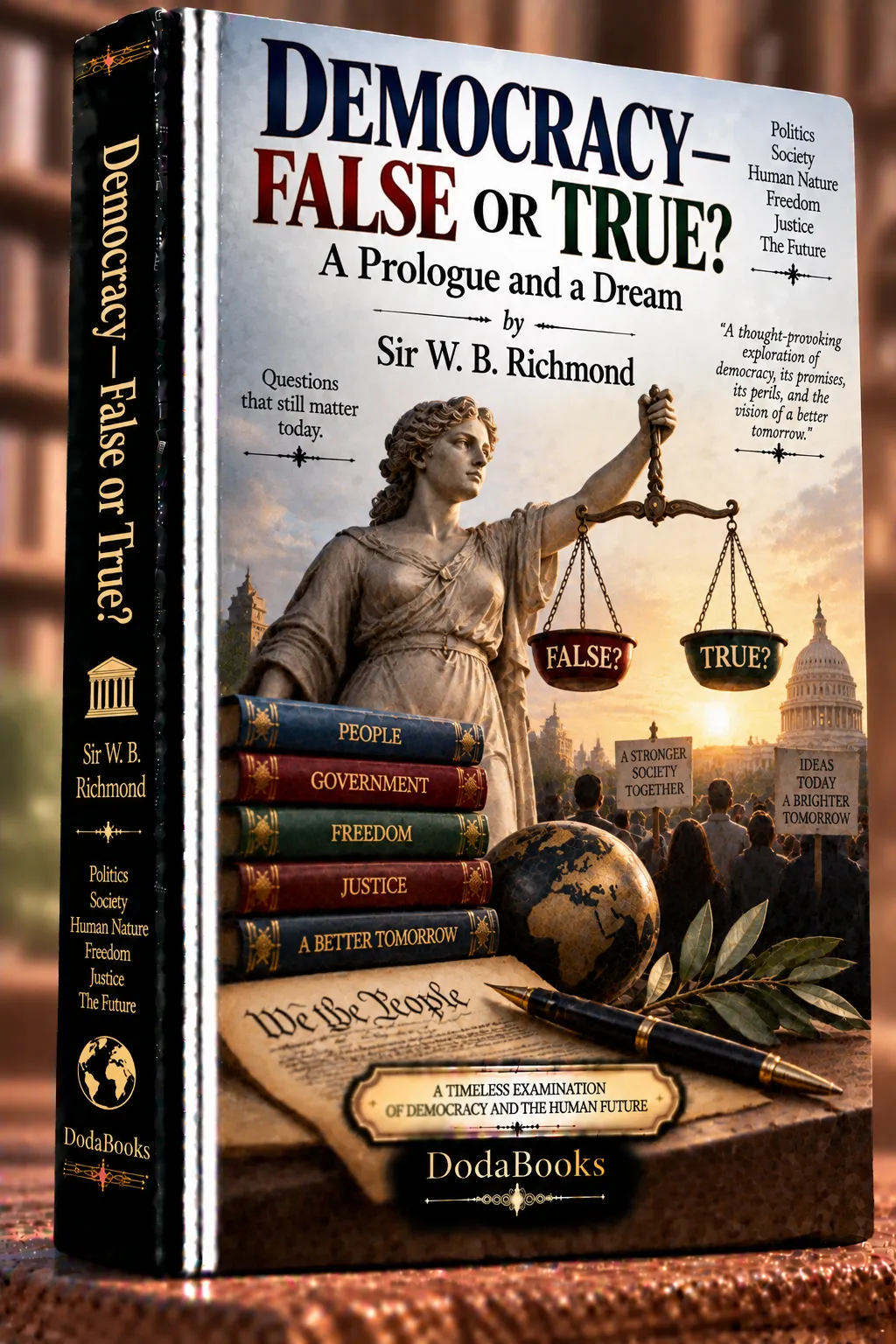
Rediscover Sir W. B. Richmond's Prophetic Critique
Read the definitive edition of Richmond's post-war masterpiece, accompanied by historical notes elucidating Victorian aesthetic socialism, guild traditions, and Edwardian labor politics.
Get Democracy False or True?The Ruskinian Lineage: Beauty as the Benchmark of Liberty
To understand Richmond’s argument, one must appreciate his deep artistic roots. Baptized with the middle name Blake in tribute to family friend William Blake, Richmond grew up immersed in the Pre-Raphaelite and Arts and Crafts movements. Under the personal mentorship of John Ruskin, he absorbed the central tenet that the moral health of any civilization is directly reflected in its architecture, its craft, and the daily creative joy of its working people.
Where contemporary political scientists defined democracy purely through procedural mechanisms—ballot boxes, universal suffrage, parliamentary coalitions—Richmond insisted that a political system can only be judged by the quality of human being it fosters. If a society boasts universal suffrage yet forces ninety percent of its populace to live in coal-choked tenements, laboring as mindless cogs in mechanized factories producing disposable commercial trash, that democracy is fundamentally fraudulent.
Richmond’s scathing prose dissects the illusion of political emancipation. He observes that voters are routinely flattered by demagogues on the hustings, only to be cast aside once the polls close. Political machines consolidate power by treating citizens not as discerning sovereign souls, but as malleable mobs swayable by cheap sensationalist slogans and yellow journalism.
The Tyranny of Partisanship and the Decline of Craft
A major theme of Democracy False or True? is Richmond’s uncompromising attack on the British party system. Richmond argued that party loyalty inevitably poisons individual conscience:
“Party spirit is the grave of personal honor and the nursery of political hypocrisy. Under its baleful spell, men vote not for what their conscience declares just, but for what their faction requires to preserve its tenure of office.”
For Richmond, true democracy demands an unyielding foundation of individual character. When politicians prioritize tribal party victories over objective national virtue, governance degenerates into legalized bribery, where public funds are dispersed to appease factional interests rather than cultivate noble public goods.
Furthermore, Richmond mourned the tragic extinction of the English craftsman. Drawing direct parallels to William Morris, Richmond argued that human dignity is inextricably tied to creative labor. Industrial mass production, by stripping workers of ownership over design and execution, alienated the laborer from the product of their hands. The false democrat promises workers higher wages while leaving them enslaved to the monotony of the assembly line; the true democrat seeks to reorganize labor so that every workman may take pride in genuine craftsmanship and beauty.
Aesthetic Political Philosophy
A rare, profound synthesis of Arts and Crafts visual philosophy and constitutional theory, analyzing statecraft through beauty and moral architecture.
First-Hand Post-WWI Perspective
Written in 1920 amidst the ruins of post-war Europe, capturing the raw disillusionment and prophetic warnings of Britain's intellectual vanguard.
Critique of Demagoguery
Strikingly prescient warnings regarding media manipulation, party machines, and the degradation of public discourse by populist rhetoric.
Annotated Historical Context
Full explanatory apparatus providing insights into Richmond's mosaic work at St. Paul's Cathedral, his Ruskinian circles, and Edwardian labor unrest.
The Visionary “Dream”: Richmond’s Commonwealth
The second half of Richmond’s work takes the form of an allegorical vision—a “Dream” of an idealized English Commonwealth. Inspired by Plato’s Republic and Thomas More’s Utopia, yet distinctly grounded in the pastoral English landscape, Richmond envisions a society that has transcended the ugly commercialism of the nineteenth century.
In this transformed realm:
- Education as Character Formation: Schools cease to be factories training obedient industrial labor; instead, they cultivate music, literature, natural history, physical grace, and civic ethics.
- Civic Splendor over Private Ostentation: Cities are stripped of billboard advertising and grime, rebuilt with stately public halls, garden commons, and dignified communal baths adorned with enduring mosaics and sculpture.
- The Aristocracy of Merit: Leadership is not purchased through campaign treasuries or inherited through aristocratic privilege, but entrusted to public servants whose lifelong virtue, scholarship, and dedication to the common good have been proven in open service.
Richmond’s vision is neither orthodox state socialism nor unbridled laissez-faire capitalism; it is an aristocratic commonwealth of virtue—a society where excellence is pursued for the common benefit of all citizens.
Why Read Richmond in the Twenty-First Century?
In an age dominated by algorithmic echo chambers, hyper-partisan gridlock, and the rapid commodification of digital culture, Richmond's centenary warnings resonate with startling clarity. He reminds us that democracy without aesthetic reverence, civic duty, and moral courage is an empty shell.
Comparing Richmond’s Thought to Contemporary Thinkers
Richmond’s critique provides a fascinating counterpoint to the political debates of his era. While John Stuart Mill championed procedural liberty and representative government, and Fabian socialists like Sidney and Beatrice Webb advocated bureaucratic state planning, Richmond insisted that institutional reforms are futile without an ethical transformation of the citizen.
| Intellectual Figure | Central Doctrine | Critique of Society | Richmond’s Alternative View |
|---|---|---|---|
| John Ruskin | Aesthetic Morality | Industrial labor degrades human dignity | Embraces Ruskin’s core ethos and applies it directly to post-WWI democratic reform |
| William Morris | Guild Socialism | Capitalist profit destroys decorative arts | Rejects revolutionary Marxism; advocates an ethical, meritocratic civic commonwealth |
| Fabian Socialists | Technocratic Planning | Free markets create unequal distribution | Warns that bureaucratic state control merely replaces capitalist bosses with political bureaucrats |
| Sir W. B. Richmond | Aesthetic Democracy | Procedural democracy masking corporate greed | Demands character education, civic beauty, and craft autonomy as prerequisites of freedom |
Richmond recognized what many modern theorists overlook: that spiritual alienation cannot be cured solely by economic redistribution or legislative fiat. If the built environment remains hideous, if culture is dumbed down to cater to the lowest common denominator, and if work is divorced from creativity, human beings will remain unfree regardless of who occupies parliament.
Deepen Your Understanding of Civic Liberty
Secure your copy of Sir W. B. Richmond's enduring masterpiece. Beautifully typeset for modern e-readers with comprehensive historical introductions and footnotes.
Get the Definitive Edition NowRestore Conscience and Beauty to Statecraft
Get the annotated edition of Sir W. B. Richmond's profound post-war inquiry into liberty, guild craftsmanship, and civic virtue.
Read the Definitive EditionThe Literary and Historical Legacy
Sir William Blake Richmond died in 1921, shortly after Democracy False or True? was published. As a result, the work stands as his final intellectual testament—a passionate farewell from one of the last towering figures of the Victorian golden age. While the subsequent decades saw the rise of totalitarian ideologies and the eventual entrenchment of managerial welfare states, Richmond’s warnings about the fragility of true democracy remain unrefuted.
Readers of modern political philosophy, environmental aesthetics, and democratic theory will find in Richmond an eloquent ally against the cynicism of contemporary politics. His call to restore beauty, craft, and conscience to the heart of the civic enterprise is a timeless challenge to every generation that values genuine freedom.
Frequently Asked Questions
Who was Sir William Blake Richmond?
Sir William Blake Richmond (1842–1921) was an eminent British artist, sculptor, and Royal Academician. He is world-renowned for designing the Byzantine glass mosaics inside St. Paul's Cathedral in London and for painting portraits of leading Victorian figures, including William Gladstone and Otto von Bismarck. He was also a passionate civic activist and environmental campaigner who founded the Coal Smoke Abatement Society.
What is the central thesis of Democracy False or True?
Richmond argues that genuine democracy is not merely a matter of elections and parliamentary procedures, but a spiritual and ethical state characterized by civic responsibility, human dignity, and creative labor. He contends that modern party politics and industrial mechanization have created a 'false democracy' that enslaves workers and degrades culture under the guise of political equality.
How did the Arts and Crafts movement influence Richmond's politics?
Mentored by John Ruskin, Richmond believed that the physical and aesthetic condition of a society reflects its spiritual health. He maintained that stripping workers of joy in craft through repetitive industrial labor destroys the foundation of citizenship. For Richmond, beauty in public architecture and dignity in work were indispensable requirements for true liberty.
What makes DodaBooks' annotated edition of this book essential?
The DodaBooks annotated edition provides complete historical context, explaining Edwardian political crises, post-WWI labor disputes, and the artistic circles of St. Paul's Cathedral. It includes biographical footnotes, definitions of archaic Victorian terminology, and an analytical introduction connecting Richmond's ideas to twenty-first-century democratic debates.
Where can I purchase the complete annotated ebook?
You can purchase and immediately download the meticulously curated digital edition directly from DodaBooks at https://dodabooks.com/ebook/democracy-false-or-true-a-prologue-and-a-dream-by-sir-w-b-richmond/.