Daughters of Nijo
Onoto Watanna’s Exquisite Meiji Romance of Switched Destinies, Royal Intrigue, and Female Passion in Kyoto and Tokyo
Published in 1904 at the pinnacle of international fascination with Meiji-era Japan, Daughters of Nijo: A Romance of Japan stands as one of the most vibrant, intricately plotted works by Onoto Watanna—the pen name of Winnifred Eaton (1875–1954). Eaton, the first published Asian-American novelist, broke unprecedented ground in Western publishing by crafting deeply immersive, romantic narratives set within the inner chambers of Japan’s aristocracy.
While many of her contemporaries engaged in superficial Orientalist exoticism, Watanna imbued her stories with psychological nuance, sharp social critique, and an undeniable narrative vigor. In Daughters of Nijo, she constructs a daring tale of identity, sacrifice, and romantic rebellion that subverts the rigid hierarchical conventions of the Tokugawa legacy and the modernizing Meiji court.
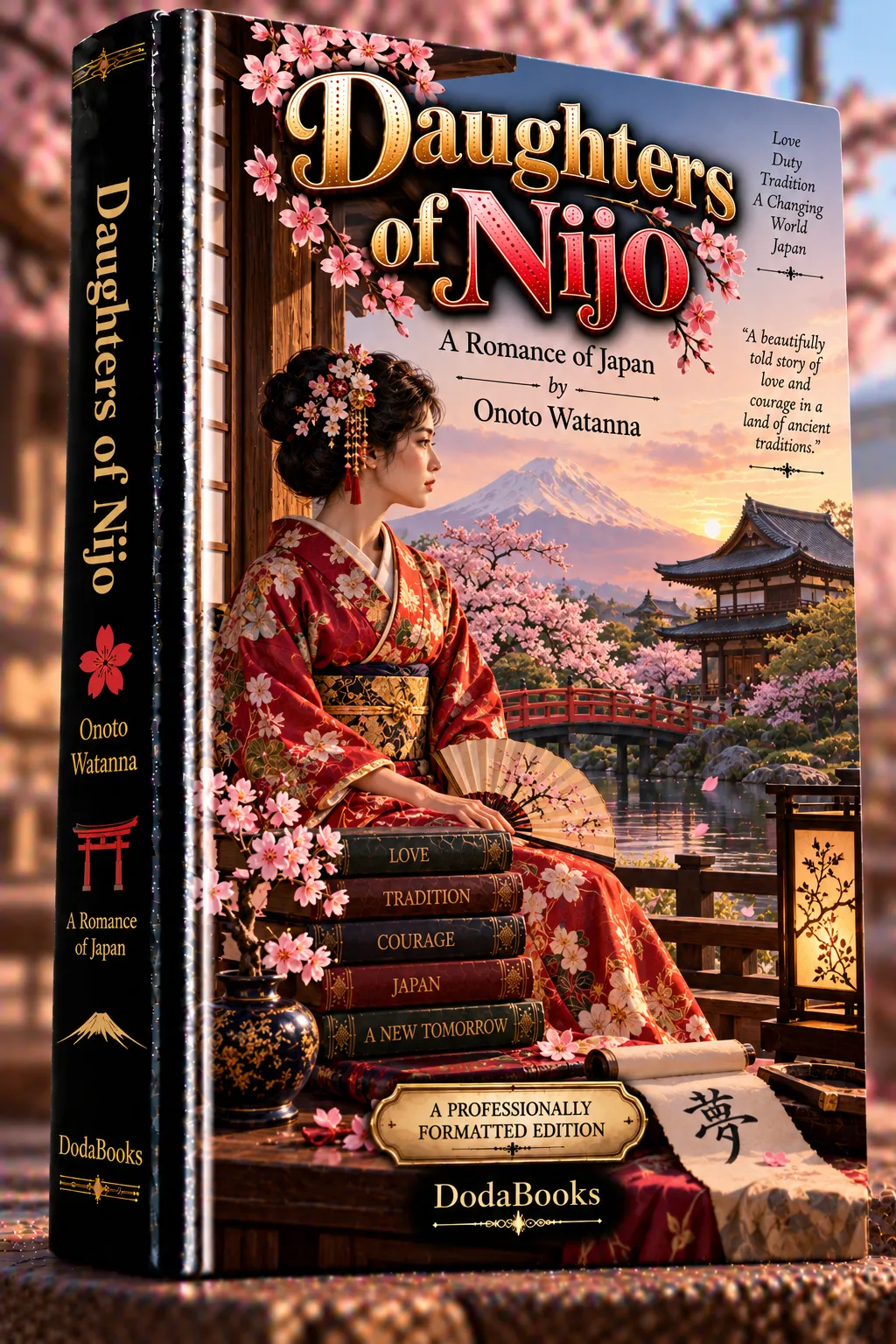
Immerse Yourself in the Splendor of Imperial Kyoto
Discover Onoto Watanna's celebrated novel featuring comprehensive annotations explaining Meiji political modernization, court etiquette, and Eaton's landmark literary legacy.
Get Daughters of NijoThe Double Bind: Sawa and Sado-ko
At the heart of Daughters of Nijo lies a classic yet brilliantly executed device: the secret double. Two young women, identical in appearance yet separated by vast social chasms, find their lives intertwined in ways that threaten the stability of the imperial court:
- Princess Sado-ko: Raised in the opulent, cloistered seclusion of the Nijo palace in Kyoto, betrothed from childhood to Prince Junzo—an ambitious nobleman of the imperial house. Despite her luxurious surroundings, Sado-ko suffocates under court etiquette and longs for personal freedom and genuine love.
- Sawa: A humble maiden living on the outskirts of Kyoto, the unacknowledged daughter of the late Prince of Nijo by a geisha. Joyous, spirited, and deeply connected to nature, Sawa loves a modest young painter named Noriteru, unaware of her royal blood.
When the two women encounter one another and discover their mirror resemblance, their meeting sets in motion an audacious exchange of roles. Sawa enters the glittering world of the court to fulfill her mother’s unacknowledged legacy, while Sado-ko seeks refuge in the simplicity of provincial anonymity.
Watanna uses this doubling motif not merely for comic mistaken identity, but as a poignant exploration of social caste, gender subjugation, and the arbitrary nature of aristocratic privilege. Through their reversed fortunes, both women discover that true nobility resides not in court decrees or hereditary titles, but in the courage to choose one’s own path.
Meiji Modernization and the Imperial Transition
Written against the backdrop of the Russo-Japanese War (1904–1905), Daughters of Nijo captures Japan at a pivotal historical crossroads. The transition from ancient Kyoto (the thousand-year spiritual and imperial capital) to modern Tokyo (the bustling political center of Westernizing technology and military power) mirrors the internal dilemmas faced by the characters.
Watanna paints Kyoto with luminous nostalgia—its bamboo groves, cherry blossom gardens, ancient stone lanterns, and Buddhist temples—while depicting Tokyo as an energetic metropolis of modern politics, European-style dress, and swift social change. The tension between tradition (giri, duty and obligation) and human emotion (ninjo, individual desire) forms the emotional core of the novel, echoing the central dramatic conflict of classical Japanese theater such as Kabuki and Bunraku.
Asian-American Literary Heritage
A central milestone in early Asian-American letters by Winnifred Eaton, the first author of Asian descent to achieve mainstream bestseller status in North America.
Rich Meiji Cultural Texture
Evocative descriptions of court costume, tea ceremonies, temple festivals, and imperial etiquette grounded in the transformative transition from Kyoto to Tokyo.
Subversive Female Agency
Protagonists who actively defy arranged marriages, court hierarchies, and patriarchal mandates to carve out their own artistic and domestic destinies.
Historical & Literary Annotations
Detailed notes explaining Japanese terminology, court ranks, and Eaton's complex biographical strategies within the North American publishing industry.
The Enigma of Onoto Watanna: Winnifred Eaton’s Masquerade
One cannot fully appreciate Daughters of Nijo without understanding the remarkable biography of its author. Born Winnifred Eaton in Montreal to an English merchant father and a Chinese mother, she and her sister Edith Eaton (who wrote under the pen name Sui Sin Far) navigated an era dominated by intense anti-Asian sentiment and the Chinese Exclusion Act.
While Edith chose to write realistic, compassionate accounts of Chinese immigrant struggles in North American Chinatowns, Winnifred adopted a Japanese persona. Adopting the Japanese-sounding pseudonym “Onoto Watanna,” wearing kimonos for author photographs, and presenting herself as the daughter of a Japanese noblewoman, she leveraged Western fascination with Japan following the 1894 Sino-Japanese War to achieve extraordinary literary and financial success.
“Winnifred Eaton’s adoption of the Onoto Watanna persona was not merely commercial calculation; it was a daring performance of racial passing in reverse—a strategic masquerade that allowed an author of Chinese descent to claim creative space and articulate female autonomy on the world stage.”
Seen through this lens, the themes of disguise, false pedigree, and switched identities in Daughters of Nijo take on profound autobiographical resonance. Sawa’s struggle to claim her rightful place in the Nijo palace while masking her geisha origins reflects Eaton’s own complex negotiations with racial identity, cultural performance, and social survival.
Why Daughters of Nijo Transcends Conventional Romance
Beyond its lyrical prose and romantic charm, the novel provides a masterclass in narrative tension, pitting hereditary court obligations against the sacred claims of the individual heart. It stands as an enduring monument to early multicultural literature.
Experience the Full Annotated Work
Read the definitive edition of Daughters of Nijo formatted with exquisite digital typography and comprehensive scholarly footnotes.
Get Daughters of Nijo on DodaBooksStylistic Virtuosity and Narrative Rhythm
Watanna’s prose style in Daughters of Nijo is lush, sensory, and melodic. She captures the delicate gradations of Japanese seasonal poetry, incorporating natural imagery—the scattering of autumn leaves, the drifting petals of cherry blossoms, the cold mist rising from the Kamogawa river—to foreshadow emotional transformations.
Her dialogue balances stylized court formality with flashes of sharp wit, particularly when Sawa’s unvarnished honesty pierces the hypocrisies of aristocratic sycophants. Unlike Western romances of the era that treated Asian characters as voiceless decorative backdrops, Watanna grants her Japanese protagonists rich interiority, complex moral motivations, and autonomous agency.
Experience the Definitive Annotated Edition
Read Onoto Watanna's enchanting novel with complete scholarly notes, cultural glossaries, and historical commentary. Download immediately on your favorite e-reader.
Get the Edition on DodaBooksCritical Reception and Modern Recovery
At the time of its release in 1904, Daughters of Nijo was widely praised by Western reviewers for its charm, vivid atmosphere, and delicate sentiment. However, during the mid-twentieth century, Eaton’s work fell into obscurity, occasionally dismissed by early Asian-American literary scholars for catering to popular tastes.
In recent decades, feminist and post-colonial literary theorists have radically reassessed Onoto Watanna. Scholars now recognize that her novels, far from being simple romances, deploy parody, masquerade, and double-voiced discourse to critique both Western imperial arrogance and Asian patriarchal hierarchies. Daughters of Nijo is now recognized as an indispensable text in American ethnic literature, women’s writing, and the global history of the novel.
Frequently Asked Questions
Who was the real author behind Onoto Watanna?
Onoto Watanna was the pen name of Winnifred Eaton (1875–1954), a Chinese-British-Canadian novelist and journalist. She was the younger sister of author Edith Eaton (Sui Sin Far). By adopting a Japanese pen name, Winnifred became the first published Asian-American novelist and achieved widespread commercial success in North America.
What is the central plot of Daughters of Nijo?
The novel follows Princess Sado-ko of Kyoto, who is trapped in an arranged royal betrothal, and Sawa, an illegitimate daughter of the same noble family living in obscurity. When the two look-alikes meet, they switch roles, leading to romantic entanglements, court intrigue, and personal growth as each woman seeks true love and self-determination.
When and where is the novel set?
The story is set in Japan during the late Meiji era (around the turn of the twentieth century). The narrative shifts between the ancient, tradition-bound imperial capital of Kyoto and the modern, fast-paced political capital of Tokyo.
What makes DodaBooks' edition of Daughters of Nijo unique?
The DodaBooks annotated edition features extensive footnotes explaining Meiji-era court ranks, social customs, and Japanese cultural concepts such as 'giri' (duty) and 'ninjo' (human affection). It also includes a critical biographical introduction analyzing Winnifred Eaton's role in American literary history.
Where can I get the complete digital book?
You can purchase and instantly download the fully annotated ebook directly from DodaBooks at https://dodabooks.com/ebook/daughters-of-nijo-a-romance-of-japan-by-onoto-watanna/.