Crime and Punishment Summary by Part & Chapter: Complete Plot Breakdown
Published serially in the literary journal The Russian Messenger in twelve monthly installments throughout 1866, Fyodor Dostoevsky’s Crime and Punishment (Prestupleniye i Nakazaniye) is the defining psychological masterpiece of world literature. Conceived during a period of agonizing personal debt and written concurrently with his novella The Gambler, Dostoevsky transformed what began as a sensational tabloid crime story into an epochal philosophical exploration of guilt, moral transgression, and spiritual resurrection.
Set amidst the sweltering, squalid haymarkets, taverns, and cramped garrets of 1860s St. Petersburg during a suffocating July heatwave, the novel follows Rodion Romanovich Raskolnikov, an impoverished, brilliant former law student. Consumed by an intellectual theory that divides humanity into ordinary cattle and “extraordinary” men who possess the moral right to overstep legal laws for higher purposes, Raskolnikov brutally murders an elderly pawnbroker with an axe.
Yet Crime and Punishment is not a whodunit—the murder occurs in the opening chapters. Rather, it is a profound psychological “why-dunit” and “how-dunit”, chronicling Raskolnikov’s immediate descent into feverish delirium, his cat-and-mouse intellectual duel with the forensic investigator Porfiry Petrovich, and his tortuous path toward moral confession guided by the self-sacrificing faith of Sonya Marmeladova.
Whether you are studying Dostoevsky for a literature course or conquering this classic for personal enrichment, this comprehensive summary breaks down all six parts and the Siberian Epilogue in rich detail.
⚡ Crime and Punishment: Masterwork Overview
- Author: Fyodor Dostoevsky (1821–1881)
- Publication Date: Serialized January – December 1866 in The Russian Messenger; published as a revised two-volume novel in 1867
- Structure: Six Parts (41 chapters total) plus a two-part Siberian Epilogue
- Setting: St. Petersburg, Russia (specifically the Sennaya Square / Haymarket district, the Catherine Canal, and police bureaus) in July 1865, concluding in a Siberian penal fortress on the Irtysh River (1866–1867)
- Core Conflict: Raskolnikov commits a double murder to prove his "Extraordinary Man" theory, but his innate human conscience shatters his intellectual rationale, driving him into fever, isolation, and eventual confession
- Key Themes: The fallacy of rationalist utilitarianism and nihilism; the psychological torture of moral guilt; Christian redemption through suffering; and the resurrection of the soul
📜 Structural Architecture: The Six-Part Movement
Dostoevsky balances the novel with classical symmetry: Part 1 details the Crime, while Parts 2 through 6 chronicle the Punishment (which is primarily psychological rather than legal), culminating in the Epilogue’s spiritual rebirth.
+--------------------------------------------------------------------------------------------------------------------+
|                                    CRIME AND PUNISHMENT FORMAL TIMELINE                                            |
+--------+----------------------+-----------------------------+------------------------------------------------------+
| PART   | SETTING & CHRONOLOGY | CHAPTERS                    | KEY DRAMATIC & PSYCHOLOGICAL MILESTONES              |
+--------+----------------------+-----------------------------+------------------------------------------------------+
| Part 1 | St. Petersburg       | Chapters 1–7                | Raskolnikov's poverty; meeting Marmeladov; letter   |
|        | (Days 1–3)           |                             | from mother; the mare-beating dream; the axe murders |
+--------+----------------------+-----------------------------+------------------------------------------------------+
| Part 2 | St. Petersburg       | Chapters 1–7                | Feverish delirium; hiding loot beneath a stone;      |
|        | (Days 4–6)           |                             | police summons; Razumikhin's care; Marmeladov dies  |
+--------+----------------------+-----------------------------+------------------------------------------------------+
| Part 3 | St. Petersburg       | Chapters 1–6                | Arrival of Dunya & Pulkheria; Luzhin's arrogance;   |
|        | (Days 7–8)           |                             | Porfiry Petrovich debates the "Extraordinary Man" art|
+--------+----------------------+-----------------------------+------------------------------------------------------+
| Part 4 | St. Petersburg       | Chapters 1–6                | Svidrigailov arrives; Raskolnikov visits Sonya;      |
|        | (Days 8–9)           |                             | reading the raising of Lazarus; Porfiry's trap     |
+--------+----------------------+-----------------------------+------------------------------------------------------+
| Part 5 | St. Petersburg       | Chapters 1–5                | Katerina's memorial feast; Luzhin frames Sonya;    |
|        | (Day 10)             |                             | Raskolnikov unmasks Luzhin; confession to Sonya      |
+--------+----------------------+-----------------------------+------------------------------------------------------+
| Part 6 | St. Petersburg       | Chapters 1–8                | Svidrigailov's dark proposals & suicide; Porfiry's|
|        | (Days 11–14)         |                             | final plea; Raskolnikov confesses at police bureau   |
+--------+----------------------+-----------------------------+------------------------------------------------------+
| Epilogue| Siberia (1866–1867)  | Sections 1–2                | Penal servitude on the Irtysh River; illness; Sonya's|
|        |                      |                             | love; the New Testament; dawn of resurrection        |
+--------+----------------------+-----------------------------+------------------------------------------------------+
🪓 Part 1: The Theory, the Despair, and the Axe (Chapters 1–7)
The novel opens on an exceptionally hot evening in early July in St. Petersburg. Rodion Romanovich Raskolnikov, a destitute twenty-three-year-old former university student, steps out of his suffocating, closet-like garret in Stolyarny Lane. He is handsome, proud, and intensely brooding, dressed in filthy rags and paralyzed by severe nervous hypochondria.
He makes a “trial rehearsal” visit to Alyona Ivanovna, an elderly, repulsive pawnbroker with sharp, distrustful eyes. He pawns an old silver watch for a few kopecks, carefully memorizing the layout of her apartment, the locks on her doors, and the keys hanging at her waist.
The Tavern and Marmeladov’s Tragedy (Chapter 2)
Overwhelmed by nausea and self-disgust, Raskolnikov retreats into a filthy underground tavern. There he meets Semyon Zakharovich Marmeladov, a dismissed civil servant ruined by alcoholism. In a famous, heart-wrenching monologue, Marmeladov confesses his degradation: his tubercular, high-born wife Katerina Ivanovna is spitting blood and beating her starving children, while his gentle eighteen-year-old daughter Sonya (Sofya Semyonovna) has been forced to obtain a “yellow ticket” (the official registration for legal prostitutes) to buy bread for the family.
Raskolnikov escorts the drunken Marmeladov home to his squalid room, secretly leaves all his remaining copper kopecks on the windowsill, and leaves in philosophical agitation.
The Letter from Home (Chapters 3–4)
The next morning, Raskolnikov receives a letter from his devoted mother, Pulkheria Alexandrovna. The letter delivers crushing news:
- His beloved, fiercely moral sister Avdotya Romanovna (Dunya) has endured cruel slander while working as a governess in the rural home of the wealthy, predatory Arkady Ivanovich Svidrigailov.
- To rescue her family from destitution and pay for Rodion’s university studies, Dunya has accepted a marriage proposal from Pyotr Petrovich Luzhin, a vain, wealthy, middle-aged court counselor who explicitly desires a bride who has suffered poverty so that she will be perpetually subservient to him.
Raskolnikov is infuriated by Dunya’s sacrificial prostitution: “Dunya’s marriage is the exact same thing as Sonya Marmeladova’s yellow ticket! I will not allow this sacrifice!”
The Dream of the Beaten Mare and the Murders (Chapters 5–7)
Exhausted, Raskolnikov collapses in the grass on Vasilyevsky Island and experiences a terrifying nightmare: as a young boy, he watches a drunken peasant named Mikolka brutally beat an old, frail mare to death with an iron crowbar because the beast cannot pull an impossibly heavy cart. Raskolnikov awakens drenched in sweat, horrified by the bloodlust in his soul: “Lord! Can it be that I will truly take an axe and smash her skull?”
Yet as he walks through the Haymarket, he overhears a conversation between German traders and Alyona Ivanovna’s gentle, half-witted sister, Lizaveta. Lizaveta will be away from the apartment tomorrow at exactly 7:00 PM. The pawnbroker will be alone!
Believing that fate has commanded him, Raskolnikov steals an axe from his building’s caretaker lodge, sews a cloth loop inside his coat, and arrives at the pawnbroker’s door. When Alyona turns to untie a fake pledge parcel, Raskolnikov draws the axe and buries the blunt end into her skull, killing her instantly. He steals her keys and rummages through a trunk for gold jewelry.
Suddenly, Lizaveta unexpectedly walks into the room. Paralyzed with terror, Raskolnikov strikes Lizaveta with the sharp blade of the axe, killing her as well. Washing the blood from his boots in a pail of water, he narrowly escapes when two clients ring the doorbell, slipping down the staircase unnoticed as the painter tradesmen leave.
🩸 Part 2: Delirium, the Stone, and the First Panic (Chapters 1–7)
Raskolnikov awakens the next morning in a feverish, terrified stupor. He finds dried blood on his frayed trousers and frantic scraps of fringed cloth.
The Police Summons and Hiding the Loot
A summons arrives ordering him to report to the local police precinct. Raskolnikov believes he is already caught. However, the summons is merely a formal demand by his landlady to pay back rent. While at the station, he overhears the police clerks gossiping about the double murder of the pawnbroker. Overcome by terror and fever, Raskolnikov faints on the floor, instantly drawing the suspicion of the assistant police inspector, Ilya Petrovich (“Gunpowder”).
Realizing he cannot keep the stolen jewelry in his garret, Raskolnikov wanders through St. Petersburg. He finds an enclosed, secluded courtyard near the Voznesensky Prospect, rolls aside a heavy stone slab, buries the gold items and purse beneath the earth, and drops the stone back in place. He never looks inside the purse to see how much money he stole.
The Devotion of Razumikhin
Raskolnikov’s physical and mental collapse deepens into a multi-day delirium. When he awakens, he finds his loyal university friend, Dmitri Prokofyich Razumikhin, nursing him. Razumikhin is vigorous, honest, and practical: he has bought Raskolnikov new clothes with money sent by his mother and summoned an eccentric young doctor, Zosimov.
While Zosimov discusses the psychology of the murder, Pyotr Petrovich Luzhin enters the room. Luzhin pontificates on Western economic rationalism (arguing that self-interest and capital accumulation are the only true moral duties). Disgusted by Luzhin’s arrogant condescension toward Dunya and his mother, Raskolnikov verbally attacks him and throws him out of the room.
The Death of Marmeladov (Chapter 7)
Wandering the streets in a semi-conscious trance, Raskolnikov witnesses a commotion: an aristocratic carriage has run over the drunken Marmeladov. Raskolnikov carries the dying man home to Katerina Ivanovna’s apartment.
Marmeladov dies in the arms of his weeping daughter Sonya, who arrives in her yellow-ticket attire. Raskolnikov hands his mother’s entire emergency remittance (twenty-five rubles) to the destitute widow to pay for funeral expenses. As he leaves, Sonya chases him down the stairs to thank him; Raskolnikov asks her to pray for him.
Returning to his garret, Raskolnikov faints on his threshold: his mother Pulkheria and sister Dunya are waiting for him inside.
🧠 Part 3: The Intellectual Duel Begins (Chapters 1–6)
In Part 3, the psychological net begins to close around Raskolnikov. Although physically reunited with his family, Raskolnikov behaves with erratic hostility, forbidding Dunya from marrying Luzhin: “It is either Luzhin or me! If you marry him, you cease to be my sister!”
Razumikhin, instantly enchanted by Dunya’s nobility and beauty, takes over the management of the family, acting as their protector.
The “Extraordinary Man” Theory Unpacked (Chapter 5)
Desperate to recover the silver watch he pawned to Alyona Ivanovna before the murder, Raskolnikov visits the lead investigating magistrate, Porfiry Petrovich, accompanied by Razumikhin.
Porfiry Petrovich is a short, round, thirty-five-year-old bachelor with intelligent, liquid eyes and a deceptively jovial manner. Instead of conducting a standard interrogation, Porfiry pivots the conversation to an article Raskolnikov published six months earlier in Periodical Discourse, entitled “On Crime.”
Porfiry summarizes Raskolnikov’s radical thesis:
- Humanity is fundamentally divided into two categories: “Ordinary” (the material) and “Extraordinary” (men of genius).
- The ordinary masses are conservative, obedient, and exist merely to reproduce their kind under established moral laws.
- The extraordinary individuals (like Lycurgus, Solon, Caesar, and Napoleon) are innovators who destroy the existing order. Because their work advances humanity, they possess the inherent moral right to overstep laws, shed blood, and execute obstacles without being considered common criminals.
+-----------------------------------------------------------------------------------------------+
|                       RASKOLNIKOV'S "EXTRAORDINARY MAN" THEORY ANALYZED                      |
+--------------------------+---------------------------------+----------------------------------+
| CATEGORY                 | NATURE OF THE INDIVIDUAL        | RELATION TO MORAL LAW            |
+--------------------------+---------------------------------+----------------------------------+
| The "Ordinary" (Louse)   | The vast majority; obedient,    | Bound strictly by moral codes,   |
|                          | conservative, reproductive      | civil laws, and social conscience|
+--------------------------+---------------------------------+----------------------------------+
| The "Extraordinary"      | Rare innovators & leaders       | Transcends moral law; possess    |
| (Napoleon / Caesar)      | (one in ten thousand)           | the right to eliminate obstacles |
+--------------------------+---------------------------------+----------------------------------+
Porfiry playfully, yet with terrifying forensic sharpness, asks Raskolnikov:
“Tell me, Rodion Romanovich… when you were writing your article, surely you didn’t consider yourself one of those extraordinary people? Didn’t you think that you, too, might step over an old woman to benefit mankind?”
Raskolnikov turns pale, realizing that Porfiry already suspects him. As Raskolnikov returns home, a mysterious tradesman stops him on the street, stares into his eyes, and whispers: “Murderer!” before vanishing into the crowd.
🕊️ Part 4: Svidrigailov, Sonya, and the Raising of Lazarus (Chapters 1–6)
Part 4 introduces Raskolnikov’s two spiritual poles: the abyss of nihilism (Svidrigailov) and the beacon of grace (Sonya).
The Shadow: Arkady Ivanovich Svidrigailov
While Raskolnikov rests in his room, Svidrigailov quietly appears at his bedside. Svidrigailov is a wealthy, dissolute fifty-year-old sensualist whose wife Marfa Petrovna recently died under suspicious circumstances. Svidrigailov admits that he has crossed every moral boundary, has driven servants to suicide, and experiences terrifying, banal hallucinations of eternity (which he imagines not as a great void, but as “a dusty bathhouse in the countryside, with spiders in every corner”).
Svidrigailov offers Raskolnikov ten thousand rubles to help Dunya break off her engagement with Luzhin, observing that he and Raskolnikov share a secret spiritual kinship: “We are birds of a feather, you and I!”
The Light: Reading the Gospel with Sonya (Chapter 4)
Raskolnikov visits Sonya in her miserable room overlooking the canal. He is baffled by how this timid, degraded young woman can maintain her sanity while working as a prostitute.
He discovers that her sanity is sustained entirely by radical Christian faith. Falling to his knees, Raskolnikov kisses her muddy boots. When she recoils in horror, he proclaims:
“I did not bow down to you; I bowed down to all of suffering humanity.”
Seeing a dog-eared New Testament on her table (given to her by Lizaveta, the woman he murdered!), Raskolnikov commands Sonya to read him the story of the Raising of Lazarus from the Gospel of John. Sonya reads with trembling, radiant conviction:
“Jesus said unto her: I am the resurrection and the life: he that believeth in me, though he were dead, yet shall he live…”
Raskolnikov looks at her: the murderer of the innocent and the sacrificial harlot, brought together over the eternal book. He promises Sonya that tomorrow, he will tell her who killed her friend Lizaveta.
Porfiry’s Psychological Trap (Chapter 5)
The next day, Raskolnikov visits Porfiry Petrovich’s office. Porfiry admits that he has zero physical evidence, but explains his psychological trap:
“If I arrest a man too soon, I give him a defined position. But if I leave him alone to pace the streets, he will walk into my open mouth of his own accord! He will circle around me like a moth around a candle flame!”
Just as Raskolnikov is about to lose his composure and scream, a surprise occurs: Nikolay, a house painter who was working in the building during the murder, bursts into the room and falsely confesses to the crime! Porfiry is forced to release Raskolnikov for the moment.
💥 Part 5: The Memorial Scandal and the Confession (Chapters 1–5)
Luzhin’s Malicious Conspiracy
At the memorial funeral feast held by Katerina Ivanovna for Marmeladov, chaos erupts. Katerina, consumed by consumption and pride, insults the German landlady Amalia Ivanovna.
Suddenly, Luzhin bursts into the room, accusing Sonya of stealing a one-hundred-ruble banknote from his desk. Sonya weeps, denying the theft, but Luzhin demands that the police be summoned.
Before Sonya can be arrested, Luzhin’s roommate, Andrey Semyonovich Lebezyatnikov, steps forward: he witnessed Luzhin secretly slip the banknote into Sonya’s pocket! Raskolnikov steps forward to explain Luzhin’s motive: Luzhin wanted to ruin Sonya so that Dunya and her mother would break ties with Raskolnikov. Exposed and humiliated, Luzhin flees in disgrace.
The Confession to Sonya (Chapter 4)
Following the scandal, Raskolnikov rushes to Sonya’s room. Locking the door, he asks her to guess who killed the pawnbroker and Lizaveta. Sonya gazes into his tormented face and realizes the truth:
“What have you done, what have you done to yourself!” she cries, throwing her arms around his neck and weeping with infinite pity.
Raskolnikov tries to explain his rational motives:
- “I wanted to become a Napoleon… I wanted to see if I had the right to step over blood.”
- “I didn’t kill a human being; I killed a principle! I killed a louse, a useless, venomous old parasite!”
Sonya looks at him with horror: “A human being is not a louse!”
She tells him the only path to salvation:
“Go at once, this very minute! Stand at the crossroads, bow down, kiss the earth which you have defiled, and say aloud to the whole world: I have murdered! Then God will send you life again.”
Sonya places her wooden baptismal cross around his neck, promising that she will follow him to Siberia and stay with him forever.
🌪️ Part 6: Svidrigailov’s End and the Final Surrender (Chapters 1–8)
In Part 6, the external world collapses around Raskolnikov:
- Katerina Ivanovna goes insane, dragging her children into the streets to dance for money, collapses from a hemorrhage, and dies. Svidrigailov uses his wealth to pay for her funeral and place the orphan children in reputable foster homes.
- Porfiry Petrovich visits Raskolnikov’s garret: Porfiry reveals that he knows Nikolay’s confession was false. He urges Raskolnikov to confess voluntarily: “I give you two days. Confess, and the court will show mercy. Life is waiting for you!”
Svidrigailov’s Suicide (Chapters 5–6)
Svidrigailov lures Dunya to his apartment, locks the door, and reveals that he overheard Raskolnikov’s confession through the wall. He threatens to expose Rodion unless Dunya surrenders to his sexual advances.
Dunya draws a revolver and fires twice, grazing Svidrigailov’s scalp, but refuses to shoot again. Realizing that Dunya will never love him, Svidrigailov unlocks the door and lets her go.
That night, amidst a howling thunderstorm, Svidrigailov wanders through the slums of St. Petersburg, haunted by nightmares of innocence corrupted. At dawn, he walks up to a tower station on the Peterburgsky Prospect, looks into the eyes of a bewildered Jewish watchman, announces that he is “going to America,” and shoots himself in the right temple.
The Confession at the Police Station (Chapter 8)
Saying farewell to his mother and sister, Raskolnikov goes to the Sennaya Square. Remembering Sonya’s words, he kneels in the muddy marketplace and kisses the filthy ground. The surrounding peasants mock him as a drunkard.
He walks up the stairs of the police bureau. When he hears that Svidrigailov has committed suicide, his nerve fails and he turns to leave.
On the threshold of the building, he catches sight of Sonya, standing in the rain, looking at him with desperate, sorrowful love. Raskolnikov turns back, enters the office of Ilya Petrovich, and speaks clearly:
“It was I who killed the old pawnbroker woman and her sister Lizaveta with an axe, and robbed them.”
🌅 Epilogue: Siberia and the Resurrection of Lazarus
Raskolnikov is sentenced to eight years of penal servitude in Siberia. His mother dies of grief and brain fever, having guessed her son’s terrible fate. Dunya marries Razumikhin in St. Petersburg.
Sonya moves to the prison town on the Irtysh River, supporting herself by sewing and visiting Raskolnikov weekly. Yet for his first eighteen months in the labor camp, Raskolnikov remains unrepentant. He does not regret the murder; he only regrets his own weakness for having confessed: “My conscience finds no especially terrible guilt in my past… My only sin was that I was a coward!” The peasant convicts despise him as an atheist gentleman and try to kill him during a church service.
The Awakening on the Riverbank
During Easter week, Raskolnikov falls dangerously ill. From his hospital cot, he has a terrifying apocalyptic dream of microscopic intellectual microbes spreading across the earth, driving men into mutual destruction because each believes himself to possess the absolute truth.
Recovering, Raskolnikov sits on a log beside the vast Siberian river. Sonya approaches and sits beside him.
Suddenly, something snaps inside his soul. Weeping uncontrollably, Raskolnikov throws himself at Sonya’s feet and embraces her knees. Sonya gazes at him and realizes: he loves her.
That night in his barracks, Raskolnikov takes out the New Testament that Sonya gave him and places it beneath his pillow:
“Seven years, only seven years! At the beginning of their happiness, at certain moments, they were both ready to look at those seven years as if they were seven days… But that is the beginning of a new story—the story of the gradual renewal of a man, the story of his gradual regeneration, of his passing from one world into another…”
❓ Frequently Asked Questions
Why did Raskolnikov murder the pawnbroker?
Raskolnikov had two distinct motives: an intellectual one and a practical one. Practically, he was destitute, facing eviction, and wanted money to support his sister and finish his studies. Intellectually, he wanted to test his “Extraordinary Man” theory—to prove whether he was a daring visionary like Napoleon who could transcend common moral laws, or merely a submissive “louse.”
Why was Lizaveta murdered if she was innocent?
Lizaveta’s murder was unintentional. She returned to the apartment unexpectedly while Raskolnikov was rummaging through the pawnbroker’s chest. Her death shatters Raskolnikov’s moral justification: while he rationalized killing the “parasitic” pawnbroker, he killed the gentle, innocent Lizaveta purely out of panic and self-preservation.
What is the symbolic significance of the Raising of Lazarus?
The story of Lazarus (John 11) is the central Christian allegory of the novel. Just as Lazarus had been dead in the tomb for four days before Jesus commanded him to rise, Raskolnikov’s soul is dead in the tomb of nihilism and pride. Through Sonya’s love and faith, Raskolnikov undergoes spiritual resurrection.
How does Porfiry Petrovich catch Raskolnikov without physical evidence?
Porfiry uses psychological profiling. He knows Raskolnikov is proud, nervous, and consumed by feverish guilt. Instead of arresting him, Porfiry plays with him psychologically, knowing that an intellectual killer cannot bear the silence of being suspected and will eventually confess voluntarily to relieve his mental torment.
What does Svidrigailov represent in the novel?
Svidrigailov represents Raskolnikov’s dark double. Svidrigailov has successfully lived by the “extraordinary man” philosophy, completely discarding moral law for sensual pleasure. Yet his life ends in absolute spiritual emptiness, disgust, and suicide, showing Raskolnikov the inevitable destination of nihilism.
📚 Related Articles
Exploring classic philosophical novels and psychological masterpieces? Check out our The Moonstone Summary Guide or our The Count of Monte Cristo Summary Guide.
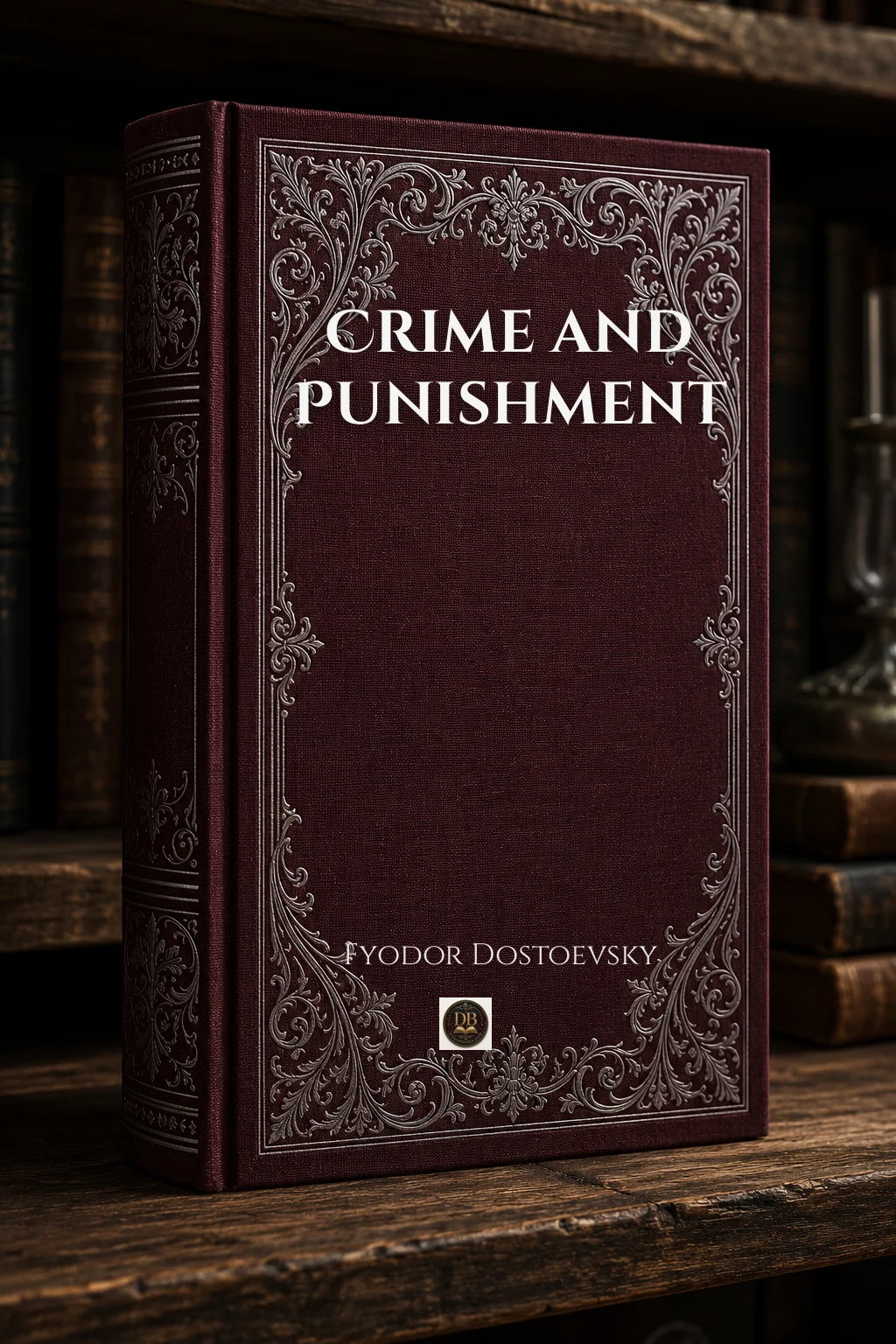
🪓 Experience Dostoevsky’s Masterpiece in Full Splendor
Read the novel that defined psychological fiction in an authoritative, distraction-free edition:
- ✅ Complete, unabridged 41-chapter text across all six parts and the Siberian Epilogue
- 🏛️ St. Petersburg geography & 1860s Russian context decoded — understand the intellectual currents
- 🗂️ Passage-specific annotation cards detailing Russian naming customs and philosophical debates
- 🔒 DRM-free EPUB format — readable on any Kindle, Kobo, iPad, or mobile device
- 📥 Instant digital download delivered directly after checkout