Cranford Summary by Chapter: Complete 16-Chapter Victorian Guide
First serialized between December 1851 and May 1853 in Charles Dickens’s literary weekly Household Words, Elizabeth Gaskell’s Cranford is celebrated as one of the most delightful, humane, and quietly subversive portraits of provincial English society in Victorian literature. Based closely on Knutsford, the Cheshire market town where Gaskell was raised after her mother’s death, the work rejects the conventional, melodrama-heavy plots of 19th-century fiction in favor of an episodic, character-driven chronicle of an “Amazonian” village ruled almost exclusively by fiercely respectable spinsters and widows.
Narrated with gentle humor and acute social insight by Mary Smith, a young woman who divides her time between the bustling industrial city of Drumble (a thinly disguised Manchester) and the timeless provincial lanes of Cranford, the novel centers on the gentle, self-effacing Miss Matty Jenkyns. Alongside her formidable older sister Miss Deborah, the sharp-tongued Miss Pole, the romantic Miss Jessie Brown, and the aristocratic Lady Glenmire, Miss Matty navigates the intricate, unspoken rules of “elegant economy”—a dignified social camouflage designed to concealgenteel poverty behind a veneer of strict social propriety.
Yet beneath Cranford’s humorous tea-table politics and anxieties over carpet-protecting paper paths lies a profound exploration of grief, economic vulnerability, female solidarity, and quiet moral courage. This comprehensive chapter-by-chapter summary breaks down all sixteen chapters of Cranford, illuminating Gaskell’s subtle narrative architecture, historical allusions, and enduring thematic depth.
| Chapter Group | Chapters | Central Village Focus | Major Plot & Emotional Developments |
|---|---|---|---|
| The Amazonian Kingdom & The Browns | Chapters 1–2 | Rules of Cranford & Captain Brown | Establishing “elegant economy”; Dickens vs. Dr. Johnson feud; Captain Brown’s tragic death saving a child |
| Old Letters & Lost Loves | Chapters 3–4 | The Rectory Archive | Deborah’s death; burning 18th-century family letters; the tragic romance of Miss Matty and Mr. Holbrook |
| The Country Visit & Ancient Heartbreak | Chapters 5–6 | Woodley & Paris Memories | Visit to Mr. Holbrook’s rustic manor; Holbrook’s sudden death; Matty buys a widow’s cap in secret mourning |
| The Aristocrat & Village Visits | Chapters 7–8 | The Court & Tea Etiquette | Miss Barker’s competitive tea party; Mrs. Jamieson’s royal guest Lady Glenmire; flannel waistcoats for cows |
| Magic, Illusion & The Great Panic | Chapters 9–11 | Signor Brunoni & Robbery Fears | The traveling conjuror; village hysteria over imaginary thieves; Miss Pole arms herself with poker and tea tray |
| The Wounded Magician & Aga Jenkyns | Chapters 12–13 | Samuel Brown & The Lost Peter | Signor Brunoni revealed as disabled soldier; Peter Jenkyns’s flogging and vanishing; Lady Glenmire’s engagement |
| Financial Crash & Female Solidarity | Chapters 14–15 | The Town and County Bank | The bank collapses; Matty bankrupt; opening the tea shop; Martha and Jem’s loyalty; secret fund from the ladies |
| The Return of the Chutnee Prince | Chapter 16 | The Assembly Rooms Reborn | “The Great Aga” Peter returns wealthy from India; peace made with Mrs. Jamieson; the community triumphant |
☕ Chapters 1–2: The Amazonian Kingdom and Captain Brown
Chapter 1: Our Society
Mary Smith introduces the curious social order of Cranford. The town is in the sole possession of the “Amazons”—widows and spinsters who hold all social sway and treat the presence of adult men as an inconvenient, coarse intrusion:
“If a married couple come to settle in the town, somehow the gentleman disappears; he is either fairly frightened to death by being the only man in the Cranford evening parties, or he is said to have ‘business in town’ which takes him away.”
Cranford society is governed by an unbending, unspoken code of “elegant economy”:
- It is considered vulgar and un-genteel to acknowledge poverty; instead, economizing is practiced as an elevated art form.
- Formal calls must last precisely fifteen minutes by the clock, and the conversation must remain sedate and guarded.
- Candlelight is hoarded: one candle is lighted for sitting, but a second is never struck unless a guest is actually playing preference (cards).
This delicate female sanctuary is violently disrupted by the arrival of Captain Brown, a retired, middle-aged half-pay military officer who moves to Cranford with his two daughters. Worse than being a man, Captain Brown openly commits the cardinal sin of Cranford society: he admits he is poor. When asked why he walks everywhere, he cheerfully proclaims that he cannot afford a carriage, shocking the ladies into frozen silence.
Despite this initial outrage, Captain Brown’s inherent decency and practical benevolence gradually win the town over. When Miss Betsy Barker’s prize Alderney cow falls into a lime pit and loses all its hair, Captain Brown kindly advises her to fit the shivering beast with a flannel waistcoat and drawers, which the cow wears contentedly around the village.
          [ THE CODE OF "ELEGANT ECONOMY" ]
+-------------------------------------------------------+
| 1. Never acknowledge poverty—treat thrift as virtue   |
+-------------------------------------------------------+
                           |
                           v
+-------------------------------------------------------+
| 2. Rigid 15-minute social calls by the mantle clock   |
+-------------------------------------------------------+
                           |
                           v
+-------------------------------------------------------+
| 3. Preserve carpets with newspaper paths on rainy days|
+-------------------------------------------------------+
                           |
                           v
+-------------------------------------------------------+
| 4. Social standing determined by birth, not wealth    |
+-------------------------------------------------------+
Chapter 2: The Captain
The feud between Captain Brown and the village arbiter, Miss Deborah Jenkyns (the late rector’s authoritarian elder daughter), comes to a comic head over contemporary literature. Captain Brown is an ardent admirer of the lively, serial installments of Charles Dickens’s The Pickwick Papers, reading the humorous exploits of Sam Weller aloud with booming laughter. Miss Deborah, fiercely loyal to the Augustan gravitas of Dr. Samuel Johnson’s Rasselas, scoffs at Dickens as vulgar and ephemeral:
- Miss Deborah challenges Captain Brown to compare a page of Rasselas with a page of Pickwick.
- Captain Brown politely maintains that he finds Dickens vastly more entertaining, causing Deborah to freeze him with Johnsonian disdain.
Behind this literary dispute lies profound private tragedy. Captain Brown’s eldest daughter, Miss Brown, is dying slowly of an incurable spinal affliction. The younger daughter, Miss Jessie Brown, nurses her sister with heroic, exhausted devotion, refusing a proposal of marriage from a dashing young officer named Major Gordon because she cannot abandon her dying sibling.
Tragedy strikes suddenly. While reading the latest green-covered number of The Pickwick Papers at the Cranford railway station, Captain Brown spots a small child wandering onto the tracks in front of an approaching engine. He lunges forward, hurls the child to safety, but is struck and killed instantly by the train.
Days later, the bedridden Miss Brown dies from the shock of her father’s death. Just as the orphaned, destitute Miss Jessie prepares to leave Cranford in despair, Major Gordon—having seen the news of the accident in the London papers—rushes to Cranford, sweeps Jessie into his arms, and marries her in the parish church, providing a bittersweet triumph of romantic loyalty amidst sudden bereavement.
📜 Chapters 3–6: Old Letters and Lost Loves
Chapter 3: A Love Affair of Long Ago
Not long after Miss Jessie’s wedding, the formidable Miss Deborah Jenkyns dies suddenly in her sleep. Her younger sister, the gentle, timid Miss Matty, is left alone in the family rectory, terrified of making decisions without Deborah’s commanding guidance. Mary Smith returns to Cranford to keep Miss Matty company.
Miss Matty confesses a long-buried secret: decades earlier, she had loved and wished to marry an honest, unpretentious country squire named Thomas Holbrook. However, her haughty father (the Rector) and sister Deborah had forbidden the match, declaring that a yeoman farmer was socially inferior to the daughter of a Jenkyns. Matty dutifully submitted to family authority and remained unwed.
One evening, Matty and Mary spend hours sorting through the old mahogany secretary, burning bundles of family correspondence to prevent strangers from reading their private thoughts after Matty’s death:
- Letters from the 18th century reveal the Rector’s pompous courtship of their mother.
- Touchingly, their mother’s letters detail the birth of her babies, her anxieties over household linens, and her profound maternal pride in her wayward young son, Peter.
Chapter 4: A Visit to an Old Bachelor
While shopping in the neighboring market town, Miss Matty, Mary, and Miss Pole unexpectedly bump into Mr. Holbrook. Though now an eccentric, weather-beaten bachelor of sixty-five who quotes poetry and manages his own fields, Holbrook immediately recognizes his former love. With courtly awkwardness, he invites Miss Matty and her companions to spend a day at his ancient, moated farmhouse, Woodley.
Chapter 5: Old Maids’ Children
The day at Woodley is an extraordinary pastoral interlude. Mr. Holbrook welcomes the ladies with rustic hospitality, reciting Alfred Lord Tennyson’s Locksley Hall as they walk through his orchards and gardens. Miss Matty is overcome with quiet emotion, observing the gentle, bookish life she might have shared had she dared to defy her family thirty years before.
During the visit, Holbrook serves a hearty farmhouse meal featuring green peas, which the etiquette-bound Cranford ladies struggle to eat daintily with two-pronged bone forks until Holbrook sensibly shows them how to shovel them up with a knife.
Chapter 6: Poor Peter
Shortly after the visit, Mr. Holbrook undertakes an uncharacteristic journey to Paris. Upon his return, he catches a severe chill and dies rapidly. Miss Matty does not speak of her grief, but in secret, dignified mourning, she purchases a simple widow’s cap and quietly resigns herself to enduring the rest of her solitary life:
“She never mentioned his name again; but she gave away her bright ribbons, and wore nothing but quiet caps and sad lavender gowns. If she had been his widow, she could not have mourned him with a deeper, purer fidelity.”
The chapter shifts to the backstory of Matty’s lost brother, Peter Jenkyns. As a mischievous schoolboy, Peter had dressed up in his sister’s bonnet and shawl and paraded through the rectory garden cradling a pillow like a baby to fool the villagers into thinking Miss Deborah had given birth out of wedlock. Enraged by this public scandal, the Rector publicly flogged Peter in the garden with his walking cane.
Humiliated, Peter kissed his weeping mother goodbye, walked to Liverpool, and joined the Royal Navy. Years later, after his mother died of a broken heart, Peter sent home exotic shawls from India and was reported to have fought bravely in the Burmese wars, but eventually vanished without a trace, leaving Matty as the last surviving Jenkyns.
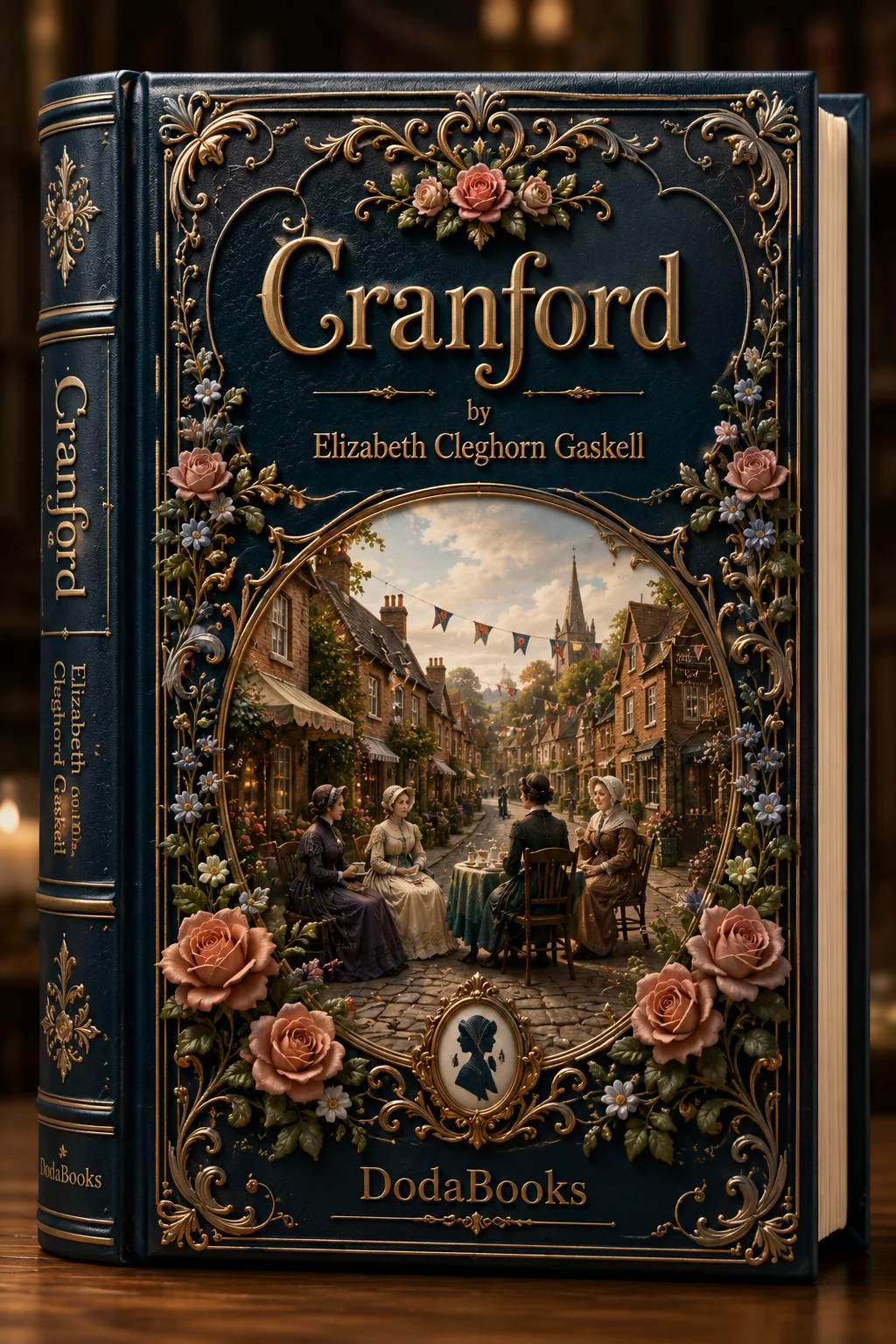
🏡 Step Inside Mrs. Gaskell’s Beloved Victorian Village
Experience Cranford in its definitive digital edition from DodaBooks—featuring deep historical commentary on Victorian etiquette, tea rituals, and female economics:
- 🗂️ Complete 16-Chapter Text — Unabridged and formatted with elegant typography
- 📜 Historical Notes — Explaining Dickens’s Household Words serialization, Dr. Johnson’s Rasselas, and 19th-century bank crashes
- ☕ The Knutsford Background — Discover the real-life Cheshire spinsters who inspired Miss Matty and Miss Pole
- 📱 Universal DRM-Free EPUB — Read seamlessly across Kindle, Kobo, iPad, and Android
🎩 Chapters 7–11: Aristocrats, Conjurors, and The Great Panic
Chapters 7–8: Visiting Etiquette and Lady Glenmire
These chapters present Gaskell’s most brilliant social satire, chronicling two competing tea parties:
- Miss Betsy Barker’s Party: Miss Barker, a retired milliner and former lady’s maid, throws an elaborate tea party for the Cranford elite. The ladies spend hours strategizing what caps to wear and whether accepting Miss Barker’s invitation will compromise their social rank. During the evening, Miss Barker’s Alderney cow story is retold, and Mrs. Jamieson’s tyrannical fat dog, Carlo, is spoiled with cream sponge cakes.
- Mrs. Jamieson’s Grand Gathering: Mrs. Jamieson, the self-appointed aristocratic dictator of Cranford (due to her deceased husband being the son of an Irish baronet), condescends to invite the village ladies to meet her titled sister-in-law, Lady Glenmire.
The Cranford ladies expect Lady Glenmire to be an intimidating, unapproachable patrician. Instead, they find a warm, sensible, unpretentious Scottish widow in mourning dress who immediately charms Miss Matty by praising her hand-knitted mittens and treating everyone with natural courtesy.
Chapters 9–11: The Magician and the Cranford Panic
In Chapter 9, the village is thrilled by the arrival of a traveling Italian conjuror, Signor Brunoni (in reality, an English former soldier named Samuel Brown), who performs sleight-of-hand tricks at the Assembly Rooms. While the conservative Mrs. Jamieson snubs the show as dangerous, Miss Matty, Miss Pole, and Mary Smith are thoroughly captivated.
Following the performance, a wave of collective hysteria known as “The Cranford Panic” sweeps the town:
- Reports spread of suspicious Italian organ-grinders, fierce-looking peddlers, and mysterious chalk marks on garden gates.
- Miss Pole convinces herself that the town is being targeted by an international syndicate of ruthless housebreakers. She sleeps with a poker under her pillow and constructs a barricade of tin canisters on her stairs.
- Mrs. Jamieson locks her doors and claims her dog Carlo was poisoned by burglars (in reality, he was simply sick from eating macaroons).
- Miss Matty nervously inspects underneath her bed every night, hoping that if a robber is hiding there, he will be comfortable:
“She used to roll a ball under the bed; if it came out on the other side, she knew the coast was clear. But she always said she hoped that if a robber was under there, he would be quiet and not frighten her.”
💔 Chapters 12–15: The Fallen Magician and the Financial Crash
Chapters 12–13: The True Story of Signor Brunoni
The great panic dissolves into genuine charity when Mary and Miss Pole discover that Signor Brunoni has fallen seriously ill with fever in an impoverished roadside tavern outside town.
Miss Pole investigates and discovers that the terrifying foreign conjuror is simply an honest English ex-soldier named Samuel Brown, whose long-suffering wife Phoebe has walked miles across India during military campaigns, carrying her surviving infant on her back. Touched by the family’s plight, the Cranford spinsters mobilize to nurse the conjuror, provide broths, and protect his family.
Meanwhile, a massive social earthquake rocks Cranford: Lady Glenmire announces her engagement to Mr. Hoggins, the local country surgeon!
- Mrs. Jamieson is utterly humiliated that her titled sister-in-law would marry a vulgar, loud-talking medical practitioner whose surname she considers offensively barnyard-like.
- Mrs. Jamieson cuts Lady Glenmire off and demands that all respectable Cranford ladies boycott the couple. However, Miss Matty quietly refuses to join the boycott, showing compassion for Lady Glenmire’s right to pursue happiness.
Chapters 14–15: The Town and County Bank Collapses
While in a shop in a neighboring village, Miss Matty watches a poor countryman try to pay for a piece of flannel for his wife with a five-pound note from the Town and County Bank. The shopkeeper refuses to accept it, whispering that the bank has stopped payment.
Miss Matty steps forward and does something extraordinary. Knowing that she is an owner of shares in the Town and County Bank, she feels personally responsible for the bank’s honesty. She insists on trading the worthless five-pound bank note for five solid gold sovereigns from her own purse, refusing to let an innocent laborer lose his hard-earned money.
Days later, the full catastrophe is revealed: the Town and County Bank has completely collapsed:
- As a shareholder, Miss Matty’s entire life savings are wiped out.
- She faces total, destitute poverty and the immediate prospect of losing the rectory.
- Her character shines with transcendent moral beauty: she refuses to blame the directors, accepts her poverty with serenity, and vows to pay every farthing she owes.
          [ THE COMMUNITY'S RESPONSE TO MATTY'S RUIN ]
+-------------------------------------------------------------+
| 1. Martha (The Maid) refuses to leave; marries Jem Hearn    |
|    so Matty can board as a lodger in her own house          |
+-------------------------------------------------------------+
                              |
                              v
+-------------------------------------------------------------+
| 2. The Spinsters' Secret League: Miss Pole, Mrs. Forrester,  |
|    and Mary's father secretly pool funds to pay Matty a     |
|    confidential annual pension of £30                       |
+-------------------------------------------------------------+
                              |
                              v
+-------------------------------------------------------------+
| 3. Matty opens a small, dignified shop selling tea & almond  |
|    comfits to Cranford schoolchildren                       |
+-------------------------------------------------------------+
When Mary’s father, a shrewd Drumble businessman, arrives to inspect Matty’s accounts, he is stunned by the response of the town:
- Martha, the faithful young servant, insists on marrying her suitor Jem Hearn immediately so they can rent Matty’s house and keep Miss Matty as a cherished lodger.
- In Chapter 15, Miss Pole secretly gathers the Cranford spinsters. Despite their own tight financial constraints, each lady quietly pledges a portion of her small income to create a secret, anonymous pension for Miss Matty, proving that female solidarity in Cranford is far stronger than economic hardship.
- To maintain her independence, Miss Matty opens a small, dignified shop in her parlor selling high-quality green tea and glass jars of confectionery to village children.
👳 Chapter 16: The Return of the Great Aga
Chapter 16: Peace to Cranford
Months pass, and Miss Matty flourishes in her little tea parlor. Her integrity is so delicate that when a customer comes to buy green tea, she secretly warns them if she suspects the competition sells it cheaper.
Meanwhile, Mary Smith, remembering the story of Phoebe Brown’s military travels in India, sends an urgent letter to an English trading house in Chunderabadd, asking if anyone has news of a lost officer named Peter Jenkyns.
One afternoon, a tall, sun-bronzed gentleman dressed in exotic foreign garments arrives at Miss Matty’s door. It is Peter Jenkyns—now the wealthy, revered “Aga Jenkyns”, who has made a vast fortune in Indian trade and has returned home to care for his sister for the rest of her days!
Peter’s return instantly transforms Cranford:
- He pays off all outstanding debts from the Town and County Bank.
- He buys back the family rectory, lavishly redecorates the rooms, and fills the house with silk shawls, carved ivory, and casks of spicy Indian chutnee.
- Peter uses his charm, wealth, and diplomatic wit to heal the social rift between Mrs. Jamieson and the newly married Mrs. Hoggins (Lady Glenmire), uniting the entire village at a grand reunion at the Assembly Rooms.
The novel closes with Miss Matty surrounded by lifelong friends, enjoying the twilight of her life in peace, security, and universal affection—a testament to the enduring triumph of quiet goodness over the vanity of the world.
🧠 Central Themes and Literary Analysis
1. “Elegant Economy” vs. True Generosity
The brilliant comedic engine of Cranford is the gap between appearance and reality. The ladies spend hours practicing “elegant economy”—hiding butter dishes when visitors knock, cutting paper trails over carpets, and feigning indifference to expensive delicacies. Yet when real catastrophe strikes (Miss Matty’s ruin), these same parsimonious spinsters instantly sacrifice their personal savings without hesitation. Gaskell shows that their petty frugality is not selfishness; it is the protective armor that allows them to practice magnificent generosity when their neighbors need them.
2. The Vanishing Pre-Industrial Village
Written during the explosive expansion of Victorian industrialism, Cranford stands as an affectionate elegy for the English village. The railway that kills Captain Brown in Chapter 2 symbolizes the violent intrusion of the modern machine age into the pastoral garden of Knutsford. Throughout the book, Cranford’s timeless traditions are contrasted with the smoky, ruthless, balance-sheet mentality of Drumble.
3. A Commonwealth of Women
Unlike almost every other Victorian novel, Cranford is an almost purely female commonwealth. Men in the novel are either dead (the Rector, Captain Brown, Mr. Holbrook), absent (Peter in India), or comic interlopers (Mr. Hoggins). Within this female sphere, power is mediated not through legal contracts or physical force, but through friendship, shared memory, and moral care. Gaskell proves that an aging spinster’s parlor can be as morally significant as a parliamentary chamber.
❓ Frequently Asked Questions
Is Cranford based on a real town?
Yes. Cranford is a direct, loving fictionalization of Knutsford in Cheshire, where Elizabeth Gaskell was raised by her maternal aunt, Hannah Lumb, following her mother's death. Many characters—including Miss Matty, Captain Brown, and Miss Betsy Barker—were based on real Knutsford residents whom Gaskell knew in her youth.
Why did Captain Brown and Miss Deborah feud over Charles Dickens?
In Chapter 1, Captain Brown loves Charles Dickens's newly published serial The Pickwick Papers for its humor and common humanity, whereas Miss Deborah Jenkyns insists that Dr. Samuel Johnson's 18th-century philosophical allegory Rasselas is the only prose fit for polite society. This debate mirrored real Victorian literary arguments between traditional neoclassical decorum and vibrant, democratic modern realism.
Why does Miss Matty feel responsible for the bank's failure in Chapter 14?
In the Victorian era, many provincial joint-stock banks operated with unlimited liability for their shareholders. Because Miss Matty inherited shares in the Town and County Bank, she viewed herself as a legal partner in the enterprise. When the bank collapsed, her strict Christian conscience dictated that she had a personal, moral duty to compensate innocent noteholders, even at the cost of her own ruin.
What is the significance of Peter Jenkyns's return at the end?
Peter's dramatic return from India acts as a fairy-tale resolution, providing financial salvation for Miss Matty while healing the village's social divisions. Symbolically, Peter brings the exotic riches of the British Empire back to revitalized provincial Cranford, allowing Miss Matty to retain her quiet independence surrounded by her beloved community.
☕ Fall in Love with Elizabeth Gaskell’s Masterpiece
Experience the definitive digital edition of Cranford from DodaBooks—complete with historical notes and Victorian cultural insights:
- 📖 Complete 16-Chapter Text — Unabridged, beautifully typeset for modern e-readers
- 💡 Exhaustive Literary Notes — Explaining Victorian etiquette, tea rituals, and social history
- 📜 Historical Context — Learn about the real Knutsford figures who inspired Mrs. Gaskell
- 🔓 100% DRM-Free — Read on Kindle, Kobo, iPad, or Android anytime, anywhere