Cranford Characters: Miss Matty, Mary Smith & Miss Pole Explained
At the heart of Elizabeth Gaskell’s Cranford lies one of the most delightfully realized, psychologically acute character ensembles in Victorian literature. Rather than constructing a narrative around conventional romantic heroines or daring gentlemen, Gaskell centers her provincial masterpiece on a fiercely independent community of aging spinsters and widows navigating the narrow straits of “genteel poverty” with dignity, eccentric rituals, and unexpected moral grandeur.
The undisputed emotional anchor of this world is Miss Matty Jenkyns, whose delicate fragility, deep-seated grief over a lost youthful love, and transcendent Christian charity elevate the novel from provincial comedy into universal literature. Observing her with affectionate clarity is Mary Smith, the perceptive young narrator whose visits bridge the gap between Cranford’s timeless traditions and the bustling modern industrialism of Drumble. Surrounding them is a memorable constellation of provincial types—from the domineering, Johnson-quoting Miss Deborah Jenkyns and the indefatigable, panic-prone Miss Pole to the warm-hearted Scottish aristocrat Lady Glenmire and the long-lost, sun-bronzed brother Peter Jenkyns.
This comprehensive character guide profiles every major figure in Cranford, analyzing their social rank, psychological motivations, and symbolic role in Gaskell’s celebration of female solidarity.
| Character Name | Social Role in Village | Defining Personality Traits | Narrative & Symbolic Significance |
|---|---|---|---|
| Miss Matty Jenkyns | Central Protagonist & Spinster | Gentle, self-effacing, compassionate, resilient | The moral heart of Cranford; proves that meekness can harbor supreme ethical courage |
| Mary Smith | First-Person Narrator | Observant, empathetic, modern, resourceful | Connects industrial modernity (Drumble) with pastoral tradition; the loyal chronicler |
| Miss Deborah Jenkyns | Matty’s Deceased Elder Sister | Authoritarian, intellectual, severe, proud | The arbiter of neoclassical decorum; enforces social conformity and family pride |
| Miss Pole | Cranford’s Chief Gossip & Sleuth | Inquisitive, alarmist, opinionated, energetic | Drives village comedic subplots; yet proves fiercely generous during Matty’s crisis |
| Captain Brown | Retired Half-Pay Military Officer | Honest, unpretentious, practical, heroic | The rare male interloper; sacrifices his life to save a child, breaking social taboos |
| Miss Jessie Brown | Captain Brown’s Younger Daughter | Devoted, cheerful, resilient, loyal | The faithful daughter whose self-sacrificing love is rewarded by marriage to Major Gordon |
| Mr. Thomas Holbrook | Matty’s Long-Lost Suitor | Rustic, intellectual, eccentric, chivalrous | Embodies the lost pastoral romance sacrificed on the altar of Jenkyns family pride |
| Peter Jenkyns (“The Aga”) | Matty’s Long-Lost Brother | Mischievous, adventurous, wealthy, diplomatic | The prodigal son returned from India; serves as the fairy-tale savior of the village |
| Mrs. Jamieson | Self-Appointed Village Aristocrat | Haughty, indolent, snobbish, dog-obsessed | Satirizes rigid, hollow social hierarchy; terrified of marrying below her caste |
| Lady Glenmire | Mrs. Jamieson’s Scottish Sister-in-Law | Sensible, warm, unpretentious, democratic | Subverts aristocratic snobbery by marrying the village surgeon, Mr. Hoggins |
🌸 The Ladies of Cranford
🕊️ MISS MATTY JENKYNS (THE MORAL COMPASS)
The Gentle Soul of the Rectory
“She had a childlike, tender heart, and was so anxious to do what was right that she was perpetually doubting her own judgment… Her humility was the most beautiful thing I ever saw.”
Background & Family Role
Miss Matilda “Matty” Jenkyns is the younger daughter of the late Rector of Cranford. For decades, her existence was completely subsumed under the tyrannical intellectual authority of her elder sister, Miss Deborah. Trained to view herself as intellectually inferior, Matty deferred to Deborah on every matter—from the color of her bonnet ribbons to the tragic renunciation of her youthful suitor, Mr. Thomas Holbrook.
The Quiet Triumph of Goodness
When Deborah dies, Matty is left alone in the world, terrified of managing her own household. Yet, when catastrophic misfortune strikes, Matty reveals an extraordinary, steely moral backbone:
- The Five-Pound Note: When she witnesses a poor country laborer being refused service because his bank note is drawn from the failing Town and County Bank, Matty insists on exchanging it for five gold sovereigns from her own purse, refusing to let an innocent workingman suffer because of an institution in which she holds shares.
- Dignified Independence: When the bank fails and leaves her penniless, she accepts poverty without bitterness or self-pity, immediately opening a modest tea shop in her parlor to support herself with dignity.
- Delicate Scruples: As a shopkeeper, her honesty is so tender that she advises village mothers not to buy expensive green tea if black tea is more economical, and slips free almond comfits into the pockets of poor children.
Why She Matters
Miss Matty is the quintessential Victorian portrait of quiet Christian sainthood. In a society obsessed with industrial wealth, rank, and social climbing, Matty demonstrates that gentle kindness, unconditional empathy, and personal integrity possess a timeless, indestructible power.
📖 MARY SMITH (THE MODERN CHRONICLER)
The Empathetic Bridge to the Modern World
“I was always glad when my father said I might go and spend a month with Miss Matty; Cranford was like a quiet backwater after the busy, noisy streets of Drumble.”
Narrative Function and Social Background
Mary Smith serves as the first-person narrator of Cranford. The daughter of a wealthy, practical businessman in the booming manufacturing city of Drumble, Mary occupies a unique liminal space in Victorian society:
- She belongs to the modern, pragmatic, industrial world of ledgers, railways, and investments.
- Yet, she possesses an intuitive emotional sympathy for the fading provincial rituals and spinsters of Cranford.
Her Active Agency in the Plot
Far from being a passive observer, Mary is the crucial problem-solver who protects Miss Matty:
- She secretly contacts her father to manage Matty’s complicated legal liabilities after the bank crash.
- She organizes the secret annual pension fund among the Cranford spinsters.
- Remembering the clues dropped by Signor Brunoni’s wife about India, Mary takes the bold initiative to write to Chunderabadd, directly orchestrating the miracle of Peter Jenkyns’s return.
Why She Matters
Mary Smith is Elizabeth Gaskell’s fictional alter-ego. Through Mary’s loving, slightly amused, but deeply respectful lens, Gaskell invites the reader to laugh with the Cranford spinsters without ever diminishing their humanity or dignity.
👑 MISS DEBORAH JENKYNS (THE PROPRIETY CZAR)
The Neoclassical Dictator
“Miss Jenkyns wore a high, stiff cap and spoke in balanced periods like Dr. Johnson. She was the final authority on everything in Cranford, from the length of a visit to the immortality of the soul.”
Personality and Philosophy
Though Miss Deborah dies in Chapter 3, her formidable shadow hangs over the entire novel. As the rector’s eldest daughter, Deborah saw herself as the guardian of Augustan intellectual elegance and social caste:
- She worshiped the heavy, Latinate prose of Dr. Samuel Johnson’s Rasselas, treating Charles Dickens’s serial realism as vulgar and dangerous.
- She forced her younger sister Matty to sacrifice her marriage to Thomas Holbrook out of a rigid sense of family pedigree.
- She formulated the unwritten rules of Cranford etiquette, establishing the fifteen-minute limit on morning calls and the rigorous taboos against mentioning money.
Why She Matters
Deborah represents the conservative, aristocratic past of provincial England—a world anchored in classical learning and rigid social hierarchies that was rapidly being rendered obsolete by Victorian industrial capitalism.
🕵️ MISS POLE (THE VILLAGE SLEUTH)
The Queen of Cranford Espionage
“Miss Pole had a genius for discovery. If an egg was laid in Cranford, Miss Pole knew the hen that laid it, the price it would fetch, and the purpose for which it was intended before the shell was cold.”
The Great Investigatrix
Miss Pole is the comedic dynamo of the village. Energetic, opinionated, and relentlessly curious, she appoints herself the chief investigator of all local affairs:
- She leads the charge during “The Cranford Panic”, arming herself with a brass poker, barring her windows, and constructing elaborate conspiracy theories about Italian housebreakers.
- She exposes the real identity of the magician Signor Brunoni, tracking him to his sickbed at a roadside inn.
Her Surprising Heart
While Miss Pole can be sharp-tongued, cynical about men, and exasperatingly nosy, Gaskell reveals her profound capacity for love during Miss Matty’s ruin. It is Miss Pole who secretly convenes the village ladies, swallows her pride, and rallies the spinsters to pool their meager allowances into an anonymous pension for their friend.
Why She Matters
Miss Pole demonstrates that Victorian spinsters were not passive, decorative parlor ornaments, but dynamic, intelligent women whose abundant energies, denied professional outlets by society, were channeled into community oversight, mutual aid, and unflagging civic loyalty.
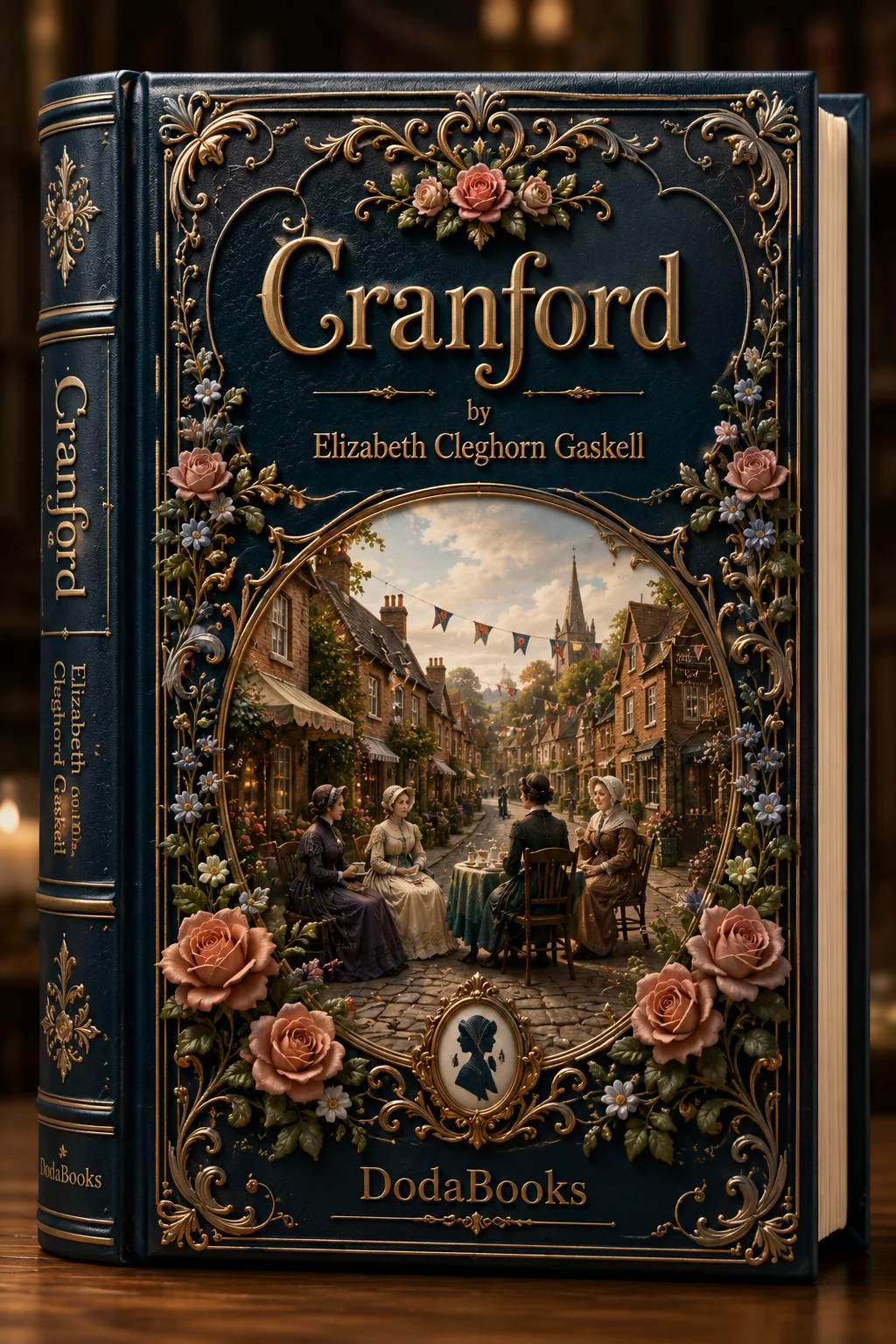
☕ Meet the Real Women Behind Elizabeth Gaskell’s Classic
Explore the authentic historical letters, Knutsford archives, and Victorian customs that inspired Miss Matty and Miss Pole with the DodaBooks Annotated Edition:
- 🗂️ Complete 16-Chapter Text — Unabridged, beautifully typeset for modern e-readers
- 📜 Historical Character Dossiers — Biographical notes on the real Knutsford figures who inspired Mrs. Gaskell
- 🔍 Interactive Notes — Comprehensive explanations of Victorian bank failures, tea trade economics, and Indian military service
- 📱 Universal DRM-Free EPUB — Read instantly across Kindle, Kobo, iPad, and Android
🎩 The Men of Cranford: Interlopers & Heroes
🎖️ CAPTAIN BROWN (THE MARTYR OF THE RAILS)
The Plain-Speaking Hero
“He was a half-pay captain who dared to speak the truth in a town that lived on illusions. He had the courage to say he was poor, and the greater courage to die for a stranger’s child.”
Breaking the Amazonian Barrier
Captain Brown is the first adult male to breach Cranford’s female fortress. Middle-aged, poor, and unpretentious, he cheerfully ignores Cranford’s code of “elegant economy”:
- He walks openly through the street carrying a steaming tin canister of fried potatoes from the bakery.
- He reads Charles Dickens aloud in public and laughs uproariously, utterly unfazed by Miss Deborah’s Johnsonian scowls.
- He demonstrates practical compassion, advising Miss Barker to clothe her naked, scalded cow in flannel drawers and tenderly nursing his dying invalid daughter.
His Tragic Sacrifice
Captain Brown’s death in Chapter 2 is the most shocking and modern moment in the novel. Struck by an incoming steam locomotive while saving a toddler on the tracks, Brown becomes an innocent martyr to the emerging machine age.
Why He Matters
Captain Brown shatters the ladies’ belief that masculinity is inherently coarse and destructive. His self-sacrificing heroism teaches Cranford that true gentility is defined by active benevolence rather than empty parlor etiquette.
🌿 MR. THOMAS HOLBROOK (THE RUSTIC SCHOLAR)
The Poetic Yeoman of Woodley
“He lived like an old Saxon thane, surrounded by his cattle, his fields, and his books. He quoted Tennyson while walking in his orchard, and had never forgotten the girl he loved thirty years before.”
The Lost Ideal of English Manhood
Thomas Holbrook represents the vanishing class of independent English yeoman farmers:
- He lives in a moated Tudor farmhouse called Woodley, dressing in homespun country cloth and managing his own estate.
- Yet, Holbrook is a deeply cultivated man of letters, reading Dante, Shakespeare, and modern romantic poetry like Tennyson’s Locksley Hall.
The Lingering Sorrow
When Holbrook invites Miss Matty, Mary, and Miss Pole to Woodley, he treats Matty with delicate, courtly reverence. Their reunion proves that their love has never died, making Holbrook’s sudden death following his trip to Paris one of the most tender, heartbreaking tragedies in Victorian literature.
Why He Matters
Holbrook exposes the tragic folly of artificial social class. Had Matty been permitted to marry this noble, intellectual country squire, her life would have been filled with love and intellectual companionship rather than decades of lonely, impoverished spinsterhood.
👳 PETER JENKYNS / THE AGA (THE PRODIGAL SAVIOR)
The Boy Who Ran Away to India
“He had paraded in his sister’s petticoats as a boy, and returned as a prince of the Orient, laden with silk shawls, Indian pearls, and tales of tiger hunts.”
From Boyhood Prankster to Eastern Magnate
As a mischievous schoolboy, Peter was the terror of Cranford, playing outrageous pranks on the village spinsters until a brutal public whipping by his father drove him into the Royal Navy. Surviving shipwrecks, Indian mutinies, and Burmese wars, Peter reinvents himself as “The Great Aga”—a fabulously wealthy trader and diplomat revered by Indian rajahs.
The Fairy-Tale Resolution
Peter’s return in Chapter 16 acts as the ultimate providential miracle:
- He pays all debts, restores the family rectory, and provides Miss Matty with lavish security.
- He uses his worldly charm to end village feuds, reconciling Mrs. Jamieson with Lady Glenmire and uniting Cranford in joyful celebration.
Why He Matters
Peter brings the vast, exotic wealth of the British Empire home to rejuvenate the impoverished, insular world of provincial Cheshire. He represents the classic Victorian archetype of the prodigal son whose adventures abroad redeem the family estate.
📊 The Cranford Social Hierarchy & Class Matrix
In Cranford, social rank was not determined by raw bank balances, but by a baroque calculus of birth, titles, connections to the church or military, and adherence to ancient etiquette:
               [ CRANFORD'S RIGID SOCIAL CASTE ]

                               👑
                     [ THE ARISTOCRATIC TIER ]
                     Mrs. Jamieson & Lady Glenmire
                     (Titles, Carriage, Bloodline)
                               │
                               ▼
                      [ THE RECTORY GENTRY ]
                     Miss Deborah & Miss Matty Jenkyns
                     (Clerical Pedigree, Dr. Johnson)
                               │
                               ▼
                   [ THE PROFESSIONAL SPINSTERS ]
                     Miss Pole & Mrs. Forrester
                     (Ancient Cranford Lineage, Gossip)
                               │
                               ▼
                   [ THE RETIRED TRADESPEOPLE ]
                     Miss Betsy Barker (Ex-Milliner)
                     (Wealthy, but socially insecure)
                               │
                               ▼
                 [ THE DOMESTIC SERVANTS & LABOUR ]
                     Martha, Jem Hearn & Farm Hands
                     (Loyal, essential moral foundation)
🧠 Female Solidarity vs. Victorian Patriarchy
Throughout Cranford, Elizabeth Gaskell crafts a subtle but revolutionary critique of Victorian patriarchal capitalism:
[ PATRIARCHAL SYSTEM ]                   [ CRANFORD FEMALE SOLIDARITY ]
• Industrial factories (Drumble)          • "Elegant economy" & mutual care
• Commercial bank crashes (Town & County) • Voluntary anonymous pension fund
• Rigid family tyranny (The Rector)       • Lifelong sisterhood & shared tears
• Railways & machine deaths               • Domestic tea rituals & quiet healing
When the patriarchal commercial apparatus fails—when the Town and County Bank collapses due to the negligence of male directors in Drumble—it is the impoverished, disenfranchised women of Cranford who restore moral order:
- Martha defies economic self-interest to provide a home for her former mistress.
- The spinsters secretly sacrifice their personal creature comforts to keep Miss Matty solvent.
- Miss Matty chooses personal financial ruin over cheating a poor country laborer.
Gaskell demonstrates that the feminine values of Cranford—empathy, shared responsibility, and community care—are infinitely more resilient and moral than the competitive, profit-driven capitalism of Victorian men.
❓ Frequently Asked Questions
Why did Miss Matty never marry Mr. Holbrook?
Miss Matty was deeply in love with Thomas Holbrook in her youth, but her aristocratic father (the Rector) and her domineering elder sister Deborah forbade the marriage because Holbrook was merely a country yeoman farmer, which the Jenkyns family considered socially inferior to their clerical pedigree. Matty dutifully submitted to her family's wishes, enduring decades of quiet sorrow.
Why does Mrs. Jamieson object so violently to Lady Glenmire's second marriage?
Mrs. Jamieson is an extreme social snob whose entire self-worth derives from her deceased husband's aristocratic lineage. When her sister-in-law Lady Glenmire decides to marry Mr. Hoggins, the local country doctor, Mrs. Jamieson feels personally disgraced that a titled lady would marry a common medical tradesman with an unrefined, vulgar-sounding surname.
Who is Signor Brunoni, and why was he important to Cranford?
Signor Brunoni was the stage name of Samuel Brown, an impoverished English ex-soldier who performed conjuring tricks at the Assembly Rooms. His performance sparked a village-wide panic over imaginary Italian thieves, but when he fell desperately ill, his plight brought out the deep, practical Christian charity of the Cranford spinsters, who nursed him back to health.
What does Martha's loyalty to Miss Matty demonstrate?
Martha, Miss Matty's young maid-of-all-work, refuses to abandon her mistress when Matty loses all her money in the bank crash. Martha hastens her marriage to her suitor Jem Hearn so they can rent Matty's house and board Miss Matty as an honored guest. This relationship illustrates Gaskell's belief in the deep, affectionate bonds between social classes in traditional English village communities.
🏡 Relive Elizabeth Gaskell’s Warmest Victorian Classic
Immerse yourself in the unforgettable lives of Miss Matty, Mary Smith, and the Cranford spinsters with the definitive DodaBooks edition:
- 🗂️ Complete 16-Chapter Text — Unabridged and optimized for modern reading devices
- 📜 Historical Character Notes — Behind-the-scenes biographies of the real Knutsford originals
- ☕ 100+ Annotations — Explaining Victorian social customs, bank crashes, and tea etiquette
- 📥 Instant DRM-Free EPUB — Compatible with Kindle, Apple Books, Kobo, and Android