Cornish Characters and Strange Events by S. Baring-Gould
Smugglers of Prussia Cove, Ghost-Hunters of Bodmin Moor, and Wreckers of the Granite Coast: Sabine Baring-Gould’s Monumental 1909 Treasury of Celtic Folklore and Maritime Adventure
Tucked into the far southwestern toe of Great Britain, jutting defiantly into the roaring Atlantic swell, the ancient Celtic duchy of Cornwall has always remained a world unto itself. Separated from England by the Tamar River, Cornwall was a land of granite moors, treacherous serpentine reefs, ancient tin mines, and fierce, clannish maritime communities. Long after the rest of Britain was standardized by Victorian industrial railways and suburban respectability, Cornwall remained steeped in pagan superstitions, holy well lore, ghost legends, and legendary defiance of Crown authority.
No chronicler possessed a deeper intimacy with the spirits, history, and people of the West Country than the Reverend Sabine Baring-Gould (1834–1924). Parson of Lew Trenchard in Devon, hymn-writer (famed for “Onward, Christian Soldiers”), pioneer folk-song collector, and archaeologist, Baring-Gould was one of the most astonishingly prolific scholars of the Victorian and Edwardian eras. In his colossal 1909 masterwork, Cornish Characters and Strange Events, Baring-Gould assembled an unforgettable, 790-page treasury chronicling the wildest smugglers, wreckers, astrologers, holy recluses, and eccentric gentlemen who walked the windswept headlands of Cornwall across three centuries.
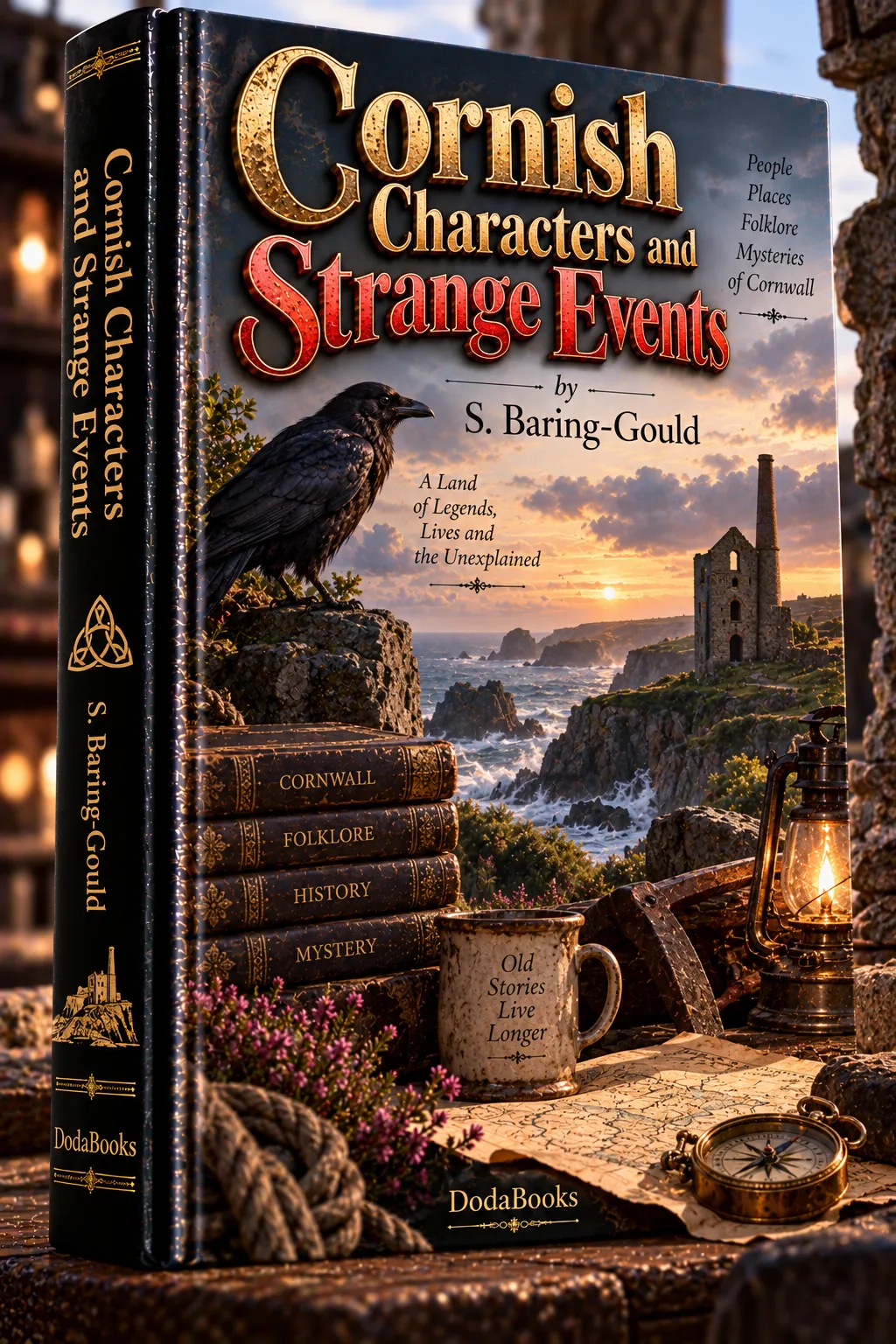
Step Onto the Wild, Haunted Headlands of Cornwall
Read Sabine Baring-Gould's definitive treasury Cornish Characters and Strange Events, annotated with Cornish dialect glossaries, maritime maps, and historical context.
Read Baring-Gould's Treasury NowThe Kings of Prussia Cove: Smuggling on the Celtic Coast
At the heart of Cornish history lies the legendary trade of “free trading”—the euphemism for the vast smuggling networks that defied British excise collectors throughout the eighteenth and early nineteenth centuries. With its jagged sea caverns, hidden coves, and dangerous tidal currents, the Cornish coastline was engineered by nature for contraband:
- John Carter, the “King of Prussia”: Baring-Gould provides an extensive, gripping history of John Carter and his brothers, who fortified Prussia Cove (near Mount’s Bay). Carter mounted iron cannons on the rocky headlands, dug subterranean tunnels connecting his cottage directly to secret sea caves, and ruled his smuggling kingdom with absolute authority.
- The Code of the Honest Smuggler: In one famous episode preserved by Baring-Gould, excise officers seized a cache of Carter’s tea and stored it in the Penzance custom-house. Carter broke into the government building at night and retrieved his stolen tea—taking only what was rightfully his own and refusing to touch a single pound belonging to anyone else, declaring that an honest man never stole another man’s property!
- Wrecking Legends and Savage Reefs: Baring-Gould addresses the dark folklore of Cornish wreckers who supposedly lured merchant ships onto granite reefs with false lanterns tied to horses’ tails. Drawing on parish records and court proceedings, he separates sensational Victorian penny-dreadful myths from the grim historical realities of coastal salvaging and maritime tragedy.
Eccentric Parsons and West Country Oddities
As an Anglican parson himself, Baring-Gould took mischievous delight in chronicling the extraordinary eccentricities of West Country clergymen who ruled their isolated moors and coastal parishes like feudal despots:
- Parson Hawker of Morwenstow: The legendary Robert Stephen Hawker, Vicar of Morwenstow, who dressed in a claret-colored coat, sea-boots, and a blue fisherman’s jersey, kept a pet pig that slept in his study, and swam out to rocks under the moonlight wrapped in an oilskin sheet to pretend to be a mermaid, singing hymns to astonished villagers through a foghorn.
- Holy Wells and Cursing Stones: Baring-Gould records ancient Celtic pagan rituals that persisted beneath Christian veneer well into the nineteenth century—visiting holy wells to drop pins and curse enemies, consulting local “white witches” (pellers) for herbal charms, and leaving offerings for the piskies (Cornish pixies) in tin mine shafts.
- Daniel Gumb, the Stone Philosopher: A self-taught mathematician and stonecutter who carved a home out of natural granite slabs on the moors near Cheesewring, living with his wife and family beneath a massive fifteen-ton boulder where he chiseled Euclid’s geometrical proofs into the stone floor.
"Cornwall was a land apart, where the sea and the moor
wove themselves into the very marrow of human character.
Its people were men of fierce loyalties and wild independence,
who loved a smuggler better than an excise man,
and feared the wrath of an old white witch
far more than the judgment of an earthly magistrate."
— S. Baring-Gould, Cornish Characters and Strange Events
Explore the Complete 790-Page Cornish Treasury with Notes
The DodaBooks annotated edition clarifies Cornish dialect words, includes geographic maps of West Country smuggling coves, and provides Baring-Gould's full text.
Get Cornish Characters for $0.99Sabine Baring-Gould: The Father of Modern British Folklore
Sabine Baring-Gould was an extraordinary polymath whose contribution to English cultural preservation cannot be overstated:
- Saving the Traditional Folk Song: Recognizing that compulsory state schooling and industrialization were rapidly destroying oral folklore, Baring-Gould traversed Devon and Cornwall in the late 1880s, sitting in village taverns and cottages to transcribe traditional folk songs from elderly farm laborers, publishing the landmark collection Songs of the West.
- The Archaeological Eye: Unlike romantic mythologists who invented Celtic fantasies, Baring-Gould approached folklore with archaeological rigor. He conducted pioneering excavations of prehistoric hut circles on Dartmoor and examined parish marriage registers, wills, and court testimonies to verify every legend he recorded.
- The Voice of Celtic Independence: In Cornish Characters, Baring-Gould passionately champions the distinct identity of the Cornish people, celebrating their ancient Celtic heritage, their bilingual Cornish-English history, and their proud independence from Anglo-Saxon uniformity.
Interlinking with Related Folklore, History, and Curious Classics
Readers captivated by Sabine Baring-Gould’s rich folklore, regional eccentricities, and historical curiosities will find wonderful companion volumes in our catalog:
- English Idiosyncrasy & Social Oddities: Expand your journey through bizarre British personalities with John Timbs’s delightful 1866 classic in English Eccentrics and Eccentricities Guide.
- Cornish Romance & Alpine Song: Follow an independent young heroine whose journey begins along the rugged Cornish coast in Grant Allen’s Linnet by Grant Allen Guide.
- Cult Melodrama & Victorian Voices: For another completely unique, idiosyncratic voice from the British Isles, discover Amanda McKittrick Ros’s celebrated cult classic in Irene Iddesleigh Guide.
Why the DodaBooks Edition of Cornish Characters Is Indispensable
Spanning nearly 800 pages, original copies of Baring-Gould’s masterwork are heavy collector’s items that are difficult to handle and read. The DodaBooks Edition brings this treasury into the digital age with premier quality:
- Cornish Dialect & Topographical Glossary: Decodes archaic West Country dialect terms (such as gugh, zawn, quillet, and bal-maidens) and identifies historic locations across Penwith, Lizard, and Bodmin Moor.
- Comprehensive Chapter Directory: Allows readers to browse effortlessly through dozens of individual biographies, historical sketches, and ghostly legends.
- Flawless Formatting: Pristine typography, verified table of contents, and responsive layout optimized for all modern smartphones, tablets, and e-readers.
Discover the Magic and Mystery of Ancient Cornwall
Journey into the secret sea caves, haunted moors, and forgotten lore of the Celtic West in Sabine Baring-Gould's definitive historical treasury.
Download the Complete EbookFrequently Asked Questions
Who was Sabine Baring-Gould?
Sabine Baring-Gould (1834–1924) was an eminent Anglican priest, folklorist, novelist, archaeologist, and hymn-writer (known for authoring Onward, Christian Soldiers). Based in Devon, he wrote over 1,200 publications and was a pioneering collector of West Country oral folk songs and folklore.
What topics are covered in Cornish Characters and Strange Events?
The volume covers a vast range of Cornish history and folklore from the 16th to the 19th centuries, including famous smugglers (the Carter family of Prussia Cove), eccentrics (Parson Hawker of Morwenstow), ghost sightings, white witches, local saints, mining disasters, and shipwreck salvage.
Are the accounts in Cornish Characters historically reliable?
Yes. Baring-Gould was a meticulous antiquarian who verified his accounts using parish baptism and burial registers, family letters, local court records, and Admiralty papers, making the book a primary historical resource alongside its folklore value.
Is the Cornish language discussed in the book?
Yes. Baring-Gould discusses the decline of the Celtic Cornish language, including the famous Dolly Pentreath (often credited as the last native speaker of Cornish), as well as lingering dialect phrases, place names, and folklore expressions used by locals.
Where can I get the complete digital edition?
The complete, annotated digital edition of Cornish Characters and Strange Events is available for immediate download directly from DodaBooks at https://dodabooks.com/ebook/cornish-characters-and-strange-events-by-s-baring-gould/.