The Confessions of St. Augustine is one of the most influential works in Western Christianity and philosophy. Written between AD 397 and 400, it is not merely an autobiography but a profound meditation on memory, time, sin, grace, and the restless human heart seeking God.
🙏
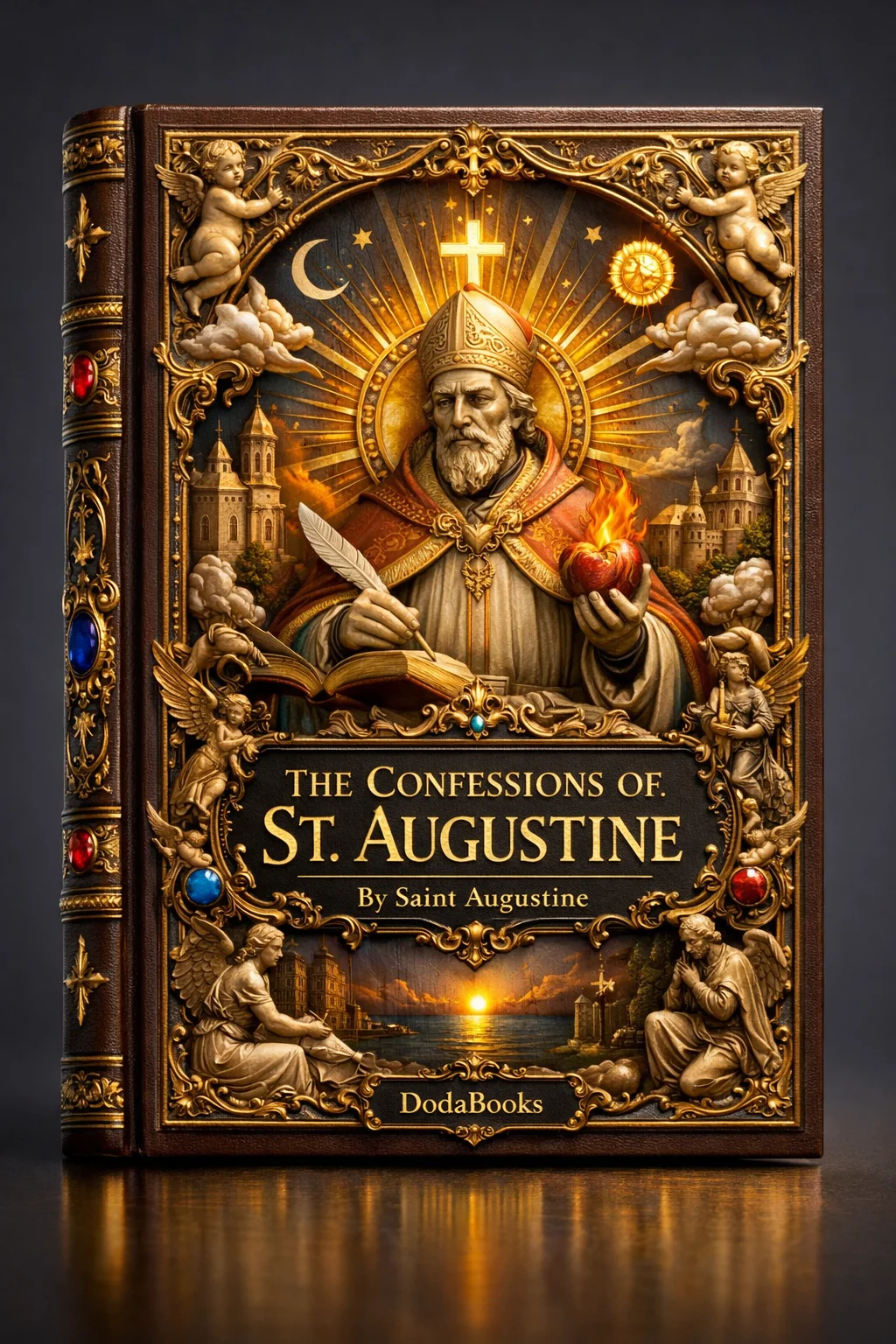
The Confessions of St. Augustine
The timeless spiritual autobiography of one of Christianity's greatest thinkers — Augustine's journey from sin to sainthood, written as a confession of praise to God.
| Author | Saint Augustine of Hippo |
| Written | AD 397–400 |
| Genre | Spiritual autobiography, philosophy, theology |
| Books | 13 |
| Setting | The late Roman Empire — Thagaste (modern Algeria), Carthage, Rome, Milan |
| Legacy | A foundational text of Western Christianity; revolutionized autobiography as a literary form |
🙏 The Story
The work is structured in thirteen books. The first nine trace Augustine’s early life with an honesty unprecedented in ancient literature. He recounts his infancy, his boyhood (including the famous pear theft — a seemingly minor crime that he uses to probe the mystery of sin), his education in Carthage, his embrace of Manichaeism, his teaching career in Rome and Milan, and his long struggle with lust and ambition.
Augustine’s mother Monica, a devout Christian, prays for him ceaselessly. His friend Alypius accompanies him through every stage of his journey. And Ambrose, the bishop of Milan, provides the intellectual example that finally shatters Augustine’s objections to Christianity.
The climax comes in Book VIII, in a garden in Milan. Augustine hears a child’s voice chanting “Take up and read.” He opens the Bible at random to Romans 13:13–14 and feels his will finally surrender. His conversion is one of the most famous scenes in all of literature — a moment of grace that he spent the rest of his life trying to understand.
The final four books shift from narrative to philosophical theology. Book X examines the nature of memory and the soul’s longing for God. Book XI offers a groundbreaking analysis of time — perhaps the most influential discussion of temporality in ancient philosophy. Books XII and XIII provide an allegorical reading of Genesis, exploring creation, the Trinity, and the Sabbath rest of the soul.
📖 Literary Significance
The Confessions is the first great autobiography in Western literature, and it established the form for all that followed. Augustine writes not to tell his own story but to confess the goodness of God — and this unique purpose gives the work its distinctive voice: intimate, prayerful, relentlessly introspective, and universal in its concerns.
The work’s influence is staggering. It shaped medieval theology (every major medieval thinker engaged with it), inspired the Reformation (Luther was an Augustinian monk), and continues to be studied by philosophers, theologians, and literary scholars. Wittgenstein, Heidegger, and Arendt all engaged with Augustine’s analysis of time and memory.
The Confessions is also a literary masterpiece. Augustine’s Latin is powerful and rhythmical, his psychological insight is profound, and his willingness to expose his own failures makes the work feel astonishingly modern. The pear theft, the grief over his friend’s death, the garden conversion — these scenes have moved readers for sixteen centuries.
✨ What Makes the DodaBooks Edition Special
This edition uses the classic 1838 translation by E. B. Pusey, carefully prepared for modern readers without distractions or clutter.
Zero Distractions
No ads, no license pages, no project boilerplate — just the complete text, clean and uninterrupted.
Smart Typography
Curly quotes, em-dashes, proper ellipsis — typeset with care for a premium reading experience.
Book Navigation
Full table of contents with navigation to each of the 13 books — easily jump between them.
Cleaned & Polished
All Gutenberg boilerplate stripped, consistent formatting throughout the text.
No DRM
You own your copy — read on any device, anytime, forever.
Instant Download
EPUB format included, delivered instantly after purchase.
🏛️ Historical & Cultural Context
Augustine wrote the Confessions at a hinge of Western history. Born in 354 and writing around 397–400, he lived through the slow collapse of the Roman Empire in the West — Rome would be sacked by Alaric in 410 — and the formal establishment of Christianity as the empire’s approved religion. This was not a settled Christian world but a society still arguing about what being Christian should mean, and the Confessions was part of that argument, addressed to God but written to be read by others.
Augustine’s own path had taken him through the intellectual movements of the age. He was trained as a rhetorician — the era’s most prestigious skill, the art of persuasion — and taught it in Carthage and Rome before moving to Milan, then the imperial capital and a magnet for ambitious intellectuals. His biography tracks the options a clever fourth-century young man faced: worldly ambition, a fashionable heretical sect called Manichaeism, the deep current of Neoplatonist philosophy, and finally Christianity as embodied by the brilliant bishop Ambrose of Milan. Understanding these four poles — rhetoric, Manichaeism, Neoplatonism, Christianity — is the key to seeing why the Confessions is structured the way it is.
🛤️ The Intellectual Journey: Rhetoric to Faith
The Confessions is often read as a story of moral struggle, and it is — but it is equally a story of an intellectual conversion. Augustine loved language and argument before he loved God, and he was a magnificently successful teacher of rhetoric. He tells us plainly that before his conversion he pursued worldly success through words, and that his turn to the truth had to pass through the very disciplines that had made him vain.
Manichaeism attracted him because it seemed to offer a rational explanation of evil: two cosmic principles, light and darkness, locked in conflict, which let you blame matter rather than your own will. Augustine was drawn to it for almost a decade and remained attached to it long after his doubts began. It was the Manichaeans’ weakness in argument that first loosened his grip, and the reading of Platonist books (the “books of the Platonists”) that gave him the intellectual ladder upward.
Neoplatonism taught him that reality is spiritual, that God is not matter, and that the soul’s ascent toward the good is possible — ideas that dissolved his earlier materialist beliefs. What Neoplatonism could not give him was a way to acknowledge his own will’s weakness, or a personal savior. That is what Christianity, through Ambrose’s preaching and the words of Scripture, finally supplied. The journey is, in Augustine’s own telling, an ascent from the love of words, through a false answer to the problem of evil, through a true philosophy, and at last to the God who meets the restless heart. His most famous sentence gathers the whole arc into one line:
“You have made us for yourself, and our heart is restless until it rests in you.”
✝️ The Theological Heartland
Augustine’s thought in the Confessions touches nearly every doctrine that later defined Western Christianity, which is why the book is indispensable to theology. Most famously, it contains the argument about time that has never been bettered in outline: time, Augustine argues, does not exist independently of the mind, because the past and future exist only in memory and expectation, and the present is an instant that flees. This analysis — found in Book XI — made Augustine a bridge between ancient philosophy and modern philosophy of mind.
The book also dwells on grace, memory, and the will. Augustine’s account of his own paralysis before conversion — the famous scene in the garden in Milan, where he cries out and cannot move while his old self holds him back — is a profound study of how a divided will fails to act even when it knows the good. His reflections on memory in Book X, on the pear theft in Book II, and on the grief he felt at the death of a dear friend in Book IV are all meditations on the restless, fragile self. Readers who come to the Confessions expecting only a conversion memoir are often astonished by how philosophically demanding — and how psychologically exact — it is.
🕯️ Why It Still Matters
Sixteen centuries on, the Confessions still speaks because Augustine tells the truth about interior experience in a way almost no one before him had dared. He confesses what he did, but more than that he confesses what he felt: the vanity, the shame, the grief, the longing. This is the feature that makes the book feel modern despite its ancient setting, and it is why the Confessions is studied as literature and psychology as much as theology.
It also matters as the founding text of autobiography. Before Augustine, no one had written a sustained account of a single inner life as a story with meaning. The form he invented — the self examined in relation to a larger order — runs straight through the Confessions’ descendants, from the Autobiography of Benjamin Franklin to the spiritual memoirs of countless writers since. Augustine gave the West its vocabulary for the inner life, and that alone makes him one of the most important writers who ever lived.
🎓 How to Read It
The Confessions repays a plan. Books I through IX are the narrative of Augustine’s life up to his conversion and his mother Monica’s death, and they are the natural place to begin — vivid, moving, and accessible to any reader. Book X turns to memory and the desire for God; Book XI is the great discussion of time; Books XII and XIII read the opening of Genesis allegorically. A rewarding first reading can stop after the narrative (Book IX) or after Book XI (time), saving the Genesis commentary for a second pass, since the tone shifts from story to philosophical theology.
Read slowly enough to feel the intensity. Augustine writes in long, interior, prayerful sentences, and the power of the book is cumulative — a single paragraph can contain a whole meditation. It also helps to know that his Latin, and the translations rooted in it like Pusey’s, reward re-reading. For a companion study of the theology of the American experiment, our guide to teaching the Declaration of Independence traces a very different branch of inherited ideas about freedom and the soul.
❓ Frequently Asked Questions
Do I need to be a Christian to read this?
No. The Confessions is a work of universal human interest — a story of struggle, growth, and the search for meaning. Non-Christian readers have found it valuable as philosophy, as literature, and as a psychological portrait. Augustine’s analysis of time, memory, and the will is philosophically significant regardless of one’s religious beliefs.
What is the famous pear theft story about?
As a boy, Augustine stole pears from a neighbor’s tree — not because he was hungry, but for the thrill of doing wrong. He spends several chapters analyzing this seemingly trivial act, probing the mystery of why humans sometimes choose evil when they know what is good. It is one of literature’s first great psychological self-examinations.
How long does it take to read?
At 383 pages, most readers finish in 8-12 hours. The 13 books are each short enough to read in a single sitting. Books I–IX (the narrative) are the most accessible; Books X–XIII (the philosophical theology) are denser.
Which translation should I read?
This edition uses the classic E. B. Pusey translation (1838), admired for its fidelity to Augustine’s Latin and its stylistic beauty. It has been the standard English version for generations of readers and captures the prayerful, intimate tone of the original.
What is the garden conversion scene?
In Book VIII, Augustine, in great distress over his inability to change his life, hears a child’s voice from a neighboring garden chanting “Tolle, lege” (Take up and read). He opens the Bible to Romans 13:13–14, and his will finally surrenders to God. The scene is one of the most famous conversion narratives in all of literature.
What was Manichaeism, and why did it matter to Augustine?
Manichaeism was a dualist religion teaching that the world is a battleground between two eternal principles of light and darkness. It attracted Augustine for almost a decade because it seemed to offer a rational explanation of evil that let him shift blame onto matter rather than on his own will. He ultimately rejected it, and much of the early Confessions records its hold and its collapse under argument.
How does Augustine's account of time work?
In Book XI, Augustine argues that time does not exist outside the mind: the past exists only in memory, the future only in expectation, and the present is a barely measurable instant. His analysis is considered a landmark in the philosophy of time and still shapes how philosophers and physicists think about time today.
Who were the key people in Augustine's life and conversion?
Three names matter most. His mother Monica, a devout Christian, prayed for him for years and is remembered with extraordinary tenderness. Ambrose, the bishop of Milan, combined intellectual brilliance with personal example and broke Augustine’s objections to Christianity. His friend Alypius accompanied him through his struggles and experienced conversion with him. All three appear throughout the Confessions.
📚 Related Articles
🙏 Read the Spiritual Classic
The Confessions of St. Augustine is one of the most influential books ever written — a spiritual autobiography of astonishing honesty and depth. The DodaBooks edition presents Pusey’s classic translation in a clean, distraction-free format:
- ✅ Complete 13-book text — every word of the classic translation
- ✒️ Smart typography — curly quotes, em-dashes, proper ellipsis
- 📜 Full table of contents with book navigation
- 🔒 DRM-free — read on any device, anytime
- 📥 Instant download — EPUB format