Confessions of an English Opium-Eater: De Quincey’s Architecture of Dreams
First published anonymously in *The London Magazine* in 1821, Thomas De Quincey’s *Confessions* pioneered the literature of addiction, combining baroque prose symphonies, street-level London tragedy, and terrifying metaphysical hallucinations.
Long before modern psychiatry, psychoanalysis, or the medicalization of chemical dependency, Thomas De Quincey (1785–1859) published a revolutionary autobiographical work that altered the course of English literature: Confessions of an English Opium-Eater. Writing with a hypnotic, polyphonic prose style that he termed “impassioned prose,” De Quincey offered the world its first profound psychological anatomy of the ecstatic sensory heights and the terrifying psychological abyss wrought by opium (laudanum) addiction.
Far from a dry moral tract or a clinical case study, the Confessions represents a supreme triumph of High English Romanticism. De Quincey transformed his private agony into an epic mythological journey through the labyrinthine streets of Regency London, the classical valleys of Wales, and the terrifying, infinite architectural nightmares of Giovanni Battista Piranesi. Readers exploring our distinguished collection of classic essays and memoirs will discover in De Quincey’s prose a work of astonishing modern relevance—the direct ancestor of Edgar Allan Poe, Charles Baudelaire, and modern psychological stream-of-consciousness fiction.
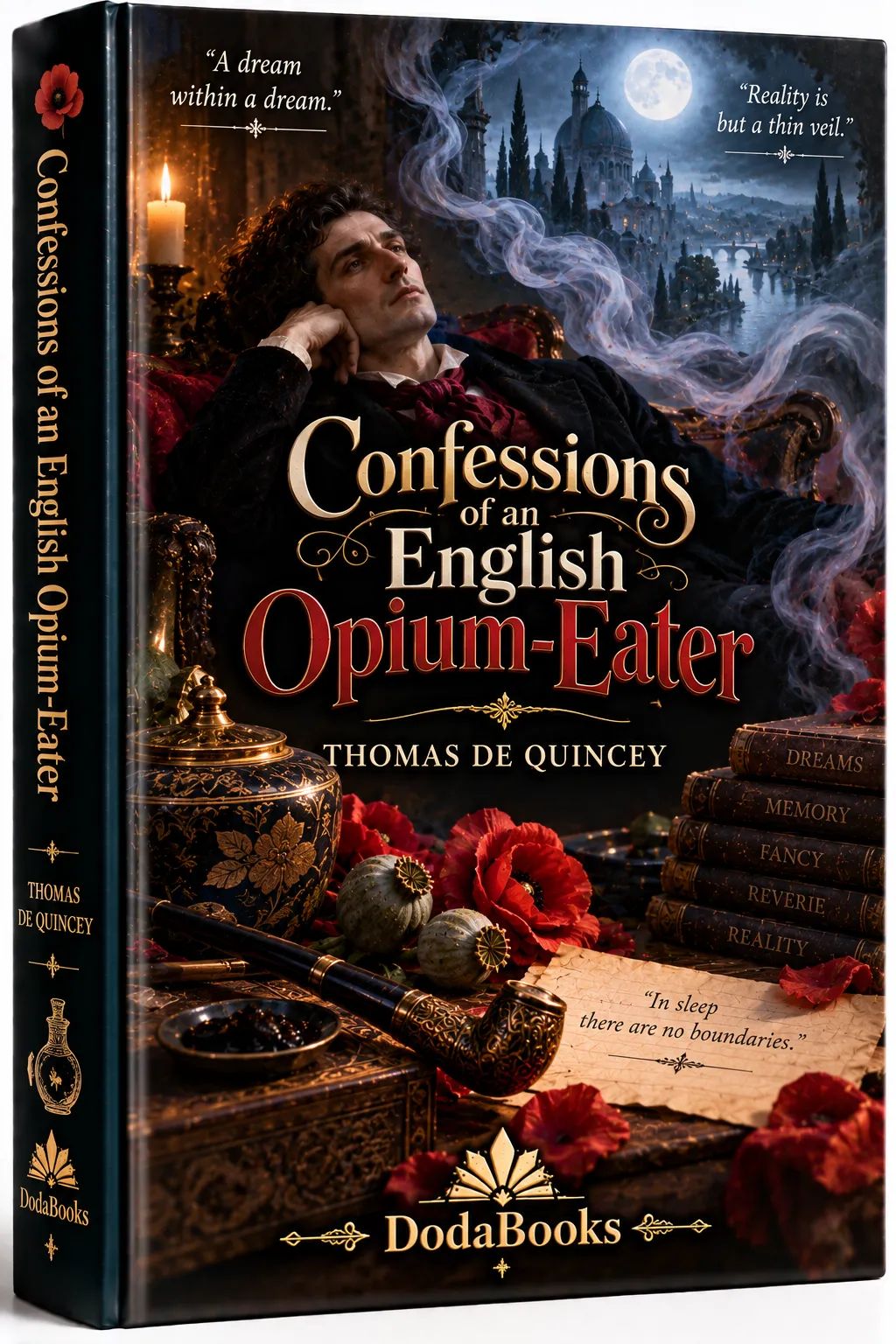
Read the Definitive Annotated Edition
Experience Thomas De Quincey's Romantic masterpiece with extensive explanatory notes on 19th-century pharmacology, Regency London topography, and classical philosophical allusions.
Get the Annotated eBookNarrative Structure: From Homeless Prodigy to the Phantasmagoria
De Quincey structured his autobiographical confession into two distinct, interconnected movements that balance documentary realism with visionary hallucination:
Part I: The Preliminary Confessions
The narrative opens not with the drug, but with De Quincey’s youth. A brilliant Greek scholar who ran away from Manchester Grammar School at seventeen, De Quincey wandered through rural Wales before drifting to London, penniless and alienated from his aristocratic guardians.
Here, De Quincey paints some of the most moving, heartbreaking descriptions of urban poverty in nineteenth-century literature:
- The Abandoned House in Greek Street: Surviving on crusts in a drafty, rat-infested house alongside a friendless ten-year-old orphan girl.
- Ann of Oxford Street: His tragic friendship with Ann, a teenage London prostitute whose kindness and selfless generosity saved his life during a deadly fever on the cold pavements of Soho. When De Quincey temporarily left London, he lost all trace of Ann, and her haunting, lost memory became the emotional anchor of his lifetime.
                    THE BIOGRAPHICAL ARC OF THE OPIUM-EATER

       Regency Runaway (1802)                  The Panacea (1804)               The Nightmare Abyss (1812–1821)
    ┌───────────────────────────┐           ┌───────────────────────────┐     ┌────────────────────────────────┐
    │ Cold Soho pavements       │           │ Laudanum prescribed for   │     │ 8,000 drops of laudanum a day  │
    │ Starvation & Orphan Child │ ────────► │ excruciating facial pain  │ ──► │ Piranesi staircases of doom    │
    │ Lost Love: Ann of Oxford  │           │ Ecstatic sensory harmony  │     │ Malay phantom & Oriental terror│
    │       Street              │           │ "Pleasures of Opium"      │     │ "Pains of Opium" & Paralysis   │
    └───────────────────────────┘           └───────────────────────────┘     └────────────────────────────────┘
Part II: The Pleasures and Pains of Opium
In 1804, while a student at Oxford suffering from excruciating neuralgic facial pain, De Quincey purchased his first vial of tincture of opium (laudanum) at a chemist’s shop on Oxford Street. The initial effect was nothing short of divine revelation: an intoxicating clarity of intellect, emotional serenity, and heightened aesthetic appreciation during opera performances in Covent Garden.
Yet by 1812, daily therapeutic use had metastasized into catastrophic physical dependency, consuming up to 8,000 drops (nearly half a pint) of laudanum per day. The sublime “Pleasures” collapsed into the terrifying “Pains”: relentless digestive agony, creative paralysis, and apocalyptic nocturnal dreams that threatened to extinguish his sanity.
The Dream Architecture: Piranesi Staircases and the Malay Phantom
What elevates Confessions of an English Opium-Eater into the pantheon of world literature is De Quincey’s visionary rendering of his nightmares during the final chapters:
- The Spatial Vertigo (The Piranesi Effect): Influenced by Italian engraver Giovanni Battista Piranesi’s Carceri d’Invenzione (Imaginary Prisons), De Quincey dreamed of colossal, Gothic stone staircases winding upward into infinite mists, where he watched himself climbing endlessly without ever reaching a summit, only to look down into bottomless abysses.
- The Horror of Infinite Time: In his dreamscapes, time expanded into terrifying cosmological proportions. Centuries and millennia were compressed into single nights: “I sometimes seemed to have lived for seventy or a hundred years in one night; nay, sometimes had feelings representative of a millennium passed in that time.”
- The Malay Phantom and Oriental Dread: A mysterious, wandering Malay sailor who briefly appeared at De Quincey’s cottage in Grasmere was transformed by his laudanum dreams into an ominous, mythological demon, dragging the dreamer into chaotic, ancient Asian civilizations—crawling with crocodiles, Chinese pagodas, and idolatrous temples that suffocated the soul.
                      DE QUINCEY'S DUAL VISIONS OF OPIUM

          The Pleasures of Opium                 The Pains of Opium
     ┌───────────────────────────────┐   ┌───────────────────────────────┐
     │ Transcendent mental clarity   │   │ Paralysis of the will         │
     │ Deep aesthetic harmony at opera│  │ Infinite Piranesi staircases  │
     │ Universal benevolence & peace │   │ Suffocating Asian phantoms    │
     │ Lyrical sensory expansion     │   │ Resurfacing of unresolved grief│
     └───────────────────────────────┘   └───────────────────────────────┘
                     ▲                                   ▲
                     └─────────────────┬─────────────────┘
                                       ▼
                       The Psychological Truth of Addiction:
                       The Panacea Becomes the Torturer
Major Themes in De Quincey’s Masterpiece
1. The Invention of “Impassioned Prose”
De Quincey consciously rebelled against the dry, balanced, rationalist prose of eighteenth-century essayists like Samuel Johnson and Joseph Addison. He created a new literary idiom—an ornate, musical, rhythmic prose style featuring Latinate cadences, cascading subordinate clauses, and symphonic crescendos designed to evoke the fluid logic of dreams and unconscious memory.
2. The Palimpsest of the Human Mind
In a famous metaphor elaborated in his later writings, De Quincey compared the human brain to a palimpsest—an ancient parchment where successive layers of writing have been erased, yet where no memory is ever truly destroyed. Under the chemical influence of opium, ancient childhood memories, the lost face of Ann of Oxford Street, and forgotten guilts were chemically revived, anticipating Sigmund Freud’s theories of the unconscious by nearly a century.
3. Urban Alienation in the Modern Metropolis
De Quincey was the first great English flâneur to document the cold, crushing indifference of the modern industrial city. Walking the rainy avenues of London, he realized that a man could starve to death in the midst of millions of fellow citizens—a theme of metropolitan solitude that would profoundly influence later urban masterworks such as Leroy Scott’s Children of the Whirlwind and Charles Dickens.
Comparative Literary Context
To contextualize De Quincey’s groundbreaking masterpiece within the wider world of literature, philosophy, and memoir, consider these parallels:
| Work & Author | Era & Milieu | Mode & Genre | Core Focus |
|---|---|---|---|
| Confessions of an English Opium-Eater (Thomas De Quincey) | Regency Britain (1821) | Romantic Memoir & Essay | Lyrical addiction, London wanderings, dreamscapes |
| Anarchism and Other Essays (Emma Goldman) | Early 20th c. USA (1910) | Revolutionary Philosophy | Social liberation, prison abolition, feminist autonomy |
| The Zeppelin’s Passenger (E. Phillips Oppenheim) | WWI England (1918) | Espionage Mystery | Wartime home front intrigue, loyalty, enemy spies |
| Two on a Tower (Thomas Hardy) | Victorian Wessex (1882) | Cosmic Realism & Romance | Stellar astronomy, secret passion, class tragedy |
While radical political philosophers like Emma Goldman focused on liberating humanity from external economic and state coercion, Thomas De Quincey explored the internal, metaphysical prisons of the human mind. Furthermore, just as Thomas Hardy in Two on a Tower explored how the vastness of the stellar cosmos induces existential vertigo, De Quincey discovered that same terrifying infinity within the boundless recesses of his own opium-stimulated imagination.
Step Inside De Quincey's Dream Labyrinth
Experience Confessions of an English Opium-Eater in this definitive annotated edition, complete with historical notes on Regency pharmacology, London street maps, and critical essays.
Read The Annotated EditionThe Enduring Legacy of De Quincey’s Confessions
Published anonymously in 1821, the Confessions became an instant bestseller, scandalizing moralists while captivating the literary world. French poet Charles Baudelaire was so enchanted by the book that he translated and adapted it into his landmark study of narcotics, Les Paradis Artificiels (1860). Hector Berlioz credited the work as the direct inspiration for his groundbreaking orchestral masterpiece Symphonie Fantastique.
Today, Confessions of an English Opium-Eater remains an astonishingly fresh and vital work. In an era still wrestling with the complexities of chemical dependency, mental health, and urban loneliness, De Quincey’s honest, compassionate, and beautifully orchestrated confession stands as a towering monument of English literature.
Frequently Asked Questions
Why did Thomas De Quincey start taking opium?
De Quincey first took opium in 1804 while an undergraduate student at Oxford University to relieve excruciating neuralgic facial pain and toothache. At the time, laudanum (opium dissolved in alcohol) was completely legal, cheap, and widely prescribed by physicians as a universal cure for pain, coughs, and gastrointestinal ailments.
Who was Ann of Oxford Street and why is she so significant?
Ann of Oxford Street was a sixteen-year-old London prostitute who befriended De Quincey when he was a destitute, starving runaway in Soho. On one occasion, when De Quincey collapsed from hunger on the street, Ann spent her last pennies to buy him warm wine and spice, saving his life. After De Quincey temporarily left London, he searched desperately for her but never found her again; she remained a permanent, haunting symbol of lost innocence and angelic grace throughout his dreams.
Did De Quincey ever recover from his opium addiction?
De Quincey struggled with laudanum dependency for over five decades. While he managed to drastically reduce his dosage at several points in his life to write and support his family, he never completely stopped taking the drug. He died at the age of seventy-four in Edinburgh, outliving many of his non-addicted contemporary Romantic peers.
What literary influence did Confessions have on later authors?
The Confessions invented modern addiction literature and profoundly shaped psychological fiction. Authors directly influenced by De Quincey's baroque prose and dream aesthetics include Edgar Allan Poe, Charles Baudelaire, Arthur Conan Doyle (who gave Sherlock Holmes an opium addiction), Jorge Luis Borges, and William S. Burroughs.
What features are included in the DodaBooks annotated edition?
The DodaBooks annotated edition includes comprehensive annotations identifying the 19th-century medical uses and pharmacology of laudanum, historical maps of Regency London and the Soho streets frequented by De Quincey, classical translations of his extensive Greek and Latin references, and critical commentaries on Romantic psychology. You can explore and download the definitive annotated edition directly from DodaBooks at https://dodabooks.com/ebook/confessions-of-an-english-opium-eater-by-thomas-de-quincey/.
Related Romantic and Literary Masterpiece Guides
Explore further classic essays, Romantic literature, and psychological memoirs in our collection: