Childe Harold's Pilgrimage Summary by Canto: Complete 4-Canto Guide (Lord Byron)
Published in sections between 1812 and 1818, Lord Byron’s Childe Harold’s Pilgrimage was one of the most explosive literary sensations in Western history. Following the publication of Cantos I and II in March 1812, the twenty-four-year-old poet famously remarked: “I awoke one morning and found myself famous.” The poem single-handedly launched the nineteenth-century European cult of Byronism, redefining Romantic literature through its restless, brooding traveler who flees moral exhaustion in England to wander across a war-torn and historically resonant Europe.
Composed in the nine-line Spenserian stanza, the poem operates simultaneously as a grand travelogue, a fierce anti-tyrannical political manifesto, a meditation on the ruins of fallen empires, and an intimate psychological autobiography. Moving from the blood-soaked battlefields of the Peninsular War in Portugal and Spain (Canto I) to the Ottoman-ruled ruins of classical Greece (Canto II), the cataclysm of Waterloo and the sublime Swiss Alps (Canto III), and finally the tragic monuments of Renaissance and Roman Italy (Canto IV), Byron crafts an epic of historical disillusionment and artistic transcendence.
This comprehensive canto-by-canto guide analyzes the narrative journey, historical backdrops, philosophical epiphanies, and landmark passages across all four cantos.
| Canto | Publication | Primary Setting | Critical Narrative & Philosophical Milestones |
|---|---|---|---|
| Canto I | 1812 | Portugal & Spain | Harold flees English satiety; Lisbon & Sintra; Peninsular War battlefields (Talavera); bullfight in Cadiz; defiance of Napoleonic tyranny. |
| Canto II | 1812 | Greece & Albania (Ottoman Empire) | Mediterranean voyage; Ali Pasha’s court at Tepelena; lament over ruined Athens; fierce condemnation of Lord Elgin’s stripping of Parthenon marbles. |
| Canto III | 1816 | Belgium, the Rhine & Switzerland | Exiled Byron parts from daughter Ada; battlefield of Waterloo; Napoleon’s hubris; sublime Lake Leman; spiritual communion with nature & Rousseau. |
| Canto IV | 1818 | Italy (Venice, Florence & Rome) | Bridge of Sighs in Venice; tombs of Dante & Petrarch; Rome as “Niobe of nations”; the Dying Gladiator; closing sublime apostrophe to the Ocean. |
🇪🇸 Canto First: Satiety, Spain, and the Peninsular War
CANTO I: FLIGHT FROM ENGLAND TO IBERIA
Albion (London) ──► Lisbon & Sintra ──► Battle of Talavera ──► Cadiz Bullfight
(Moral Satiety)     (Deceptive Eden)     (War's Brutal Folly)    (Spanish Defiance)
The Sated Aristocrat
The poem opens with an introduction to Childe Harold—the title “Childe” being an archaic medieval designation for a young noble candidate for knighthood. Harold is a young English aristocrat who has squandered his youth in reckless debauchery, sensual excess, and cynical pleasure-seeking. Stricken by deep spiritual satiety, melancholia, and disgust with high society, Harold rejects his homeland (“Albion”) and bids farewell to his ancestral halls in the famous lyric “Good Night to my native Shore.”
Portugal: The Deceptive Eden
Harold sails to Lisbon, sailing past the mouth of the Tagus. While the lush mountain palaces of Sintra appear to be a pastoral paradise, Harold quickly observes the grim contrast between nature’s magnificence and human squalor: Lisbon is filthy, impoverished, and degraded by foreign occupation. Byron delivers a scathing political critique of the Convention of Cintra (1808), in which bumbling British diplomats allowed defeated French forces to evacuate Portugal with all their plunder intact.
Spain: The Carnage of War
Traveling on horseback across the Sierra Morena into Spain, Harold plunges into the horrors of the Peninsular War (1807–1814). Rather than romanticizing warfare, Byron describes battlefield slaughter with unsparing realism. At the plains of Talavera and Albuera, thousands of French and Spanish soldiers bleed to death for the vain ambitions of crowned tyrants:
“There shall they rot—Ambition’s honour’d fools!
Yes, Honour decks the turf that wraps their clay!
Vain Sophistry! in these behold the tools,
The broken tools, that tyrants cast away…”
The Maid of Saragossa & The Bullring of Cadiz
In contrast to the incompetent Spanish aristocracy, the common people of Spain fight for their freedom with heroic fury. Byron celebrates Agustina, the Maid of Saragossa, a young woman who stepped over the dead body of her lover to fire the city cannons against Napoleon’s besieging legions.
The canto concludes in the sun-drenched, sensual port city of Cadiz. Harold attends a traditional Sunday bullfight, which Byron depicts in lavish, bloody detail. The spectacle of the gored horses, the dying bull, and the cheering spectators mirrors the broader violence of European warfare: mankind’s insatiable thirst for blood cloaked in festive ritual. Despite Cadiz’s radiant women, Harold remains emotionally isolated, confessing to a Spanish maiden (Ines) that his heart is permanently frozen by a hidden, incurable sorrow.
🏛️ Canto Second: Albania, Ruined Greece, and the Curse of Elgin
Harold sails from Gibraltar into the Mediterranean, passing Malta and the Ionian Islands to enter the mysterious, Ottoman-controlled territory of Epirus (modern-day Albania and northern Greece).
CANTO II: THE OTTOMAN EAST & THE ATHENIAN RUINS
Ionian Sea ──► Tepelena (Ali Pasha) ──► Acropolis of Athens ──► Lament for Hellas
(Sailing East) (Albanian Hospitality)   (Elgin's Desecration)   ("Hereditary Bondsmen")
The Rugged Land of Albania
In 1809, Albania was an exotic, virtually unvisited territory for Western Europeans. Harold journeys through wild mountain gorges to the remote mountain fortress of Tepelena to visit the court of the legendary Ottoman ruler Ali Pasha:
- Ali Pasha is a fascinating study in despotism: a courtly, white-bearded patriarch of exquisite manners who simultaneously rules his subjects with ruthless, bloodthirsty terror.
- Harold is deeply impressed by the fierce martial independence and loyal hospitality of the Suliote warriors, whose traditional dances and war chants (“Tambourgi! Tambourgi!”) Byron transcribes with anthropological vitality.
The Desecration of Athens
Crossing into Attica, Harold’s mood darkens into profound grief as he climbs the Acropolis of Athens. Where classical philosophy, democracy, and art once flourished, Harold finds goats grazing among fallen temple columns under the lazy gaze of Turkish sentries.
Byron launches a blistering, world-famous polemic against his fellow countryman, Thomas Bruce, 7th Earl of Elgin, who between 1801 and 1812 systematically dismantled the Parthenon’s friezes and shipped the marbles to Britain:
“Cold is the heart, fair Greece! that looketh on thee,
Nor feels as lovers o’er the dust they loved;
Dull is the eye that will not weep to see
Thy walls defaced, thy mouldering shrines removed
By British hands, which it had best behoved
To guard those relics ne’er to be restored.”
The Call to Freedom
Byron addresses the enslaved Greek people with fiery revolutionary passion, warning them that foreign empires (Britain, France, or Russia) will never grant them independence:
“Hereditary bondsmen! know ye not
Who would be free themselves must strike the blow?”
This rallying cry anticipated Byron’s actual physical sacrifice a decade later, when he sailed to Greece in 1823 to fight and die for Greek independence at Missolonghi.
🌊 Canto Third: Waterloo, Rousseau, and the Alpine Sublime
Published four years after Cantos I and II in November 1816, Canto III marks a dramatic evolution in Byron’s poetic genius. In the intervening years, Byron had achieved stratospheric fame, married Annabella Milbanke, suffered a disastrous marital collapse amidst rumors of incest, and was driven into permanent exile from England amidst public scandal.
Consequently, in Canto III, the fictional mask of “Childe Harold” largely dissolves: the speaker is unmistakably Lord Byron himself, addressing his infant daughter Ada Lovelace, whom he would never see again:
“Is thy face like thy mother’s, my fair child!
ADA! sole daughter of my house and heart?
When last I saw thy young blue eyes they smiled,
And then we parted,—not as now we part,
But with a hope.—”
CANTO III: TRAUMA, HISTORY & TRANSCENDENCE
Exile from England ──► Waterloo Battlefield ──► Rhine Castles ──► Lake Leman (Geneva)
(Daughter Ada)         (Napoleon's Hubris)     (Romantic Ruins)    (Alpine Storm & Pantheism)
The Battlefield of Waterloo
Traveling across Flanders, Byron visits the field of Waterloo, where Napoleon had met his final defeat just one year prior in June 1815. Byron vividly recreates the tragic eve of the battle—the famous Duchess of Richmond’s Ball in Brussels, where the sounds of waltzing and youthful laughter were suddenly drowned out by the thundering roar of French artillery:
“There was a sound of revelry by night,
And Belgium’s capital had gather’d then
Her Beauty and her Chivalry, and bright
The lamps shone o’er fair women and brave men…
But hush! hark! a deep sound strikes like a rising knell!”
Byron meditates on the psychology of Napoleon Bonaparte. He views the Emperor not as an ordinary villain, but as a titanic, restless Byronic soul whose unquenchable ambition and inability to govern his own passions doomed him to defeat and exile on Saint Helena.
The Rhine and Lake Leman
Byron travels up the Rhine, past crumbling medieval castles, and settles in Switzerland on the shores of Lake Leman (Lake Geneva). Here, spending the summer of 1816 with Percy Bysshe Shelley, Mary Shelley, and Claire Clairmont, Byron’s poetry achieves cosmic spiritual height.
Influenced by Jean-Jacques Rousseau and Shelley’s pantheistic philosophy, Byron escapes human cruelty by communing directly with the natural sublime:
- When a ferocious summer thunderstorm erupts over the Alps, Byron identifies his own turbulent soul with the lightning crashing over the Jura mountains:
“I live not in myself, but I become
Portion of that around me; and to me
High mountains are a feeling, but the hum
Of human cities torture…”
Nature offers the solitary exile a sanctuary that human society denied him.
🏛️ Canto Fourth: Italy, the Colosseum, and the Eternal Ocean
Published in April 1818, Canto IV is the longest, grandest, and most triumphant section of the poem. Set entirely in Italy, the poet travels from Venice through Ferrara and Florence to Rome. The character of “Childe Harold” is entirely dropped; Byron speaks in his own magnificent, mature voice.
CANTO IV: THE ITALIAN PILGRIMAGE
Venice (Bridge of Sighs) ──► Florence (Santa Croce) ──► Rome (Colosseum) ──► The Eternal Ocean
(Dying Republic)             (Tombs of Genius)          ("Niobe of Nations")   (Apostrophe to Sea)
Venice: The Floating City
The canto opens with one of the most famous lines in English verse:
“I stood in Venice, on the Bridge of Sighs;
A palace and a prison on each hand:
I saw from out the wave her structures rise
As from the stroke of the enchanter’s wand…”
Byron laments the fallen glory of the Venetian Republic, now subjugated by Austrian rule, yet asserts that Venice lives forever through the art of Shakespeare (Othello, The Merchant of Venice) and her ancient maritime spirit.
Florence and Santa Croce
Passing through Ferrara (commemorating the tragic Renaissance poet Torquato Tasso), Byron arrives in Florence. In the church of Santa Croce, he meditates before the tombs of four Italian intellectual giants: Machiavelli, Michelangelo, Galileo, and Alfieri. He shames Florence for having exiled her greatest poet, Dante Alighieri, whose bones lie buried in Ravenna.
Rome: The Niobe of Nations
Arriving in Rome, Byron confronts the grandest ruins of human history. He famously dubs Rome *“the Niobe of nations”—*a weeping, childless queen whose imperial splendor has turned to dust.
Inside the ruins of the Colosseum, Byron composes his celebrated, heartbreaking description of the Dying Gladiator:
- An innocent Dacian barbarian, captured and brought to Rome to fight for the amusement of bloodthirsty Roman patricians.
- As the gladiator bleeds out upon the sand, his mind wanders far away from the cheering amphitheater to his humble thatched hut on the Danube, his playful children, and his young wife. Byron prophesies that vengeance will one day fall upon Rome for its cruelty.
THE DYING GLADIATOR'S FINAL THOUGHTS
Physical Reality in Rome:            Distant Spiritual Vision:
Blood dripping on amphitheater sand  ◄──────► Thatched hut on the Danube river
Cruel applause of Roman spectators   ◄──────► Young barbarian children at play
The Sublime Apostrophe to the Ocean
The poem culminates on the shores of the Mediterranean at sunset with the immortal Apostrophe to the Ocean (Stanzas 178–184). Standing before the surging waves, Byron contrasts the petty, fleeting empires of humanity (Assyria, Greece, Rome, Carthage) with the eternal, untamable power of the sea:
“Roll on, thou deep and dark blue Ocean—roll!
Ten thousand fleets sweep over thee in vain;
Man marks the earth with ruin—his control
Stops with the shore; upon the watery plain
The wrecks are all thy deed, nor doth remain
A shadow of man’s ravage, save his own,
When, for a moment, like a drop of rain,
He sinks into thy depths with bubbling groan,
Without a grave, unknell’d, uncoffin’d, and unknown.”
In the ocean, Byron finds the mirror of his own untamable soul. His pilgrimage concludes not with despair, but with magnificent, defiant serenity: the pilgrim departs, but his verse remains an eternal monument to human liberty.
❓ Frequently Asked Questions
Why did Childe Harold's Pilgrimage make Lord Byron so instantly famous?
When Cantos I and II appeared in 1812, Britain had been locked in exhausting wars against Napoleonic France for nearly two decades. Byron's vivid, eyewitness travel descriptions of sunny Portugal, Spain, and Ottoman Greece offered readers an intoxicating escape, while his dark, charismatic persona captured the romantic spirit of the age.
What is a Spenserian stanza?
A Spenserian stanza is a complex nine-line poetic form invented by Edmund Spenser in The Faerie Queene (1590). The first eight lines are written in iambic pentameter (10 syllables), while the final ninth line is an alexandrine (12 syllables in iambic hexameter), rhyming ababbcbcc. Byron adopted it to blend antique gravity with expansive romantic music.
Why did Byron abandon the character of "Harold" in Canto IV?
In Cantos I and II, Byron attempted to maintain a fictional boundary between himself and the cynical Harold. However, by 1816–1818, after his scandalous exile from England, the public already identified Harold completely with Byron. In Canto IV, Byron admitted in his preface that maintaining the persona was an unnecessary pretense, choosing to speak directly in his own voice.
How did the poem influence the Greek War of Independence?
Canto II was the opening salvo of the philhellenic movement in Europe. Byron's passionate lament for ancient Greek liberty and his excoriation of the Ottoman occupation inspired thousands of volunteers and intellectuals across Europe and America to support Greece's struggle for independence in the 1820s.
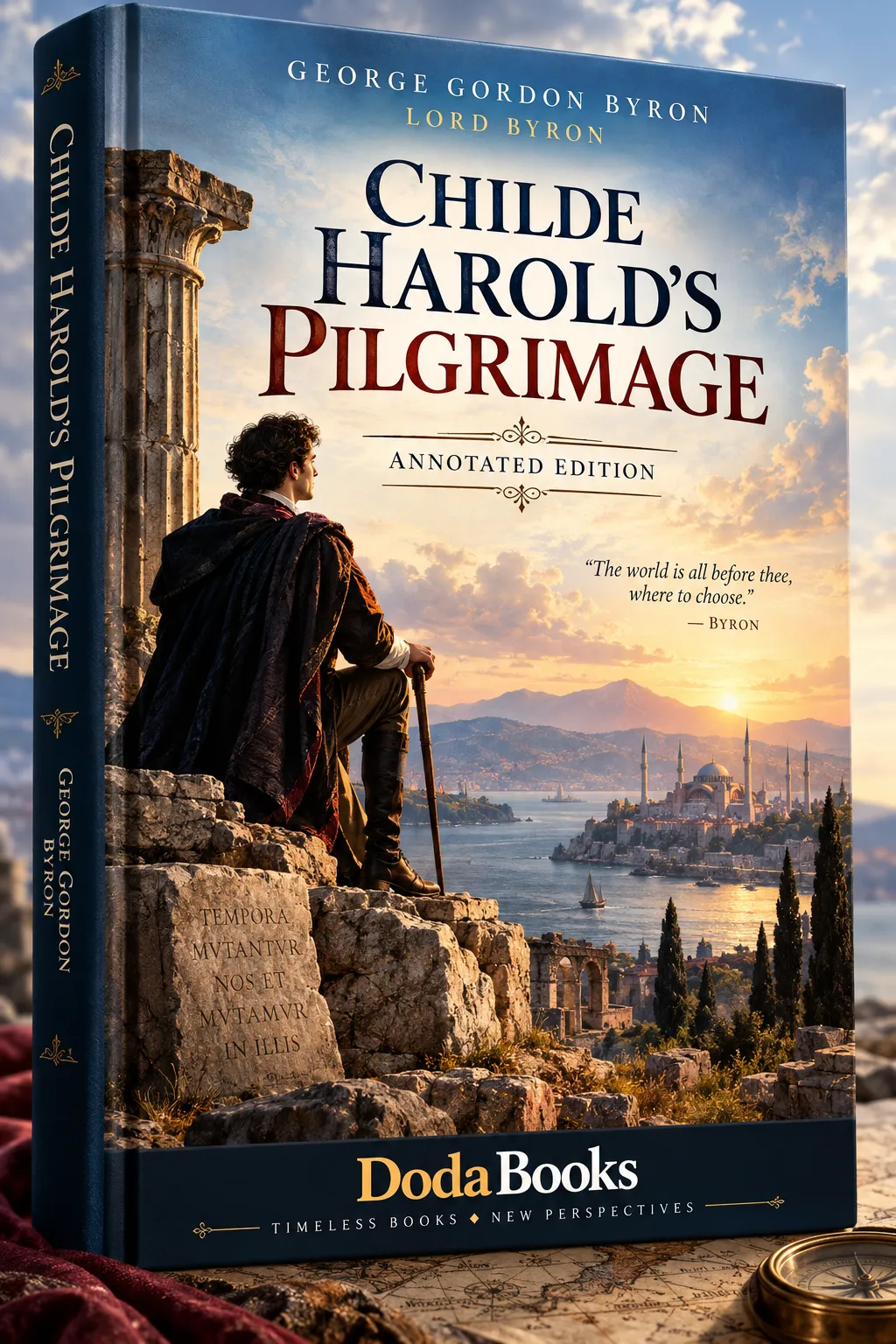
📖 Experience Byron’s Landmark Romantic Epic
Read Lord Byron’s monumental masterpiece with complete historical, classical, and biographical context in the DodaBooks Annotated Edition:
- 🏛️ All 4 Cantos Complete & Unabridged — Restored from the authoritative 1818 text
- 💡 Exhaustive Footnotes on the Napoleonic Wars & Classical Rome — Explaining Waterloo, Ali Pasha, Elgin, and the Colosseum
- 📱 Designed for Verse Reading — Proper Spenserian stanza indentation optimized for e-readers and smartphones
- 🔓 100% DRM-Free — Read anywhere on Kindle, Kobo, iPad, or Android with complete freedom
👉 Get the Annotated Edition of Childe Harold’s Pilgrimage at DodaBooks →