Lord Byron’s Childe Harold’s Pilgrimage (1812–1818) was the literary sensation that transformed a melancholic young nobleman into Europe’s first celebrity poet overnight. Following a disillusioned aristocrat across the battlefields, ruins, and sublime vistas of war-torn Europe, this poetic masterpiece redefined modern heroism, melancholia, and romantic wanderlust for generations to come.
🦅
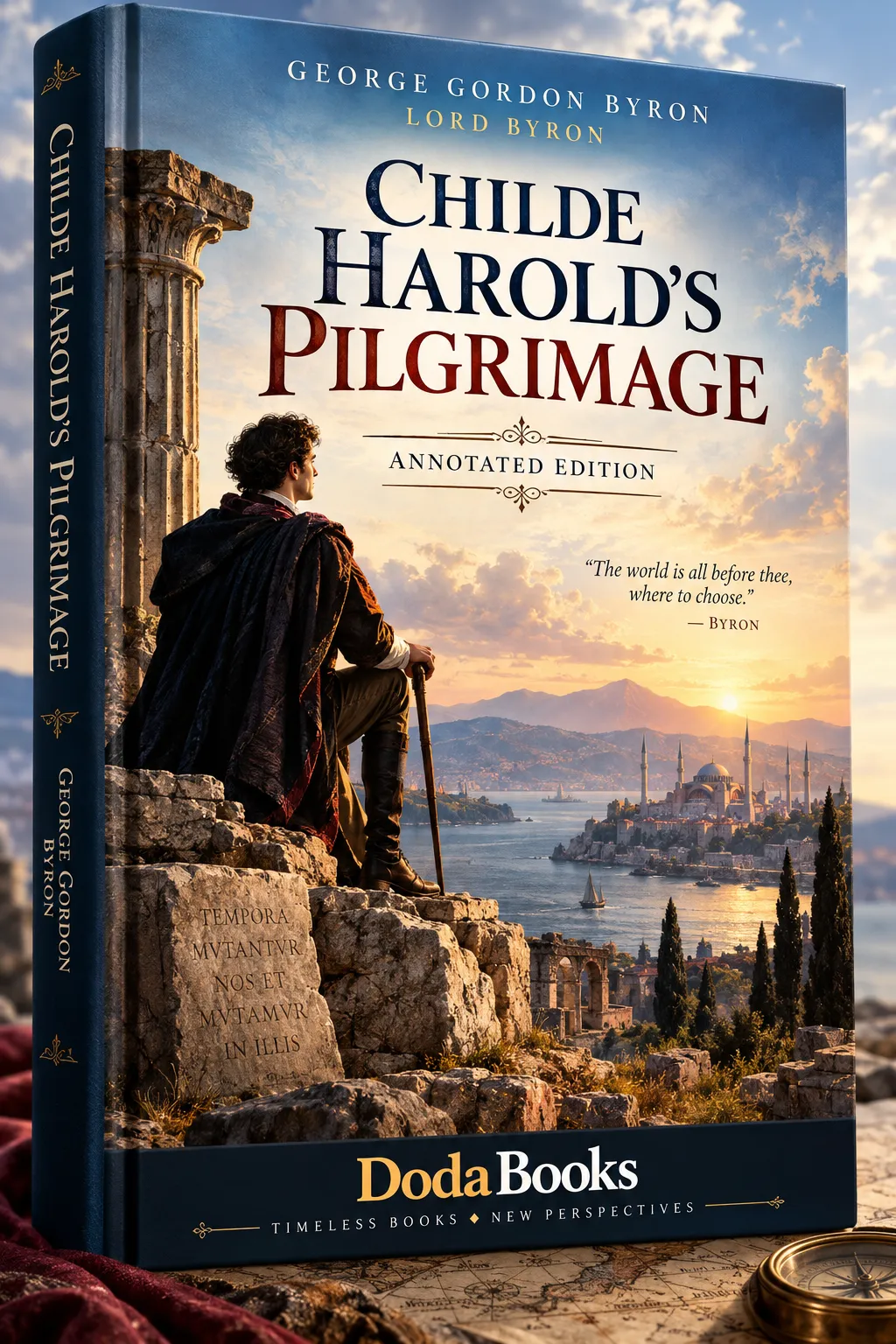
Childe Harold's Pilgrimage
The revolutionary Spenserian epic that birthed the Byronic hero and ignited European Romanticism. Join Lord Byron's melancholic wanderer across Portugal, Spain, Greece, Albania, Waterloo, and the sublime Swiss Alps.
| Author | Lord Byron (George Gordon Byron) |
| Published | 1812–1818 (Cantos I–IV) |
| Genre | Narrative Poetry, Romanticism, Travelogue |
| Form | Spenserian Stanza (ababbcbcc) |
| Setting | Portugal, Spain, Albania, Greece, Waterloo, Switzerland, Italy |
| Central Themes | Disillusionment, Solitude, Imperial Ruin, Sublime Nature, Historical Memory |
| Reading Time | 4–6 hours |
| Summary Time | 20 minutes |
🏛️ The Genesis of a Cultural Phenomenon
When the first two cantos of Childe Harold’s Pilgrimage were published by John Murray in March 1812, its twenty-four-year-old author famously remarked in his journal: “I awoke one morning and found myself famous.” The initial print run of five hundred quarto copies sold out in three days, followed by edition after edition as reading parlors across Britain and continental Europe fell under Byron’s hypnotic spell.
The origins of the poem lie in Byron’s grand tour of the Mediterranean between 1809 and 1811. Barred from touring conventional European destinations due to the Napoleonic Wars, Byron and his friend John Cam Hobhouse journeyed through Lisbon, Seville, Cadiz, Gibraltar, Malta, Albania, and Greece. Byron carried notebooks wherever he traveled, recording direct sensory impressions of local customs, guerrilla resistance against French occupation, ancient ruins overgrown with weeds, and the stark political subjugation of modern Greeks under Ottoman rule.
Byron chose the ancient title “Childe”—a medieval designation for a young noble candidate awaiting knighthood—to emphasize Harold’s youth, inherited status, and moral unreadiness. Harold sets sail not on a chivalric mission of holy devotion, but to escape profound spiritual exhaustion (ennui), satiety from reckless youthful debauchery, and the bitter agony of unrequited affection.
"Whilome in Albion's isle there dwelt a youth,
Who ne in virtue's ways did take delight;
But spent his days in riot most uncouth,
And vex'd with mirth the hallows of the night."
Yet as the poem progressed across its subsequent cantos—composed after Byron’s scandalous divorce and permanent exile from England in 1816—the fictional persona of Harold gradually dissolved. In Cantos III and IV, Harold recedes into the shadows, and Byron speaks directly in his own electrifying, vulnerable, and monumental voice.
🗺️ Canto-by-Canto Narrative Breakdown
Canto I: The Iberian Peninsular War
The poem opens with Harold bidding farewell to his ancestral hall and native shores. Arriving in Portugal, he marvels at the breathtaking topography of Cintra while contrasting natural beauty with the squalor and political corruption of Lisbon. Crossing into Spain, Harold witnesses the raw ferocity of the Peninsular War. He visits the bloody battlefield of Talavera, gazes upon the Maid of Saragossa fighting fiercely at the ramparts alongside Spanish patriots, and attends a ferocious bullfight in Cadiz. The canto is defined by a searing critique of military vanity: kings and generals gamble human lives for fleeting political prestige, leaving common soldiers to bleach upon barren plains.
Canto II: Greece and the Tragedy of Fallen Greatness
Harold voyages across the Ionian Sea, docking in Prevesa and venturing deep into the rugged mountains of Albania. He is hosted by the notorious warlord Ali Pasha at Tepeleni, documenting Albanian folk dances, honor codes, and martial hospitality with ethnographic precision. From Albania, Harold travels to Athens. Standing amidst the Parthenon ruins, Byron vents fierce indignation against Lord Elgin for looting the Parthenon marbles, mourning that modern Greece lies dormant under Ottoman despotism while European travelers treat her monuments as artistic plunder.
Canto III: Waterloo, the Rhine, and the Alpine Sublime
Written in Switzerland during the celebrated “Year Without a Summer” of 1816, Canto III represents a dramatic philosophical leap. Byron reflects on his recent domestic catastrophe and daughter Ada before turning his gaze toward the battlefield of Waterloo. He meditates upon the tragic ambition of Napoleon Bonaparte—a mind of volcanic power defeated by its inability to rest—before journeying up the Rhine valley to Lake Geneva. In Switzerland, influenced by Percy Bysshe Shelley and Jean-Jacques Rousseau, Byron communes with the tempestuous beauty of the Alps, discovering in thunderstorm and glacier a spiritual sanctuary far superior to human society.
"I live not in myself, but I become
Portion of that around me; and to me
High mountains are a feeling, but the hum
Of human cities torture."
Canto IV: Venice, Rome, and the Immensity of Ocean
Canto IV is Byron’s Italian masterpiece. Opening on the Bridge of Sighs in Venice, Byron reflects on the decline of the Venetian Republic before moving through Ferrara, Florence, and Arqua. In Rome, the poet contemplates the Colosseum and the dying gladiator, meditating on the rise and fall of empires: “Assyria, Greece, Rome, Carthage, what are they?” The poem culminates in the legendary apostrophe to the Ocean at Civitavecchia, where the sea stands as an eternal, invincible force that swallows mortal vanity, naval armadas, and conquering tyrants without a trace.
🎭 The Birth of the Byronic Hero
Childe Harold’s Pilgrimage is the foundational text of the Byronic hero—an archetype that permanently reshaped world literature, inspiring Charlotte Brontë’s Rochester, Emily Brontë’s Heathcliff, Melville’s Captain Ahab, and Dostoevsky’s underground men.
Psychological Anatomy
What makes the Byronic hero so radically compelling compared to classical heroic models?
- Alienation and Guilt: The Byronic hero carries a dark, unspoken transgression in his past—a secret remorse that renders conventional social honors hollow.
- Intellectual Superiority and Cynicism: He possesses razor-sharp perception and scorns hypocritical social institutions, religious dogmatism, and moral platitudes.
- Brooding Passion: Beneath his icy aristocratic exterior burns volcanic emotional intensity, capable of fierce loyalty or devastating vengeance.
- Defiant Individualism: Even when crushed by fate or societal condemnation, he refuses to surrender his autonomy or bow to orthodox repentance.
🦅 CHILDE HAROLD
The Restless Wanderer
“With pleasure drugg’d, he almost long’d for woe, / And e’en for change of scene would seek the beaten foe.”
Harold represents the archetypal aristocratic exile. Satiated by hedonism yet spiritually starved, he abandons homeland and domestic warmth to roam foreign shores in search of authentic emotion.
Why He Matters
Harold transformed the travelogue from factual journalism into a psychological drama. By projecting inner despair onto external historical landscapes, Harold established that the ultimate journey is an expedition into the depths of human consciousness.
👑 LORD BYRON (THE NARRATOR)
The Poetic Titan
“I have not loved the world, nor the world me; / I have not flatter’d its rank breath, nor bow’d / To its idolatries a patient knee.”
Byron begins as an omniscient narrator commenting on Harold’s journey, but gradually overtakes the narrative entirely. His autobiographical intimacy, biting political satire, and philosophical defiance provide the poem with its enduring vitality.
Why He Matters
Byron shattered the fourth wall between author and protagonist. He turned lyric poetry into a direct confession of existential agony, political rebellion, and aesthetic ecstasy that spoke directly to a generation shattered by political revolution.
📘 Annotated Insight — Byron’s use of the Spenserian stanza (nine lines rhyming ababbcbcc with an alexandrine finale) was an audacious homage to Edmund Spenser’s The Faerie Queene. While Spenser used the form for allegorical chivalry, Byron weaponized its intricate musicality for brooding introspection, sudden conversational satire, and thunderous historical declarations.
🔍 Major Themes & Literary Analysis
1. The Transience of Empire and Human Vanity
Throughout Harold’s journey, monumental empires crumble into dust. Byron lingers over the bones of fallen soldiers at Talavera and Waterloo, the bleached marble of Athens, and the ruined arches of Rome. For Byron, history is an eternal cycle of tyranny, revolt, corruption, and decay. The poet warns contemporary imperial powers—most notably Great Britain—that their proud navies and triumphant armies will eventually meet the exact same fate that befell Caesar, Alexander, and Napoleon.
2. Nature as Spiritual Transcendence
When human companionship produces only betrayal and sorrow, the natural world offers restorative communion. In the high Swiss Alps, Byron describes lightning storms not as terrifying disasters, but as expressions of cosmic vitality that echo the turbulent soul. Nature is not an indifferent backdrop; it is an animate sanctuary where the poet can dissolve the torment of individual identity into mountain mist and rushing river.
3. The Unconquerable Human Mind
Despite his pervasive melancholy, Byron champions the creative intellect as man’s ultimate dignity. In Canto IV, the dying Roman gladiator, though bleeding on the amphitheater sand for the amusement of a barbaric mob, retains sovereignty over his thoughts, mentally returning to his humble hut on the Danube and his innocent children. Physical chains and tyrannical empires cannot subdue the sovereign mind.
📖 Explore the Annotated Edition at DodaBooks →
✨ What Makes the DodaBooks Annotated Edition Essential
Reading Childe Harold’s Pilgrimage in a raw public domain scan is an exhausting trial. The text contains hundreds of untranslated Latin and Italian quotations, obscure geographical references to forgotten Balkan mountain passes, and dense political commentary on the Peninsular War that modern readers cannot decipher without continuous reference lookups.
The DodaBooks Annotated Edition restores the brilliance and readability of Byron’s masterpiece:
Comprehensive Historical Footnotes
Every reference to Waterloo, Ali Pasha, Lord Elgin, and the Iberian Peninsular campaign explained in immediate context.
Classical Allusion Unpacker
Greek mythology, Roman emperors, architectural ruins, and philosophical references made instantly crystal clear.
Geographical Context
Track Harold and Byron across Spain, Albania, the Swiss Alps, and Venice with detailed itinerary notes.
Meter & Form Commentary
Appreciate Byron's masterful mastery of the Spenserian stanza with poetic analysis across all four cantos.
Pure DRM-Free Ownership
Keep your EPUB file forever. Read on Kindle, Kobo, iPad, reMarkable, or your favorite mobile reading app.
Flawless Typesetting
Enjoy handcrafted typography, custom drop caps, proper poetic indentation, and zero scanning corruptions.
❓ Frequently Asked Questions
Why is the poem called "Childe" Harold's Pilgrimage?
In medieval English heraldry, a "Childe" was a title reserved for a noble youth candidate who had not yet won his spurs as a knight. Byron used the archaic term to signal Harold's aristocratic pedigree, youthful inexperience, and ironic status as an anti-hero who undertakes a pilgrimage not for religious absolution, but to flee his own inner exhaustion.
Is Childe Harold based on Lord Byron himself?
Yes. While Byron initially attempted to maintain a polite fictional separation between himself and Harold, contemporaries recognized immediately that Harold was a direct portrait of the young poet. By Cantos III and IV, composed during Byron's exile from Britain, Byron largely dropped the Harold mask and spoke directly in his own autobiographical voice.
What is the Spenserian stanza and why did Byron use it?
The Spenserian stanza consists of nine lines rhyming ababbcbcc, featuring eight iambic pentameter lines concluded by a single six-foot alexandrine line. Invented by Edmund Spenser for The Faerie Queene, Byron adopted it to blend antique courtly music with modern, sweeping rhetorical declarations.
Why was Lord Elgin controversial in Canto II?
In Canto II, Byron passionately denounces Lord Elgin for removing classical marble sculptures from the Parthenon in Athens and shipping them to Britain. Byron regarded this as cultural vandalism and theft from an oppressed nation unable to protect its own heritage.
How long does it take to read Childe Harold's Pilgrimage?
The poem comprises approximately 4,500 lines across four cantos. Most readers complete it in 4 to 6 hours. However, reading with scholarly annotations offers a significantly richer experience by unlocking Byron's dense historical, political, and philosophical allusions.
Why should I choose the DodaBooks edition over a free Gutenberg copy?
Raw public domain versions of Byron's poetry are notoriously difficult to read: line breaks are often mangled, French and Latin quotations lack translations, and critical historical footnotes are omitted. DodaBooks provides a carefully typeset, complete edition with comprehensive modern annotations, ensuring an effortless, immersive reading experience.
🦅 Journey Through Europe with the Ultimate Romantic Epic
Don’t struggle through obscure 19th-century references, untranslated Latin verses, and mangled formatting. The DodaBooks Annotated Edition of Childe Harold’s Pilgrimage delivers:
- ✅ Complete Unabridged Text — All four cantos in their authoritative, unedited sequence
- 📜 Historical & Classical Footnotes — Context on Waterloo, Greek independence, and Roman ruins
- ✒️ Exquisite Poetry Typesetting — Beautiful indentation, smart quotes, and responsive layout
- 🔒 100% DRM-Free Freedom — Read smoothly across any e-reader or mobile device
- 📥 Instant Digital Delivery — EPUB format ready for immediate download