The Byronic Hero & Characters in Childe Harold's Pilgrimage Explained
Few literary archetypes have exerted as profound and permanent an influence on modern culture as the Byronic Hero. From Emily Brontë’s Heathcliff and Charlotte Brontë’s Mr. Rochester to twentieth-century cinematic anti-heroes like Batman, James Dean, and Han Solo, the brooding, rebellious outcast who rejects social conformity originates directly in Lord Byron’s Childe Harold’s Pilgrimage (1812–1818).
When Byron created Childe Harold, he claimed to be designing a fictional cautionary example—an aristocratic youth consumed by early debauchery and spiritual satiety. Yet the European reading public instantly recognized that Harold was an intoxicating mirror of the poet himself: proud, melancholic, fiercely cynical, yet capable of volcanic passion and sublime aesthetic sensitivity. Furthermore, as the poem progressed across the continent, Byron populated Harold’s journey with a gallery of titanic historical figures—including Napoleon Bonaparte, Jean-Jacques Rousseau, Ali Pasha, and the tragic Dying Gladiator—each reflecting different facets of the Byronic soul.
This comprehensive character study breaks down the anatomy of the Byronic Hero, the relationship between Harold and Byron, and the major historical and symbolic figures who shape this Romantic masterpiece.
| Figure / Character | Type / Identity | Symbolic Role | Psychological Trajectory |
|---|---|---|---|
| Childe Harold | Fictional English Nobleman | The Original Byronic Hero | Sated with pleasure; flees moral exhaustion in England to wander across Europe; slowly merges with Byron. |
| Lord Byron (The Narrator) | The Poet in Exile | The Romantic Prophet | Cast out of England; seeks emotional asylum in nature, art, and defiance against crowned tyranny. |
| Napoleon Bonaparte | French Emperor (Waterloo) | The Titan of Unquenchable Ambition | Grandest historical manifestation of the Byronic spirit; doomed by inability to govern his own colossal passions. |
| Ali Pasha of Tepelena | Ottoman Despot of Epirus | The Oriental Patriarch / Ruthless Sovereign | Combines courtly, white-bearded hospitality with cold-blooded tyranny; fascinated European Romantics. |
| The Maid of Saragossa | Spanish Patriot Heroine | Heroic Female Agency & Freedom | Fired cannons over her dead lover’s body; shames the corrupt male Spanish nobility. |
| Jean-Jacques Rousseau | Enlightenment Philosopher | The Apostle of Romantic Sensibility | Burned with spiritual passion and idealized love; father of Romantic communion with nature. |
| The Dying Gladiator | Roman Amphitheater Dacian Captive | The Innocent Victim of Imperial Power | Bleeds out on the Colosseum sand while his mind flies home to his children on the Danube. |
| Ada Lovelace | Byron’s Infant Daughter | The Pure Unseen Anchor | Addressed in Cantos III; represents the poet’s deepest vulnerability and severed domestic affections. |
🖤 1. The Anatomy of the Byronic Hero
CORE ATTRIBUTES OF THE BYRONIC HERO
┌────────────────────────────────────────────────────────┐
│ 1. ARISTOCRATIC OUTCAST: Nobly born, yet estranged     │
│ 2. SPIRITUAL SATIETY (ENNUI): Early exhaustion of joy   │
│ 3. SECRET SORROW / GUILT: A dark, unnamed past trauma  │
│ 4. INTELLECTUAL SUPERIORITY: Cynical contempt for cant │
│ 5. FIERCE INDEPENDENCE: Refuses to bow to kings or mobs│
│ 6. CAPACITY FOR SUBLIME LOVE: Deep passion for nature  │
└────────────────────────────────────────────────────────┘
Before Byron, literary heroes were divided largely between virtuous, upright chivalric gentlemen (like Sir Walter Scott’s heroes) or grotesque Gothic villains (like Ann Radcliffe’s Montoni). Byron obliterated this binary by creating a protagonist who was simultaneously sinful and sympathetic, dark yet noble, emotionally scarred yet intellectually dazzling.
The Essential Traits of the Byronic Hero in Childe Harold:
- Premature Satiety and World-Weariness: Harold has experienced every sensual pleasure that wealth and nobility can provide in youth, only to find them empty:
“He felt the fulness of satiety:
Then loathed he in his native land to dwell,
Which seem’d to him more lone than Eremite’s sad cell.” - The Secret, Incurable Guilt: The Byronic Hero always carries a mysterious psychic wound that he refuses to disclose to the world. In Canto I, when the Spanish maiden Ines asks Harold why he smiles so bitterly, he replies in stanzas that became the manifesto of nineteenth-century melancholia:
“It is that weariness which springs
From all I meet, or hear, or see:
To me no pleasure Beauty brings;
Thine eyes have scarce a charm for me.
It is that settled, ceaseless gloom
The fabled Hebrew wanderer bore;
That will not look beyond the tomb,
But cannot hope for rest before.” - Contempt for Conventional Society: Harold detests the hypocritical moral codes (“cant”) of polite drawing rooms. He flees England not because he has been expelled, but because he cannot breathe amidst the superficial conformity of his peers.
- Communion with the Wild Sublime: While human beings disgust him, untamed nature—oceans, mountain crags, lightning storms—awakens his soul to ecstatic communion:
“To sit on rocks, to muse o’er flood and fell,
To slowly trace the forest’s shady scene…
This is not solitude; ’tis but to hold
Converse with Nature’s charms, and see her stores unroll’d.”
🎭 2. Childe Harold vs. Lord Byron: The Mask that Melted
One of the most fascinating aspects of Childe Harold’s Pilgrimage is the gradual dissolution of the fictional persona:
THE EVOLUTION OF BYRON'S PROTAGONIST
Cantos I & II (1812): ──► Canto III (1816): ──────► Canto IV (1818):
Childe Harold as a        Harold & Byron blur;       Harold completely discarded;
fictional medieval mask   Personal marital trauma    Byron speaks directly
(Archaic Spenserian)      (Exile & Baby Ada)         (The Sovereign Bard)
In 1812, Byron insisted in his preface that Harold was purely an imaginary vehicle to connect different European settings. He was terrified that readers would confuse him with Harold’s cynical dissipation.
However, by 1816, life had violently imitated art. Byron’s aristocratic marriage had exploded in scandal; the British press had turned upon him with venomous fury, and he was forced to sign his deed of separation and sail from Dover into permanent exile. When he wrote Canto III in Switzerland, Byron could no longer pretend to be detached. He opened the canto by naming his real infant daughter, Ada:
“Is thy face like thy mother’s, my fair child!
ADA! sole daughter of my house and heart?”
By Canto IV in Italy, Byron explicitly discarded the character of Harold in his dedication to his friend John Cam Hobhouse, writing: “I had become weary of drawing a line which every one seemed determined not to perceive.” Harold’s journey was Byron’s own spiritual resurrection through art.
👑 3. Napoleon Bonaparte: The Byronic Titan of History
In Canto III, Byron’s meditation on the battlefield of Waterloo leads him to analyze the figure who fascinated him above all living contemporaries: Napoleon Bonaparte.
Byron recognized Napoleon as his historical alter-ego:
- Both were self-made titans who conquered Europe through sheer willpower and creative energy.
- Both possessed a fatal inability to rest or govern their own passions.
- Both were ultimately crushed by coalitions of mediocre, conservative monarchs.
Byron captures the tragedy of Napoleon’s boundless ambition with astonishing psychological penetration:
“Conqueror and captive of the earth art thou!
Sheer hast thou bound them to thy chariot-wheels…
But quiet to quick bosoms is a hell,
And there was that within thee which has sprung
High and unspeakable, which would not dwell
In its own narrow boundary, but clung
To comprehend the universe, and stung
Thy soul to madness…”
Napoleon failed because his soul was too colossal for human limitations; in falling, he became the ultimate tragic hero of the modern political era.
⚔️ 4. Ali Pasha of Tepelena: The Oriental Despot
In Canto II, Byron’s encounter with Ali Pasha provides a chilling, unforgettable portrait of late-Ottoman despotism:
- The Paradox of Eastern Tyranny: Byron is astonished to find that this notorious warlord—responsible for massacres, beheadings, and brutal conquest—possesses the mildest voice, a snow-white beard, and the most courtly manners in Europe:
“Yet in his lineaments ye cannot trace,
While Gentleness her look on his hath lent,
The deeds that lurk beneath, and stain him with disgrace.” - Cultural Contrast: Through Ali Pasha, Byron exposes the hypocrisy of Western stereotypes: the Albanian chieftain is ruthless, yet his word of honor to his guests is sacred—a stark contrast to the deceitful European diplomats who signed the Convention of Cintra.
🌹 5. The Maid of Saragossa: The Heroic Feminine
In Canto I, while the male Spanish nobility flees from Napoleon’s advancing armies, Byron immortalizes Agustina Zaragoza (The Maid of Saragossa):
- During the brutal siege of Saragossa in 1808, when the Spanish artillerymen were all killed, Agustina snatched the match from her dead lover’s hand and fired the cannon directly into the French column.
- Byron celebrates her not as a coarse virago, but as a tender, loving woman transformed into a fierce avenging angel of liberty:
“Yet are Spain’s maids no race of Amazons,
But form’d for all the witching arts of love…
But where’s the softer sex, when Danger calls?
By all the vows that ever lover swore,
She stands an altar, and a sacred pyre!”
🏛️ 6. The Dying Gladiator: The Voice of the Oppressed
In Canto IV, standing inside the ruins of the Roman Colosseum, Byron composes one of the greatest character vignettes in Romantic poetry: the Dying Gladiator (based on the famous Hellenistic marble sculpture in the Capitoline Museum).
THE GLADIATOR'S TRAGIC CONTRAST
The Brutal Arena:                       The Distant Danube:
"He leans upon his hand—his manly brow  ◄─────► "He heard it, but he heeded not—his eyes
Consents to death, but conquers agony,           Were with his heart, and that was far away;
And his droop’d head sinks gradually low..."    He reck’d not of the life he lost nor prize,
                                                But where his rude hut by the Danube lay..."
The Dying Gladiator represents the innocent human collateral crushed beneath the wheels of imperial conquest. While bloodthirsty Roman patricians cheer his agonizing death, the gladiator’s dying consciousness retreats thousands of miles north to his humble hut on the Danube, his young children at play, and their Dacian mother.
Through this nameless barbarian, Byron delivers a prophetic curse upon imperialism: the gladiator’s death demands historical vengeance, which arrived when the Goths and Vandals sacked imperial Rome.
❓ Frequently Asked Questions
How does the Byronic Hero differ from Milton's Satan?
The Byronic Hero is directly descended from the charismatic, defiant Satan of Milton's Paradise Lost ("Better to reign in Hell than serve in Heaven"). However, while Milton's Satan is cosmic evil personified, Byron humanizes the archetype with genuine moral grief, tragic self-awareness, and a capacity for tender love and communion with nature.
Why did Byron include his daughter Ada in Canto III?
Byron was legally separated from his wife Annabella and was barred from ever seeing his infant daughter Ada again before leaving England in 1816. Addressing Ada in the opening and closing stanzas of Canto III allowed Byron to immortalize his paternal love, leaving a permanent poetic testament that his daughter would read when she reached adulthood.
Is Napoleon considered a hero or a villain in the poem?
Neither exclusively. Byron views Napoleon as a sublime, tragic figure of titanism. He admires Napoleon's brilliant genius and his defiance of hereditary European monarchs, but condemns his imperial hubris, his bloody disregard for human life, and his ultimate betrayal of the principles of the French Revolution.
What influence did Childe Harold have on Emily Brontë's Heathcliff?
The Brontë siblings (Charlotte, Emily, Anne, and Branwell) read Lord Byron voraciously in their youth. Emily Brontë modeled Heathcliff in Wuthering Heights directly on the Byronic Hero archetype: dark, brooding, vengeful, aristocratic in temperament despite his low social standing, and consumed by an obsessive, transcendent passion.
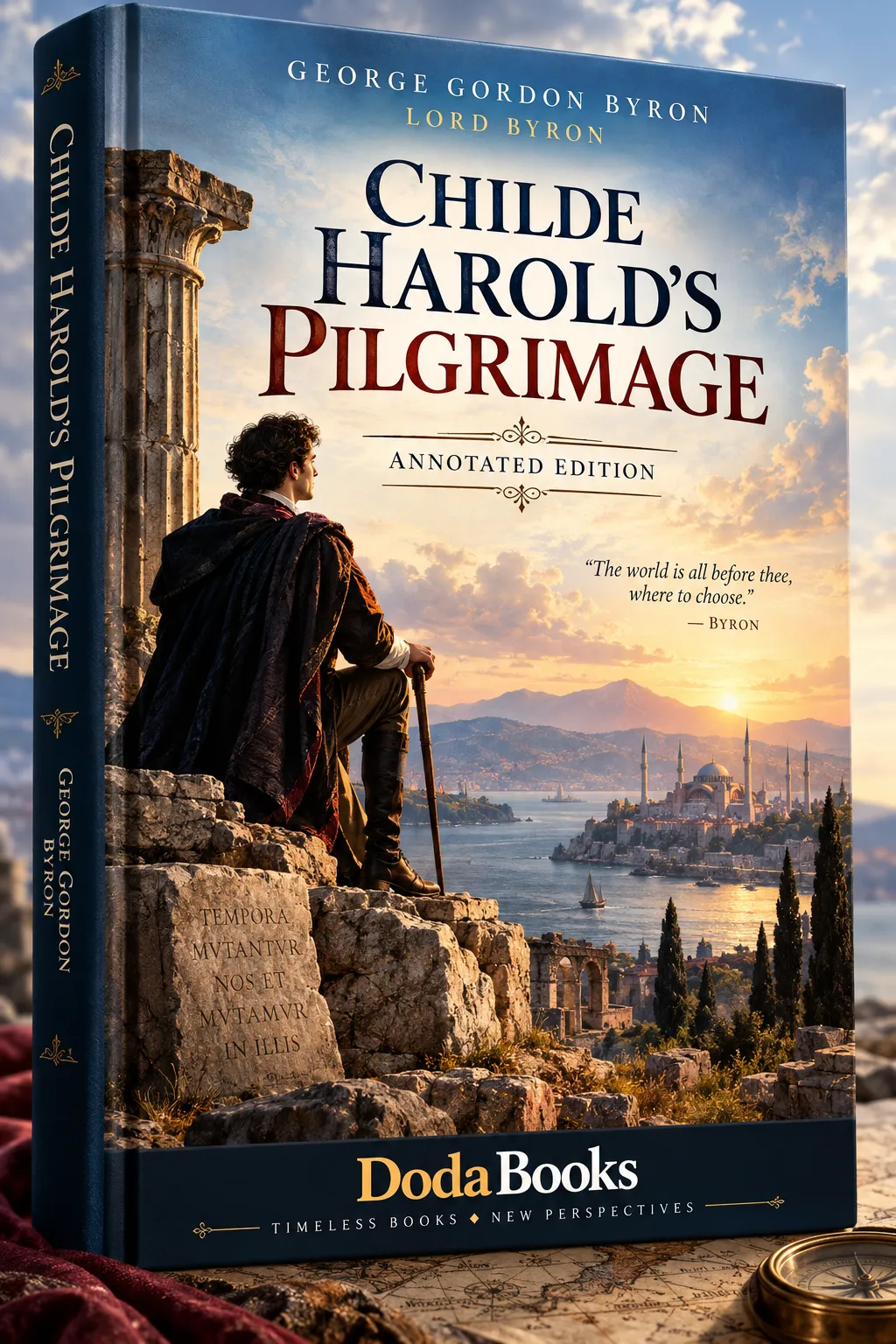
📖 Explore the Archetype that Defined Romanticism
Immerse yourself in Lord Byron’s legendary characters and historical portraits in the definitive digital edition from DodaBooks:
- 🏛️ All 4 Cantos Uncut — Complete Spenserian stanzas with original punctuation and prefaces
- 💡 Exhaustive Character & Historical Footnotes — Contextualizing Napoleon, Ali Pasha, Rousseau, and the Dacian Gladiator
- 📱 Pristine Digital Formatting — Beautifully indented verse engineered for Kindle, iPad, and smartphone reading
- 🔓 100% DRM-Free — Yours to keep, read, and transfer across all your devices permanently
👉 Get the Annotated Edition of Childe Harold’s Pilgrimage at DodaBooks →