Changeling, and Other Stories
Donn Byrne’s Hypnotic Collection of Irish Folklore, Belfast Pugilism, Parisian Exiles, and High-Seas Romance
In the vibrant literary landscape of the 1920s, while modernist writers like James Joyce were deconstructing narrative syntax and F. Scott Fitzgerald was chronicling the Jazz Age, another Irish-born writer held millions of readers spellbound with an entirely different artistic sorcery. Brian Oswald Donn-Byrne (1889–1928), writing as Donn Byrne, was hailed across Britain and America as the supreme modern heir to the ancient Gaelic seanchai—the traditional Irish bardic storyteller.
Published in 1923 at the height of his international fame, Changeling, and Other Stories showcases the full, dazzling range of Byrne’s genius. Bringing together thirteen masterfully crafted tales, the collection moves effortlessly from ancient Celtic myth and fairy lore in the Glens of Antrim to the smoky boxing clubs of Belfast, the dusty tracks of South American horse-breeders, and the bohemian cafes of pre-war Paris.
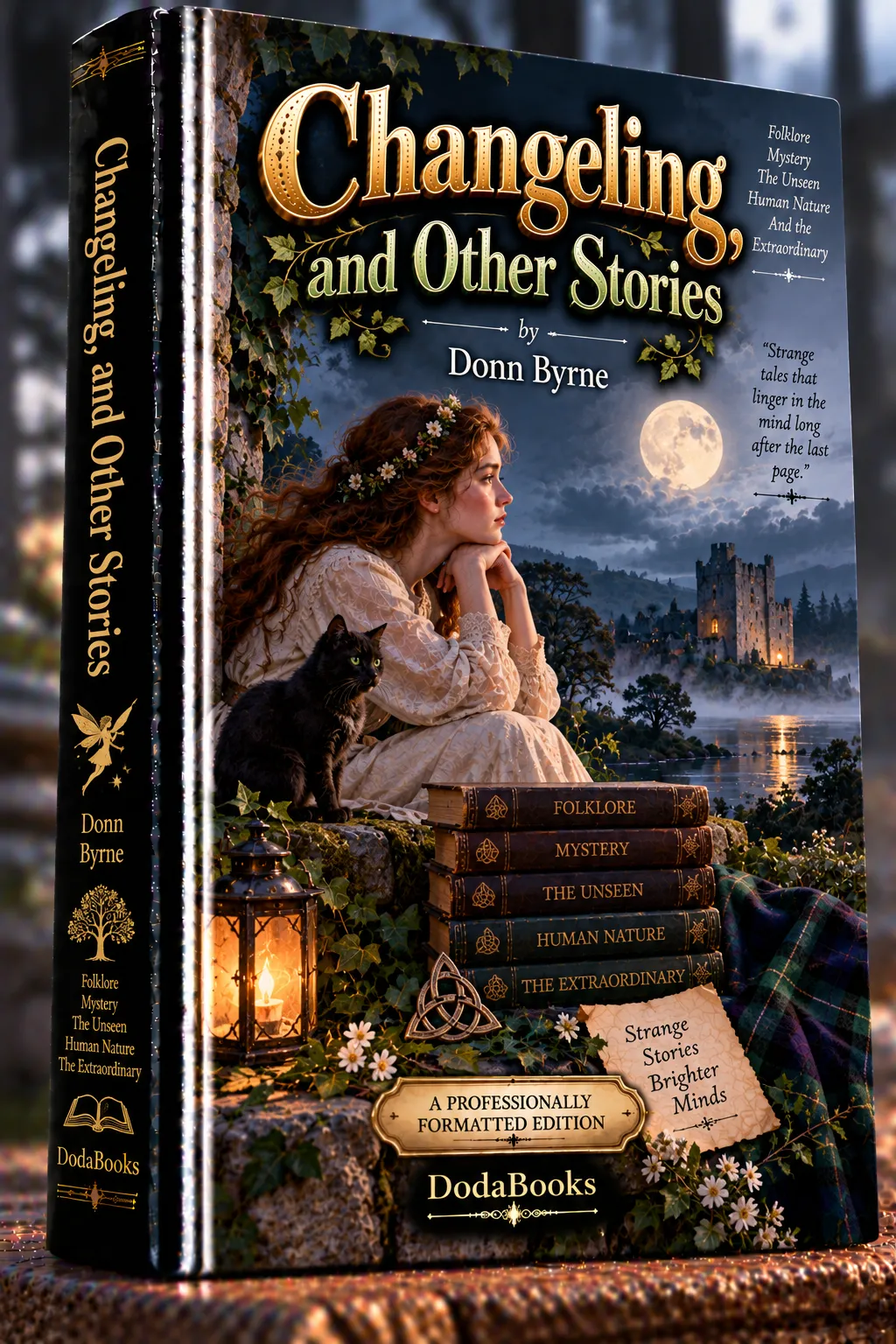
Immerse Yourself in Donn Byrne's Lyrical Prose
Read the definitive edition of Changeling, and Other Stories, enriched with cultural annotations detailing Irish mythology, Ulster dialect, and Byrne's tragic, romantic life.
Get Changeling, and Other StoriesThe Bardic Cadence: The Architecture of Byrne’s Style
What immediately enchants any reader encountering Donn Byrne is the intoxicating musicality of his language. Born in Brooklyn to Irish parents from County Armagh and raised in the rugged Glens of Antrim speaking both Irish and English, Byrne absorbed the rhythmic rhythms, inversion of clauses, and poetic hyperbole of Gaelic oral poetry.
His sentences do not merely convey plot; they sing, weep, and ride like thoroughbred horses across open turf:
“There is a sorrow on the hills when the heather fades, but there is a grander sorrow in the heart of an exile when he remembers the white roads of Antrim under an autumn moon.”
Unlike the dry naturalism of contemporaries who reduced human life to mechanical biology, Byrne was an unrepentant romantic. He believed that romance was not an escape from reality, but the deepest, most honorable reality of all—a recognition that heroism, passionate love, tragedy, and honor are the true spiritual fuels of existence.
Highlights from the Thirteen Tales
The stories collected in Changeling demonstrate Byrne’s astonishing thematic versatility. Rather than confining himself to picturesque peasant portraits, he bridges ancient folklore and twentieth-century modernity with effortless grace:
1. “Changeling”
The title story is a psychological and mythic tour-de-force. Drawing on the ancient Celtic folk belief that fairies steal human babies and replace them with sickly, uncanny doubles (changelings), Byrne transposes the legend into a subtle study of marital estrangement and spiritual renewal. A husband begins to suspect that the joyous, high-spirited woman he married has been replaced by a cold, alien creature—leading to an emotional confrontation between mortal duty and otherworldly enchantment.
2. “The Master of Raymond Lally”
A poignant tale of friendship, racing passion, and financial ruin. Byrne captures the feverish excitement of Irish equestrian life with the insider knowledge of an experienced horseman. The story examines the quiet nobility of a gentleman who sacrifices his fortune and social reputation to honor a debt of fidelity.
3. “A Story Against Women”
Despite its provocative title, this tale is a brilliant, ironic exploration of feminine resilience and masculine bluster. Set among Irish fox-hunters and rural gentry, it dismantles patriarchal posturing with delicious wit and profound affection for strong-willed women.
4. “In Praise of Lady Kyteler”
A dark, atmospheric historical tale revisiting the infamous fourteenth-century witchcraft trial of Alice Kyteler in Kilkenny. Byrne reconstructs medieval Anglo-Norman Ireland with extraordinary sensory vividness, contrasting ecclesiastical paranoia with pagan earth-mysticism.
Unrivaled Rhythmic Prose
Byrne's unique Gaelic-English phrasing creates a hypnotic, spoken-word cadence that echoes ancient bardic recitations and Ulster ballads.
Thirteen Diverse Masterpieces
A panoramic collection spanning Celtic folklore, medieval witch trials, prizefighting in Belfast, and romantic intrigue in Manhattan and Paris.
Rich Celtic Mythological Lore
Deep engagement with Irish fairy lore, changeling beliefs, ancient pagan rites, and the oral traditions of the Glens of Antrim.
Scholarly Annotations & Glossary
Explanatory notes defining Ulster Irish dialect terms, historical figures, equestrian terminology, and geographical landmarks.
Experience the Full Annotated Work
Read the definitive edition of Changeling, and Other Stories formatted with exquisite digital typography and comprehensive scholarly footnotes.
Get Changeling, and Other Stories on DodaBooksDonn Byrne and the Irish Literary Revival
Where did Donn Byrne fit in the broader tapestry of Irish letters? While W. B. Yeats, Lady Gregory, and J. M. Synge were leading the Dublin-centered Irish Literary Revival through the Abbey Theatre, Byrne maintained a fiercely independent trajectory. Educated at University College Dublin and the Sorbonne, he was intimately familiar with classical and European literature, yet he remained deeply skeptical of the aesthetic self-consciousness of Dublin literary salons.
Byrne wrote for the great democratic reading public. His stories appeared in the Saturday Evening Post, Collier’s, and Hearst’s International, commanding some of the highest fees in the history of magazine publishing. Yet despite his commercial triumph, his artistic integrity remained uncompromising. Scholars of modern Irish literature recognize that Byrne possessed an ear for Ulster dialect and rural folk psychology that rivaled William Carleton and Patrick MacGill.
“Donn Byrne did not write about Ireland as an aloof metropolitan observer looking through a microscope; he wrote as an exile singing through tears, painting every hill and bog with the fierce devotion of a man who knew he could never fully go home again.”
Tragically, Byrne’s life was cut short in 1928 at the age of thirty-eight, when his motorcar plunged into Courtmacsherry Bay in County Cork. His sudden passing robbed world literature of one of its most gifted romantic voices, but his legacy survives in masterpieces like Messer Marco Polo, The Wind Bloweth, and this dazzling collection Changeling.
The Re-Discovery of an Irish Master
For decades out of print or available only in battered antique copies, Donn Byrne's finest short fiction has been revived for modern readers who crave soaring language, sweeping emotion, and authentic folkloric magic.
The DodaBooks Annotated Edition: Restoring Byrne’s World
Reading Byrne today is an exhilarating experience, yet his rich cultural and historical references can pose challenges for the uninitiated. The DodaBooks curated edition provides:
- Glossary of Ulster and Irish Dialect: Definitions of Gaelic phrases, regional slang, and folkloric terms (sidhe, firbolg, pishogue, banshee).
- Historical Context of the 1920s: Explanations of post-revolutionary Irish politics, the aftermath of the Anglo-Irish War, and the transatlantic diaspora.
- Biographical Commentary: A detailed chronicle of Byrne’s bohemian youth, his Olympic-level fencing, his rise to international fame, and his untimely death in Cork.
Experience the Magic of Donn Byrne Today
Read all thirteen breathtaking tales in an exquisitely formatted digital edition with scholarly introductions and complete explanatory apparatus.
Get Changeling, and Other StoriesWhy Modern Storytellers Must Read Byrne
In an era when contemporary fiction often retreats into sterile minimalism and clinical realism, Donn Byrne stands as a triumphant reminder of what storytelling can achieve when language is allowed to soar. His prose has the sweep of epic poetry, the intimacy of fireside confession, and the fierce, burning heart of the Celtic imagination. Whether you are a lifelong lover of Irish literature or discovering his work for the first time, Changeling, and Other Stories is an unforgettable journey into wonder.
Frequently Asked Questions
Who was Donn Byrne?
Donn Byrne (1889–1928), born Brian Oswald Donn-Byrne, was an Irish-American novelist and short story writer. Raised in the Glens of Antrim in Northern Ireland, he gained international fame in the 1920s for his lyrical, romantic prose style and works such as Messer Marco Polo and The Wind Bloweth before dying tragically in a car accident at age 38.
What types of stories are in Changeling, and Other Stories?
The collection contains thirteen diverse stories spanning ancient Celtic folklore, modern Irish country life, prizefighting in Belfast, high-stakes horse racing, historical witchcraft trials, and romantic encounters in New York, South America, and Paris.
What is the folkloric concept of a 'changeling'?
In Celtic folklore, a changeling is a fairy child or enchanted wooden effigy left in secret by the fairies (the Aos Sí) to replace a stolen human child. In Byrne's title story, the concept is brilliantly reworked into a psychological metaphor for emotional transformation and estrangement within marriage.
How does Byrne's style differ from James Joyce or W. B. Yeats?
While Joyce pursued modernist stream-of-consciousness realism and Yeats focused on mystical poetry and the theatrical revival, Byrne embraced the traditional oral storytelling cadences of the Gaelic seanchai, crafting accessible yet deeply poetic romantic narratives for a mass international readership.
Where can I purchase the complete annotated ebook?
You can purchase and immediately download the meticulously curated digital edition directly from DodaBooks at https://dodabooks.com/ebook/changeling-and-other-stories-by-donn-byrne/.