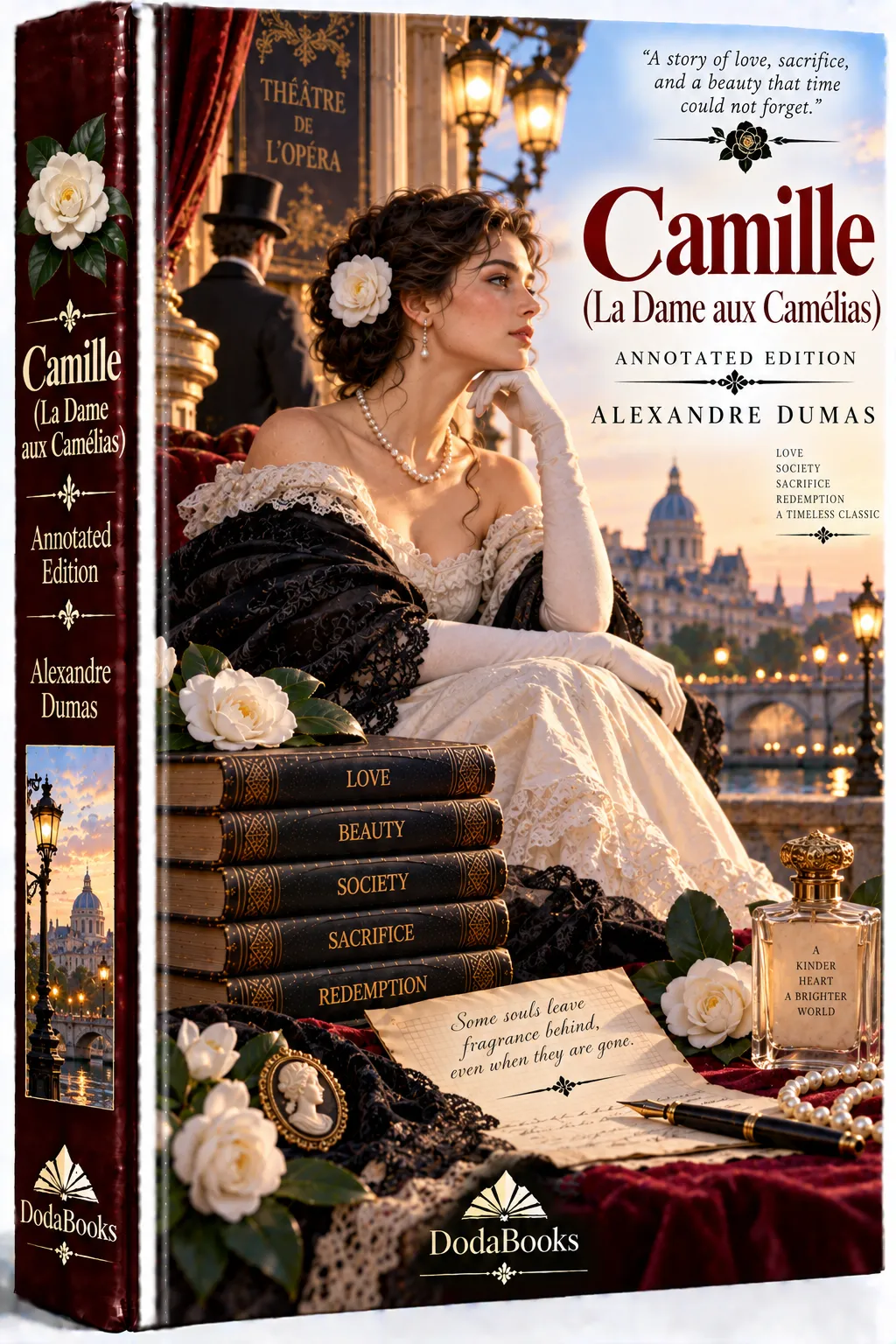
Alexandre Dumas fils’s Camille (La Dame aux Camélias, 1848) is the heartbreaking chronicle of Marguerite Gautier, a luminous Parisian courtesan whose transcendent love for a passionate young bourgeois leads to the ultimate act of moral renunciation. Adapted into Verdi’s opera La Traviata and immortalized by Greta Garbo on screen, the novel remains one of the supreme monuments of romantic tragedy.
🥀
Camille (La Dame aux Camélias)
The poignant tragedy of Marguerite Gautier and Armand Duval. Unpack Alexandre Dumas fils's searing portrait of Parisian courtesan society, self-sacrifice, and doomed passion in 19th-century France.
| Author | Alexandre Dumas fils |
| Published | 1848 (Novel), 1852 (Play) |
| Genre | Tragic Romance, Social Realism, Epistolary Novel |
| Setting | Paris and Bougival, France (1840s) |
| Central Themes | Sacred vs. Profane Love, Social Hypocrisy, Self-Sacrifice, Consumption/Mortality |
| Reading Time | 5–7 hours |
| Summary Time | 22 minutes |
🎭 The True Story Behind the White Camellias
Behind the pages of Camille lies one of the most intense and tragic real-life romances of 19th-century Paris. In September 1844, twenty-year-old Alexandre Dumas fils met Alphonsine Rose Plessis—better known across Parisian salons and opera houses as Marie Duplessis—at the Théâtre des Variétés. Marie was arguably the most famous and refined courtesan (demi-mondaine) in France: gifted with delicate beauty, exquisite conversational wit, and an appetite for fine literature and art, her patrons included wealthy counts, ambassadors, and the elderly Duke of Guiche.
Dumas fell madly in love with Marie, entering into an intense eight-month affair. Marie’s lifestyle, however, required fortunes that the young, indebted writer could never provide. Furthermore, Marie was already in the grip of pulmonary tuberculosis, seeking oblivion in endless balls, midnight suppers, and luxury. Reluctantly acknowledging that he could neither finance her life nor endure sharing her affections with wealthy benefactors, Dumas broke off the relationship in the summer of 1845. Less than two years later, in February 1847, Marie died destitute and alone at the age of twenty-three while her possessions were auctioned off to pay her creditors.
Devastated by grief and remorse, Dumas locked himself in a room in Saint-Germain-en-Laye and wrote La Dame aux Camélias in just three weeks. By transforming Marie into Marguerite Gautier and himself into Armand Duval, Dumas achieved immortality for his lost love and ignited an enduring cultural myth.
📖 Complete Plot Overview & Narrative Journey
The novel utilizes a layered framing device. It opens shortly after Marguerite Gautier’s death, as the unnamed narrator attends the public auction of her luxurious Parisian apartment on the Rue d’Antin. Moved by curiosity and pity, the narrator purchases Marguerite’s personal copy of Abbé Prévost’s Manon Lescaut, containing a handwritten dedication from Armand Duval. Days later, a feverish, grief-stricken Armand arrives at the narrator’s home, desperately begging to buy the volume back. As the two men bond, Armand agrees to recount the full, unvarnished story of his love affair with the Lady of the Camellias.
The Courtesan and the Camellias
Marguerite Gautier was known across Paris for wearing white camellias twenty-five days of the month and red camellias for the remaining five. Armand first glimpses her at the Opéra-Comique and falls instantly, obsessively in love. When Marguerite suffers a severe coughing fit during a boisterous supper party at her residence, Armand follows her into her dressing room and professes his profound adoration, begging her to abandon her destructive nocturnal lifestyle. Marguerite, accustomed to cynical transaction rather than sincere devotion, is moved by Armand’s genuine tears and grants him her heart, warning him that her life is fragile, dangerous, and short.
The Pastoral Idyll at Bougival
Determined to flee the corrosive atmosphere of Paris, Marguerite leases a country house in Bougival. There, surrounded by rolling meadows and river breezes, she and Armand experience months of pure, pastoral bliss. Marguerite begins pawning her jewelry, horses, and carriages in secret to settle her enormous Parisian debts without burdening Armand. Armand dreams of marrying Marguerite and living in peaceful domesticity.
The Father’s Fatal Intervention
The idyllic paradise collapses when Armand’s father, Monsieur Duval, arrives unannounced. Finding Marguerite alone, he acknowledges her nobility of soul but appeals to her maternal and moral conscience: Armand’s association with a notorious courtesan will ruin his professional future and destroy the marriage prospects of his pure, innocent younger sister. Monsieur Duval asks Marguerite for the ultimate sacrifice: she must renounce Armand completely and convince him that she never loved him.
The Final Agony and Redemption
Recognizing the truth of Monsieur Duval’s arguments, Marguerite makes the heart-wrenching decision to sacrifice her own happiness. She abruptly abandons Bougival, returns to Paris, and deliberately takes back a wealthy aristocratic patron, Count de Varville. Shattered and enraged, Armand publicly insults Marguerite at a crowded ball, throwing a fistful of banknotes into her lap to “pay” for her past favors.
Armand flees abroad, unaware of Marguerite’s fatal sacrifice. While Armand travels in the East, Marguerite’s tuberculosis reaches its terminal phase. Alone, abandoned by her fickle society friends, and attended only by a faithful maid and doctor, Marguerite keeps a secret diary addressed to Armand. In these final pages, she reveals the truth of her sacrifice and reaffirms her undying devotion before drawing her final breath. When Armand returns, it is only to exhume her coffin and weep over her memory.
👥 Character Profiles & Motivations
🥀 MARGUERITE GAUTIER
The Redeemed Courtesan
“I may die tomorrow. What matters to me a future I shall never see? But to be loved as you love me—that is life!”
Marguerite rises from peasant poverty in Normandy to the pinnacle of Parisian high society through her beauty and charm. Behind her diamond jewelry and cynical wit lies a soul yearning for genuine affection, spiritual purity, and forgiveness.
Why She Matters
Marguerite shattered the Victorian moral trope of the “fallen woman” as an irredeemable monster. By prioritizing Armand’s familial honor above her own life, Marguerite achieves profound moral transcendence, proving that true virtue resides in the heart rather than in social status.
💔 ARMAND DUVAL
The Impassioned Idealist
“I love you with all the strength of my soul, Marguerite. If you will let me, I will give my life to make you forget what you have suffered.”
Armand is an earnest, sensitive young man of modest bourgeois background. His passion for Marguerite is consuming, volatile, and jealous, blinding him to the crushing economic realities of 19th-century courtesan existence.
Why He Matters
Armand represents the romantic ego: passionate and sincere, yet prone to destructive jealousy and social cowardice. His trajectory from ecstasy to vindictive cruelty and agonizing remorse highlights the vulnerability of idealistic love within a rigid class system.
👔 MONSIEUR DUVAL
The Voice of Social Order
“You have a noble heart, Mademoiselle; but society has its laws. A moment of self-denial today will save my son and my daughter from lifelong disgrace.”
Armand’s father is not a cruel villain, but a conventional, honorable representative of the 19th-century French bourgeoisie. He respects Marguerite’s dignity yet ruthlessly defends the family name and social hierarchy.
Why He Matters
Monsieur Duval embodies the patriarchal state and bourgeois social morality. His intervention demonstrates that individual romantic passion is ultimately crushed whenever it threatens established family and class structures.
📘 Annotated Insight — Dumas fils deliberately aligned Marguerite’s story with Abbé Prévost’s 18th-century masterpiece Manon Lescaut. However, whereas Manon’s vanity and moral weakness destroy her lover Des Grieux, Marguerite inverts the archetype: she willingly embraces martyrdom to ensure Armand’s moral and social salvation.
🔍 Major Themes & Critical Analysis
1. The Economy of Pleasure vs. Pure Love
Dumas provides an unsparing economic dissection of the demi-monde. Marguerite’s lavish existence costs over 100,000 francs per year—money supplied by wealthy old men who purchase her time, elegance, and beauty. Dumas reveals how courtesan culture was an indispensable hypocrisy of the French upper classes: wealthy aristocrats indulged their desires in the private apartments of courtesans while publicly enforcing moral decorum in their drawing rooms. Armand and Marguerite’s love is revolutionary precisely because it rejects financial transaction in favor of reciprocal emotional devotion.
2. Illness as Metaphor: Consumption and Moral Purifying
Tuberculosis (consumption) plays a pivotal symbolic role in 19th-century romantic literature. The feverish glow, coughing of blood, and wasting of the physical body were romanticized as signs of excessive passion, spiritual sensibility, and inner fire. In Camille, Marguerite’s physical illness mirrors her spiritual condition: as her physical frame wastes away, her vanity and worldliness dissolve, leaving behind pure, unselfish love.
3. The Cruelty of Social Stigma
Despite Marguerite’s inner purity, French society refuses to allow a courtesan to transcend her past. Monsieur Duval makes it clear that even if Armand were to marry Marguerite, French society would ostracize them, and Armand’s sister would be denied an honorable marriage due to the scandal. The tragedy demonstrates that the bourgeois order demands the literal death of the marginalized woman to preserve its respectable facade.
📖 Explore the Annotated Edition at DodaBooks →
✨ What Makes the DodaBooks Annotated Edition Essential
Camille is steeped in the intricate monetary, legal, and social nuances of 1840s Paris. Raw scans frequently leave readers confused by monetary values (louis d’or, francs), legal codes concerning dowries and inheritance, and French theater conventions.
The DodaBooks Annotated Edition provides the ultimate reading experience:
Monetary & Class Conversions
Understand the real financial stakes of Marguerite's debts, carriage rentals, and boudoir maintenance with modern currency glosses.
Theatrical & Cultural References
In-depth notes on 19th-century Parisian opera houses, the Théâtre du Vaudeville, and social customs of the demi-monde.
Biographical Dossier
Explore the real letters and historical records of Marie Duplessis, Franz Liszt's devotion to her, and Dumas's lifelong regret.
Literary Parallel Analyses
Understand the vital connections between Camille, Verdi's *La Traviata*, and Prévost's *Manon Lescaut*.
Permanent DRM-Free Copy
Read across all your devices without digital restrictions. Compatible with Kindle, Kobo, Apple Books, and Android.
Polished French Translations
Elegant, clean prose featuring accurate translations of French colloquialisms, letters, and diary entries.
❓ Frequently Asked Questions
Why is Marguerite called "The Lady of the Camellias"?
Marguerite was famous for always appearing in public wearing camellias in her corsage or holding a bouquet of them. She chose camellias because they are scentless flowers that did not irritate her delicate, consumptive lungs, and their stark colors symbolized her emotional state and availability.
How does Camille relate to Verdi's opera La Traviata?
Giuseppe Verdi attended the stage adaptation of La Dame aux Camélias in Paris in 1852 and was deeply moved. Working with librettist Francesco Maria Piave, he adapted the novel into his iconic 1853 opera La Traviata ("The Fallen Woman"), renaming Marguerite to Violetta Valéry and Armand to Alfredo Germont.
Was Marie Duplessis really as noble as Marguerite Gautier?
Historical accounts confirm that Marie Duplessis was remarkably cultured, learning English and German, playing piano, and befriending prominent intellectuals including Franz Liszt. While Dumas romanticized certain aspects of their final parting, Marie's charm, dignity, and tragic death at twenty-three were entirely real.
What is the difference between Alexandre Dumas père and fils?
Alexandre Dumas père (the father) wrote sweeping historical adventure romances including The Three Musketeers and The Count of Monte Cristo. Alexandre Dumas fils (the son) focused on psychological realism, domestic tragedy, and social problems, with Camille being his undisputed masterpiece.
Why should I purchase the DodaBooks edition?
Many online versions of Camille suffer from awkward 19th-century Victorian censorship that sanitized Marguerite's courtesan status, rendering key plot motivations nonsensical. DodaBooks delivers the complete, uncensored text accompanied by historical commentary and modern annotations that capture the raw emotional power of Dumas's original vision.
🥀 Experience the Supreme Masterpiece of Romantic Tragedy
Step into the gilded salons and rustic meadows of 1840s Paris. The DodaBooks Annotated Edition of Camille (La Dame aux Camélias) provides:
- ✅ Complete Uncensored Text — The unabridged translation restoring Dumas’s original emotional intensity
- 📜 Historical Demi-Monde Notes — Insights into courtesan economics, fashion, and social codes
- ✒️ Typeset with Care — Flawless typography, drop caps, and clean formatting
- 🔒 100% DRM-Free Freedom — Yours to keep and read on any e-reader or device
- 📥 Instant Download — Immediate delivery in high-quality EPUB format
For another powerful French historical drama of persecution and sacrifice, explore John Bloundelle-Burton’s The Scourge of God Guide. For intense romantic drama across exotic landscapes and cultural clashes, read Joan Conquest’s celebrated desert romance in The Hawk of Egypt Guide. To experience the ancient medieval foundation of tragic French and Celtic romance, explore Joseph Bédier’s immortal The Romance of Tristan and Iseult Guide.