James Boswell’s Life of Samuel Johnson, LL.D. (1791) is celebrated worldwide as the supreme biography in the English language. A monumental portrait of Georgian London’s greatest lexicographer, moralist, and conversationalist, this masterpiece revolutionized the biographical genre, bringing the brilliant, eccentric, and formidable Dr. Johnson roaring back to life across two and a half centuries.
📜
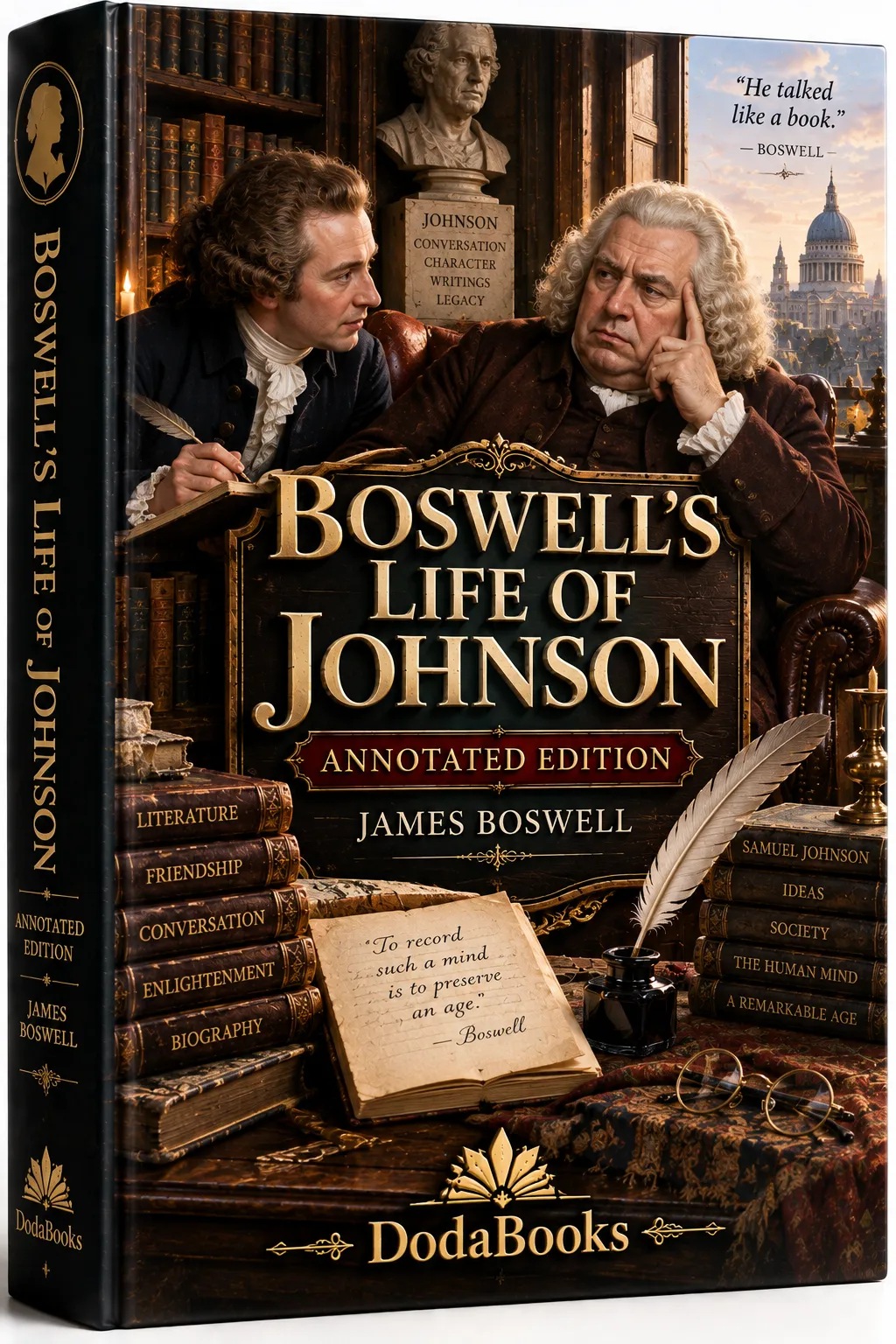
Boswell's Life of Johnson
The greatest biography ever written in the English language. Step into the bustling coffeehouses, taverns, and literary salons of 18th-century London alongside the incomparable Dr. Samuel Johnson and his devoted chronicler James Boswell.
| Author | James Boswell |
| Subject | Dr. Samuel Johnson (1709–1784) |
| Published | 1791 (London) |
| Genre | Biography, Memoir, Intellectual History |
| Setting | London, Oxford, Lichfield, Edinburgh (1709–1784) |
| Central Themes | Friendship, Literary Immortality, Human Eccentricity, Moral Courage, The Art of Conversation |
| Reading Time | 12–16 hours |
| Summary Time | 25 minutes |
This vibrant Georgian circle was later painted with luminous intimacy in Louise Imogen Guiney’s classic biographical essays.
☕ The Miracle of May 16, 1763
The fateful encounter that produced the greatest biographical partnership in history occurred on the afternoon of Monday, May 16, 1763, in the back parlor of Thomas Davies’s bookshop on Russell Street, Covent Garden. James Boswell, an ambitious twenty-two-year-old Scottish law student and aspiring man-of-letters, was drinking tea when the massive, lumbering figure of fifty-three-year-old Dr. Samuel Johnson unexpectedly walked through the door.
Johnson was already an intellectual giant: the solitary author of the monumental Dictionary of the English Language (1755), the moral essayist behind The Rambler, and the undisputed conversational monarch of London. Boswell was trembling with nervousness. When Davies jokingly introduced Boswell as coming from Scotland—well aware of Johnson’s notorious prejudice against the Scots—Johnson delivered a swift, crushing retort: “Mr. Johnson, (said I,) I do indeed come from Scotland, but I cannot help it.” Johnson replied with devastating dry wit: “That, Sir, I find, is what a very great many of your countrymen cannot help.”
Far from taking offense, Boswell was captivated. He recognized immediately that behind Johnson’s rough, scarred exterior, twitching tics (now understood as Tourette syndrome), and booming voice lay the most acute intellect, profound moral compassion, and sparkling conversational wit in Europe. Boswell began recording Johnson’s exact spoken words in pocket notebooks each night, preserving spontaneous conversations with a fidelity and dramatic immediacy never before achieved in literature.
📖 The Structural Tapestry of Johnson’s Life
Boswell’s biography is not a dry chronicle of dates and publications; it is a vibrant, panoramic drama of Georgian intellectual society:
1. The Early Years of Struggle and Poverty (1709–1737)
Boswell meticulously reconstructs Johnson’s early hardships: born in Lichfield to a struggling bookseller, afflicted from infancy with scrofula (the “King’s evil”) that left him blind in one eye and scarred, and forced to leave Pembroke College, Oxford due to lack of funds. Arriving in London in 1737 with his former pupil David Garrick and only fourpence in his pocket, Johnson spent two decades living on the edge of starvation, sleeping in garrets and writing anonymous parliamentary reports for Edward Cave’s Gentleman’s Magazine.
2. The Heroic Labor of the Dictionary (1746–1755)
Johnson spent nine grueling years compiling the Dictionary of the English Language in his garret on Gough Square. While the French Academy required forty scholars and forty years to compile their national dictionary, Johnson completed his single-handedly with the help of six amanuenses. Boswell details Johnson’s legendary letter to Lord Chesterfield, in which the destitute scholar rebuked the haughty nobleman who had ignored him during his seven years of labor only to offer flattering patronage once the work was complete: “Is not a patron, my Lord, one who looks with unconcern on a man struggling for life in the water, and, when he has reached ground, encumbers him with help?”
3. The Golden Age of “The Club” (1764–1784)
Following the award of a royal pension of £300 a year from George III in 1762, Johnson was finally freed from financial desperation. He and painter Joshua Reynolds founded “The Literary Club” (often simply “The Club”), which met at the Turk’s Head tavern in Soho. Here, Boswell captures the brilliant intellectual crossfire between the greatest minds of the age: Johnson, Edmund Burke, Oliver Goldsmith, David Garrick, Edward Gibbon, and Adam Smith.
4. The Final Sickness and Christian Resignation
Boswell handles Johnson’s declining years and dread of death with deep tenderness. Afflicted by asthma, dropsy, and strokes, Johnson faced his final days with unyielding intellectual lucidity and devout Christian prayer, passing away peacefully on December 13, 1784, before being buried in Westminster Abbey.
👥 The Central Figures of the Circle
🦁 DR. SAMUEL JOHNSON
The Colossus of English Letters
“No man but a blockhead ever wrote, except for money.”
Johnson was a bundle of contradictions: deeply compassionate toward beggars and stray cats yet terrifying in intellectual debate; plagued by severe depression and guilt yet capable of explosive, table-shaking laughter; an unbending Tory who passionately opposed the transatlantic slave trade.
Why He Matters
Johnson is the ultimate model of intellectual integrity and common sense (lexicographical authority combined with unyielding moral courage). His spoken aphorisms remain the sharpest observations on human vanity ever uttered.
✒️ JAMES BOSWELL
The Revolutionary Biographer
“I will not cut off his claws, nor make my tiger a cat to please anybody.”
Boswell was vain, sociable, emotionally volatile, and insatiably curious. His genius lay in his unmatched ability to draw Johnson out through provocative questions and his meticulous memory for conversational rhythm and cadence.
Why He Matters
Boswell invented modern biography. By refusing to sanitize Johnson’s flaws, eccentricities, and melancholic outbursts, he created a complete, three-dimensional portrait of a great human being rather than an idealized marble bust.
🎨 OLIVER GOLDSMITH
The Lovable Literary Foil
“Goldsmith, for shortness and brevity, could write like an angel, and talk’d like poor Poll.”
Goldsmith, author of The Vicar of Wakefield and She Stoops to Conquer, was Johnson’s dear friend and frequent conversational sparring partner. Often awkward and envious in society, he was fiercely defended by Johnson against all detractors.
Why He Matters
Goldsmith brings warmth, humor, and domestic color to the meetings of The Club, showing Johnson’s tender loyalty toward his fellow struggling writers.
📘 Annotated Insight — For over a century, Victorian critics like Thomas Babington Macaulay claimed that Boswell wrote a great book purely by accident because he was a foolish, servile sycophant. The 20th-century discovery of Boswell’s vast private archives at Malahide Castle completely shattered this myth, proving that Boswell was a conscious, master literary architect who carefully shaped his journal entries into art.
🔍 Major Themes & Johnsonian Wisdom
1. Truth in Biography vs. Hagiography
Before Boswell, biographies were stiff moral eulogies that erased the subject’s flaws to present a blameless role model. Boswell firmly rejected this practice, asserting: “In every picture there must be shade as well as light.” He documents Johnson’s compulsive touchings of lampposts, his gargantuan appetite for veal pie, and his verbal savagery when provoked, creating a living human portrait.
2. The Social Antidote to Solitude and Melancholy
Both Johnson and Boswell suffered from severe clinical depression (what the 18th century called the “black dog” or “hypochondria”). For Johnson, intellectual work, intense conversation, and the vibrant life of London streets were the only reliable remedies: “When a man is tired of London, he is tired of life; for there is in London all that life can afford.”
3. Clear-Eyed Realism and Moral Integrity
Johnson had zero tolerance for sentimental cant, romantic illusions, or fashionable complaints. When Boswell worried about public scandals or political agitation, Johnson famously commanded him: “Clear your mind of cant, Sir!” Johnson urged men to face the harsh realities of mortality, economic necessity, and human imperfection without self-deception.
📖 Explore the Annotated Edition at DodaBooks →
✨ What Makes the DodaBooks Annotated Edition Essential
Boswell’s Life of Johnson is famous for its dense web of 18th-century political, theatrical, and classical references. Raw scans are notoriously difficult to navigate, full of untranslated Latin quotations, obscure references to forgotten Whig politicians, and dense Georgian idioms.
The DodaBooks Annotated Edition makes this monumental classic a pure pleasure to read:
18th-Century London Guide
Detailed notes explaining Covent Garden, the Turk's Head tavern, Fleet Street, Grub Street, and Georgian social customs.
Conversational Context Footnotes
Understand the background of every debate between Johnson, Burke, Goldsmith, and Garrick at The Club.
Classical & Latin Translations
Immediate, accurate translations of Johnson's numerous Latin, Greek, and French quotations and epigrams.
Johnsonian Works Glossary
Context on the *Dictionary*, *Rasselas*, *The Rambler*, *Lives of the Poets*, and Johnson's political pamphlets.
100% DRM-Free Freedom
Enjoy permanent digital ownership. Read smoothly across your Kindle, Kobo, iPad, or mobile phone.
Seamless Navigation
Chronological year-by-year index and chapter navigation allowing you to easily browse Johnson's life and letters.
❓ Frequently Asked Questions
Why is Boswell's Life of Johnson considered the greatest biography?
Boswell was the first biographer to recreate real-life conversations with dramatic immediacy, capturing the exact cadence, humor, and emotional depth of his subject. Instead of writing a distant chronological report, Boswell makes readers feel as if they are sitting directly across the table from Dr. Johnson in a London tavern.
Did Dr. Johnson really write his Dictionary all by himself?
Yes. While the French Academy employed forty scholars over forty years, Johnson compiled his 42,773-word Dictionary of the English Language in nine years with only six copyists assisting him with physical transcription. It remained the gold standard of English lexicography until the Oxford English Dictionary over a century later.
What condition did Dr. Johnson suffer from?
Modern medical historians and neurologists universally agree that Dr. Johnson suffered from Tourette syndrome, characterized by involuntary motor tics, gesticulations, vocal utterances, and compulsive rituals. He also endured lifelong clinical depression and scrofula.
Is the book too long or difficult for a modern reader?
While the full unabridged work is extensive, it is remarkably accessible and entertaining because it is largely composed of sparkling dialogue, witty anecdotes, and sharp observations. Reading it in an annotated digital edition with clear navigation makes exploring Johnson's world effortless.
Why should I purchase the DodaBooks edition?
Due to its vast length, free public domain scans of Life of Johnson are frequently plagued by missing letters, broken line breaks, and completely absent translations of Latin phrases. DodaBooks provides a clean, fully checked, beautifully typeset digital edition with comprehensive historical notes and intuitive year-by-year navigation.
📜 Pull Up a Chair at London’s Greatest Table
Join Dr. Samuel Johnson and James Boswell in the vibrant literary salons of 18th-century London. The DodaBooks Annotated Edition of Boswell’s Life of Johnson delivers:
- ✅ Complete Authoritative Text — The full, unabridged chronicle from 1709 to 1784
- 📜 Historical & Classical Footnotes — Context on Georgian politics, literature, and Grub Street
- ✒️ Typeset for Comfortable Reading — Beautiful fonts, smart quotes, and custom layout
- 🔒 100% DRM-Free Ownership — Read across all your devices without restrictions
- 📥 Instant Digital Delivery — High-quality EPUB format ready for immediate reading