Body-Build and Its Inheritance
Charles Benedict Davenport’s Landmark 1923 Carnegie Institution Study on Human Morphological Variation, Ontogeny, and Quantitative Genetics
In 1923, the Carnegie Institution of Washington issued Publication No. 329: a dense, highly specialized, and meticulously tabulated scientific monograph titled Body-Build and Its Inheritance. Penned by Charles Benedict Davenport (1866–1944)—one of the prominent architects of American experimental biology and the director of the Cold Spring Harbor Biological Laboratory—this monumental treatise represented one of the earliest comprehensive attempts to apply quantitative Mendelian genetics and statistical biometric modeling to human physical constitution.
Examining thousands of pedigree charts, physiological measurements, and developmental growth curves, Davenport sought to answer a fundamental biological question: How do genes and environmental nutrition interact to govern human skeletal frame, metabolic mass, and the bodily proportions of “slender” versus “fleshy” builds? Today, viewed through the lens of modern genomics and the critical history of science, Body-Build and Its Inheritance serves as a fascinating window into the origins of quantitative human biology and anthropometry.
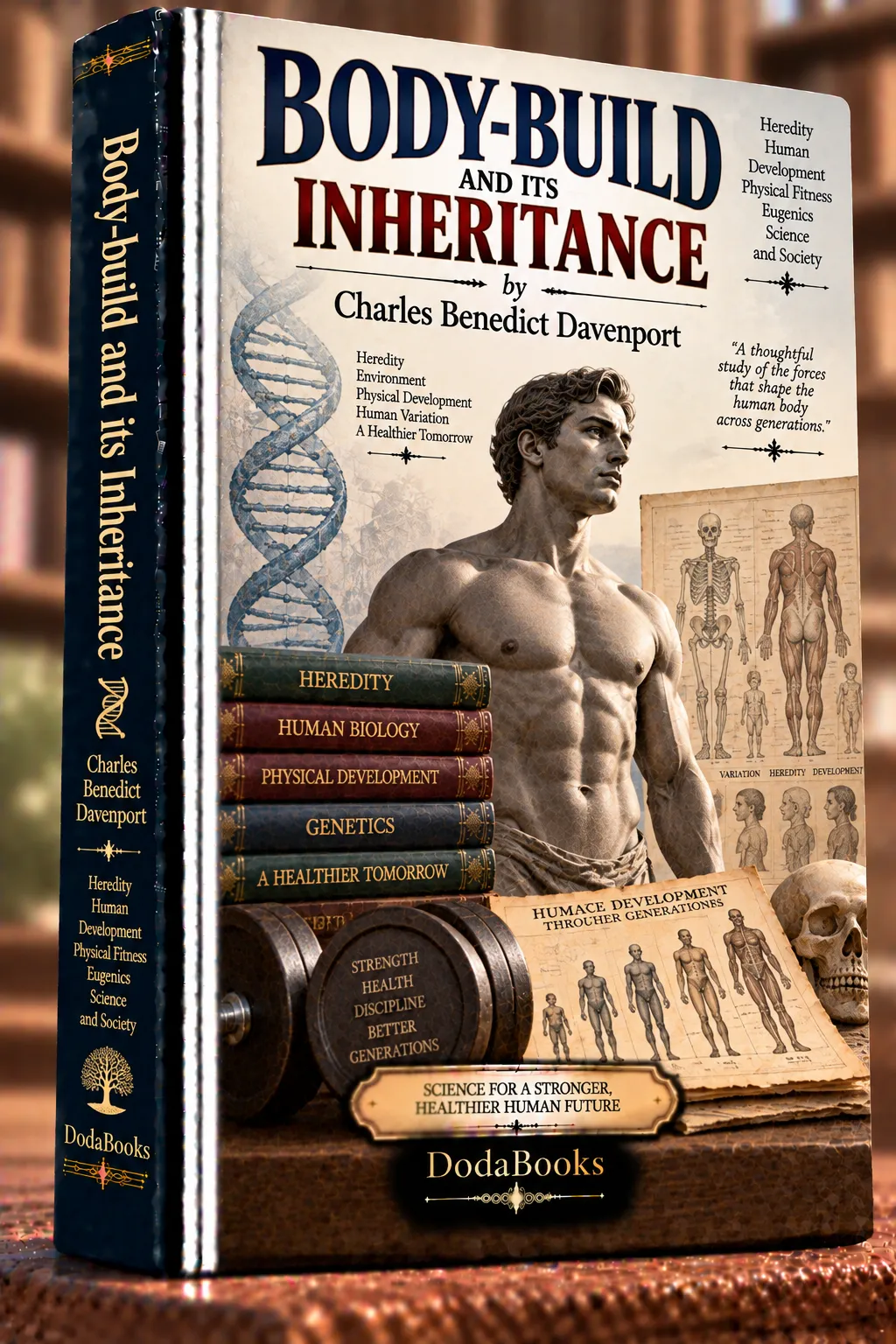
Explore the Origins of Human Quantitative Genetics
Read Davenport's foundational Carnegie Institution monograph with extensive critical annotations explaining biometric methods, Mendelian history, and the evolution of modern polygenic theory.
Get Body-Build and Its InheritanceThe Scientific Core: Measuring the Human Body Index
At the center of Davenport’s investigation was the quest for an objective, mathematical index of human nutritional and morphological “build.” Long before the universal adoption of the Quetelet Index (modern Body Mass Index or BMI), biometricians struggled with how to capture bodily stoutness independently of height.
Davenport proposed and rigorously tested several mathematical ratios, ultimately focusing on: 25 ext{Index of Build} = rac{ ext{Weight}}{ ext{Chest Circumference} imes ext{Stature}^2} \quad ext{or} \quad rac{ ext{Weight}}{ ext{Stature}^2}25
Using these biometric indices, Davenport classified adult human morphology into five distinct biometric categories:
- Very Slender (Asthenic): Characterized by narrow thoracic cages, lean musculature, and rapid metabolic burn.
- Slender: Lean bodily habitus with below-average adipose distribution.
- Medium: Balanced mesomorphic somatic structure.
- Fleshy: Elevated adiposity and robust skeletal frame.
- Very Fleshy (Pyknic): Pronounced broad build, heavy bone density, and substantial adipose deposition.
Mendelian Inheritance vs. Polygenic Complexity
When Davenport began his work, the biological world was divided by a bitter intellectual dispute between Mendelian geneticists (who believed traits were inherited through discrete, particulate units discovered by Gregor Mendel) and Biometricians led by Karl Pearson (who argued that human traits varied continuously along a smooth Gaussian bell curve and could not be explained by simple particulate genes).
In Body-Build and Its Inheritance, Davenport attempted an audacious intellectual synthesis:
“The inheritance of body-build cannot be reduced to a single, monolithic unit-character. While fleshiness and slenderness exhibit distinct familial tendencies, the observed distributions reveal the operation of multiple interacting factors—a polygenic architecture influenced by endocrine regulation and developmental ontogeny.”
Davenport analyzed hundreds of multi-generational family pedigrees. He demonstrated that when two slender parents marry, their offspring are overwhelmingly slender, whereas the union of two fleshy parents yields a wider phenotypic variance, suggesting recessive and dominant polygenic modifiers. While modern genetics has replaced his specific multi-factor models with complex genome-wide association studies (GWAS) identifying hundreds of metabolic quantitative trait loci (QTLs), Davenport was among the very first researchers to recognize that human body composition is polygenic rather than monogenic.
Landmark Biometric Data
Original 1923 Carnegie Institution tables, frequency distributions, and developmental growth curves tracing human morphological changes from infancy to old age.
Early Polygenic Modeling
One of the earliest attempts in the history of science to reconcile discrete Mendelian genetics with continuous, quantitative phenotypic variations in humans.
Precursor to Somatotyping
Pioneering concepts that laid the groundwork for Ernst Kretschmer's constitutional psychiatry and William Sheldon's mid-century somatotype theory (ectomorph, mesomorph, endomorph).
Critical Historical Commentary
Modern scholarly notes situating Davenport's work within the history of science, Cold Spring Harbor research, and contemporary metabolic genetics.
Developmental Ontogeny: The Shift from Infant to Adult
A remarkably modern aspect of Davenport’s monograph is his focus on developmental ontogeny—the changes in body proportions that occur across an individual’s lifetime. Davenport observed that human infants are universally born “fleshy” or robust in build, with a high chest-to-stature ratio necessary for thermal regulation and vital organ protection.
As children mature between the ages of six and fourteen, they enter a rapid elongation phase where stature outpaces transverse thoracic expansion, causing the index of build to drop sharply into the “slender” zone. Following puberty, secondary sexual dimorphism and metabolic stabilization shift build back toward adult equilibrium. By charting these longitudinal trajectories, Davenport demonstrated that genes do not dictate a static bodily form, but rather govern dynamic rates of growth and metabolic maturation over time.
Study the Milestones of Anthropometry and Genetics
Read Charles Davenport's seminal 1923 research study with modern annotations and historical contextualization. Essential reading for historians of science, biometricians, and geneticists.
Get Body-Build and Its InheritanceEndocrine Glands and Metabolic Regulation in 1920s Biology
A pivotal chapter in Davenport’s treatise explores the physiological mechanism connecting inherited genes to gross anatomical structure: the endocrine glandular system. In the early 1920s, endocrinology was undergoing an intellectual revolution following the isolation of thyroxine, adrenaline, and early research into pituitary extracts.
Davenport hypothesized that inherited genes did not shape bones and muscle tissue directly, but rather operated through glandular pacemakers that regulated metabolic rate and growth:
- The Thyroid as a Metabolic Accelerator: Davenport correlated hyperthyroid activity with lean, slender bodily builds, noting that an overactive thyroid accelerates caloric consumption and inhibits adipose tissue storage. Conversely, hypothyroid states were identified as contributing to fleshy, sluggish somatotypes.
- Pituitary Control of Skeletal Elongation: Drawing upon clinical observations of acromegaly and gigantism, Davenport recognized that the anterior pituitary gland directs the growth plates of long bones. Variations in pituitary output during puberty determine whether stature outpaces torso breadth.
- Adrenal and Gonadal Dimorphism: The monograph examines how sex hormones direct the differential accumulation of subcutaneous fat in males versus females following adolescence, creating sexually dimorphic indices of build.
By framing human morphology within this physiological chain, Davenport demonstrated a sophisticated understanding of biological intermediation that anticipated modern metabolic endocrinology.
Historical Context: Cold Spring Harbor and 20th-Century Science
To read Davenport responsibly today, one must understand his central place in the history of science. As the founding director of the Cold Spring Harbor Biological Laboratory and the Eugenics Record Office (ERO), Davenport was a central figure in early twentieth-century American scientific institutions. Supported by major philanthropic grants from Andrew Carnegie and Mary Harriman, Davenport gathered vast troves of genealogical and phenotypic data.
While his statistical and quantitative methodologies advanced the field of physical anthropometry, early twentieth-century geneticists operated under simplistic assumptions that often failed to separate genetic causation from environmental variables such as poverty, diet, and disease.
“The enduring scientific value of Body-Build and Its Inheritance lies not in endorsing early 20th-century ideological dogmas, but in its status as a primary historical artifact documenting how empirical biology struggled to transition from qualitative descriptive anatomy to quantitative statistical modeling.”
Modern readers, geneticists, and historians can study Davenport’s empirical tables to see firsthand how researchers of the 1920s grappled with non-linear inheritance, endocrine influences (such as thyroid and pituitary secretions), and the limits of statistical observation.
Why Study Early Twentieth-Century Scientific Treatises?
Scientific progress does not happen in a vacuum. By reading foundational texts like Davenport's 1923 Carnegie monograph, scholars and readers uncover the intellectual scaffolding that led to modern statistical biology, epidemiology, and constitutional medicine.
Study the Complete Carnegie Institution Publication
Read Davenport's comprehensive monograph with all original statistical tables, growth curves, and modern scholarly footnotes.
Get the Edition on DodaBooksThe Annotations in the DodaBooks Edition
The DodaBooks curated edition of Body-Build and Its Inheritance provides an indispensable critical apparatus:
- Mathematical Annotations: Modern derivations of Davenport’s biometric indices, comparing them to the Quetelet Index (BMI), Ponderal Index, and contemporary body volume metrics.
- Historiographical Essays: Scholarly essays examining the debates between the Pearsonian biometricians and American Mendelians.
- Endocrine and Metabolic Context: Notes comparing 1920s theories of glandular metabolism to contemporary discoveries in leptin signaling, basal metabolic rate (BMR), and polygenic inheritance.
Frequently Asked Questions
Who was Charles Benedict Davenport?
Charles Benedict Davenport (1866–1944) was an American biologist, biometrician, and prominent scientific administrator who served as director of Cold Spring Harbor Eugenics Record Office and the Department of Genetics of the Carnegie Institution of Washington.
What is the main subject of Body-Build and Its Inheritance?
Published in 1923 by the Carnegie Institution, the monograph investigates the hereditary and developmental factors governing human physical constitution, comparing 'slender' versus 'fleshy' bodily builds through statistical pedigree analysis, anthropometric measurements, and growth curves.
How did Davenport define 'build'?
Davenport defined build through biometric ratios calculating the relation of body weight to stature and chest circumference, classifying adult human morphology into five categories: Very Slender, Slender, Medium, Fleshy, and Very Fleshy.
How does this work connect to modern genetics?
While early 20th-century models were primitive compared to modern molecular genetics, Davenport's recognition that human body shape is polygenic (governed by multiple interacting genetic factors rather than a single gene) was a significant step in the history of quantitative trait genetics.
Where can I get the complete digital book?
The complete, annotated digital edition of Davenport's monograph is available for immediate download at DodaBooks at https://dodabooks.com/ebook/body-build-and-its-inheritance-by-charles-benedict-davenport/.