Black Beauty Summary by Part and Chapter: Complete 49-Chapter Breakdown
Published on November 24, 1877, Anna Sewell’s Black Beauty: His Grooms and Companions, the Autobiography of a Horse stands as one of the most beloved and influential novels in English literary history. Selling more than fifty million copies, Sewell’s groundbreaking work broke radical new ground by narrating an entire Victorian life story from the intimate first-person perspective of a horse.
Far from being a mere sentimental children’s tale, Black Beauty is a searing, documentary-like indictment of Victorian animal cruelty, labor exploitation, and fashionable vanity. Across forty-nine chapters divided into four distinct parts, Sewell traces Beauty’s journey from the lush, idyllic meadows of his youth to the grueling, rain-swept cobblestones of London, exposing the horrific reality of the bearing rein, overworked cab horses, and the redemptive power of human empathy.
This comprehensive guide provides an exhaustive chapter-by-chapter and part-by-part summary of all forty-nine chapters of Black Beauty, detailing every major character encounter, moral lesson, and plot turning point.
| Structural Part | Chapters | Key Settings | Major Plot & Thematic Arc |
|---|---|---|---|
| Part I: Youth & Birtwick Park | Chapters 1–21 | The breeding meadow & Squire Gordon’s Birtwick estate | Early training; friendship with Ginger and Merrylegs; kindness of John Manly; saving the Squire at the broken bridge |
| Part II: Earlshall & Fashion’s Cruelty | Chapters 22–31 | Earlshall Park & country job stables | The torture of the fashionable bearing rein; Ginger’s rebellion; Reuben Smith’s drunken ride; ruined knees |
| Part III: The London Cab Horse | Chapters 32–45 | Streets and cab-stands of Victorian London | Hard labor under kind cabman Jerry Barker; the cruelty of Sunday cab rentals; Ginger’s tragic death; Jerry’s illness |
| Part IV: Dark Depths to Sanctuary | Chapters 46–49 | Skinner’s ruthless cab stables & meadow sanctuary | Beauty’s collapse under heavy railway luggage; rescue by Farmer Thoroughgood; reunion with Joe Green |
🌾 PART I: Youth & Birtwick Park (Chapters 1–21)
Chapter 1: My Early Home
The narrator begins with his earliest memories: a pleasant, sunlit meadow shaded by apple trees and a clear brook with water lilies. He lives alongside his mother, a wise and respected cart-horse named Duchess (whom their master affectionately calls “Pet”), and six other young colts. Duchess imparts the foundational moral code that guides Beauty throughout his life:
“I hope you will grow up gentle and good, and never learn bad ways; do your work with a good will, lift your feet up well when you trot, and never bite or kick, even in play.”
Chapter 2: The Hunt
One morning, Beauty and his mother witness a fox hunt. A pack of baying hounds and riders in scarlet coats tear across the landscape. A young horse attempting to leap a high hedge falls into a ditch, breaking his neck, while his rider—George Gordon, the only son of local Squire Gordon—is killed instantly. Duchess mourns the senseless brutality, noting that men destroy horses and themselves for the sake of chasing a hare or fox.
Chapter 3: My Breaking In
Beauty reaches four years of age and undergoes the “breaking in” process. He describes the strange, uncomfortable sensations of learning to wear a halter, bridle, and a cold iron bit placed across his tongue:
“Those who have never had a bit in their mouth cannot think how bad it feels; a great piece of cold hard steel, between your teeth and over your tongue, with the reins held tight.” His master trains him with exquisite patience and gentleness, introducing him to saddles, girths, horseshoes, and the noisy roar of railway locomotives, until Beauty learns to ignore traffic and sudden sounds.
Chapter 4: Birtwick Park
Beauty is sold to Squire Gordon and relocated to Birtwick Park, a magnificent country estate. He is given a spacious, comfortable box stall with clean sweet straw and an airy window. Here Beauty meets John Manly, the Squire’s skilled and compassionate coachman, and young stable assistant James Howard.
Chapters 5–6: A Fair Start & Liberty
Beauty meets his stable companions: Merrylegs, a cheerful, fat, dapple-grey pony who carries the Squire’s young daughters, and Ginger, a tall, handsome chestnut mare with a sour disposition and a habit of biting and snapping. When John Manly turns the three horses loose in the orchard on sunny afternoons, Beauty discovers that Ginger’s hostility stems not from malice, but from a lifetime of abuse.
Chapters 7–8: Ginger’s Backstory
In two moving chapters, Ginger confides the trauma of her upbringing. Torn from her mother as a foal, she was broken in by brutal trainers who whipped, starved, and forced her into submission with cruel gag-bits:
“They never gave me a kind word or a pat. If I did not understand what they wanted, it was a strike of the whip or a cut with the spur. I determined that if men were my enemies, I would be theirs.” Ginger marvels at the kindness of John Manly, who treats horses as partners rather than slaves, gradually softening her hardened heart.
Chapters 9–11: Merrylegs & The Evils of Fashion
Merrylegs explains his strict code: he will tolerate children tumbling over him, but if boys tease him with pins or whips, he gently drops them off in the soft grass.
In Chapters 10 and 11, the horses discuss the senseless cruelties inflicted on horses for human fashion:
- Blinkers: Leather flaps that restrict vision, frightening horses by preventing them from seeing behind them.
- Docked Tails: Sir Oliver, an elderly carriage horse, reveals that his tail was chopped off as a colt so he would look fashionable, leaving him defenseless against swarms of biting flies in the summer heat.
Chapter 12: A Stormy Day (The Broken Bridge)
During a violent autumn tempest, Squire Gordon and John Manly travel on business in the dogcart with Beauty. The wind howls, branches shatter, and a massive oak tree crashes across the road just ahead of them. Returning after nightfall in pitch blackness, they approach a wooden bridge over a flooded river.
Beauty steps onto the bridge, stops dead, and refuses to move. Even when the Squire touches him with the whip, Beauty firmly stands his ground. Suddenly, the toll-gate keeper runs out of his cottage shouting in terror: the middle of the bridge has been washed away by the flood! Had Beauty stepped forward, carriage, horse, and passengers would have plunged into the roaring, fatal current. The Squire strokes Beauty with tears in his eyes: “God has made the beasts with an instinct that surpasses our reason.”
Chapters 13–15: The Devil’s Trade Mark & Stable Education
In Chapter 13, John Manly confronts a cruel brickmaker who savagely beats his horse. Manly declares that cruelty is the devil’s own trademark:
“Bad-tempered people and cruel people are the devil’s own servants, and they wear his trademark on their faces.” In Chapters 14 and 15, young James Howard proves his skill and is offered an advanced position as head groom at Clifford Hall.
Chapters 16–17: The Stable Fire
While the Squire and John Manly are away on business, Beauty and Ginger are lodged in an inn stable in a market town. In the middle of the night, a careless hostler with a pipe drops a match into the hayloft. Thick, suffocating smoke fills the stable, and horses whinny in terror. Terrified horses refuse to move in the smoke until James Howard runs calmly into the burning barn, talks gently to Beauty, slips his coat over Beauty’s eyes to blindfold him, and leads him safely through the flames. James then rushes back into the inferno to save Ginger.
Chapters 18–20: Going for the Doctor & Joe Green’s Blunder
Late one night, Squire Gordon wakes John Manly in panic: Mrs. Gordon is dying of acute fever, and the doctor lives eight miles away in the city. John saddles Beauty, whispering: “Ride for your life, Beauty! Everything depends on you!” Beauty gallops at full speed over hills and stony roads, reaching the doctor’s house in forty-five minutes.
On the return journey, the heavy doctor rides Beauty back at the same grueling pace. When they arrive at Birtwick, the doctor rushes upstairs, and Beauty collapses in his stall, dripping with sweat, his sides heaving, steaming like a furnace.
The young, inexperienced stable boy, Joe Green (who replaced James Howard), makes a fatal blunder: believing he is being helpful, Joe washes Beauty’s legs with icy cold well-water, gives him a full bucket of cold water to drink, and covers him only with a light cotton sheet before going to bed.
Within hours, Beauty develops severe chills, inflammation of the lungs, and excruciating body-wide cramps. John Manly rushes into the stable, nursing Beauty through days of agony with hot bran mashes and poultices. Joe Green is devastated by his ignorance, and through this ordeal, he resolves never to treat an animal without understanding its physical needs. In Chapter 20, Joe courageously confronts a drunken carter who is brutally flogging horses stuck in the mud, testifying in court and securing the abuser’s conviction.
Chapter 21: The Parting
Mrs. Gordon’s health fails completely, and doctors order the family to move to the warmer climate of southern Europe. Birtwick Park is closed, and the stable is broken up:
- Merrylegs is gifted to the local vicar on the strict promise that the pony will never be sold and will be humanely put down in old age.
- Joe Green and John Manly find new positions.
- Black Beauty and Ginger are purchased together by the wealthy Earl of W— of Earlshall Park.
🏛️ PART II: Earlshall & Fashion’s Cruelty (Chapters 22–31)
Chapters 22–23: Earlshall Park & The Bearing Rein Strike
Beauty and Ginger arrive at Earlshall Park, a fashionable aristocratic estate managed by head coachman Mr. York. York is a knowledgeable horseman, but he serves a vain, imperious mistress: the Countess of W—. The Countess demands that her carriage horses wear the bearing rein (checkrein) pulled up tightly to force their heads into an unnatural, aristocratic arch:
“York, those horses are not held high enough! I must have their heads raised up in the style that is proper for my carriage!”
York reluctantly tightens the reins four inches. The effect is agonizing. The bearing rein bends Beauty’s neck back, compresses his windpipe, causes violent muscle spasms in the shoulders, and forces heavy foam and blood to drip from his mouth.
In Chapter 23, the Countess demands that the reins be shortened to the final notch. Ginger can endure the suffocation no longer. She rears wildly, kicks through the carriage splash-board, breaks the harness, and collapses in a tangle of straps. Ginger is injured, deemed unsuitable for high-society carriage work, and demoted to heavy field labor.
Discover Anna Sewell's complete Victorian campaign against the bearing rein with our annotated edition.
📖 Get the Annotated Edition at DodaBooks →Chapter 24: The Lady Anne
Beauty is assigned to Lady Anne, the Earl’s kind, spirited daughter. One afternoon, Lady Anne rides a skittish young horse named Leander while her cousin rides Beauty. A passing herd of colts frightens Leander, who bolts out of control down the road. Realizing Lady Anne is in mortal peril, Beauty gallops heroically, intercepts the runaway mare at a crossroads, and allows her cousin to catch the bridle, saving the young woman’s life.
Chapters 25–26: Reuben Smith & The Tragic Fall
When York accompanies the Earl to London, the Earlshall stable is left under the care of Reuben Smith, a skilled horseman who struggles with periodic alcoholism.
One evening, Reuben drives Beauty to town. While at a tavern, Reuben gets heavily intoxicated. The stable hostler warns Reuben that Beauty has lost a nail from his shoe and that the shoe is dangerously loose. Reuben curses the hostler and rides away into the dark.
Galloping Beauty at reckless speed over a road covered in sharp, jagged flints, the loose shoe flies off. Forced to gallop with a bare, split hoof, Beauty stumbles and crashes violently to his knees. Reuben Smith is hurled across the road, striking his head on a stone post and dying instantly. Beauty lies bleeding in the dark until found by a search party.
Chapters 27–31: Ruined Knees & Job-Horse Degradation
Beauty survives, but his front knees are badly scarred. In Victorian England, scarred knees ruined a gentleman’s carriage horse, as it signaled a horse that stumbled. The Earl sells Beauty to a job-master in a livery stable.
Chapters 28 through 31 depict Beauty’s descent through commercial hiring stables. He is rented out to careless, incompetent, and ignorant amateur drivers:
- Drivers who don’t understand how to hold the reins.
- Cockney tourists who crack whips continuously and force horses up steep hills without loosening the bearing rein.
- A dishonest groom who systematically steals Beauty’s oats to sell to a pawnbroker, leaving Beauty emaciated until the thief is arrested.
🚕 PART III: The London Cab Horse (Chapters 32–45)
Chapters 32–33: The London Horse Fair & Jerry Barker
Sold at a chaotic London horse auction, Beauty expects the worst. He is closely inspected by a clean-cut, cheerful man with kind grey eyes: Jerry Barker, a licensed London hackney cab driver. Jerry purchases Beauty for twenty-four pounds, names him “Jack,” and brings him to his humble home.
Beauty is introduced to Jerry’s loving family: his devoted wife Polly, his twelve-year-old son Harry, and his eight-year-old daughter Dolly. Jerry’s stable is clean, sweet-smelling, and well-ventilated, and Jerry provides Beauty with warm water, nourishing mash, and gentle brushing every evening.
Chapter 34: An Old War Horse
In the adjoining stall, Beauty meets Captain, an elegant, white-nosed veteran horse who served as an officer’s mount in the British cavalry during the Crimean War (1853–1856). Captain recounts the horrors of the Charge of the Light Brigade:
“The earth trembled under our hooves, the air was full of screaming shells, smoke, and thunder. Men and horses were cut to pieces, yet on we went into the mouth of fire… Men say it was glorious; I call it horrific slaughter.”
Chapters 35–38: Cab Life & The Sunday Dilemma
Through Beauty’s eyes, Sewell provides an unforgettable documentary of 19th-century London street life: crowded stations, foggy mornings, the roar of steel-shod wheels on stone, and the desperate competition between cab drivers.
Jerry Barker lives by the Golden Rule. He refuses to whip his horses, never overcharges passengers, and takes pride in his cab’s spotless cleanliness. In Chapter 36, Jerry confronts wealthy churchgoers who demand cabs on Sunday. Jerry insists on taking Sunday as a day of rest for his family and horses, declaring:
“If God made animals to work six days, He never meant them to be worked seven. A cabman has a soul to save and a family to love as well as any gentleman.”
Chapters 39–40: Poor Ginger’s Tragic End
In Chapter 39, Jerry converses with Seedy Sam, an exhausted, sickly cab driver who works sixteen hours a day, seven days a week. Sam explains that cab-owners demand exorbitant daily vehicle rents, leaving drivers no choice but to work their horses and themselves to death simply to afford bread.
In Chapter 40, Beauty experiences the most heartbreaking moment of the novel. Standing at a cab-stand outside a theater, an old, broken-down cab pulls up. The horse is an emaciated, hollow-eyed skeleton, her ribs showing through dull hair, her knees raw, coughing painfully with every breath. It is Ginger!
Ginger weeps as she recognizes Beauty:
*“You used to say you would fight, Ginger,” said Beauty softly.
“Ah,” she sighed, “it is no use. Men are too strong. They have beaten my spirit out of me. My life has been only pain and blows. I wish I was dead.”
Beauty strokes her neck with his nose, but cannot save her. A short time later, Beauty sees a cart rumbling past carrying the dead body of a chestnut mare with a white star on her forehead. Beauty bows his head, thanking God that his beloved companion’s suffering has finally ended.
Chapters 41–45: The Demise of Captain & Jerry’s Illness
In Chapter 44, Captain is severely injured when a heavily loaded brewery dray crashes into Jerry’s cab. To spare Captain the degradation of being sold to a cart-driver, Jerry has him humanely shot.
On New Year’s Eve, Jerry is hired by two wealthy young men to wait outside a house in a freezing, wet blizzard. The gentlemen stay inside playing cards for three hours past their promised departure time. When they finally emerge, Jerry is coughing violently and drenched in ice. Jerry develops severe bronchitis and pleurisy, hovering between life and death. Doctors warn that Jerry can never drive a cab in London again. An elderly country lady, Mrs. Fowler, offers Jerry a position as her private coachman in a cottage in the countryside, forcing Jerry to sell his cab horses.
🏞️ PART IV: Darkest Depths to Final Sanctuary (Chapters 46–49)
Chapter 46: Jakes and the Lady
Beauty is sold to a commercial corn dealer named Mr. Jakes. His carter forces Beauty to wear a tight bearing rein while hauling colossal wagon-loads of grain up steep city inclines.
As Beauty strains until his lungs burn, a gentle lady in a carriage halts the carter. She speaks to him with quiet authority:
“If you would take off that bearing rein, your horse could use his neck and shoulders, and he would pull that load with half the effort.” The carter takes off the checkrein, and to his surprise, Beauty pulls the load smoothly over the crest of the hill.
Chapter 47: Hard Times (Nicholas Skinner’s Cab Stables)
Beauty is sold down into the lowest circle of equine hell: the stables of Nicholas Skinner, a ruthless fleet cab-owner who rents cabs to desperate drivers on the “job” system. Under Skinner, horses are worked eighteen hours a day, seven days a week, fed rotting grain, and given no rest.
Beauty grows thin, weak, and hollow-eyed. One sweltering summer afternoon, overloaded with a wealthy family’s heavy trunks from the railway station, Beauty is forced up a steep hill under the whip. His heart hammers against his ribs, his breath turns to gasping fire, and suddenly a blood vessel bursts in his lungs. Beauty crashes heavily onto the cobblestones, blood pouring from his nose and mouth.
Chapter 48: Farmer Thoroughgood & Willie
Skinner orders Beauty to be slaughtered for the knacker’s yard to sell his hide and meat. However, an old horse dealer notices Beauty’s fine bone structure and royal carriage, persuading Skinner to sell him for a few pounds at the auction.
At the horse fair, a compassionate old farmer named Mr. Thoroughgood and his grandson Willie examine Beauty:
“He has good blood in him, grandfather! Look at his head, look at his gentle eye! Let’s buy him and nurse him back to health.” They buy Beauty for five pounds. Throughout the winter, Willie grooms Beauty, feeds him sweet clover and bran, and turns him out into a peaceful country pasture. Beauty’s lungs heal, his strength returns, and his coat regains its lustrous black sheen.
Chapter 49: My Last Home
In the spring of his twenty-first year, Farmer Thoroughgood seeks a permanent, gentle home for Beauty. He brings him to the estate of three elderly, compassionate sisters: the Misses Blomefield.
Their young head groom inspects Beauty, noticing his scarred knees, but then gasps as he examines the white star on Beauty’s forehead and his single white foot:
“It is Black Beauty! I’d know him anywhere in the world! Beauty! Don’t you know me? It’s Joe! Little Joe Green, who nearly killed you with cold water when he was a boy!”
Beauty nuzzles his old friend’s chest, recognizing the voice of the boy who wept over him years ago at Birtwick Park. Joe Green vows that Beauty will never be sold, will never wear a bearing rein, and will live out the remainder of his days in peace.
The novel concludes with one of the most tender passages in literature:
“My troubles are all over, and I am at home; and often, before I am quite awake, I fancy I am still in the orchard at Birtwick, standing with my old friends under the apple trees.”
❓ Frequently Asked Questions
Why did Anna Sewell write Black Beauty?
Anna Sewell wrote *Black Beauty* while terminally ill and bedridden to induce empathy, kindness, and sympathetic treatment for horses. She specifically targeted working horse owners, grooms, and drivers to campaign against cruel Victorian fashion devices like the bearing rein and docked tails.
What happened to Ginger at the end of the novel?
Ginger endures years of escalating abuse and overwork, descending from high-society carriage horse to a broken-down London cab horse. In Chapter 40, Beauty encounters her in a dying, emaciated state. Shortly after, Beauty sees her dead body on a cart, bringing an end to her lifelong suffering.
How did Black Beauty ruin his knees?
In Chapter 26, a drunken groom named Reuben Smith galloped Beauty at high speed over a flint-covered road despite knowing that Beauty had a loose shoe. The shoe flew off, splitting Beauty's hoof and causing him to fall violently, severely scarring his knees and ending his career as a gentleman's carriage horse.
Who is Joe Green and why is his reunion with Beauty so emotional?
Joe Green was the inexperienced stable boy at Birtwick Park whose careless mistake (giving cold water and no blanket) almost killed Beauty with lung inflammation. Devastated by his error, Joe dedicated his life to humane horsemanship. Their reunion in Chapter 49 brings Beauty's journey full circle, providing him with a permanent sanctuary.
Did Black Beauty actually lead to changes in Victorian law?
Yes. *Black Beauty* sparked widespread public outrage in Britain and America, leading directly to the widespread abolition of the bearing rein, stricter enforcement of animal anti-cruelty laws, and the formation of numerous humane societies and equine rest homes across the globe.
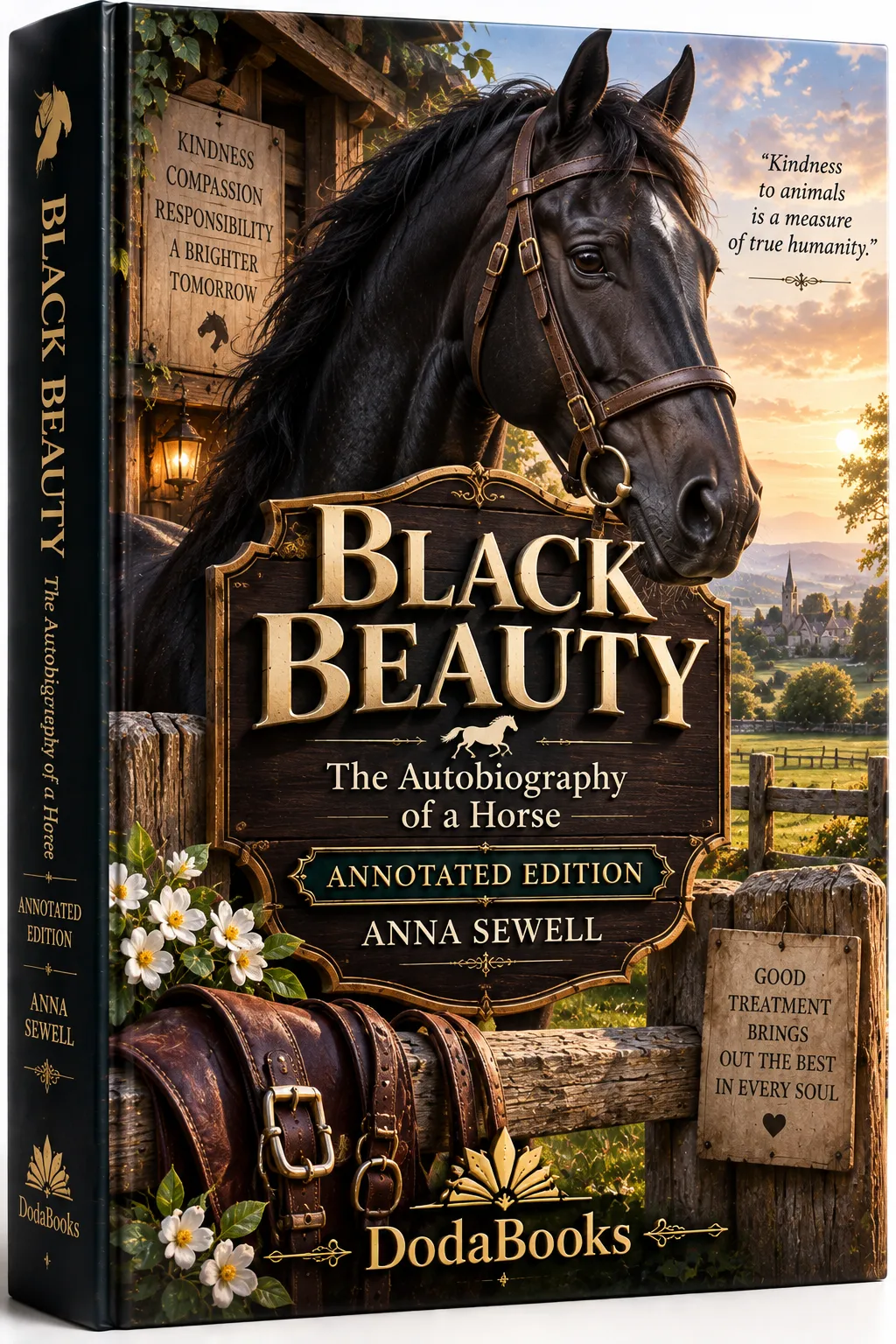
🐎 Experience the Complete 49 Chapters of Black Beauty
Read Anna Sewell’s timeless classic in its original, unabridged beauty. The DodaBooks Annotated Edition of Black Beauty delivers:
- ✅ Complete Unabridged 1877 Text — All 49 chapters restored to original literary glory
- 📜 Equine & Historical Footnotes — Context on Victorian carriage culture, bearing reins, and social reforms
- ✒️ Pristine Digital Layout — Beautiful typography, clean chapter navigation, and smart punctuation
- 🔒 100% DRM-Free Ownership — Yours forever across Kindle, Kobo, iPad, and desktop
- 📥 Instant EPUB Delivery — Download your digital copy immediately