Anna Sewell’s Black Beauty: His Grooms and Companions, the Autobiography of a Horse (1877) is one of the top ten bestselling books of all time, with over fifty million copies sold worldwide. Written from the intimate first-person perspective of a working Victorian horse, this groundbreaking novel did more to abolish animal cruelty and transform public conscience than any piece of legislation in the 19th century.
🐎
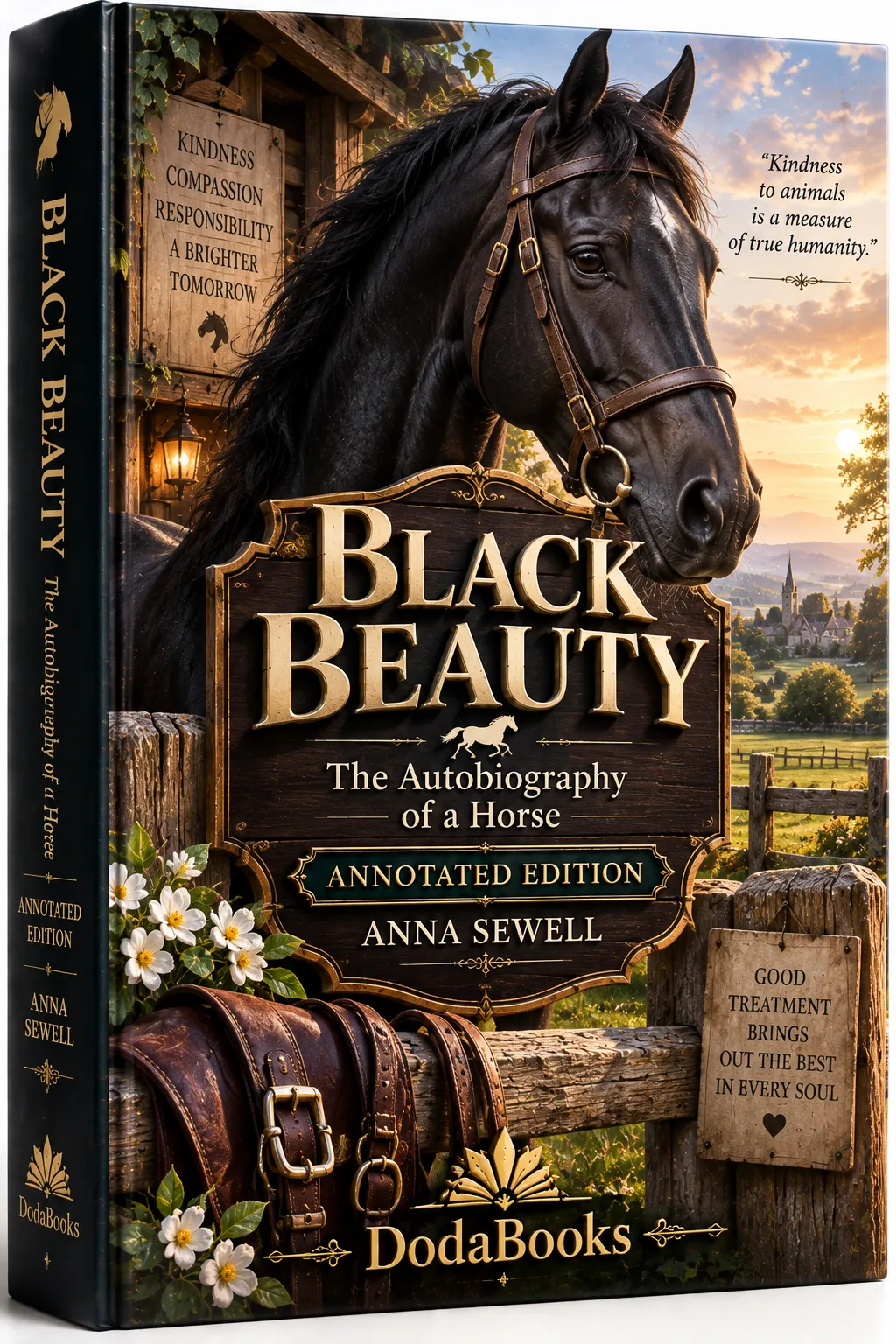
Black Beauty
The revolutionary Victorian autobiography of a horse that changed human hearts forever. Journey with Black Beauty from sunlit country meadows to the grueling, rain-soaked cobblestones of London.
| Author | Anna Sewell |
| Published | November 24, 1877 (Jarrold & Sons, London) |
| Genre | Anthropomorphic Fiction, Social Reform Novel, Autobiography |
| Structure | 49 Chapters across 4 Parts |
| Setting | Country estates, market towns, and London, England (1860s–1870s) |
| Central Themes | Empathy & Kindness, Animal Rights vs. Human Greed, The Cruelty of Fashion (Bearing Rein), Labor Exploitation |
| Reading Time | 4–5 hours |
| Summary Time | 18 minutes |
🌾 Written from an Invalid’s Bed: The Creation of a Masterpiece
Anna Sewell (1820–1878) lived a life defined by physical suffering, intense empathy, and quiet heroic courage. At the age of fourteen, while walking home from school in the rain, she slipped and severely injured both ankles. Mismanaged by contemporary bone-setters, the injury left her permanently lame, unable to stand or walk without crutches for the remainder of her life.
Confined to her family’s house in Norfolk, Sewell’s primary connection to the outside world became horse-drawn carriage travel. She drove a pony chaise herself, developing an extraordinary, intuitive bond with horses. Rather than using whips or harsh curb bits, Sewell guided her animals through gentle voice commands, patience, and mutual trust. She observed with burning anguish how London cab horses and country coach horses were routinely beaten, overloaded, and forced to wear agonizing fashionable devices like the “bearing rein.”
Between 1871 and 1877, Sewell’s health deteriorated drastically. Suffering from terminal hepatitis, she was bedridden and in continuous pain. Too weak to hold a pen, she dictated the forty-nine chapters of Black Beauty to her mother, Quaker author Mary Wright Sewell, or penciled fragments onto small slips of paper. As Sewell stated in her journal, her sole purpose in writing was not to entertain children, but “to induce kindness, sympathy, and an understanding treatment of horses.” She lived just five months after its publication on November 24, 1877, long enough to see her book become an international sensation.
📖 The Journey of Black Beauty: Narrative Breakdown
The novel is structured into four distinct phases, tracking Beauty’s life from idyllic youth to harsh labor and final sanctuary:
Part One: The Meadow and Birtwick Park (Chapters 1–21)
Beauty begins life in a pleasant, sunlit meadow, suckled by his wise mother Duchess, who imparts the moral foundation that guides him throughout his life: “Do your work with a good will, lift your feet up well when you trot, and never bite or kick.”
Trained by a gentle master, Beauty is purchased by Squire Gordon of Birtwick Park. Here Beauty spends his golden years under the care of kind coachman John Manly and young stable hand James Howard. At Birtwick, Beauty befriends Ginger, a spirited chestnut mare whose past abuse by violent trainers has made her cynical and defensive, and Merrylegs, a cheerful, sturdy dapple-grey pony who carries the Squire’s young daughters. Beauty demonstrates courage and intelligence, saving the Squire’s life by refusing to cross a flooded, broken bridge in the middle of a midnight storm.
Part Two: Earlshall Park and the Torture of Fashion (Chapters 22–31)
When Mrs. Gordon falls ill and the family relocates abroad, Birtwick Park is broken up. Beauty and Ginger are sold to Earlshall Park, home of the fashionable Earl of W—. While the Earl is not actively cruel, his vain wife, the Countess of W—, insists that her carriage horses must wear the bearing rein (checkrein) to force their heads high in an unnatural, fashionable arch.
The bearing rein chokes Beauty and Ginger, causing severe muscle spasms, respiratory distress, and mouth bleeding. Ginger rebels, kicking wildly and breaking the carriage pole, which leads to her being demoted to heavy farm work. Beauty’s knees are ruined when a drunken groom, Reuben Smith, gallops him at full speed along a flint-covered road with a loose shoe, throwing Beauty and killing Smith.
Part Three: The London Cab Horse (Chapters 32–45)
Blemished by scarred knees, Beauty can no longer serve as a gentleman’s carriage horse. He is sold into the grueling world of Victorian London cab service. He is purchased by Jerry Barker, a hardworking, pious, and compassionate London cabman. Jerry treats Beauty with exquisite kindness, providing good oats, warm water, and essential rest on Sundays.
Through Beauty’s eyes, Sewell provides a vivid documentary portrait of 19th-century London street life: ruthless competition between cab drivers, wealthy aristocrats demanding cabs in freezing blizzards, and the exhausting plight of working-class laborers. Beauty briefly encounters his beloved friend Ginger, now a broken, hollow-eyed wreck dragged down by relentless beatings and starvation. Days later, Beauty sees Ginger’s dead body on a cart, thanking God that her suffering is finally at an end.
Part Four: The Darkest Depths and Final Meadow (Chapters 46–49)
When Jerry Barker falls severely ill from bronchitis and gives up cab driving, Beauty is sold to a ruthless cab owner named Nicholas Skinner, who works his horses seven days a week on meager rations. Overloaded with luggage from a railway station, Beauty collapses on a steep hill, his lungs bursting with blood.
Saved from the slaughterhouse by a sympathetic horse dealer who sees his noble breeding, Beauty is nursed back to health and purchased at an auction by two gentle sisters and their coachman—none other than Joe Green, the former stable boy from Birtwick Park! Recognizing Beauty by a white star on his forehead and a white foot, Joe wept with joy. Beauty spends his peaceful final years grazing in a green orchard, murmuring in his sleep that he is back at Birtwick Park.
🐴 Equine Character Profiles
🖤 BLACK BEAUTY
The Noble Narrator
“There is no religion without love, and people may talk as much as they like about their religion, but if it does not teach them to be good and kind to man and beast, it is all a sham.”
Handsome, well-bred, obedient, and observant, Beauty endures both luxury and horrific exploitation with dignity, patience, and unwavering loyalty.
Why He Matters
Beauty was the first non-human protagonist in English fiction to speak directly in the first person with moral authority, forcing readers to view human cruelty through the sensitive eyes of the creature enduring it.
🔥 GINGER
The Rebellious Chestnut
“If they had been civil with me, I should have learned as well as any other; but they were always snapping and snapping, and snatching at my head.”
Spirited, proud, and scarred by early abuse, Ginger refuses to submit meekly to human injustice. Her tragic descent from proud carriage horse to broken dray horse is the emotional heartbreak of the novel.
Why She Matters
Ginger demonstrates that “vicious” animal behavior is the direct consequence of human abuse, standing as an enduring symbol of systemic exploitation.
🎩 JERRY BARKER
The True Christian Cabman
“He said he had no right to make another man work when he ought to be at church, and that his horses needed the day of rest as much as he did.”
Jerry is honest, sober, kind, and devoted to his family. He treats his horses as living partners rather than machines to be driven into the grave.
Why He Matters
Jerry proves that even in an impoverished, hyper-competitive urban economy, compassion and moral integrity are possible.
📘 Annotated Insight — The immediate real-world impact of Black Beauty was astonishing. The novel led directly to public outrage against the bearing rein, causing its widespread abandonment across Britain and North America. Organizations such as the RSPCA and American Humane Society distributed over three million copies to cab drivers, police officers, and stable hands.
🔍 Major Themes & Social Impact
1. The Abolition of the Bearing Rein
The primary target of Sewell’s crusade was the Victorian “bearing rein.” Invented purely for aesthetic vanity, this rein strapped a horse’s head tightly backward toward its chest to produce a proud, arched neck. Sewell documented the horrific medical reality: respiratory suffocation, spinal damage, and early death. Black Beauty turned a private equine torment into a major public scandal.
2. Labor Rights and Christian Compassion
Sewell linked the suffering of animals directly to the exploitation of human workers. Jerry Barker cannot afford to rest his horses because greedy railway companies and selfish patrons demand Sunday transportation. Sewell advocated for mandatory days of rest, fair wages, and temperance, arguing that cruelty to animals is inextricably linked to poverty and human degradation.
3. The Power of Empathy
By using the first-person equine perspective, Sewell pioneered what modern psychologists term “radical empathy.” She forced Victorian society—which treated working animals as disposable industrial engines—to acknowledge that horses possess complex nervous systems, memories, affections, grief, and the capacity for intense physical and psychological suffering.
📖 Explore the Annotated Edition at DodaBooks →
✨ What Makes the DodaBooks Annotated Edition Essential
While often sold today as a simplified children’s book, Black Beauty is a sophisticated 19th-century social reform novel packed with specific Victorian harness terminology, veterinary practices, and legal debates that modern readers miss.
The DodaBooks Annotated Edition restores Sewell’s profound adult vision:
Equine Harness & Bit Glossary
Clear explanations and diagrams of the bearing rein, curb bits, blinkers, and Victorian carriage gear.
Victorian Social History Notes
Context on London cab licenses, the watermen's stands, railway depots, and 19th-century veterinary medicine.
Anna Sewell's Biography
The poignant, complete life story of Anna Sewell and her mother Mary, including extracts from Sewell's personal journals.
Animal Welfare Crusade Timeline
Track the real-world legislative reforms and RSPCA campaigns directly sparked by the publication of Black Beauty.
100% DRM-Free Freedom
Yours permanently to read on Kindle, Kobo, Apple Books, Android, or reMarkable without restrictions.
Complete Unabridged Text
All 49 original chapters with restored 1877 typography, smart punctuation, and beautiful chapter headings.
❓ Frequently Asked Questions
Was Black Beauty originally written for children?
No. Anna Sewell explicitly stated that she wrote Black Beauty for adults—specifically for grooms, cab drivers, horse owners, and working men—to foster empathy and abolish cruel practices like the bearing rein. Only in later decades was it marketed as a children's story, often in heavily abridged and sanitized editions.
What exactly was the "bearing rein" and why was it harmful?
The bearing rein (or checkrein) was a strap running from the horse's bit to the back of the harness, forcing the animal's head into a high, unnatural arch. It was used purely for aristocratic fashion. It severely restricted breathing, caused intense muscle spasms in the neck and shoulders, and made it agonizingly difficult for horses to pull heavy loads up hills.
Did Anna Sewell write any other books?
No. Black Beauty was Anna Sewell's only published novel. She struggled with chronic illness her entire adult life and died in April 1878, just five months after the novel was published.
How does the novel end for Black Beauty?
After enduring horrific abuse as a London cab horse and collapsing from exhaustion, Beauty is rescued by a caring horse dealer and eventually purchased by the kind Misses Blomefield. He is reunited with Joe Green, his beloved groom from his youth at Birtwick Park, and lives out his days in a peaceful green pasture.
Why should I purchase the DodaBooks edition?
Many modern printings of Black Beauty are heavily abridged children's adaptations that strip out Sewell's vital social critique, discussions of cab labor laws, and Victorian religious themes. DodaBooks provides the complete, unabridged 1877 text with comprehensive annotations explaining the historical and equine context.
🐎 Experience the Greatest Animal Story Ever Told
Rediscover the book that stirred the conscience of the world. The DodaBooks Annotated Edition of Black Beauty delivers:
- ✅ Complete Unabridged 1877 Text — All 49 chapters restored to their original literary glory
- 📜 Historical & Harness Footnotes — Context on Victorian equine culture and welfare reforms
- ✒️ Exquisite Typography — Beautiful reading layout with smart quotes and clean margins
- 🔒 100% DRM-Free Ownership — Yours forever across Kindle, Kobo, and iPad
- 📥 Instant Download — Immediate delivery in pristine EPUB format