Black Beauty Characters: Equine and Human Personalities Explained
When Anna Sewell published Black Beauty in 1877, she achieved an unprecedented literary feat: giving animals authentic psychological interiority, distinct personalities, and moral agency without descending into cartoonish anthropomorphism. The horses of Black Beauty do not talk to humans; they communicate through subtle equine body language, ear positions, whickers, and physical resistance, while narrating their experiences with profound emotional clarity.
Equally compelling is Sewell’s diverse human cast. From high-minded country coachmen to vain aristocrats, compassionate working-class cab drivers, and drunken grooms, the human characters serve as a moral barometer of Victorian society. Through their treatment of beasts, Sewell reveals the true nature of the human soul.
This comprehensive character analysis examines the psychological depth, symbolic significance, and character arcs of every major equine and human figure in Anna Sewell’s immortal masterpiece.
| Character | Species / Role | Core Personality Traits | Symbolic Representation |
|---|---|---|---|
| Black Beauty (“Jack / Black Auster”) | Dark Bay / Black Gelding | Patient, noble, observant, courageous | The Dignity and Suffering of the Working Animal; Christian Endurance |
| Ginger | Chestnut Mare | Spirited, traumatized, defensive, defiant | The Victim of Early Abuse; The Inevitable Tragedy of Defiance |
| Merrylegs | Dapple-Grey Pony | Cheerful, sturdy, playful, uncompromising | Healthy Boundaries; Childhood Innocence and Protection |
| Captain | Retired Warhorse | Dignified, battle-scarred, solemn | The Trauma of Imperial Warfare; The Forgotten Veteran |
| John Manly | Coachman at Birtwick Park | Sober, deeply knowledgeable, humane | The Ideal Horseman; True Christian Stewardship |
| Jerry Barker | London Hackney Cabman | Kind, pious, hardworking, principled | Working-Class Virtue; The Champion of the Golden Rule and Sunday Rest |
| Joe Green | Stable boy turned Groom | Well-meaning, clumsy, learns from error | The Power of Moral Growth and Humane Education |
| Countess of W— | Aristocrat at Earlshall | Vain, imperious, superficial | The Cruelty of High-Society Fashion (The Bearing Rein) |
| Reuben Smith | Groom at Earlshall Park | Talented horseman plagued by alcoholism | Human Frailty and the Deadly Cost of Addictive Negligence |
| Nicholas Skinner | Ruthless London Cab Fleet Owner | Greedy, unfeeling, brutal | Unchecked Gilded-Age Capitalism and Labor Exploitation |
🐴 The Equine Characters: Personalities in the Stall
1. Black Beauty: The Noble Narrator
Black Beauty is the moral center of the novel. Born of royal stock with an ebony coat, a bright white star on his forehead, and a single white foot, Beauty inherits his mother Duchess’s gentle disposition and ironclad work ethic:
“I always tried to do my work with a good will, and lift my feet up well when I trotted, and never bite or kick.”
Beauty represents Christian fortitude and patience in the face of suffering. Unlike Ginger, who rebels violently against cruel treatment, Beauty endures hardship with dignified obedience. Yet Beauty is never passive or cowardly:
- He risks his own life during the midnight storm, refusing to cross the broken bridge and saving Squire Gordon’s life.
- He gallops until his lungs are on fire to fetch the doctor for the dying Mrs. Gordon.
- He heroically intercepts Lady Anne’s runaway horse to prevent a fatal accident.
Even when demoted to the grueling streets of London, pulling overloaded four-wheeled cabs in freezing winter blizzards, Beauty maintains his gentle nobility. His journey is a testament to the resilience of the animal spirit, and his final sanctuary with Joe Green provides one of literature’s most satisfying reunions.
2. Ginger: The Tragedy of the Broken Rebel
🔥 GINGER (THE CHESTNUT MARE)
The Defiant Soul Crushed by Human Cruelty
“They never gave me a kind word or a pat. If I did not understand what they wanted, it was a strike of the whip or a cut with the spur. I determined that if men were my enemies, I would be theirs.”
Ginger is Black Beauty’s most important companion and literary foil. Born a spirited, sensitive chestnut mare with a white blaze, Ginger was torn from her mother too early and placed in the hands of brutal, impatient horse-breakers who used savage curb bits, whips, and spurs to force her into submission.
As a result, Ginger develops a defensive, biting temperament. She distrusts all humans, assuming that cruelty is the universal law of existence. Only under the gentle, patient hands of John Manly at Birtwick Park does Ginger begin to soften, discovering that love and kindness are possible:
“It was the first time I had ever been treated like a friend, and it made all the difference in the world.”
Yet Ginger’s fate is the most tragic in the novel. At Earlshall Park, when the vain Countess of W— tightens the bearing rein until Ginger is suffocated, Ginger stages a desperate “strike for liberty,” kicking the carriage to splinters. Her defiance is punished with demotion to heavy field labor and eventual sale into the brutal London cab trade.
In Chapter 40, Beauty encounters Ginger in the streets of London: a broken, coughing, emaciated ruin whose spirit has been utterly beaten out of her. When Beauty strokes her with his nose, she whispers that she only wishes for death. Days later, Beauty sees her dead body on a knacker’s cart.
Why She Matters
Ginger represents the thousands of spirited animals and oppressed working-class laborers who are broken and discarded by an unfeeling industrial society. She demonstrates that abuse leaves permanent psychological scars that even kindness cannot always heal.
3. Merrylegs: The Guardian of Childhood
🐴 MERRYLEGS (THE DAPPLE-GREY PONY)
The Sturdy Pony of Clear Boundaries
“I am twelve years old, and I know what is good for children and what is not. If they want to play, I play; but if they stick pins in me or use a stick, I gently lay down in the grass and let them tumble off.”
Merrylegs is a fat, handsome, dapple-grey pony who lives with Beauty and Ginger at Birtwick Park. Merrylegs is cheerful, reliable, and deeply fond of human children, particularly Squire Gordon’s young daughters.
Unlike the high-strung carriage horses, Merrylegs understands human psychology with humorous clarity. He establishes clear, healthy boundaries: he will never bite or kick a child, but he will not tolerate cruelty. When careless boys tease him, he simply lies down on the turf, sliding the children harmlessly off his back to teach them a lesson.
When Birtwick Park is broken up, Squire Gordon ensures that Merrylegs is gifted to a kind local vicar on the strict condition that he will never be sold, will never wear a bearing rein, and will be humanely put down when old age arrives.
Why He Matters
Merrylegs represents innocence, domestic joy, and the model of firm, non-violent resistance. He proves that animals possess distinct boundaries that humans must respect.
4. Captain: The Scarred Crimean Cavalry Veteran
⚔️ CAPTAIN (THE CAVALRY VETERAN)
The Solemn Witness to Imperial Slaughter
“Men say it was a glorious charge; I call it horrific slaughter. The earth trembled under our hooves, the air was full of screaming shells, smoke, and thunder… I saw my noble master fall with a bullet through his heart, and I was left alone in the smoke.”
Captain is an elegant, white-faced veteran horse who shares Jerry Barker’s London cab stable with Beauty. Captain served as an officer’s mount in the British cavalry during the Crimean War (1853–1856), surviving the notorious Charge of the Light Brigade at the Battle of Balaclava.
Captain provides Sewell’s searing anti-war critique. While Victorian society celebrated imperial cavalry charges in patriotic poetry and paintings, Captain recounts the visceral horror of war: horses disemboweled by cannonballs, screams of dying men, and the absolute pointlessness of human violence.
In old age, Captain serves Jerry Barker with quiet dignity until an overloaded dray crashes into the cab, severely injuring him. Rather than allowing Captain to be sold to a cruel cart-driver, Jerry pays for him to be humanely euthanized, honoring his dignity to the very end.
Why He Matters
Captain serves as a profound symbol of the forgotten veteran. Sewell uses him to remind readers that animals are conscripted into human wars without understanding or consent, bearing the horrific physical and emotional wounds of human conflict.
5. Duchess (“Pet”) & Sir Oliver
- Duchess: Black Beauty’s wise mother, a respected cart-horse who imparts the opening moral lessons of the novel. She teaches Beauty that true nobility comes not from breeding or pedigree, but from gentle conduct, reliable labor, and refusal to bite or kick.
- Sir Oliver: An older carriage horse at Birtwick with a chopped-off, docked tail. Sir Oliver delivers a blistering critique of human cosmetic surgery on animals, explaining how fashionable docking robs horses of their only natural defense against disease-bearing summer flies.
Explore the full psychological depth of Sewell's characters with our complete annotated edition.
📖 Get the Annotated Edition at DodaBooks →👥 The Human Characters: Stewards vs. Exploiters
1. John Manly: The Model of Humane Mastery
John Manly is the head coachman at Birtwick Park and the moral ideal of human stewardship in the novel. John understands that horses are sentient creatures with nervous systems, fears, and emotions. He speaks to his animals in quiet, reassuring tones, never using the whip except in moments of extreme emergency.
John’s defining moral philosophy is that cruelty and ignorance are the twin curses of the world:
“Bad-tempered people and cruel people are the devil’s own servants, and they wear his trademark on their faces… But ignorance is almost as bad as malice.” When Beauty saves the carriage at the broken bridge, John strokes his neck with tears in his eyes; when Joe Green’s ignorance nearly kills Beauty, John spends four nights sleeping in the stable, administering hot bran mashes and poultices.
2. Jerry Barker: The Saint of the London Cab-Stand
Jerry Barker is a licensed London cab driver and the most admirable human protagonist in the novel. In an era when London cab drivers were notorious for alcoholism, cheating passengers, and brutalizing their animals, Jerry lives by strict Christian principles:
- The Golden Rule: Jerry treats his horses, his family, and his passengers with unwavering fairness and kindness.
- The Sunday Rest: Jerry refuses to drive his cab on Sundays, sacrificing lucrative fares from wealthy churchgoers because he believes that both working men and beasts require a day of physical and spiritual restoration.
- Compassion for the Weak: Jerry frequently provides free rides to poor hospital patients, impoverished mothers, and lost children.
Jerry’s tragic downfall occurs on New Year’s Eve, when two wealthy, thoughtless young men keep him waiting outside a party in a freezing blizzard for three hours. Jerry contracts acute bronchitis and pleurisy, nearly dying, and is forced to leave London forever.
3. Joe Green: The Redemption of Human Education
Joe Green begins as a well-meaning but utterly ignorant fourteen-year-old stable boy who replaces James Howard at Birtwick Park. In Chapter 19, after Beauty gallops eight miles to fetch the doctor for Mrs. Gordon, Joe gives the steaming horse cold water and no blanket, bringing on a near-fatal case of lung inflammation.
Joe’s reaction to his mistake defines his character: rather than making excuses, he is overcome with remorse and dedicates his life to mastering humane horsemanship. In Chapter 20, Joe displays immense courage by standing up to a violent carter who is flogging horses in the mud, testifying against him in court. Twenty years later, in Chapter 49, Joe is the groom who recognizes Beauty’s white star and white foot, securing his beloved horse in a permanent, gentle sanctuary.
4. The Exploiters: Countess of W—, Reuben Smith & Nicholas Skinner
Sewell contrasts her virtuous characters with three distinct types of human destructiveness:
| Antagonist | The Root of Their Cruelty | The Consequences for the Horse |
|---|---|---|
| Countess of W— | Vanity & Social Conformity | Forces Beauty and Ginger into the agonizing bearing rein to look fashionable, permanently damaging Ginger’s health. |
| Reuben Smith | Addiction & Willful Negligence | A talented horseman who drinks away his senses, riding Beauty with a loose shoe over sharp flints, ruining Beauty’s knees and killing himself. |
| Nicholas Skinner | Systemic Economic Greed | Works fleet cab horses eighteen hours a day, seven days a week on meager food, driving Beauty to a near-fatal lung hemorrhage on a hill. |
⚖️ Character Foil Dynamics
┌─────────────────────────────────────────────────────────────┐
│  Endurance vs. Rebellion: Black Beauty vs. Ginger          │
│  Beauty adapts and survives; Ginger fights and is destroyed │
├─────────────────────────────────────────────────────────────┤
│  Virtue vs. Exploitation: Jerry Barker vs. Nicholas Skinner │
│  Jerry shares love and rest; Skinner extracts profit & death│
├─────────────────────────────────────────────────────────────┤
│  Knowledge vs. Negligence: John Manly vs. Reuben Smith      │
│  Manly uses reason and care; Smith surrenders to alcohol    │
└─────────────────────────────────────────────────────────────┘
The contrast between Black Beauty and Ginger is the emotional core of the novel. While Beauty represents the ideal of stoic patience, Ginger represents the tragedy of righteous anger. Sewell makes it clear that while Ginger’s rebellion against the bearing rein was completely justified, Victorian society offered no mercy to a rebellious animal. Ginger’s tragedy is an indictment of the system that created her.
The Psychology of Equine Trauma
Read detailed psychological analyses of Ginger's defensive biting behavior and how trauma was understood in 1877.
John Manly's Real-Life Models
Discover how Anna Sewell based John Manly on her own cousin and her Quaker family's humane carriage drivers.
Victorian London Cab Economics
Understand the economic realities behind Nicholas Skinner and Seedy Sam: the brutal 16-shilling daily cab rental system.
The Crimean War Context
Historical background on Captain's service in the Charge of the Light Brigade and equine military casualties.
The Misses Blomefield & Quakers
Learn how the quiet, peaceful meadow of Chapter 49 reflects Anna Sewell's own gentle Quaker upbringing and faith.
Joe Green's Legal Precedents
Historical footnotes detailing the early prosecution of animal cruelty cases under the Martin's Act in 19th-century England.
❓ Frequently Asked Questions
Why does Black Beauty have different names throughout the novel?
Each name reflects Beauty's changing social status and owner. His first master called him "Darkie"; Squire Gordon named him "Black Beauty" for his elegant coat; at Earlshall he was "Black Auster"; Jerry Barker called him "Jack"; and cab drivers nicknamed him "Old Blackie."
Is Ginger's rebellion justified in the novel?
Yes. Anna Sewell portrays Ginger's kick against the bearing rein as completely justified self-defense against agonizing physical suffocation. However, Sewell realistically depicts the cruel consequences: in Victorian society, a horse that rebelled was labeled "vicious" and sold into brutal labor.
What is the difference between John Manly and Jerry Barker?
John Manly represents the aristocratic country estate coachman with access to fine stables, top-grade oats, and plenty of pasture, while Jerry Barker represents the urban, working-class cab driver who must practice kindness in the midst of fierce London poverty, economic competition, and bad weather.
How did Reuben Smith's death impact Victorian readers?
Reuben Smith's tragic death was a powerful temperance lesson for 19th-century audiences. Sewell showed that alcohol does not merely harm the drinker; it destroys innocent animals and ruins families, as Reuben's widow and children were cast out into the workhouse.
Why does the novel end with Joe Green rather than John Manly?
Ending with Joe Green highlights the theme of education and redemption. John Manly was already an expert horseman, but Joe Green was an ignorant boy who made a terrible mistake, learned from it, and grew into a compassionate man. His reunion with Beauty symbolizes humanity's capacity to grow into true stewardship.
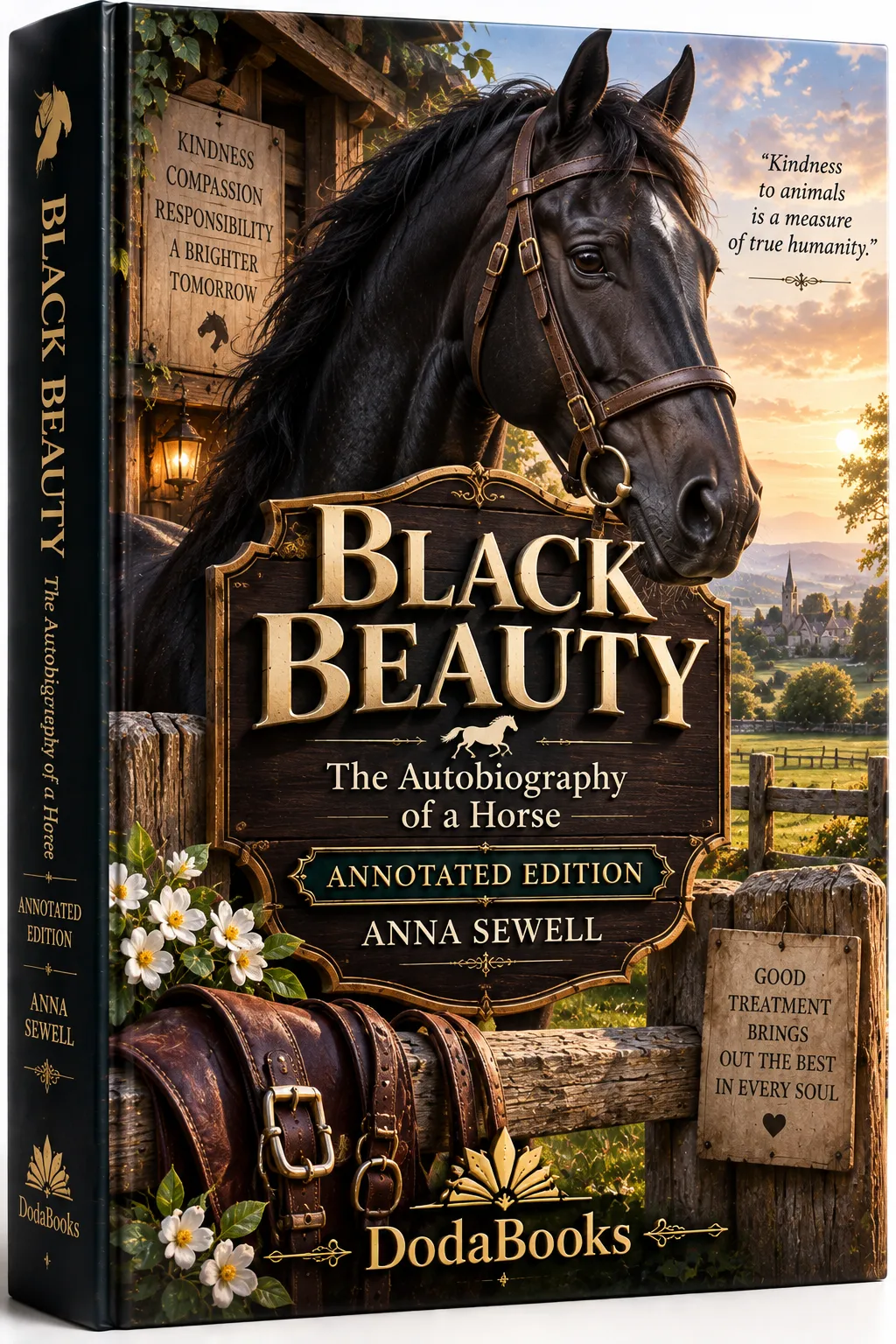
🐎 Meet the Unforgettable Personalities of Black Beauty
Discover Anna Sewell’s groundbreaking study of equine and human nature. The DodaBooks Annotated Edition of Black Beauty delivers:
- ✅ Complete Unabridged 1877 First Edition — Follow Beauty, Ginger, Merrylegs, and Jerry Barker in original prose
- 📜 Exhaustive Character Footnotes — Context on Victorian equine culture, cab laws, and Quaker humanism
- ✒️ Clear Formatting & Typography — Beautifully designed for effortless digital reading
- 🔒 100% DRM-Free Ownership — Yours forever across Kindle, Kobo, iPad, and Android
- 📥 Instant EPUB Delivery — Download your digital copy immediately