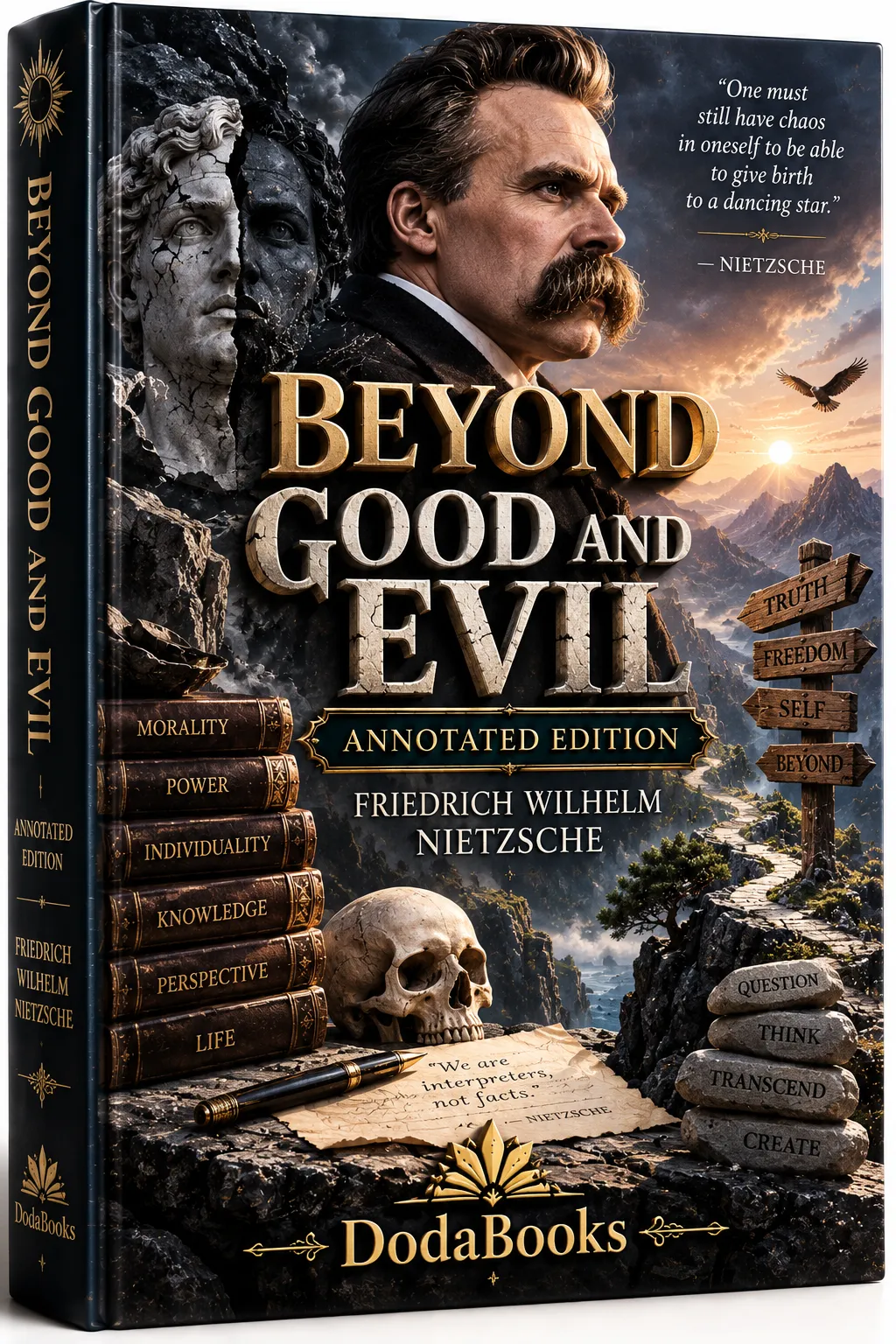
Friedrich Nietzsche’s Beyond Good and Evil: Prelude to a Philosophy of the Future (1886) is one of the most explosive, radical, and influential philosophical works ever written. Smashing through centuries of comfortable dogmatism, Nietzsche takes a philosophical hammer to traditional morality, Christian metaphysics, and Enlightenment rationalism, challenging humanity to forge new values beyond the simplistic dualism of good and evil.
⚡
Beyond Good and Evil
Nietzsche's incendiary masterpiece of philosophical liberation. Unpack the will to power, master-slave morality, the psychology of philosophers, and the birth of the free spirit.
| Author | Friedrich Nietzsche |
| Published | 1886 (Leipzig) |
| Genre | Philosophy, Aphoristic Prose, Cultural Criticism |
| Structure | 296 Aphorisms across 9 Parts plus Epode (“From High Mountains”) |
| Central Themes | Will to Power, Master vs. Slave Morality, Perspectivism, The Free Spirit, The Prejudices of Philosophers |
| Reading Time | 8–10 hours |
| Summary Time | 25 minutes |
🌋 The Storm After Zarathustra
Published in 1886 at Nietzsche’s own personal expense after being rejected by mainstream publishers, Beyond Good and Evil (Jenseits von Gut und Böse) represents the intellectual zenith of Nietzsche’s mature philosophy. Having unveiled his poetic vision of the Übermensch and the eternal return in Thus Spoke Zarathustra (1883–1885), Nietzsche felt an urgent need to translate those poetic visions into rigorous, ruthless prose.
As Nietzsche wrote to his friend Jacob Burckhardt, Beyond Good and Evil was intended to say the exact same things as Zarathustra, but “in a way that is radically different, very difficult, very subtle, even aristocratic.” Written in high Swiss mountain sanctuaries such as Sils-Maria and on the Mediterranean coast of Nice, the text is characterized by its intense psychological velocity, biting sarcasm, aphoristic brilliance, and ferocious intellectual honesty.
Nietzsche recognized that Western civilization was standing upon the brink of a catastrophic civilizational crisis. With the collapse of traditional Christian theism—what he termed “the death of God”—Europe was sleepwalking into a catastrophic void of nihilism. If old theological absolutes no longer held power, humanity faced a stark choice: either surrender to passive, hedonistic mediocrity (the “Last Man”) or summon the courage to re-evaluate all values from their very foundations.
🧭 The Nine Core Sections: Structural Breakdown
Beyond Good and Evil consists of 296 numbered aphorisms and essays divided into nine distinct sections, culminating in a poetic epode:
Part One: On the Prejudices of Philosophers (Aphorisms 1–23)
Nietzsche opens with an audacious question: “The Will to Truth, which is to tempt us to many a hazardous enterprise… what really in us is at work wanting ’the truth’?” He exposes previous philosophers—from Plato and Descartes to Kant and Spinoza—not as objective searchers of truth, but as clever advocates who invent intricate metaphysical systems merely to rationalize their personal moral prejudices and unconscious instincts. Nietzsche introduces his doctrine of perspectivism: there are no absolute metaphysical truths, only interpretations born from specific physiological, psychological, and historical perspectives.
Part Two: The Free Spirit (Aphorisms 24–44)
Nietzsche outlines the psychological profile of the “Free Spirit” (der freie Geist)—an independent, solitary thinker who refuses to belong to any political party, religious creed, or academic consensus. The free spirit loves mystery, embraces intellectual danger, and understands that profound wisdom must often wear a mask to protect itself from the vulgar misunderstandings of the mob.
Part Three: What Is Religious (Aphorisms 45–62)
Nietzsche conducts an unsparing psychological dissection of the religious instinct. He analyzes how Christianity executed a monumental “slave revolt in morals,” exalting weakness, poverty, suffering, and obedience while condemning strength, pride, intellectual curiosity, and earthly joy as sinful.
Part Four: Epigrams and Interludes (Aphorisms 63–185)
A dazzling firework display of 123 concise, piercing aphorisms covering human vanity, love, hatred, knowledge, psychology, and sexuality. Here appear some of Nietzsche’s most quoted insights:
"Whoever fights monsters should see to it that in the process he does not become a monster.
And if you gaze long enough into an abyss, the abyss will gaze back into you." (Aphorism 146)
Part Five: The Natural History of Morals (Aphorisms 186–203)
Here Nietzsche develops his famous distinction between Master Morality and Slave Morality. He examines how ethical systems are not timeless divine commands, but evolutionary symptoms of the social groups that produced them.
Part Six: We Scholars (Aphorisms 204–213)
Nietzsche contrasts the narrow, pedantic academic specialist with the true philosopher. While the scholar merely categorizes and catalogs existing ideas, the genuine philosopher is a creator, a commander, and a legislator of future human values.
Part Seven: Our Virtues (Aphorisms 214–239)
An examination of modern intellectual honesty and the virtue of intellectual cleanliness. Nietzsche warns against sentimental humanism, moral complacency, and the modern illusion that equality is inherently good.
Part Eight: Peoples and Fatherlands (Aphorisms 240–256)
Nietzsche critiques European nationalism, reserving particular scorn for German chauvinism, petty nationalism, and anti-Semitism. He champions the concept of the “Good European”—cosmopolitan, cultured individuals who transcend tribal national borders.
Part Nine: What Is Noble? (Aphorisms 257–296)
The culminating section explores the essence of aristocratic excellence, spiritual rank, and distance. Nietzsche argues that all human cultural elevation has historically arisen from aristocratic societies characterized by a “pathos of distance”—the recognition that human beings are fundamentally unequal in spiritual depth, creative capability, and intellectual power.
⚡ Core Concepts Unpacked
🦁 WILL TO POWER (DER WILLE ZUR MACHT)
The Fundamental Engine of Existence
“A living thing seeks above all to discharge its strength: life itself is will to power.” (Aphorism 13)
Nietzsche rejects Darwin’s notion that the primary drive of living organisms is mere self-preservation. Living things do not simply want to survive; they want to expand, master their environment, overcome resistance, and express creative potency.
Why It Matters
The Will to Power is neither political tyranny nor brute physical violence; it is the fundamental psychological and ontological drive toward self-overcoming, excellence, and the transformation of raw struggle into sublime culture and art.
⚔️ MASTER VS. SLAVE MORALITY
The Great Moral Schism
“The master type of man regards himself as a determiner of values; he does not require to be approved of.” (Aphorism 260)
Nietzsche divides historical ethics into two basic families:
- Master Morality: Originates among the strong and noble. The primary valuation is Good vs. Bad (Good = noble, strong, beautiful, proud; Bad = cowardly, petty, weak, base).
- Slave Morality: Originates among the oppressed and resentful. The valuation is Good vs. Evil (Good = humble, patient, meek, obedient; Evil = the powerful, the proud, the dangerous masters).
Why It Matters
Nietzsche exposed how modern democratic, egalitarian, and Christian values are secularized descendants of slave morality, driven by unconscious resentment (ressentiment) against human excellence and greatness.
🎭 PERSPECTIVISM & THE MASK
The Illusion of Pure Objectivity
“There are no moral phenomena at all, only a moral interpretation of phenomena.” (Aphorism 108)
Nietzsche argues that all human knowledge is inevitably situated, partial, and interpretive. Every philosophy reflects the organic needs and drive-hierarchy of its author.
Why It Matters
Perspectivism anticipated modern hermeneutics, postmodernism, and psychoanalysis, revolutionizing epistemology by showing that the search for “disinterested truth” is itself a psychological fiction.
📘 Annotated Insight — Aphorism 146’s warning about gazing into the abyss is often misquoted as a warning against intellectual curiosity. In context, Nietzsche is addressing the dangerous psychology of the truth-seeker: whoever ventures beyond conventional moral dogmas must develop formidable psychological fortitude, or risk being consumed by the very nihilism they set out to analyze.
🔍 Why Nietzsche Matters Today
More than a century after its publication, Beyond Good and Evil remains breathtakingly contemporary. Nietzsche accurately predicted the catastrophic ideological wars of the 20th century, the rise of mass media conformism, and the spiritual paralysis of post-religious Western secularism.
Reading Nietzsche is not a passive intellectual exercise; it is an exhilarating, disorienting workout for the mind. He challenges readers to examine their most sacred beliefs: Why do you value equality? Why do you value pity? Are your moral opinions genuine personal convictions, or merely the herd instincts of your peer group?
📖 Explore the Annotated Edition at DodaBooks →
✨ What Makes the DodaBooks Annotated Edition Essential
Beyond Good and Evil is notorious for being misunderstood when read in poor-quality, unannotated editions. Nietzsche constantly engages in fierce debates with figures of his era—Arthur Schopenhauer, Paul Rée, Richard Wagner, David Strauss, and British utilitarians—whom modern readers know little about. Without explanatory notes, many of his most brilliant satirical barbs lose their force.
The DodaBooks Annotated Edition unlocks the full power of Nietzsche’s text:
Philosophical Reference Decoder
Comprehensive footnotes explaining Kantian synthetic a priori judgments, Spinoza's metaphysics, and Schopenhauer's pessimism.
Latin & Greek Translations
Immediate in-line glosses for every untranslated classical, French, and Italian phrase used throughout the 296 aphorisms.
Context on 19th-Century Targets
Understand who Nietzsche is arguing against in each section, from British utilitarians to German academic philologists.
Aphorism-by-Aphorism Navigation
Effortlessly jump between all 296 aphorisms and the concluding poetic Epode with an interactive table of contents.
100% DRM-Free Ownership
Read across all your devices without restrictions. Fully compatible with Kindle, Kobo, Apple Books, and Android.
Helen Zimmern's Classic Translation
Features Helen Zimmern's authoritative, authorized translation, meticulously checked for philosophical accuracy and typography.
❓ Frequently Asked Questions
Does "Beyond Good and Evil" mean Nietzsche promotes evil?
No. "Beyond Good and Evil" does not mean acting immorally or promoting cruelty. Nietzsche's goal is to move beyond the simplistic, dogmatic moral dualism inherited from Judeo-Christian theology. He advocates evaluating actions based on whether they enhance human vitality, excellence, and creative flourishing ("noble vs. base") rather than conformity to universal taboos.
How does Beyond Good and Evil differ from Thus Spoke Zarathustra?
Thus Spoke Zarathustra is a philosophical, poetic allegory written in the prophetic style of the New Testament and the Persian Avesta. Beyond Good and Evil covers the exact same philosophical ground but in dense, prose aphorisms, critical essays, and psychological analysis, making it much more direct and rigorous.
What does Nietzsche mean by the "Free Spirit"?
The "Free Spirit" is Nietzsche's ideal thinker: someone who has liberated their mind from dogmatic religion, political nationalism, social conformity, and intellectual cowardice. Free spirits embrace solitude, skepticism, and intellectual danger in pursuit of higher wisdom.
Was Nietzsche an anti-Semite or a German nationalist?
Absolutely not. In Part Eight of Beyond Good and Evil and across his correspondence, Nietzsche explicitly denounces German nationalism and writes with biting contempt about European anti-Semitism, even breaking off friendships with his sister and Richard Wagner over their anti-Semitic views.
Why is the DodaBooks edition recommended over free web copies?
Free scans of Nietzsche online are littered with corrupted German spellings, missing Latin translations, and no explanatory context for complex philosophical debates. DodaBooks provides a beautifully typeset, unabridged edition with comprehensive scholarly annotations, ensuring you grasp the profound depth of every aphorism.
⚡ Challenge Your Mind with Nietzsche’s Masterpiece
Break free from philosophical dogmatism and lazy assumptions. The DodaBooks Annotated Edition of Beyond Good and Evil delivers:
- ✅ Complete Authoritative Text — All 296 aphorisms and the concluding poetic Epode
- 📜 Scholarly Footnotes & Translations — In-depth explanations of philosophical and classical references
- ✒️ Exquisite Typography — Beautiful reading layout optimized for deep contemplation
- 🔒 100% DRM-Free Freedom — Yours forever to read on Kindle, Kobo, iPad, or mobile
- 📥 Instant Digital Delivery — High-quality EPUB format available immediately
For the classical foundation of duty, inner discipline, and ancient Stoic virtue that Nietzsche contested, explore our Thoughts of Marcus Aurelius Guide.