Bacon's Essays Themes & Philosophy: Machiavellian Wit, Empiricism & Allegory Explained
Francis Bacon (1561–1626) occupies a unique and controversial summit in Western intellectual history. Celebrated by the Enlightenment as the father of modern scientific empiricism, Bacon was also an ambitious courtier, attorney general, and Lord High Chancellor under King James I who spent four decades maneuvering through the ruthless corridors of Elizabethan and Jacobean power. In The Essayes or Counsels, Civill and Morall and its mythological companion The Wisdom of the Ancients (De Sapientia Veterum), these two identities coalesce: the dispassionate scientific observer turns his gaze inward to dissect the mechanics of human ambition, political power, moral compromise, and psychological self-deception.
Unlike classical moralists who described humanity as it ought to be, Bacon examined humanity as it actually existed in the courtroom, the royal bedchamber, and the council chamber. By synthesizing Christian morality with Machiavellian political realism and ancient classical philosophy, Bacon created a body of aphoristic wisdom that remains strikingly contemporary in its psychological acuity.
This comprehensive guide analyzes the dominant philosophical themes, intellectual methods, and allegorical codes of Bacon’s essays, exploring the tension between virtue and worldly prudence.
| Core Theme / Concept | Primary Essays & Texts | Central Philosophical Conflict | Practical Modern Implication |
|---|---|---|---|
| Prudence vs. Virtue | “Of Simulation and Dissimulation” (VI), “Of Cunning” (XXII), “Of Goodness” (XIII) | Navigating corrupt social environments without succumbing to outright villainy | How ethical professionals maintain integrity within highly competitive institutions |
| The Pathology of Power | “Of Great Place” (XI), “Of Ambition” (XXXVI), “Of Faction” (LI) | The loss of personal autonomy and the perpetual anxiety of political elevation | The psychological costs of executive status, corporate politics, and burnout |
| Truth & Human Delusion | “Of Truth” (I), “Of Praise” (LIII), Novum Organum | The human appetite for comforting fictions over cold empirical realities | Cognitive biases, ideological echo chambers, and the appeal of propaganda |
| Custom, Habit & Empiricism | “Of Nature in Men” (XXXVIII), “Of Custom & Education” (XXXIX), “Of Studies” (L) | Theoretical moral intention versus automatic neurological and behavioral habit | Behavioral psychology, neuroplasticity, and experiential learning |
| Myth as Scientific Allegory | Wisdom of the Ancients (Prometheus, Pan, Sphinx, Daedalus) | Classical myths as veiled technical treatises on physics, biology, and politics | Viewing cultural archetypes as early encodings of philosophical insight |
🐍 Theme 1: Prudence vs. Virtue: The Shadow of Machiavelli
The defining tension running through Bacon’s Essays is the delicate equilibrium between Christian morality and pragmatic political cunning. Bacon was deeply influenced by Niccolò Machiavelli, famously remarking in The Advancement of Learning:
“We are much beholden to Machiavelli and others, that write what men do, and not what they ought to do.”
However, unlike Machiavelli, Bacon never glorifies cruelty or tyrannical deceit for its own sake. Instead, he addresses a fundamental dilemma faced by conscientious leaders: How can a moral individual survive and accomplish good in a world governed by selfish, predatory adversaries?
                  [THE SPECTRUM OF SECRECY & DISCLOSURE (ESSAY VI)]
                                          │
         ┌────────────────────────────────┼────────────────────────────────┐
         ▼                                ▼                                ▼
[SECRECY / RESERVATION]          [DISSIMULATION]                  [SIMULATION]
- Keeping one's own counsel      - Passive concealment            - Active false pretense
- Dispassionate silence          - Letting others assume wrongly   - Direct lying & deception
- "The virtue of a confessor"    - Permissible in self-defense     - Dangerous, weak, and ignoble
The Serpentine Wisdom of Christ
Bacon repeatedly returns to the biblical injunction: “Be ye therefore wise as serpents, and harmless as doves.” He argues that goodness without worldly wisdom is pathetic and helpless:
- A magistrate who does not understand the techniques of bribery and false evidence cannot detect or punish corrupt litigants.
- A statesman who is blind to court intrigue will be destroyed by dishonest rivals before he can implement beneficent reforms.
- True virtue requires a deep, clinical understanding of human wickedness so that good men are not ambushed by reality.
Simulation vs. Dissimulation
In Essay VI, “Of Simulation and Dissimulation,” Bacon establishes a famous threefold taxonomy of political secrecy:
- Secrecy (Reservation): The habit of keeping one’s private thoughts concealed. Bacon calls this the virtue of a confessor; it invites trust because others know their secrets are safe.
- Dissimulation (Negative Concealment): When a man deliberately allows others to misunderstand his intentions through quiet ambiguity. Bacon considers this permissible in difficult political environments, comparing it to armor worn for self-defense.
- Simulation (Positive Falsehood): When a man actively fabricates a false persona or speaks direct lies to mislead others. Bacon condemns simulation as a mark of cowardice and intellectual weakness, noting that perpetual liars destroy their own credibility and render themselves permanently suspected.
👑 Theme 2: The Pathology of Ambition, Power, and the Court
Having spent his entire adult life climbing the hierarchy of Tudor and Stuart administration—from an unbeneficed barrister to Solicitor General, Attorney General, and finally Lord Chancellor—Bacon wrote on political ambition with the harrowing authority of an insider.
       [THE CORRUPTING ENGINE OF HIGH OFFICE (ESSAY XI)]
                               │
      ┌────────────────────────┴────────────────────────┐
      ▼                                                 ▼
[THE ASCENT: THE WINDING STAIR]              [THE SUMMIT: PERPETUAL SERVITUDE]
- Flattery and factional compromise         - Servant to sovereign, fame, business
- Enduring public humiliation               - Zero control over personal time
- Sacrificing physical health               - Surrounded by flattery and hidden envy
The Winding Stair to Great Place
In Essay XI, “Of Great Place,” Bacon captures the psychological toll of political elevation:
“All rising to great place is by a winding stair; and if there be factions, it is good to side a man’s self whilst he is in the rising, and to balance himself when he is placed.”
The metaphor of the “winding stair” is central to Baconian realism. One cannot ascend directly or innocently to the summit of power; the climb requires maneuvering through dark corners, yielding to temporary compromises, and flattering influential patrons.
Yet Bacon emphasizes the bitter irony of the prize: once an ambitious man achieves high office, he discovers that he has traded personal freedom for gilded servitude. He is no longer master of his time, his speech, or his relationships. His life is consumed by administrative drudgery, while every word he utters is scrutinized by jealous rivals waiting for the slightest misstep.
The Dynamics of Faction
In Essay LI, “Of Faction,” Bacon warns rulers against becoming the partisan head of a specific court faction:
- When a king or chief magistrate aligns himself with one political party against another, he degrades his sovereign authority, transforming himself from the universal father of the commonwealth into a mere factional captain.
- Factions within a state are like the motions of planets in classical astronomy: they may have their private orbits and ambitions, but they must all be kept subordinate to the sovereign gravitation of the state.
🎭 Theme 3: Truth, Human Self-Deception, and the Theater of the Mind
Bacon’s opening essay, “Of Truth,” serves as the philosophical gateway to his entire corpus. Bacon explores why human beings exhibit a natural, instinctive resistance to unvarnished facts.
                 [THE LIGHT OF TRUTH VS. THE PLEASURE OF ILLUSION]
                                         │
         ┌───────────────────────────────┴───────────────────────────────┐
         ▼                                                               ▼
[UNADORNED TRUTH: THE DAYLIGHT]                        [THE PLEASURABLE LIE: CANDLELIGHT]
- Cold, clear, and unyielding                          - Warm, flattering, and theatrical
- Exposes human vanity and frailty                     - Satisfies pride and romantic desire
- "Shows the masques and mummeries as they are"         - "Doth ever add pleasure"
The Theatricality of Society
Bacon observes that if human life were stripped of all flattery, polite fictions, romantic fantasies, and social hypocrisies, human minds would become melancholy, impoverished, and paralyzed:
“Doth any man doubt, that if there were taken out of men’s minds vain opinions, flattering hopes, false valuations, imaginations as one would, and the like, but it would leave the minds of a number of men poor shrunken things, full of melancholy and indisposition, and unpleasing to themselves?”
Social cohesion relies heavily on theatrical illusions. Men do not merely lie to deceive their neighbors; they lie to deceive themselves. They construct flattering self-portraits to shield their egos from the humiliating realization of their limitations.
Prefiguring the “Idols of the Mind”
Bacon’s analysis of truth in the Essays directly prefigures the celebrated doctrine of the Four Idols in his scientific treatise, the Novum Organum (1620):
- Idols of the Tribe: The inherent distortions of the human senses, which project human desires and patterns onto indifferent nature.
- Idols of the Cave: The personal biases, educational prejudices, and psychological blind spots unique to each individual.
- Idols of the Marketplace: The deceptions caused by the imprecise, sloppy, and misleading nature of human language and social discourse.
- Idols of the Theatre: The dogmatic philosophical systems and ideological dogmas that stage artificial representations of reality.
🔬 Theme 4: Empirical Pragmatism, Habit, and the Science of Conduct
Bacon was among the first European thinkers to recognize that human morality is not merely an intellectual debate over abstract theological principles, but a physiological and psychological phenomenon governed by habit.
       [THE EMPIRICAL PROGRESSION OF HUMAN BEHAVIOR (ESSAY XXXIX)]
                                    │
       ┌────────────────────────────┴────────────────────────────┐
       ▼                                                         ▼
[THE INSUFFICIENCY OF PROMISES]                           [THE TYRANNY OF CUSTOM]
- Men think according to inclination                     - Men act according to habit
- Men speak according to learning                        - Only ingrained custom governs
- Discourse dissolves under pressure                       behavior during a crisis
The Dominance of Custom
In Essay XXXIX, “Of Custom and Education,” Bacon delivers a devastating observation on the gap between speech and action:
“Men’s thoughts are much according to their inclination; their discourse and speeches according to their learning and infused opinions; but their deeds are after as they have been accustomed.”
A man may hold noble philosophical beliefs and recite high moral precepts, but when placed under severe pressure or tempted by immediate gain, he will revert automatically to his ingrained behavioral habits.
Therefore, Bacon insists that moral philosophy must function like agriculture or medicine:
- It is useless to exhort people to be good through sermons; one must train their physical and mental habits through disciplined repetition from childhood.
- Custom is the principal magistrate of human life. Statesmen who understand this focus on institutional design and early education rather than relying solely on punitive laws.
The Dynamic of Human Nature
In Essay XXXVIII, “Of Nature in Men,” Bacon compares human temperament to a wild spring:
- Nature is often hidden by social etiquette, sometimes overcome by discipline, but seldom completely extinguished.
- Attempting to suppress natural desires by violent willpower alone usually causes them to erupt with doubled fury later: “Force maketh nature more violent in the return.”
- The wise man manages his impulses like a gardener: gradually weeding out destructive habits, pruning excessive passions, and creating healthy outlets for ambition.
🦅 Theme 5: Classical Allegory in The Wisdom of the Ancients
Published in Latin in 1609 as De Sapientia Veterum, Bacon’s companion masterpiece consists of thirty-one short essays interpreting classical Greco-Roman fables. Bacon rejected the contemporary view that ancient mythology was merely the primitive, superstitious poetry of uncivilized tribes. Instead, he argued that myths were sophisticated allegorical hieroglyphs created by a lost, pre-Homeric civilization to encode revolutionary insights in natural science, psychology, and governance.
       [BACON'S ALLEGORICAL CODE: DE SAPIENTIA VETERUM]
                              │
      ┌───────────────────────┼───────────────────────┐
      ▼                       ▼                       ▼
[NATURAL SCIENCE]        [POLITICAL STATECRAFT]   [MORAL PSYCHOLOGY]
- Pan (Cosmic matter)    - Styx (Binding treaties)- Narcissus (Solipsism)
- Proteus (Matter states)- Typhon (Rebellion)     - Dionysus (Unruly passions)
- Sphinx (Discovery)     - Metis (Secret counsel) - Prometheus (Foresight)
1. Myth as Political Technology
Bacon decodes several fables as brutal lessons in statecraft:
- Styx, or the Inviolability of Treaties: The gods fear only one oath—swearing by the subterranean river Styx. Bacon explains that diplomatic treaties and political alliances are never preserved by moral honor or written signatures; they are honored only when backed by the “Styx” of material necessity and reciprocal vulnerability. A ruler who relies on an ally’s goodwill is a fool; a ruler who ensures his ally cannot defect without suffering immediate ruin is a statesman.
- Typhon, or the Rebel: The monster Typhon attempts to overthrow Jupiter and cuts out the sinews of Jupiter’s hands and feet. Bacon explains that during popular insurrections, rebels always strike at the “sinews” of sovereignty—the treasury and the judicial enforcement mechanisms. Once the king recovers his finances and legal authority, the rebellion inevitably collapses under its own chaotic weight.
2. Myth as the Philosophy of Science
- Proteus, or Matter: Proteus the sea prophet can assume any shape—fire, water, serpent, lion—and will reveal his true prophecies only when trapped and bound in chains. Bacon identifies Proteus as physical matter. Nature hides its true secrets under spontaneous forms; only when scientist-engineers trap matter in the “chains” of experimental testing, heat, pressure, and mechanical manipulation will nature reveal its fundamental laws.
- Daedalus, or Mechanical Art: Daedalus invents miraculous wings and magnificent architectural works, but also creates the mechanical labyrinth and the wooden apparatus that births the monstrous Minotaur. Bacon warns that science and mechanical invention are inherently double-edged: without moral regulation, human engineering creates weapons of slaughter and labyrinthine bureaucracies that destroy their creators.
✒️ Rhetorical Style: The Aphoristic Method as an Intellectual Weapon
Bacon’s literary style was revolutionary in English prose. In the sixteenth century, Ciceronian prose dominated: ornate, expansive, decorated with elaborate rhetorical figures, and rhythmically circular. Bacon deliberately rejected this style in favor of the aphoristic, Tacitean style:
- Sentences are brief, compressed, and grammatically independent.
- Every phrase is packed with dense, balanced antitheses: “Crafty men contemn studies, simple men admire them, and wise men use them.”
- Concrete sensory metaphors collide with abstract moral categories: truth as daylight, revenge as wild justice, high office as a winding stair, wife and children as hostages to fortune.
[THE APHORISTIC STYLE VS. THE CICERONIAN STYLE]
        │
        ├─► CICERONIAN: Flowing, decorative, persuasive, passive reception
        │
        └─► BACONIAN: Terse, antithetical, challenging, demands active thought
Bacon explained in The Advancement of Learning why he preferred the aphoristic style: aphorisms cannot be made without core substance. Expansive treatises allow lazy authors to fill pages with rhetorical fluff and superficial transitions. Aphorisms, by contrast, present only the distilled essence of thought, inviting the reader to supply the connecting logic and test the premise against personal experience.
❓ Frequently Asked Questions
Was Francis Bacon an atheist or a Christian thinker?
Bacon was a devout, orthodox Christian who believed that God revealed Himself through two complementary books: the Book of Scripture (the Bible, governing moral faith) and the Book of Nature (the physical universe, governed by scientific laws). In Essay XVI, "Of Atheism," he famously observed: "A little philosophy inclineth man's mind to atheism; but depth in philosophy bringeth men's minds about to religion."
Why is Bacon's moral advice often described as cynical?
Bacon's advice appears cynical because he refuses to ignore the realities of human self-interest, corruption, and flattery. Rather than teaching men how to behave in an ideal utopia, he teaches honorable men how to navigate the treacherous realities of court politics without being destroyed by unscrupulous competitors.
How do Bacon's essays relate to his fall from political power in 1621?
In 1621, Bacon was impeached by Parliament for accepting gifts from litigants appearing before him in the Court of Chancery. While he admitted to receiving gifts—a common, corrupt practice of the period—he insisted his judicial rulings were never swayed. His essays on "Great Place" and "Judicature" read as hauntingly prophetic reflections on the very administrative traps that ultimately caused his ruin.
Why did Bacon write The Wisdom of the Ancients in Latin rather than English?
Bacon wrote De Sapientia Veterum in Latin because he intended it for the international European republic of letters, where Latin was the universal scholarly lingua franca. Furthermore, Bacon feared that modern vernacular languages like English were unstable and prone to rapid linguistic obsolescence, famously believing that Latin was the only medium that would preserve ideas permanently.
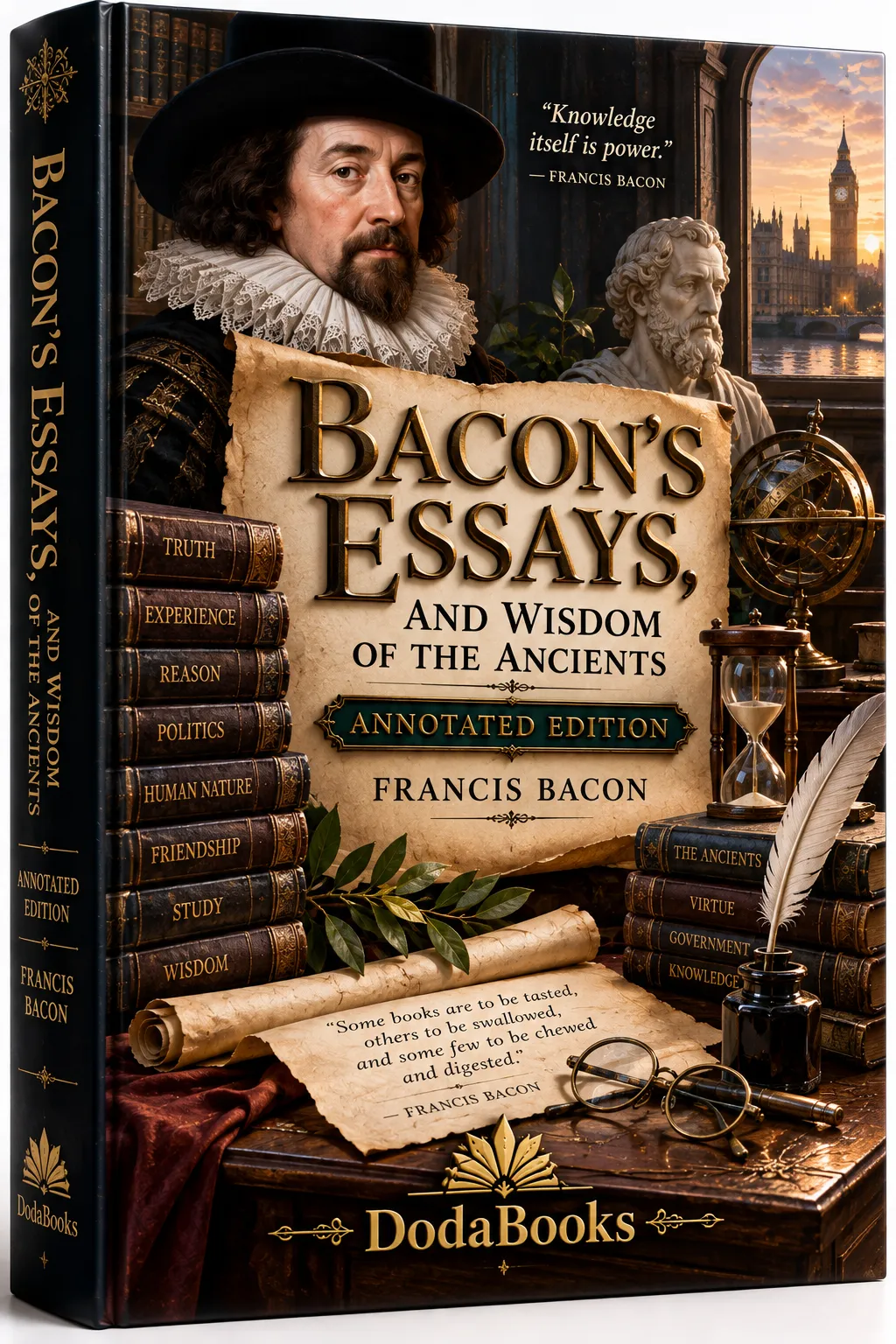
🏛️ Deepen Your Understanding of Renaissance Thought
Unlock the complete psychological and political genius of Sir Francis Bacon. The DodaBooks Annotated Edition of Bacon’s Essays and Wisdom of the Ancients delivers:
- ✅ Complete Unabridged Text — All 58 civil and moral essays plus all 31 allegorical fables
- 📜 Full Latin Translation Suite — Every classical Roman quotation translated in-line
- 🏛️ Historical & Political Annotations — Detailed commentary on Tudor and Stuart court politics
- 🔒 100% DRM-Free Ownership — Read across Kindle, Kobo, iPad, and Android without restriction
- 📥 Instant EPUB Delivery — Download your digital copy immediately