Bacon's Essays Summary: Complete Breakdown of Key Essays & Wisdom of the Ancients
Sir Francis Bacon’s The Essayes or Counsels, Civill and Morall represents the supreme achievement of English Renaissance pragmatic philosophy. First published in 1597 as a slender gathering of ten terse maxims, expanded to thirty-eight essays in 1612, and reaching its definitive form of fifty-eight essays in 1625, the collection established the essay as an enduring vehicle for intellectual inquiry in the English language.
Bacon (1561–1626)—Lord High Chancellor of England, philosopher of science, and jurist—conceived of his essays not as rambling personal memoirs in the style of Michel de Montaigne, but as sharp, concentrated instruments of statecraft, moral psychology, and worldly prudence. Written for men of ambition navigating the treacherous waters of the Elizabethan and Jacobean courts, Bacon’s meditations combine unsparing Machiavellian realism with profound classical learning and Christian ethics.
This comprehensive guide delivers an exhaustive breakdown of Bacon’s most influential essays, grouped by subject matter, followed by an in-depth summary of his companion masterwork, The Wisdom of the Ancients (De Sapientia Veterum), where thirty-one classical Greek fables are decoded as political and scientific allegories.
| Thematic Group | Representative Essays | Core Intellectual Focus | Key Aphorism / Takeaway |
|---|---|---|---|
| Truth & Mortality | “Of Truth” (I), “Of Death” (II), “Of Adversity” (V) | The nature of human belief, fear of the unknown, fortitude in crisis | “What is truth? said jesting Pilate; and would not stay for an answer.” |
| Power & Statecraft | “Of Great Place” (XI), “Of Boldness” (XII), “Of Seditions” (XV), “Of Empire” (XIX) | The machinery of high office, bureaucratic navigation, rebellion management | “Men in great place are thrice servants… All rising to great place is by a winding stair.” |
| Morals & Passion | “Of Revenge” (IV), “Of Envy” (IX), “Of Anger” (LVII) | Controlling primitive instincts, destructive public passions, wild justice | “Revenge is a kind of wild justice; which the more man’s nature runs to, the more ought law to weed it out.” |
| Human Relationships | “Of Parents & Children” (VII), “Of Marriage & Single Life” (VIII), “Of Friendship” (XXVII) | Domestic ties vs. public utility, the psychology of companionship | “Whosoever is delighted in solitude is either a wild beast or a god.” |
| Intellect & Conduct | “Of Discourse” (XXXII), “Of Custom & Education” (XXXIX), “Of Studies” (L) | Cognitive training, the art of conversation, empirical habit formation | “Reading maketh a full man; conference a ready man; and writing an exact man.” |
| Classical Allegory | The Wisdom of the Ancients (Prometheus, Sphinx, Pan, Narcissus) | Greek myths as hidden systems of natural science and political statecraft | Ancient myths preserve the fragments of an older, lost scientific civilization. |
🏛️ Part 1: Truth, Mortality, and Human Delusion
Essay I: “Of Truth”
Bacon opens his collection by examining humanity’s innate, paradoxical reluctance to accept unvarnished truth:
“What is truth? said jesting Pilate; and would not stay for an answer.”
Bacon distinguishes between theoretical skepticism (which doubts the possibility of certainty) and human vanity, which actively prefers falsehood. Truth, he observes, is like unadorned daylight: it reveals the plain, imperfect realities of life. A lie, by contrast, is like candlelight or theatrical lamplight, casting flattering shadows and exciting the imagination. Human society thrives on illusions, flattery, and poetic fictions because naked reality is often cold and distressing.
Yet despite human folly, Bacon asserts that truth is the highest sovereign good of human nature:
- The inquiry of truth is the wooing of it.
- The knowledge of truth is the presence of it.
- The belief of truth is the enjoying of it. Standing upon the vantage ground of truth is compared to standing on a cliff above the sea, observing the errors and tempests of humankind below not with arrogance, but with pity and charity.
                  [THE HIERARCHY OF TRUTH (ESSAY I)]
                                   │
      ┌────────────────────────────┼────────────────────────────┐
      ▼                            ▼                            ▼
[INQUIRY OF TRUTH]        [KNOWLEDGE OF TRUTH]        [BELIEF OF TRUTH]
- The intellectual search  - The clear comprehension  - The active enjoyment
- "The wooing of it"       - "The presence of it"     - "The sovereign good"
Essay II: “Of Death”
Bacon confronts humanity’s primal existential terror:
“Men fear death, as children fear to go in the dark; and as that natural fear in children is increased with tales, so is the other.”
Bacon argues that the gruesome accompaniments of death—groaning mourners, funeral blacks, solemn bells, and physical decay—frighten men far more than death itself. When stripped of its ritualized dread, death is a natural physiological process as painless as birth.
Furthermore, Bacon observes that every human passion easily overpowers the fear of death:
- Revenge triumphs over death through anger.
- Love despises death in devotion to another.
- Honor aspires to death for noble glory.
- Grief flieth to death to escape torment.
- Boredom (taedium vitae) courts death merely to escape monotony. A life dedicated to virtuous achievement prepares an individual to meet death with serene indifference, leaving a noble memory behind.
Essay IV: “Of Revenge”
Bacon delivers his definitive critique of personal retribution:
“Revenge is a kind of wild justice; which the more man’s nature runs to, the more ought law to weed it out.”
Bacon argues that taking private revenge binds an individual perpetually to past injuries that cannot be altered. In taking revenge, a person merely levels himself with his enemy, whereas by passing over an injury, he proves his moral superiority:
- Past injuries belong to time elapsed; the wise man focuses on present duties and future utility.
- Men do not injure others out of pure malice, but out of self-love, ambition, or profit; it is childish to rage against human self-interest as one might rage against a briar bush for scratching.
- Revenge is only pardonable in cases where the law provides no legal remedy, but even then, it must be executed without gloating. Public revenges (such as the assassinations of Julius Caesar or King Henry IV) are often politically fortunate, but private revenges invariably end in tragedy.
Essay V: “Of Adversity”
Contrasting Stoic philosophy with Christian theology, Bacon explores the tempering of the human soul:
“Prosperity is the blessing of the Old Testament; adversity is the blessing of the New.”
Prosperity brings luxury, arrogance, and moral softness, discovering vice; adversity brings fortitude, self-reliance, and spiritual clarity, discovering virtue. Just as fragrant spices and perfumes emit their sweetest scent when bruised or burned, virtuous character shines with the greatest radiance when crushed by misfortune.
👑 Part 2: Power, Statecraft, and Political Realism
             [THE ANATOMY OF POLITICAL AMBITION (ESSAY XI)]
                                   │
      ┌────────────────────────────┼────────────────────────────┐
      ▼                            ▼                            ▼
[SERVANT TO SOVEREIGN]      [SERVANT TO FAME]          [SERVANT TO BUSINESS]
- Subject to royal will     - Chained to reputation    - Consumed by ceaseless
- Lost personal autonomy    - Vulnerable to envy         administrative duties
Essay XI: “Of Great Place”
Drawing on his intimate experience in the Privy Council and Court of Chancery, Bacon dissects the psychological and political realities of high office:
“Men in great place are thrice servants: servants of the sovereign or state, servants of fame, and servants of business. So as they have no freedom; neither in their persons, nor in their actions, nor in their times.”
Bacon observes the supreme paradox of ambition: men endure immense humiliation, compromise their integrity, and sacrifice their health to ascend the ladder of power, only to discover that the summit is precarious, lonely, and exhausting. High officials cannot retire gracefully; like old actors, they cling to the stage long after their utility has vanished.
Bacon provides practical guidelines for the magistrate:
- Model the Best Precedents: Examine past leaders to emulate their successes and avoid their catastrophes.
- Eliminate the Four Vices of Authority:
- Delays: Be accessible and decide matters promptly.
- Corruption: Guard not only your own hands against bribes, but also the hands of your servants and clerks.
- Roughness: Harsh words and arrogant displays degrade the dignity of the bench.
- Pliability: Vacillating between factions earns contempt rather than gratitude.
- Ascend by the Winding Stair: All rising to high office requires indirect navigation and factional maneuvering, but once seated, the magistrate must govern with absolute impartiality.
Essay XII: “Of Boldness”
Bacon evaluates the role of audacity in public life, citing Demosthenes’ famous maxim that the first, second, and third requirement of oratory is “action.”
In politics, boldness (audacia) works wonders upon the credulous multitude because the masses are governed by appearances. Yet Bacon offers an unsparing psychological caveat:
- Boldness is the child of ignorance and baseness; it succeeds only on first impression.
- Bold men are excellent for desperate execution and minor emergencies, but disastrous as counselors or directors of policy because they cannot anticipate unseen dangers.
- Just as blind men walk confidently where sighted men tread cautiously, bold politicians charge into crises without recognizing the abyss beneath their feet.
Essay XV: “Of Seditions and Troubles”
A masterwork of political sociology, this essay examines the root causes, warning signs, and cures for civil rebellion:
- The Signs of Trouble: Spreading libels, open slanders against magistrates, factions operating unchecked, and an atmosphere where good actions are interpreted with malice.
- The Fuel of Sedition: Poverty and Discontent. As Bacon notes, “So many overthrown estates, so many votes for troubles.” If poverty in the commons is joined with bankrupt desperation among the nobility, the state is in imminent peril.
- The Remedies: Removing material hardship by encouraging trade, curbing monopolies, suppressing usury, moderating taxation, and avoiding factional favoritism by the sovereign. The prince must never align himself with one faction against another; he must remain the universal father of all his subjects.
🤝 Part 3: Human Nature, Relationships, and Practical Wisdom
               [THE BENEFITS OF GENUINE FRIENDSHIP (ESSAY XXVII)]
                                       │
         ┌─────────────────────────────┴─────────────────────────────┐
         ▼                                                           ▼
[AFFECTION & EMOTIONAL RELIEF]                             [COUNSEL & CLARITY]
- "Redoubleth joys and cutteth griefs in half"             - Purges mental confusion
- Prevents the soul from suffocating in solitude           - Delivers honest, objective advice
Essay VIII: “Of Marriage and Single Life”
Bacon weighs the civic utility of domestic commitment against personal liberty:
“He that hath wife and children hath given hostages to fortune; for they are impediments to great enterprises, either of virtue or mischief.”
Bacon observes that unmarried or childless men are freer to bestow their wealth and intellectual energies upon public institutions, but they are also more prone to selfishness and cruelty because their tenderness has never been cultivated. Married men make more reliable magistrates, disciplined soldiers, and stable citizens. Chaste women are often proud and arrogant, secure in their righteousness. Bacon concludes with wry pragmatism: a young man should not marry yet; an older man should not marry at all.
Essay XXVII: “Of Friendship”
In one of his most eloquent and classical essays, Bacon celebrates friendship as a biological and spiritual necessity:
“Whosoever is delighted in solitude is either a wild beast or a god.”
Without a true friend to whom one can communicate joys, griefs, fears, and doubts, a human being becomes a cannibal of his own heart. Bacon identifies two supreme fruits of friendship:
- Emotional Relief: Sharing emotions with a trusted confidant works a miraculous alchemy: it redoubles joys by mutual celebration and cuts griefs in half by sympathetic division.
- Intellectual Clarity: Talking through complex problems with a friend clarifies the mind. Thoughts that remain bottled up in the brain are like tangled skeins of thread; speaking them aloud unwinds them and exposes errors. Furthermore, a friend provides honest counsel, pointing out blind spots that self-love conceals.
Essay L: “Of Studies”
The most famous educational essay in the English canon outlines the balanced relationship between books and practical experience:
“Studies serve for delight, for ornament, and for ability… Crafty men contemn studies, simple men admire them, and wise men use them; for they teach not their own use; but that is a wisdom without them, and above them, won by observation.”
Bacon warns against three distinct abuses of learning:
- Sloth: Spending too much time in studies without practical action.
- Affectation: Using scholarly knowledge merely to show off in conversation.
- Pedantry: Attempting to judge business affairs purely by textbook rules.
He provides his legendary classification of literature:
“Some books are to be tasted, others to be swallowed, and some few to be chewed and digested: that is, some books are to be read only in parts; others to be read, but not curiously; and some few to be read wholly, and with diligence and attention.”
🦅 Part 4: The Wisdom of the Ancients (De Sapientia Veterum)
Published in Latin in 1609, The Wisdom of the Ancients is Bacon’s companion masterpiece. Bacon argues that classical Greek and Roman myths were not primitive children’s fables, but veiled allegorical codes constructed by an ancient prehistoric civilization to preserve vital discoveries in natural science, political philosophy, and psychology.
       [MYTH AS ALLEGORICAL CODE: THE WISDOM OF THE ANCIENTS]
                                   │
      ┌────────────────────────────┼────────────────────────────┐
      ▼                            ▼                            ▼
[PROMETHEUS]                   [SPHINX]                     [DAEDALUS]
- Myth of Human Nature         - Myth of Science            - Myth of Mechanical Art
- Divine fire = Intellect      - Riddles = Scientific laws  - Labyrinth = Unintended
- Vulture = Anxious foresight  - Monsters = Ignorance         technological chaos
1. Prometheus, or the State of Man
Prometheus steals fire from heaven to bestow life, reason, and mechanical arts upon humanity, but his punishment is to be chained to Mount Caucasus, where an eagle perpetually devours his liver.
- The Allegory: Fire represents the spark of empirical intellect and mechanical invention that separates mankind from beasts.
- The Psychological Core: The eagle devouring the liver represents humanity’s unique curse: anxious foresight. Because humans possess intelligence, they torture themselves with perpetual dread of future poverty, disease, and mortality, while animals live peacefully in the present moment.
2. Sphinx, or Science
The Sphinx—a winged monster with the face of a maiden, the claws of a lion, and riddles that destroy anyone unable to solve them—is finally slain by Oedipus, who decodes her riddle of human life.
- The Allegory: The Sphinx represents scientific and natural inquiry.
- The monster’s maiden face symbolizes the beauty and allure of knowledge; its wings denote the swift speed with which scientific ideas spread; its sharp talons represent the lethal consequences of misunderstanding natural laws (e.g., medical errors or engineering collapses).
- When a human mind (Oedipus) successfully solves nature’s riddle, the Sphinx is killed: theoretical perplexity dissolves into practical mechanical dominion.
3. Pan, or Universal Nature
Pan, the horned, goat-footed god of the wild accompanied by dancing nymphs and prone to sudden outbursts of panic terror.
- The Allegory: Pan personifies the material cosmos. His horns represent the pyramid of nature, extending from broad physical elements up to divine unity; his hairy hide signifies the variety of physical textures across the earth; his goat legs denote the downward tendency of matter.
- The sudden “Panics” attributed to him represent the sudden, irrational collective fears that seize armies and nations without visible physical cause.
4. Narcissus, or Self-Love
Narcissus rejects all companions, falls in love with his own reflection in a forest pool, withers away in futile contemplation, and is transformed into a sterile water flower.
- The Allegory: Narcissus represents the solipsistic intellectual or aristocrat (Philautia / self-love). Individuals who retire from public service and civic responsibility to engage in sterile self-admiration produce no lasting achievements. Like the flower of Narcissus, they are pleasant for a season, but yield neither fruit nor seed.
5. Daedalus, or the Mechanical Arts
Daedalus constructs the miraculous labyrinth of Crete, fashions artificial wings for flight, but also builds the wooden cow that enables the unnatural birth of the Minotaur.
- The Allegory: Daedalus embodies technological invention and mechanical engineering.
- Technology provides humanity with wonders, architecture, and flight, but when divorced from moral restraint, it creates horrific weapons and monstrous perversions (the Minotaur). Furthermore, technological systems construct complex labyrinths that trap their creators in unintended consequences.
❓ Frequently Asked Questions
How many editions of Bacon's Essays were published during his lifetime?
Francis Bacon published three distinct editions: the first in 1597 (containing 10 essays), the second in 1612 (expanded to 38 essays), and the third, definitive edition in 1625 (containing all 58 essays under the title The Essayes or Counsels, Civill and Morall).
Why does Bacon include so many Latin quotations in his essays?
In Renaissance England, Latin was the shared international language of scholarship, statecraft, and jurisprudence. Bacon quoted Roman authors like Tacitus, Cicero, Seneca, and Livy to invoke authoritative historical precedents. Modern annotated editions translate these quotations directly within the text.
What is the connection between Bacon's Essays and his scientific philosophy?
Bacon's essays apply the same empirical, observation-based methodology to human behavior that his philosophical works (such as Novum Organum) applied to the natural world. He examines human vices, motives, and institutions as observable phenomena rather than abstract theological ideals.
Why is The Wisdom of the Ancients included with Bacon's Essays?
Published in 1609, The Wisdom of the Ancients is Bacon's primary allegorical work, consisting of thirty-one short essays interpreting Greek myths. Because they share the same aphoristic density, political realism, and psychological insight as the 58 core essays, historical publishers have traditionally paired them together as a single unified masterwork.
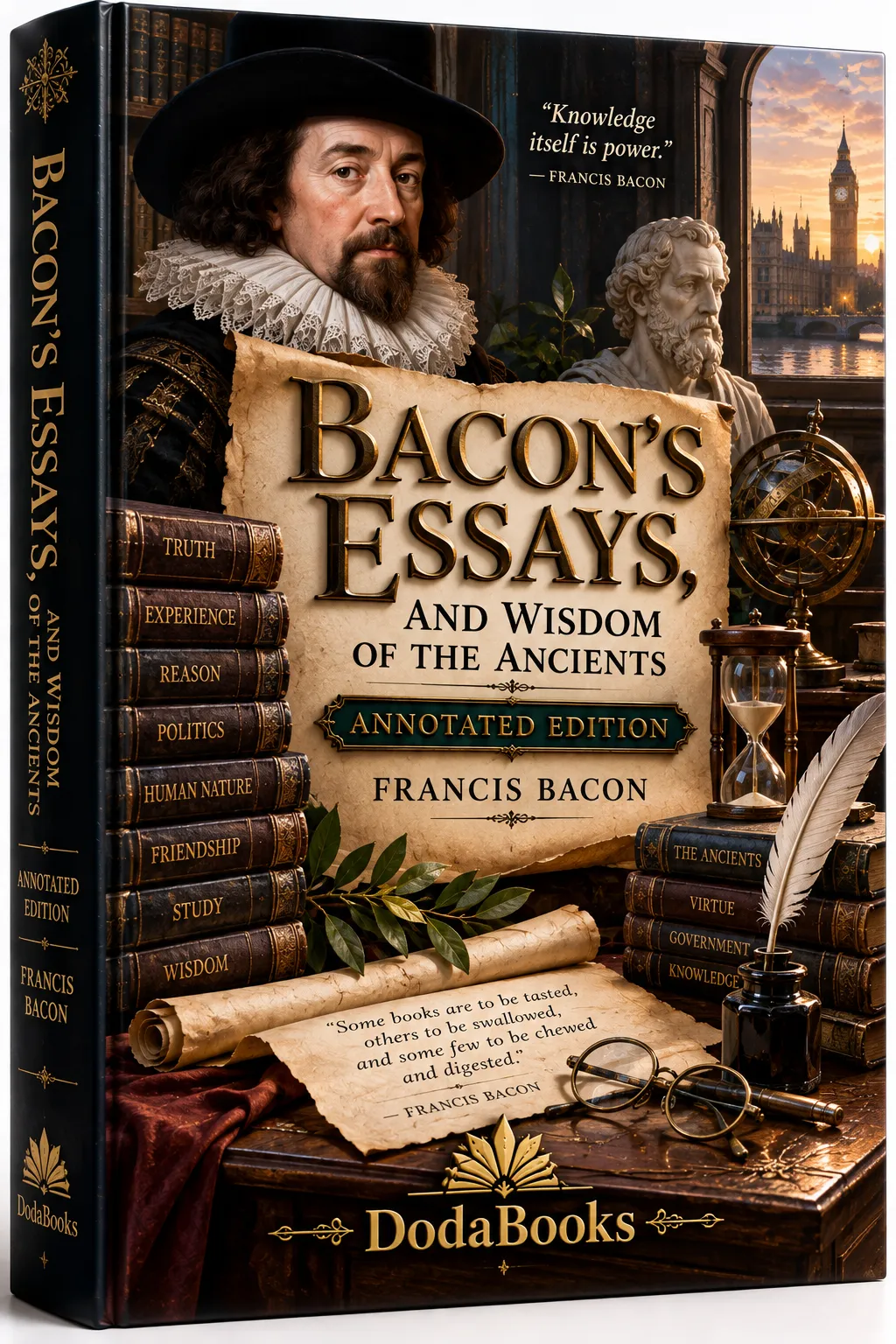
🏛️ Experience Renaissance Philosophy in Its Definitive Edition
Master the profound wisdom of Francis Bacon with complete historical and linguistic clarity. The DodaBooks Annotated Edition of Bacon’s Essays and Wisdom of the Ancients includes:
- ✅ Complete 1625 Text — All 58 civil and moral essays in authoritative, unabridged prose
- 📜 Full Text of “Wisdom of the Ancients” — All 31 classical myth-essays decoded
- 🏛️ Complete Latin Translations — Every Roman quote and proverb translated in-line
- 🔒 100% DRM-Free Ownership — Yours forever across Kindle, Kobo, iPad, and Android
- 📥 Instant EPUB Delivery — Download and begin reading immediately