Francis Bacon’s Essays, or Counsels Civil and Moral (1597–1625) stands alongside Montaigne’s essays as the foundational text of the modern essay form. Packed with razor-sharp pragmatic wisdom, unsparing psychological insight, and memorable Latinate aphorisms, Bacon’s reflections on truth, ambition, death, friendship, and statecraft provide an incomparable masterclass in Renaissance intellect and the human condition.
🏛️
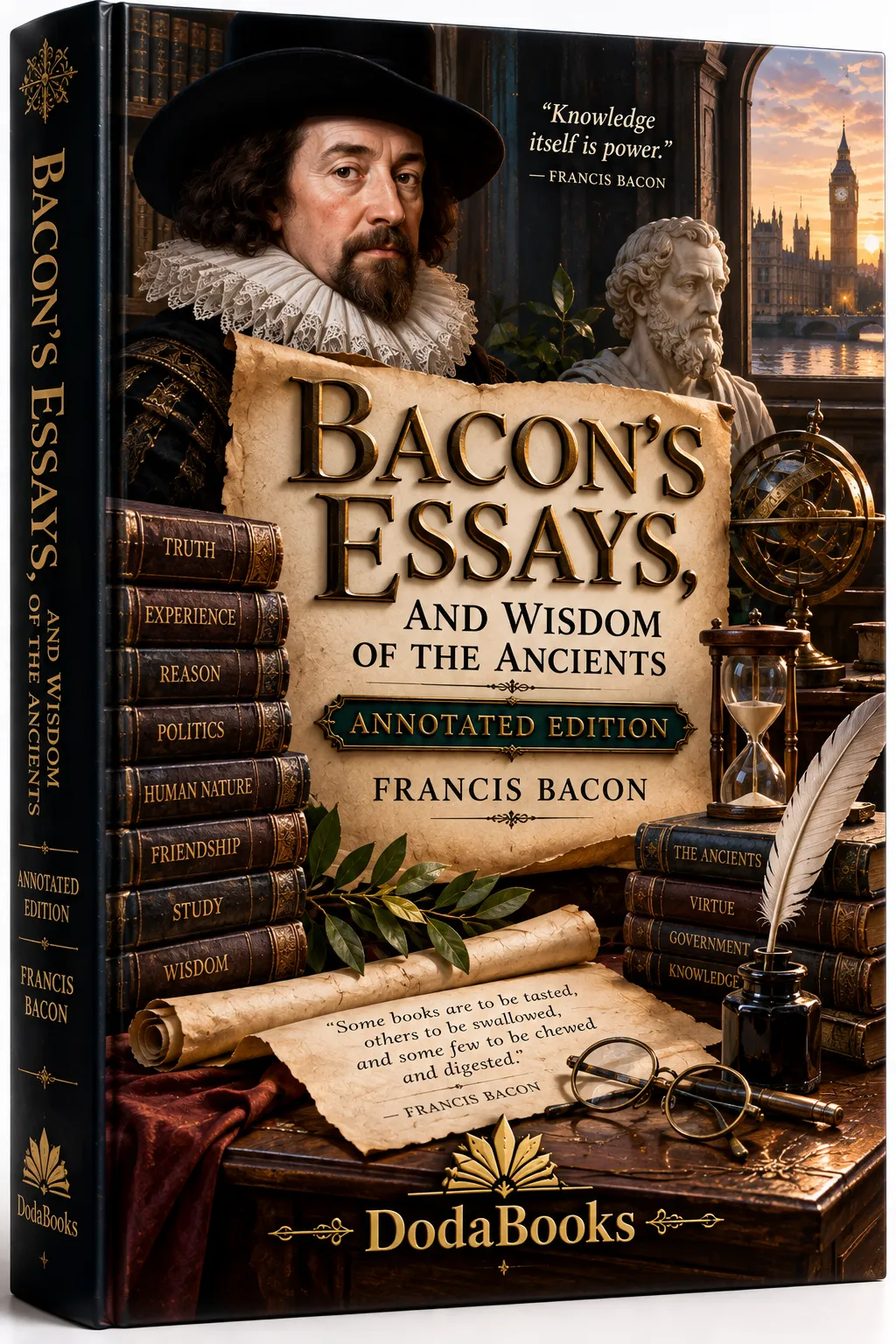
Bacon's Essays
The pinnacle of Renaissance wisdom, political realism, and moral philosophy. Explore Francis Bacon's timeless meditations on Truth, Death, Revenge, Boldness, and Statecraft, fully annotated with Latin translations and classical allusions.
| Author | Sir Francis Bacon (Lord Verulam, Viscount St Alban) |
| Published | 1597 (10 essays), 1612 (38 essays), 1625 (final 58 essays) |
| Genre | Moral Philosophy, Political Essays, Aphoristic Wisdom |
| Setting | Elizabethan and Jacobean Court, London (1590s–1620s) |
| Central Themes | Truth & Self-Deception, Ambition & Power, Prudence vs. Morality, Scientific Observation, Mortality |
| Reading Time | 6–8 hours |
| Summary Time | 20 minutes |
⚖️ The Mind of the Lord Chancellor
Sir Francis Bacon (1561–1626) was one of the most brilliant and complex minds of the European Renaissance. Serving as Lord High Chancellor of England under King James I, Bacon was simultaneously a visionary philosopher who laid the foundations of the modern empirical scientific method (Novum Organum) and a shrewd, ruthless courtier maneuvering through the dangerous corridors of Elizabethan and Jacobean court politics.
Unlike French essayist Michel de Montaigne, whose essays were sprawling, conversational, and intimate personal confessions, Bacon conceived of the essay as a compact, concentrated instrument of practical advice—“counsels civil and moral.” Bacon wrote for men of action: statesmen, judges, courtiers, and scholars who had to navigate the treacherous realities of power, court intrigue, and moral compromise.
Bacon’s literary style is unmistakable: dense, balanced, rhythmical, and packed with classical anecdotes from Roman history, biblical allusions, and Latin epigrams. Every sentence is polished like a diamond, delivering maximum philosophical force in minimum words:
"Reading maketh a full man; conference a ready man; and writing an exact man." ("Of Studies")Yet Bacon was no sterile academic. He lived what he wrote, rising to the supreme judicial office in the realm before experiencing a catastrophic fall from grace in 1621 when he was impeached by Parliament for accepting bribes from litigants—a disgrace he met with philosophical fortitude, dedicating his final years to science and the completion of his expanded 1625 edition of the Essays.
🧭 Key Essays & Thematic Breakdown
The final 1625 edition contains fifty-eight essays. Among the most celebrated and profound are:
1. “Of Truth” (Essay I)
The opening essay begins with one of the most famous lines in English literature: “What is truth? said jesting Pilate; and would not stay for an answer.” Bacon examines why human beings are naturally inclined toward falsehood. Falsehood, Bacon observes, is pleasurable because raw truth is like cold daylight, exposing human vanity and illusions, whereas lies and flattery add glittering, deceptive colors to life. Yet Bacon concludes that truth is the sovereign good of human nature, comparing the possession of truth to standing upon a high cliff, looking down with compassionate eyes on the wanderings of men in the valley below.
2. “Of Death” (Essay II)
Bacon tackles humanity’s primal fear: “Men fear death, as children fear to go in the dark.” He argues that much of the terror of death is manufactured by religious theatrics, mourning rituals, and physical pain rather than death itself. Bacon points out that every human passion—revenge, love, grief, and fear—can easily overpower the fear of death, and that a noble life ending in worthy achievement is the ultimate victory over mortality.
3. “Of Revenge” (Essay IV)
Bacon delivers his legendary verdict: “Revenge is a kind of wild justice; which the more man’s nature runs to, the more ought law to weed it out.” He argues that seeking revenge binds a man perpetually to past injuries that cannot be undone, whereas ignoring an injury places him far above his enemy: “In taking revenge, a man is but even with his enemy; but in passing it over, he is superior.”
4. “Of Great Place” (Essay XI)
A searing, insider dissection of political power and high office: “Men in great place are thrice servants: servants of the sovereign or state, servants of fame, and servants of business.” Bacon warns that men sacrifice their personal freedom and health to climb the ladder of ambition, only to find that power leaves them isolated and vulnerable to sudden ruin.
5. “Of Friendship” (Essay XXVII)
Drawing on classical philosophy, Bacon writes eloquently on the psychological necessity of genuine friendship. Without a trusted friend to whom one can open one’s heart, a man becomes a cannibal of his own soul: “Whosoever is delighted in solitude is either a wild beast or a god.” Friendship, Bacon writes, produces a miraculous double benefit: it redoubles joys and cuts griefs in half.
6. “Of Studies” (Essay L)
Perhaps the most famous educational essay ever penned. Bacon warns against both the neglect of learning and the danger of pedantic bookishness: “To spend too much time in studies is sloth; to use them too much for ornament, is affectation; to make judgment wholly by their rules, is the humour of a scholar.” He offers his celebrated guide to reading:
"Some books are to be tasted, others to be swallowed, and some few to be chewed and digested."👥 Philosophical Perspectives Unpacked
👑 THE PRAGMATIC COURTIER
The Realist Statesman
“All rising to great place is by a winding stair; and if there be factions, it is good to side a man’s self whilst he is in the rising, and to balance himself when he is placed.” (“Of Great Place”)
Bacon understands that politics requires compromise, diplomacy, and timing. He does not advocate villainy, but warns that innocent naivety in public life leads straight to disaster.
Why It Matters
Bacon anticipates modern political realism and organizational psychology, providing timeless rules for managing power, authority, and public reputation.
🔬 THE EMPIRICAL PHILOSOPHER
The Father of Modern Science
“Nature is often hidden, sometimes overcome, seldom extinguished. Force maketh nature more violent in the return.” (“Of Nature in Men”)
Bacon applies the same cool, empirical observation to human nature that he applied to the natural sciences, dissecting human motives without sentimental illusions.
Why It Matters
Bacon freed moral philosophy from scholastic dogma, treating ethics as an observable psychological phenomenon rooted in human physiology and social circumstance.
📘 Annotated Insight — In 1609, Bacon published The Wisdom of the Ancients (De Sapientia Veterum), a companion work in which he reinterpreted thirty-one classical Greek myths (Prometheus, Pan, Narcissus, Sphinx) as profound allegories of political science, moral psychology, and natural philosophy. The DodaBooks edition includes these essential companion essays alongside the main text.
🔍 Major Themes & Baconian Wisdom
1. The Balance of Morality and Pragmatism
Bacon occupies the fascinating middle ground between Christian morality and Machiavellian realism. He never glorifies evil, but he insists that moral men must possess worldly cunning (prudentia) to defend themselves against the wicked. Goodness without wisdom is helpless.
2. The Power of Custom and Habit
In “Of Custom and Education,” Bacon argues that theoretical intentions count for nothing compared to ingrained habit. Humans talk like philosophers, argue like saints, but act entirely according to habitual custom. Therefore, moral education must focus on shaping automatic physical and mental habits from early youth.
3. Aphoristic Concentration as Art
Bacon believed that knowledge is best preserved in aphorisms rather than sprawling treatises. Aphorisms, he argued, present the core kernel of knowledge without filler, forcing the reader’s mind to actively chew and digest the insight.
📖 Explore the Annotated Edition at DodaBooks →
✨ What Makes the DodaBooks Annotated Edition Essential
Reading Bacon in raw, unedited public domain texts is notoriously frustrating. Bacon wrote for an audience fluent in Latin, embedding scores of untranslated quotations from Cicero, Tacitus, Livy, Suetonius, and Seneca into nearly every paragraph without attribution.
The DodaBooks Annotated Edition makes Bacon’s genius accessible to modern readers:
Immediate Latin Translations
Every single Latin phrase, proverb, and classical verse translated in clear in-line footnotes directly below the text.
Classical Allusion Identifier
Historical context on Roman emperors, Greek philosophers, and biblical passages referenced by Bacon in each essay.
Includes "Wisdom of the Ancients"
Contains Bacon's complete, brilliant myth-interpretations (*The Wisdom of the Ancients*) alongside all 58 Essays.
Elizabethan Vocabulary Glosses
Obsolete Renaissance terms and semantic shifts explained so you never misunderstand Bacon's precise legal and moral meaning.
100% DRM-Free Ownership
Read across all your favorite devices forever: Kindle, Kobo, iPad, reMarkable, and Android e-readers.
Interactive Essay Index
Easily jump directly to any of the 58 essays using an intuitive, fully hyperlinked digital table of contents.
❓ Frequently Asked Questions
How do Bacon's essays differ from Montaigne's essays?
Michel de Montaigne invented the modern essay in France as a relaxed, conversational, and deeply personal exploration of self-discovery and doubt. Francis Bacon adopted the form in England but transformed it into a crisp, aphoristic manual of practical statecraft, worldly wisdom, and moral advice designed for men of action in public life.
Why did Bacon use so many Latin quotations?
During the Renaissance, Latin was the universal language of European scholarship, law, and diplomacy. Bacon wrote for educated Elizabethan and Jacobean gentlemen who were expected to recognize passages from Roman historians like Tacitus and Livy instantly. The DodaBooks edition provides translations for every Latin quotation.
What does Bacon mean by "Wisdom of the Ancients"?
The Wisdom of the Ancients is a collection of thirty-one short essays in which Bacon analyzes famous Greek myths (such as Daedalus, Sphinx, Prometheus, and Narcissus), revealing them as profound allegorical insights into political strategy, scientific discovery, and human nature.
Was Francis Bacon the secret author of Shakespeare's plays?
While the "Baconian theory" gained popularity in the 19th century, mainstream historians and literary scholars universally reject it. Bacon's terse, legalistic, and aphoristic prose style is fundamentally different from Shakespeare's expansive, poetic, and theatrical genius.
Why should I purchase the DodaBooks edition over a free web text?
Raw internet copies of Bacon's essays are filled with corrupt Renaissance spellings, archaic punctuation, and completely untranslated Latin phrases that obscure his meaning. DodaBooks provides a carefully modernized text, complete Latin translations, historical commentary, and the full text of Wisdom of the Ancients in a beautiful, DRM-free digital edition.
🏛️ Sharpen Your Intellect with Renaissance Wisdom
Master the art of clear thinking, worldly prudence, and elegant prose. The DodaBooks Annotated Edition of Bacon’s Essays and Wisdom of the Ancients delivers:
- ✅ Complete Authoritative Text — All 58 Essays plus the 31 myth-essays of Wisdom of the Ancients
- 📜 Complete Latin Translations — Every classical quote translated and contextualized
- ✒️ Renaissance Vocabulary Glosses — Clear modern explanations for archaic Elizabethan idioms
- 🔒 100% DRM-Free Ownership — Permanent digital access across all e-readers and tablets
- 📥 Instant Download — Immediate delivery in pristine EPUB format