Benjamin Franklin’s Autobiography is widely celebrated as the foundational document of American self-fashioning and secular autobiography. Composed in four distinct bursts across nearly two decades (1771–1790) against the backdrop of imperial crises, national revolution, and constitutional foundation, the text charts an astonishing personal metamorphosis. Franklin transforms himself from an impoverished tallow-chandler’s tenth son into an independent master printer, polymath philosopher, leading civic reformer, and international diplomat.
Unlike modern memoirs, Franklin’s Autobiography is neither a confessional psychological diary nor a chronological state history. It is an Enlightenment educational treatise, a manual of personal prudence, and an ideological fable of social mobility. Franklin crafts a narrative persona who views character as a malleable composition subject to continuous revision, moral errors as typographical “errata” that can be corrected in subsequent proofs, and human society as an improvable commonwealth.
This definitive part-by-part breakdown guides students, educators, and general readers through each of the four historical parts of Franklin’s narrative, providing rigorous structural synopses, analytical commentary, and contextual insights.
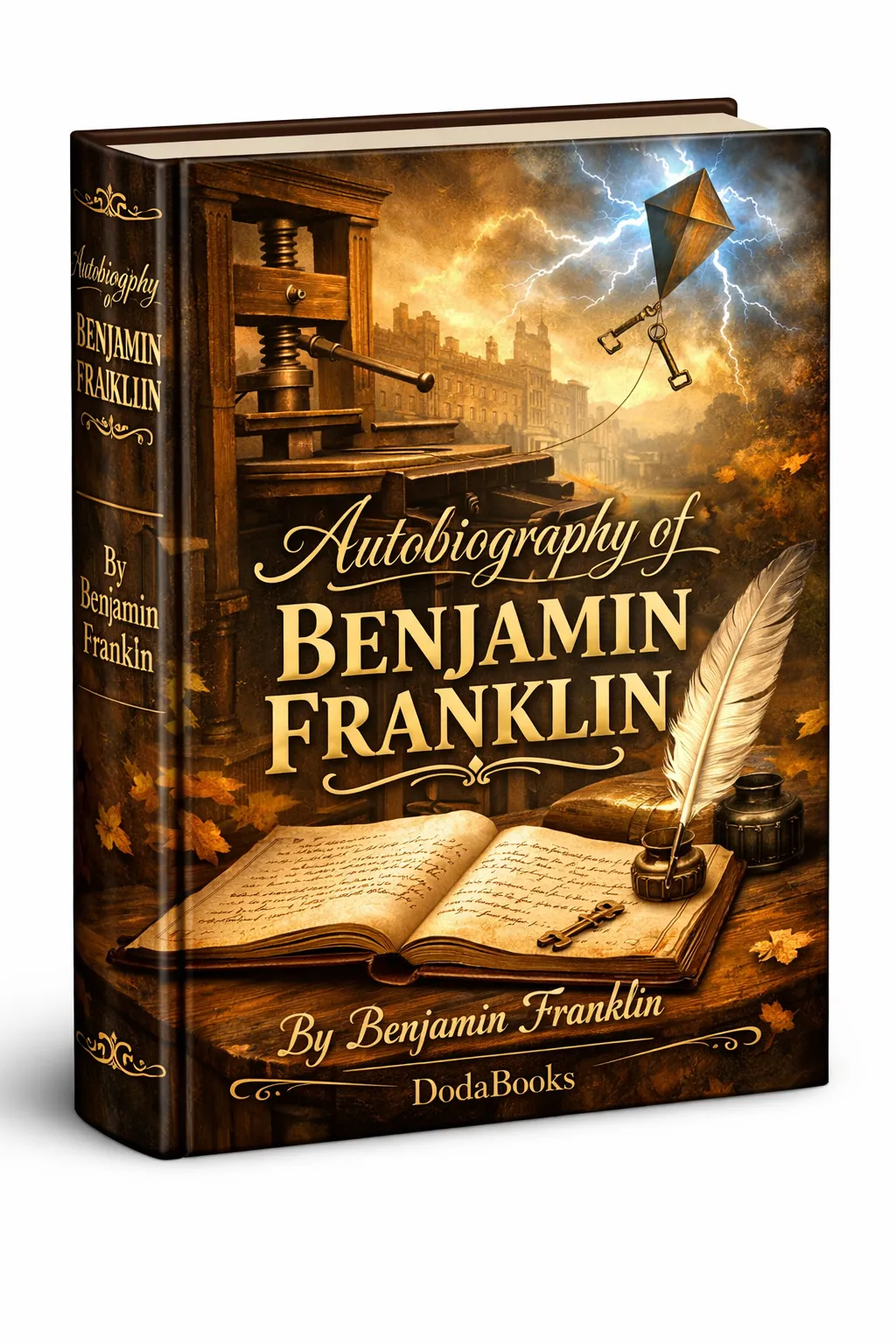
Autobiography of Benjamin Franklin
A definitive part-by-part summary and critical breakdown — exploring Franklin's Boston apprenticeship, the London sojourns, his rise as Philadelphia's master printer, civic enterprises, and pioneering electrical discoveries.
📖 Structure of Franklin’s Autobiography at a Glance
| Section | Written Date & Place | Time Span Covered | Primary Narrative Focus |
|---|---|---|---|
| Part One | 1771 (Twyford, England) | 1706–1730 | Boston boyhood, printing apprenticeship under James, escape to Philadelphia, governor Keith’s deception, first London voyage, return and Junto founding |
| Part Two | 1784 (Passy, France) | Early 1730s | Letters of Vaughan and James, the “Bold and Arduous Project of Arriving at Moral Perfection,” the 13 Virtues, daily schedule, and moral accounting |
| Part Three | 1788–1789 (Philadelphia) | 1731–1757 | Poor Richard’s Almanac, public subscription library, fire company, Academy of Philadelphia, street paving/lighting, electrical experiments, Braddock’s campaign |
| Part Four | 1789–1790 (Philadelphia) | 1757 | London diplomatic mission, confrontations with the Penn family proprietors and Lord Granville over Pennsylvania colonial sovereignty |
The Composition History: A Fragmented American Monument
To understand Franklin’s Autobiography, one must recognize that it was never written as a unified book. Franklin produced it in four disparate phases across nineteen years, navigating seismic political upheavals:
  1771: Twyford, England (Part 1)
  Written as an epistolary family memoir to his son William, royal governor of New Jersey.
        │
        ▼ (The American Revolution fractures the family; William remains a fierce Loyalist)
  1784: Passy, France (Part 2)
  Written during diplomatic triumph; addresses a rising American citizenry needing civic virtue.
        │
        ▼ (The Constitutional Convention of 1787 establishes the American Republic)
  1788–1789: Philadelphia (Part 3)
  Written by an aging, ailing statesman chronicling his civic, scientific, and defensive programs.
        │
        ▼ (Terminal illness and bedridden final months)
  1789–1790: Philadelphia (Part 4)
  Brief, unpolished account of London negotiations before Franklin's death on April 17, 1790.
Because Franklin did not live to revise or synthesize these sections, the text shifts dynamically in tone: from the intimate, humorous, domestic memories of Part 1, to the philosophical and didactic moral architecture of Part 2, and into the grand civic, administrative, and geopolitical maneuvering of Parts 3 and 4.
Part One: The Youthful Errata and the Ascent to Independence (1706–1730)
Part One was written in the quiet summer of 1771 during a country holiday at the estate of Jonathan Shipley, the Bishop of St. Asaph, in Twyford, England. It begins as an intimate, epistolary address to Franklin’s son, William Franklin, then serving as the Royal Governor of New Jersey:
“Dear Son: I have ever had pleasure in obtaining any little anecdotes of my ancestors…”
1. Ancestry, Boston Boyhood, and the Tallow-Chandler’s Shop
Franklin opens with genealogical inquiries, recounting how his Protestant ancestors in Northamptonshire, England, hid their English Bible taped under a folding stool to escape Queen Mary’s persecutions. Born in Boston in January 1706, Benjamin was the youngest son among seventeen children born to Josiah Franklin, a devout, industrious maker of soap and candles.
Recognizing Benjamin’s precocious literary aptitude, Josiah initially intended him for the Christian ministry and enrolled him in the Boston Latin School. However, financial constraints and the prospect of supporting a massive family forced Josiah to remove the ten-year-old boy after only two years of formal schooling. Benjamin was put to work cutting wicks, filling candle molds, and running errands. Hating the trade and yearning for the freedom of the open sea, Benjamin clashed with his father until Josiah compromised by apprenticing the twelve-year-old to his older brother, James Franklin, a Boston printer.
2. The Apprenticeship and Literary Self-Education
In James’s printing shop, Franklin found his true intellectual element. Surrounded by books, he negotiated with James to receive half the money spent on his board in cash, adopting a strict vegetarian diet to save money for purchasing volumes of poetry, history, and philosophy (including John Locke’s An Essay Concerning Human Understanding and Xenophon’s Memorabilia).
Franklin describes his meticulous, autodidactic method for mastering prose style:
- He acquired a volume of Joseph Addison and Richard Steele’s The Spectator.
- He read the essays, took brief keyword notes on each sentence, and locked the original away.
- Days later, he attempted to reconstruct the entire essay in his own prose, comparing his draft against the original to discover and correct his stylistic deficiencies.
- To improve his vocabulary and narrative flow, he converted Spectator essays into verse, and then translated his rhymed verse back into polished prose.
3. The Silence Dogood Letters and the Flight from Boston
In 1721, James founded The New-England Courant, one of the earliest independent newspapers in British America. Eager to contribute but fearing his brother’s disdain, sixteen-year-old Benjamin adopted the pseudonym Silence Dogood, an opinionated, sharp-witted country widow. Slipping handwritten essays under the print shop door at night, Franklin watched with delight as James and his literary circle praised the anonymous author’s sophistication.
Fourteen Dogood letters were published, mocking Harvard College’s elitism, clerical hypocrisy, and Boston social pretenses. When Benjamin confessed his authorship, James was enraged rather than pleased. When James was later imprisoned by the Massachusetts General Court for political satire, the Courant was nominally published under Benjamin’s name to bypass government censorship. However, James’s physical abuse and autocratic temper became intolerable. In 1723, taking advantage of an annulled apprenticeship contract, seventeen-year-old Benjamin secretly boarded a sloop for New York, breaking his legal indentures—an action he frankly catalogs as one of the first major errata of his life.
4. Arrival in Philadelphia and the Puffy Rolls
Finding no employment with the printer William Bradford in New York, Franklin was directed to Philadelphia. His arrival in the colonial city in October 1723 has become an iconic tableau of the American immigrant experience:
Franklin's Symbolic Arrival (October 1723):
├── Dirty, exhausted, pockets stuffed with spare shirts and stockings
├── Walking up Market Street holding three large, puffy rolls of bread
├── Eating one roll while tucking another under each arm
├── Passing the doorway of his future wife, Deborah Read, who laughs at his ridiculous appearance
└── Entering a Quaker meetinghouse to sleep soundly on a wooden bench
Securing work with the eccentric printer Samuel Keimer, Franklin quickly distinguished himself through his technical skill, sobriety, and work ethic.
5. Sir William Keith’s Mirage and the First London Voyage (1724–1726)
Franklin’s exceptional abilities caught the eye of Pennsylvania Governor Sir William Keith, who proposed to set the young man up in his own printing business. Keith promised letters of recommendation and financial credit to purchase presses and type in London. Trusting the governor’s grand promises, Franklin sailed for England in 1724 with his friend James Ralph.
Upon arriving in London, Franklin discovered that Keith was an empty promiser who had provided zero letters and no credit. Stranded in the imperial metropolis at age eighteen without funds, Franklin immediately secured employment at Palmer’s and later Watts’s famous printing houses near Covent Garden.
During this eighteen-month London sojourn:
- He astonished English compositors by carrying two heavy lead forms of type up flights of stairs, earning the moniker the “Water-American” because he drank pure water while his coworkers consumed five or six pints of strong beer daily.
- He composed a radical metaphysical pamphlet, A Dissertation on Liberty and Necessity, Pleasure and Pain (1725), arguing against free will and moral distinction—another erratum he later recanted.
- He demonstrated dazzling swimming feats in the Thames from Chelsea to Blackfriars, contemplating a career as an itinerant swimming master.
- He consorted with London free-thinkers, met Hans Sloane (selling him an American asbestos purse), and experienced urban cosmopolitanism.
6. Return to Philadelphia, Deborah Read, and the Junto
Persuaded by the merchant Thomas Denham, Franklin returned to Philadelphia in 1726 to work as a dry-goods clerk. When Denham died shortly thereafter, Franklin returned to Keimer’s printing shop, organized the undisciplined workforce, and began preparing for commercial independence.
During his absence in London, Deborah Read—believing Franklin had abandoned her—had been married to an abusive potter named John Rogers, who subsequently deserted her and fled to the West Indies. In September 1730, Franklin took Deborah as his common-law wife, braving the legal ambiguities of bigamy laws to repair his earlier neglect of her affections.
In 1727, Franklin established the Junto (or “Leather Apron Club”), a mutual-improvement society composed of twelve working-class tradesmen, artisans, and shopkeepers. Meeting every Friday evening, the Junto debated philosophy, ethics, commerce, and science, while functioning as a collaborative business network that helped launch Franklin’s commercial empire.
                  THE JUNTO (1727)
         "The Leather Apron Club of Philadelphia"
                         │
      ┌──────────────────┴──────────────────┐
      ▼                                     ▼
Intellectual Debates                  Civic Actions
- Moral Philosophy                     - Subscription Library (1731)
- Economic Policy                      - Volunteer Fire Dept (1736)
- Natural Science                      - Street Paving & Watch
- Municipal Improvement                - Defense & Militias (1747)
By 1729, Franklin and his partner Hugh Meredith bought out The Pennsylvania Gazette, transforming it into the colony’s most readable, profitable, and politically influential newspaper. Part One concludes in 1730 with Franklin firmly established as an independent master craftsman, family man, and rising civic voice.
Part Two: The Project for Moral Perfection and the Art of Virtue (1784)
Part Two represents a profound shift in narrative consciousness, written thirteen years after Part One. By 1784, when Franklin resumed his pen in Passy (a suburb of Paris), the geopolitical world had been turned upside down. The American colonies had declared independence, William Franklin had chosen the Crown, fracturing the father-son relationship forever, and Benjamin had become an internationally renowned revolutionary diplomat.
Franklin opens Part Two with two passionate letters written to him in 1782–1783 by Abel James and Benjamin Vaughan. Both correspondents urged Franklin to complete his memoirs, arguing that his life story would serve as a secular catechism and educational handbook for the newly born American Republic:
“All that has happened to you is also connected with the detail of the manners and situation of a rising people… Your history will be of a piece with the whole of your life, an instruction to your countrymen and to the world.” — Benjamin Vaughan
Responding to this summons, Franklin pivots away from personal picaresque adventures toward systemic moral instruction.
1. The Bold and Arduous Project of Moral Perfection
Around 1728–1730, at age twenty-two, Franklin conceived what he termed the “bold and arduous project of arriving at moral perfection.” Recognizing that good intentions, theological dogmas, and intellectual assent were insufficient to prevent habitual vice, Franklin sought a practical, scientific methodology for self-cultivation.
He formulated a catalog of Thirteen Virtues, attaching to each a short, precise operational maxim:
Franklin's 13 Virtues & Operational Maxims:
1. Temperance:        Eat not to dullness; drink not to elevation.
2. Silence:           Speak not but what may benefit others or yourself; avoid trifling conversation.
3. Order:             Let all your things have their places; let each part of your business have its time.
4. Resolution:        Resolve to perform what you ought; perform without fail what you resolve.
5. Frugality:         Make no expense but to do good to others or yourself; i.e., waste nothing.
6. Industry:          Lose no time; be always employ'd in something useful; cut off all unnecessary actions.
7. Sincerity:         Use no hurtful deceit; think innocently and justly, and, if you speak, speak accordingly.
8. Justice:           Wrong none by doing injuries, or omitting the benefits that are your duty.
9. Moderation:        Avoid extremes; forbear resenting injuries so much as you think they deserve.
10. Cleanliness:      Tolerate no uncleanliness in body, cloaths, or habitation.
11. Tranquillity:     Be not disturbed at trifles, or at accidents common or unavoidable.
12. Chastity:         Rarely use venery but for health or offspring, never to dulness, weakness, or injury.
13. Humility:         Imitate Jesus and Socrates.
(Note: Humility was not in Franklin’s original twelve; it was added after a Quaker friend gently informed him that he was generally considered overbearing, conceited, and insolent in debate.)
2. The Methodical Scorecard and Daily Schedule
Franklin treated moral growth as a daily accounting system. Rather than attempting to battle all vices at once, he focused intensively on one virtue per week, allowing its practice to establish a psychological foundation for the next. In a thirteen-week cycle, he traversed the entire list four times a year.
He prepared a pocket notebook ruled with red ink into seven columns for the days of the week and thirteen rows for the virtues. Each evening, he examined his conscience and marked a black dot for every transgression:
  Moral Perfection Scorecard (Sample Day):
  ┌────────────┬───┬───┬───┬───┬───┬───┬───┐
  │ TEMPERANCE │ S │ M │ T │ W │ T │ F │ S │
  ├────────────┼───┼───┼───┼───┼───┼───┼───┤
  │ Silence    │   │ • │   │ • │   │   │   │
  │ Order      │ • │ • │ • │ • │ • │ • │ • │
  │ Resolution │   │   │ • │   │   │   │   │
  │ Frugality  │   │   │   │   │ • │   │   │
  │ Industry   │   │   │   │   │   │   │   │
  └────────────┴───┴───┴───┴───┴───┴───┴───┘
Alongside his scorecard, Franklin instituted a rigorous Daily Scheme, organizing his twenty-four hours around two foundational ethical inquiries:
- Morning (5:00 AM – 8:00 AM): Address the divine power; plan the day’s business; ask: “What good shall I do this day?”
- Workday (8:00 AM – 5:00 PM): Focused industry, reading, and financial business.
- Evening (6:00 PM – 10:00 PM): Put things in place; dinner, music, conversation; examination of the day; ask: “What good have I done today?”
- Sleep (10:00 PM – 5:00 AM): Seven hours of rest.
3. The Speckled Axe and the Wisdom of Imperfection
Franklin’s philosophical genius shines in his candid acknowledgment that Order—the methodical arrangement of possessions, papers, and appointments—consistently defeated him. Because his printing enterprise, writing deadlines, and public offices demanded unpredictable hours, his book of virtues was perpetually black with marks under Order.
To illustrate his compromise with reality, Franklin recounts the famous parable of the Speckled Axe:
A man buying an axe from a smith wanted the entire surface ground as bright as the edge. The smith agreed, provided the customer turned the grinding wheel. The work was exhausting, and the customer finally cried that he would take the axe with spots on it. “No,” said the smith, “turn on, turn on; we shall have it bright by and by; as yet, it is only speckled.” “Yes,” answered the customer, “but I think I like a speckled axe best.”
Franklin concludes with characteristic dry humor that a benevolent person must allow themselves some moral blemishes: “A perfect character might be attended with the inconvenience of being envied and hated; and that a benevolent man should allow a few faults in himself, to keep his friends in countenance.”
Part Three: The Civic Architect, Philosopher, and Public Servant (1731–1757)
Written between 1788 and 1789 back home in Philadelphia, Part Three is the longest and most historically dense section of the Autobiography. In this section, Franklin transitions from private enterprise and ethical discipline to the systematic construction of public civil society.
1. The Library Company and Poor Richard’s Almanac
In 1731, Franklin organized the Library Company of Philadelphia, the first successful subscription library in North America. Fifty subscribers contributed initial capital and annual dues to purchase books from London, creating an intellectual resource that democratized learning across the middle classes. Franklin noted that this institution helped make ordinary American tradesmen and farmers as well-read as the gentry of other nations.
In 1732, Franklin launched his cultural masterpiece: Poor Richard’s Almanac, published under the persona of Richard Saunders, a henpecked, stargazing astrologer. Combining agricultural calendars, tide charts, and astrological forecasts with memorable, rhyming proverbs advocating thrift, patience, and diligence, Poor Richard sold 10,000 copies annually for twenty-five years.
Classic Aphorisms from Poor Richard / The Way to Wealth:
├── "Early to bed and early to rise, makes a man healthy, wealthy, and wise."
├── "There are no gains without pains."
├── "A flat tyre needs no pump; a small leak will sink a great ship."
├── "Drive thy business, let not that drive thee."
└── "Lost time is never found again."
In 1757, Franklin gathered these aphorisms into a unified preface titled Father Abraham’s Speech (later published worldwide as The Way to Wealth), which became one of the most widely translated and reprinted works in colonial American literature.
2. Pragmatic Municipal Reform: Watch, Fire, Paving, and Lighting
Franklin’s governing civic principle was that great societies are built not through grandiose philosophical manifestos, but through practical, iterative improvements in everyday urban living:
- The City Watch (1735): Franklin replaced the corrupt, inefficient system of hiring constable-substitutes with a professional, property-tax-funded police watch.
- The Union Fire Company (1736): Founded by Franklin and his Junto associates, this volunteer brigade established standard fire buckets, salvage bags, and mutual assistance drills, protecting Philadelphia property for decades.
- The Pennsylvania Hospital (1751): Collaborating with Dr. Thomas Bond, Franklin helped found the first hospital in British America. To secure funding from a reluctant Pennsylvania Assembly, Franklin invented the matching government grant: promising that if private donors raised £2,000, the Assembly would contribute £2,000. Believing the private goal unattainable, the legislators voted yes—and were astonished when Franklin easily met the subscription.
- Street Paving, Cleaning, and Lighting: Franklin designed improved street lamps with flat glass panes and draft vents that did not smoke or break easily, and contracted street sweepers to clear dust and mud from market thoroughfares.
3. Education and Science: The Academy of Philadelphia and the Franklin Stove
In 1749, Franklin published Proposals Relating to the Education of Youth in Pensilvania, leading directly to the establishment of the Academy of Philadelphia (which evolved into the University of Pennsylvania). Franklin championed a revolutionary modern curriculum: emphasizing English grammar, debate, modern languages, accounting, history, and experimental science rather than dead classical Latin and Greek.
In 1742, Franklin invented the Pennsylvania Fireplace (the “Franklin Stove”), an open-faced cast-iron furnace that delivered double the heat of an ordinary fireplace while consuming one-third the firewood. Consistent with his Enlightenment ethos, Franklin refused to patent the invention:
“That, as we enjoy great advantages from the inventions of others, we should be glad of an opportunity to serve others by any invention of ours; and this we should do freely and generously.”
4. Electrical Discoveries and International Acclaim (1746–1753)
Retiring from active printing in 1748 at age forty-two with a comfortable passive income from his partnership with David Hall, Franklin devoted himself to natural philosophy.
       FRANKLIN'S ELECTRICAL DISCOVERIES (1746–1752)
                           │
      ┌────────────────────┴────────────────────┐
      ▼                                         ▼
Theoretical Breakthroughs               Practical Inventions
- Coined terms:                         - The Lightning Rod (1752)
  * positive / negative charge          - Grounded iron conductors
  * conductor, armature, battery        - Protecting urban buildings
- Demonstrated conservation of charge   - Demystifying nature's terrors
- Proved identity of lightning
  and electricity (Kite experiment)
Franklin communicated his experiments to Peter Collinson of the Royal Society in London. Initially laughed at by some British academicians, Franklin’s papers were translated into French under the patronage of King Louis XV. The sensational French validation of his experiments forced the Royal Society to award Franklin the prestigious Copley Medal in 1753 and elect him a Fellow.
5. The Albany Plan of Union and the French and Indian War (1754–1757)
In 1754, as war with France loomed, Franklin represented Pennsylvania at the Albany Congress. He drew the famous “Join, or Die” cartoon (a severed rattlesnake representing the disunited colonies) and drafted the Albany Plan of Union—the first formal proposal for a unified federal colonial government. Though rejected by both colonial assemblies (who feared central taxation) and the British Board of Trade (who feared colonial independence), the Albany Plan served as the architectural prototype for the Articles of Confederation and the United States Constitution thirty years later.
When British General Edward Braddock arrived in Virginia in 1755 to march on Fort Duquesne, his army stalled for lack of transport wagons. Franklin stepped into the breach, pledging his own personal credit to contract 150 wagons and 259 packhorses from Pennsylvania German farmers. When Braddock was ambushed and slaughtered near the Monongahela River, Franklin successfully defended Pennsylvania settlers, organized frontier forts, and was appointed colonel of the Philadelphia militia.
Part Four: The Imperial Crisis and Diplomatic Mission (1757)
Written in the final months of Franklin’s life in late 1789 or early 1790 while bedridden with severe gout and kidney stone pain, Part Four is a brief, tantalizing fragment of only a few thousand words.
1. Mission to London: The Proprietary Dispute
In 1757, the Pennsylvania Assembly dispatched Franklin to London as their colonial agent. The colony was locked in a bitter fiscal struggle with the Proprietors—Thomas and Richard Penn, the sons and heirs of founder William Penn. The Penn family claimed absolute tax exemption for their vast private landholdings, even while the Pennsylvania frontier burned during the French and Indian War and needed military defense funding.
2. Confrontation with Lord Granville and the Penns
Upon arriving in London, Franklin was summoned by Lord Granville, President of the Privy Council. Granville delivered an imperial lecture that stunned Franklin:
“The King’s instructions to his governors are the law of the land, for the King is the LEGISLATOR OF THE COLONIES.”
Franklin boldly pushed back, arguing that colonial charters granted legislative authority to elected assemblies, whose acts were subject only to royal veto, not administrative decree. This constitutional confrontation crystallized the ideological conflict that would explode into open revolution two decades later.
Franklin held meetings with the Penn family, finding them arrogant, evasive, and dismissive of colonial liberties. The text ends abruptly in the summer of 1757 with Franklin consulting London attorneys and preparing his formal legal appeal to the British Crown. Franklin died on April 17, 1790, leaving the remainder of his revolutionary career, diplomatic triumphs in Paris, and constitutional leadership to be recorded by external historians.
Key Takeaways: Why Franklin’s Part-by-Part Journey Endures
                      BENJAMIN FRANKLIN'S LEGACY
                                  │
    ┌─────────────────┬───────────┴───────────┬─────────────────┐
    ▼                 ▼                       ▼                 ▼
The Self-Made Man   Civic Architecture    Enlightenment Science  Pragmatic Virtue
Social mobility     Libraries, hospitals, Direct observation,   Flexible morality,
through literacy    fire departments, and unpatented tools, and  humility in debate,
and industry public universities electrical theory continuous self-check- The Architecture of the Self: Franklin demonstrated that identity is not determined by ancestral bloodlines or inherited aristocratic privilege. Through deliberate habits, disciplined reading, and self-correction, an individual can continually reshape their character and destiny.
- The Errata Philosophy: By conceptualizing ethical and business mistakes as printer’s errors (errata), Franklin stripped moral failure of paralyzing Calvinist guilt, treating human errors as valuable feedback loops for lifelong improvement.
- Institutional Commonwealth: Franklin’s genius lay in his realization that personal prosperity is impossible without a well-ordered, safe, and intellectually vibrant community. His civic creations—libraries, hospitals, volunteer fire companies, and universities—laid the organizational bedrock of American civil society.
- Pragmatic Rhetoric: Franklin mastered the Socratic method and conversational humility, realizing that dogmatic certainty repels collaborators, whereas tentative phrasing (“I conceive,” “it appears to me”) wins debates and persuades assemblies.
Further Reading & Study Resources
- Autobiography of Benjamin Franklin: A Complete Guide — Our pillar overview of Franklin’s life, cultural impact, and historical background.
- The 13 Virtues & Moral Philosophy Analysis — In-depth philosophical critique of Franklin’s moral accounting system and Enlightenment utilitarianism.
- Where to Buy Benjamin Franklin’s Autobiography: Best Editions — Comprehensive comparison of Dover Thrift, Penguin, Oxford, Library of America, and DodaBooks editions.
- Is Franklin’s Autobiography Hard to Read? Reading Difficulty Guide — Lexile score, historical vocabulary tips, pacing analysis, and classroom discussion questions.
🖋️ Experience Franklin’s Complete Autobiography
Read Benjamin Franklin’s immortal narrative in the definitive DodaBooks digital edition. Carefully formatted with complete typography, extensive historical context, and all four original parts:
- 📖 Complete 4-Part Unabridged Text — Follows Franklin’s original manuscript including the rare fourth part
- ✒️ Classic Typographical Formatting — Proper em-dashes, curly quotes, and restored historical footnotes
- 🔍 Detailed Historical Context — Discover the real events behind the Junto, the London missions, and the kite experiment
- 📱 Universal DRM-Free EPUB — Compatible with Kindle, Kobo, Apple Books, and Android e-readers