At the Sign of the Cat and Racket: Balzac’s Anatomy of Class and Love
Standing as the gateway to Honoré de Balzac’s monumental *La Comédie Humaine*, *At the Sign of the Cat and Racket* (1830) delivers an unforgettable, poignant dissection of the unbridgeable gulf between bourgeois commercial prudence and Romantic artistic ego.
Widely revered alongside Shakespeare and Dante as one of the supreme literary world-builders in human history, Honoré de Balzac (1799–1850) embarked upon his lifelong project—La Comédie Humaine (The Human Comedy)—with a jewel of psychological observation: At the Sign of the Cat and Racket (La Maison du chat-qui-pelote). Published in 1830 during the Bourbon Restoration, this brilliant novella was chosen by Balzac to open the very first volume of Scenes of Private Life, establishing the foundational themes of his entire fictional cosmos.
Set in the dark, cramped, medieval labyrinth of Paris’s Rue Saint-Denis, the story explores the clash between two completely incompatible worlds: the rigid, pious, ledger-bound existence of a wealthy cloth draper’s family, and the glittering, aristocratic, aesthetic realm of Bohemian art. When the draper’s tender, innocent daughter falls in love with a celebrated Romantic painter who glimpses her through an antique window, Balzac stages a heartbreaking tragedy of social mismatch. Readers exploring our distinguished collection of French literature and realistic fiction will discover in Balzac’s novella an enduring masterclass in social realism and domestic grief.
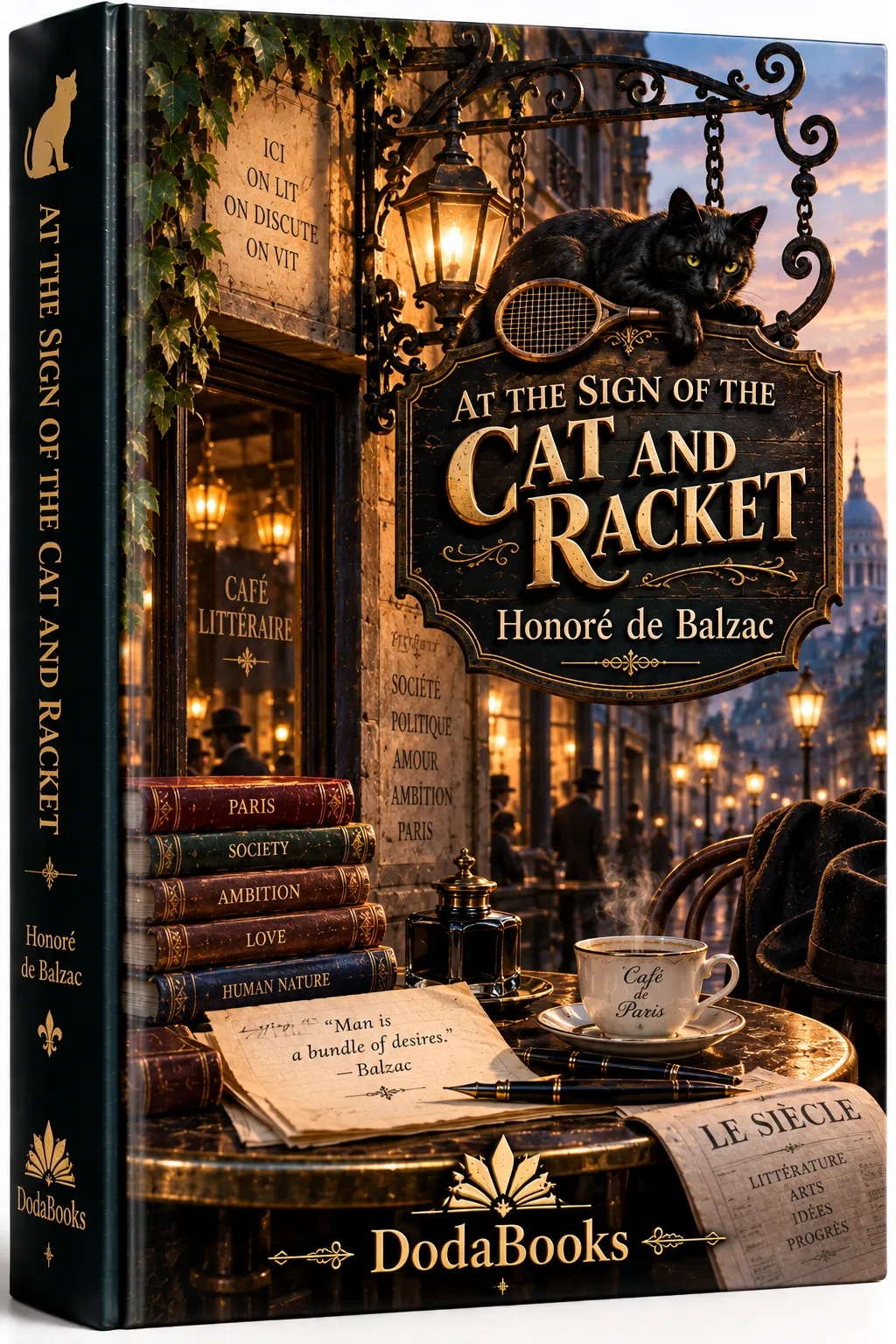
Read the Definitive Annotated Edition
Experience Honoré de Balzac's foundational realistic novella with extensive historical annotations on Restoration Paris, Parisian textile commerce, and 19th-century salon painting.
Get the Annotated eBookPlot Architecture: From the Rue Saint-Denis to the Aristocratic Salon
The novella opens with one of the most famous architectural descriptions in nineteenth-century French literature: the ancient, gabled wooden shop on the Rue Saint-Denis bearing the curious sign of the Cat and Racket (Le Chat-qui-pelote). There rules Monsieur Guillaume, a prosperous, conservative cloth merchant who lives with his wife and two daughters according to the strict, unchanging pieties of the old Parisian bourgeoisie. To Monsieur Guillaume, life is governed by double-entry bookkeeping, religious thrift, early bedtimes, and absolute submission to family hierarchy.
His younger daughter, Augustine Guillaume, is a creature of exquisite natural beauty and gentle sensitivity. One morning, her face framed by the dark wooden shop window is spotted by Théodore de Sommervieux, a brilliant, aristocratic young painter of the nascent Romantic movement.
                    THE SOCIAL CHASM IN BALZAC'S PARIS

        RUE SAINT-DENIS (Bourgeois Commerce)       THE SALON (Romantic Aesthetics)
     ┌───────────────────────────────────┐      ┌───────────────────────────────────┐
     │ M. Guillaume (The Cloth Draper)   │      │ Théodore de Sommervieux (Painter) │
     │ Ledgers, frugality & religious duty│ ◄──► │ Aristocratic rank, fashion & ego  │
     │ Distrust of art & aristocratic vanity│   │ Adoration of Augustine as "model" │
     └─────────────────┬─────────────────┘      └─────────────────┬─────────────────┘
                       │                                          │
                       ▼                                          ▼
            THE ILL-FATED MARRIAGE ─────────► Disillusionment & Emotional Abandonment
            Augustine Trapped Between Worlds  The Tragic Death of a Bourgeois Heart
Infatuated by Augustine’s maidenly grace, Théodore paints a masterpiece of her portrait, wins the Salon medal, and formally courts her. Despite the grave misgivings of Madame Guillaume—who wisely warns her daughter that “the hen should not marry the eagle”—Augustine is swept off her feet. Monsieur Guillaume reluctantly permits the marriage.
However, once installed in Théodore’s opulent Parisian studio, the dream collapses. Théodore fell in love not with a living woman, but with an aesthetic image—a muse. Once married, he discovers that Augustine possesses no intellectual wit, no appreciation for fine art, and no conversational sparkle to entertain his aristocratic friends. Bored by her domestic devotion, Théodore abandons her for the brilliant, seductive Duchesse de Carigliano. Desperate to win back her husband, Augustine visits the Duchess for counsel, only to receive a cruel lesson in feminine manipulation that shatters her fragile spirit, leading to her untimely death from heartbreak.
Major Characters: Bourgeois Duty and Bohemian Vanity
Balzac constructed his narrative around sociological archetypes that are simultaneously breathing, tragic human beings:
- Augustine Guillaume: The tragic heroine. Pure, loving, and innocent, Augustine represents the virtues of domestic devotion. Her tragedy is that her virtues are entirely unsuited to the cynical, performative demands of high-society marriage.
- Théodore de Sommervieux: The Romantic artist. Gifted with genuine creative genius, Théodore is nevertheless shallow, vain, and emotionally selfish. He mistakes aesthetic appreciation for moral love, viewing Augustine as a canvas rather than an equal soul.
- Monsieur Guillaume: The draper of the Rue Saint-Denis. The living personification of the pre-revolutionary merchant class. Honest to the penny, frugal, and suspicious of all aristocratic extravagance, Guillaume understands the brutal laws of commerce but cannot fathom the cruel laws of social ambition.
- Madame Guillaume: Augustine’s sharp-tongued, observant mother, whose gloomy forebodings about marrying outside one’s social class prove devastatingly prophetic.
- The Duchesse de Carigliano: The polished high-society aristocrat. Witty, calculating, and master of every salon art, the Duchess represents the cold emotional detachment required to dominate men in fashionable Paris.
- Joseph Lebas: Guillaume’s head clerk, an honest, hardworking tradesman who secretly adores Augustine but humbly steps aside, marrying her plainer elder sister Virginie and carrying on the family business with immense prosperity.
Core Themes: The Laws of Society and the Illusion of Romantic Passion
1. The Incompatibility of Social Castes
Balzac’s fundamental sociological thesis in At the Sign of the Cat and Racket is the absolute danger of marrying across irreconcilable class divides. In Balzac’s worldview, happiness in marriage is based not on fleeting erotic attraction, but on shared cultural habits, mutual social codes, and common values. When Augustine leaves the quiet, orderly routine of the draper’s shop for the volatile world of artists and courtiers, she is doomed because she cannot speak the language of high society.
2. The Nature of the Artistic Ego
Balzac delivers a profound, unsentimental critique of Romantic aestheticism. For Théodore de Sommervieux, passion is an artistic stimulus rather than a moral commitment. Once he has captured Augustine’s beauty on canvas, his interest evaporates. Balzac reveals the hidden cruelty of the artist who exploits real human emotions as raw fuel for creative vanity. In this respect, Balzac’s dissection of the artistic temperament anticipates Anatole France’s The Red Lily, where a sculptor’s possessive idealization also destroys genuine intimacy.
                      BALZAC'S SOCIOLOGICAL SPECTRUM

          The Bourgeois Trade World              The Aristocratic Art World
     ┌───────────────────────────────┐   ┌───────────────────────────────┐
     │ Double-entry ledger balance   │   │ Unregulated artistic spending │
     │ Deep family loyalty & duty    │   │ Fleeting affairs & social wit │
     │ Predictable domestic peace    │   │ Emotional instability & cruelty│
     │ Joseph Lebas & Virginie thrive│   │ Théodore abandons Augustine   │
     └───────────────────────────────┘   └───────────────────────────────┘
                     ▲                                   ▲
                     └─────────────────┬─────────────────┘
                                       ▼
                         The Fatal Collision:
                       Augustine Sacrificed to the Gap
3. Paris as a Living Organism
The opening chapters of the novella establish Balzac’s revolutionary approach to urban geography. The dark street of Saint-Denis, the ancient shop signs, the smell of wool, and the dust motes dancing across bolts of French calico are described with astonishing tactile richness. To Balzac, physical objects and architecture are the external mirrors of human souls and economic classes.
Comparative Literary Context
To appreciate Balzac’s genius as the founder of realistic fiction, compare At the Sign of the Cat and Racket with other classic works:
| Work & Author | Milieu & Era | Mode & Focus | Central Conflict |
|---|---|---|---|
| At the Sign of the Cat and Racket (Honoré de Balzac) | 1810s Paris | French Realism | Bourgeois commerce vs. Romantic artistic ego |
| The Red Lily (Anatole France) | 1890s Paris & Florence | Fin-de-Siècle Romance | Sculptor’s aesthetic passion vs. retrospective jealousy |
| The Secret of the Night (Gaston Leroux) | 1910s St. Petersburg | Detective Suspense | Rouletabille’s logic vs. Russian nihilist plots |
| The Ballad of the White Horse (G. K. Chesterton) | 9th c. Wessex | Epic Poetry | Christian hope vs. pagan Viking fatalism |
Where contemporaries like Gaston Leroux in The Secret of the Night utilized Parisian protagonists to solve high-stakes foreign political conspiracies, Balzac turned his microscope inward onto the everyday dramas of French domestic life. And while Anatole France in The Red Lily returned to the theme of painters, sculptors, and Parisian salons decades later, it was Balzac who first drew the definitive map of French society that made all subsequent realism possible.
Step Inside Balzac's Parisian Masterpiece
Read At the Sign of the Cat and Racket in this definitive annotated edition, complete with historical notes on Restoration Paris, textile trade history, and Balzacian realism.
Read The Annotated EditionWhy Balzac’s Novella Remains an Immortal Classic
At the Sign of the Cat and Racket is a masterpiece of economy and psychological precision. In fewer than a hundred pages, Balzac paints a complete, vibrant panorama of Restoration France, capturing the shifting balance of power between the rising mercantile bourgeoisie and the declining aristocracy.
Augustine Guillaume’s heartbreaking story remains as poignant today as when it was written. It is an eternal warning against mistaking an idealized artistic projection for authentic human love, and a moving testament to the quiet dignity of ordinary domestic virtues in a world dazzled by superficial glitter.
Frequently Asked Questions
Why is this novella called "At the Sign of the Cat and Racket"?
The title refers to the painted wooden trade sign hanging outside Monsieur Guillaume's cloth drapery shop on the Rue Saint-Denis. The sign depicted a cat playing with a racket and ball of yarn ('le chat-qui-pelote'), a traditional whimsical emblem of old Parisian guild shops that symbolized the ancient, unchanging merchant traditions of the capital.
What role does this novella play in Balzac's La Comédie Humaine?
'At the Sign of the Cat and Racket' was chosen by Balzac to open the very first volume of 'Scenes of Private Life' (Scènes de la vie privée), the first major subdivision of 'La Comédie Humaine.' It introduces readers to Balzac's revolutionary realistic technique—meticulous sociological detail, architectural symbolism, and forensic psychological analysis of money and marriage.
Is Théodore de Sommervieux based on a real artist?
While Sommervieux is a fictional creation, Balzac modeled his artistic style and temperament on prominent early French Romantic painters such as Anne-Louis Girodet and Eugène Delacroix, reflecting the contemporary debate between classical academic painting and the emotional, flamboyant Romantic school.
What advice does the Duchesse de Carigliano give to Augustine?
The Duchess reveals the cynical secrets of high-society seduction: she advises Augustine never to show her husband complete devotion or domestic subservience, but to keep him in a state of emotional anxiety through flirtation, distance, and aristocratic wit. When the naive Augustine attempts to apply these theatrical tricks, her innate honesty and grief betray her, precipitating her final breakdown.
What enhancements does the DodaBooks annotated edition provide?
The DodaBooks annotated edition includes detailed historical annotations on the economic life of Paris during the Bourbon Restoration, architectural guides to the medieval Rue Saint-Denis district, explanations of early 19th-century French legal marriage contracts, and an insightful introduction to Balzac's sociological genius. You can explore and download the definitive annotated edition directly from DodaBooks at https://dodabooks.com/ebook/at-the-sign-of-the-cat-and-racket-by-honore-de-balzac/.
Related Classic European Literature Studies
Explore further masterworks of classic French literature, Elizabethan drama, and epic poetry: