William Shakespeare’s As You Like It (c. 1599) is the Bard’s supreme pastoral romantic comedy. Celebrated for introducing Rosalind—the most intelligent, witty, and charismatic heroine in the Shakespearean canon—and Jaques’s immortal “All the world’s a stage” soliloquy, the play whisks audiences away from the corrupt, paranoid court of Duke Frederick into the magical, sun-dappled green world of the Forest of Arden.
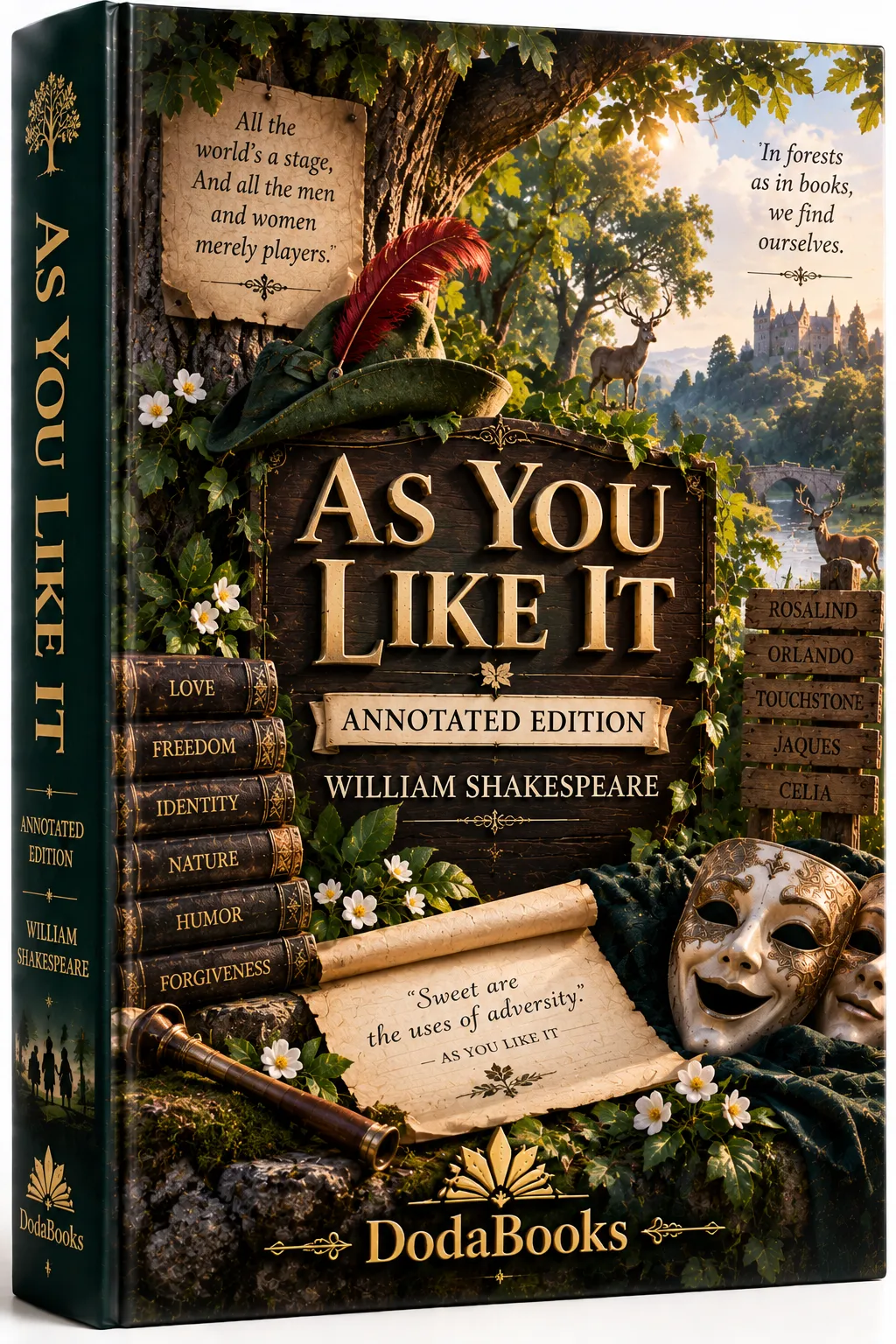
🌲
As You Like It
Shakespeare's enchanting pastoral comedy of love, disguise, and woodland wit. Flee the tyrannical court into the Forest of Arden alongside Rosalind, Orlando, Touchstone, and melancholy Jaques.
| Author | William Shakespeare |
| First Performed | c. 1599 (Globe Theatre, London) |
| Genre | Pastoral Romantic Comedy |
| Setting | A French Duchy: The Usurper’s Court and the Forest of Arden |
| Central Themes | Nature vs. Courtly Corruption, The Follies of Love, Gender Performance & Disguise, Melancholy vs. Joy |
| Reading Time | 2–3 hours |
| Summary Time | 20 minutes |
🌿 The Magic of the Green World
Written in 1599 during the triumphant opening season of the newly constructed Globe Theatre, As You Like It marks the peak of Shakespeare’s comic mastery, bridging the exuberant lyricism of A Midsummer Night’s Dream and Much Ado About Nothing with the deeper psychological complexity of Twelfth Night and Hamlet.
Based on Thomas Lodge’s popular Elizabethan prose romance Rosalynde (1590), Shakespeare transformed a conventional pastoral tale into a sparkling, multi-layered philosophical comedy. The play is built upon the classic structural contrast between two worlds:
- The Court: A dark, paranoid arena of political usurpation, sibling jealousy, tyranny, and physical danger ruled by Duke Frederick and Oliver de Boys.
- The Forest of Arden: A restorative, timeless sanctuary—partly modeled on the real Forest of Arden in Shakespeare’s native Warwickshire and partly on the mythical French Ardennes—where social ranks dissolve, exiled nobles live like Robin Hood, and lovers educate one another beneath the boughs of ancient oaks.
As Duke Senior famously reflects in his opening speech in Act II:
"Sweet are the uses of adversity,
Which, like the toad, ugly and venomous,
Wears yet a precious jewel in his head;
And this our life, exempt from public haunt,
Finds tongues in trees, books in the running brooks,
Sermons in stones, and good in every thing."
📜 Act-by-Act Plot Breakdown
Act I: Peril and Flight at Court
The play opens with young Orlando de Boys bitterly lamenting his mistreatment at the hands of his tyrannical elder brother Oliver, who denies him an honorable gentleman’s education. When Orlando enters a wrestling match at Duke Frederick’s court and heroically defeats the Duke’s champion Charles, he catches the eye of Duke Frederick’s niece, Rosalind. Love blossoms instantly between Orlando and Rosalind, who gives him a chain from her neck.
However, Duke Frederick’s paranoia flares up: he abruptly banishes Rosalind on pain of death simply because her father, the rightful Duke Senior, was deposed and exiled to the Forest of Arden. Duke Frederick’s daughter Celia refuses to abandon her beloved cousin. Together with the court fool Touchstone, the two women resolve to flee to Arden. For safety on the road, Rosalind disguises herself as a handsome young man named Ganymede, while Celia dresses as a simple shepherdess named Aliena.
Act II: The Sanctuaries of Arden
In Arden, the exiled Duke Senior and his loyal lords live a carefree pastoral life. Among them is the cynical philosopher Jaques, who mourns over wounded deer and critiques human vanity. Meanwhile, Orlando and his faithful elderly servant Adam arrive in Arden on the verge of starvation. Orlando bursts into Duke Senior’s banquet with drawn sword, demanding food, but is disarmed by the Duke’s gentle hospitality and welcome.
Act III: The Trees of Love and Ganymede’s Cure
Orlando wanders through Arden, carving romantic verses to Rosalind onto tree trunks and hanging sonnets from the branches. Rosalind (disguised as Ganymede) and Celia discover the verses.
When Rosalind encounters Orlando, she does not reveal her true identity. Instead, she offers him a witty, audacious proposition: Ganymede will pretend to be “Rosalind,” and Orlando must woo Ganymede every day to be “cured” of his romantic love-sickness. Orlando eagerly agrees, setting up Shakespeare’s most brilliant comedic dynamic: a woman disguised as a man pretending to be herself, teaching her lover how to love realistically.
Act IV: The Lessons of Realism
Beneath the trees, Rosalind puts Orlando through a rigorous school of romantic psychology. She mocks romantic melodrama—quipping that “Men have died from time to time, and worms have eaten them, but not for love”—demanding genuine emotional maturity and constancy rather than poetic clichés.
Meanwhile, a subplot unfolds: the proud shepherdess Phebe falls madly in love with Ganymede (Rosalind), while the honest shepherd Silvius desperately woos Phebe, and Touchstone courts the rustic country wench Audrey. The forest is threatened when Oliver arrives, sent by Duke Frederick to kill Orlando; but when Orlando saves Oliver’s life from a hungry lioness and a venomous snake, Oliver undergoes a complete moral conversion, falling instantly in love with Celia (Aliena).
Act V: The Fourfold Wedding and the Epilogue
With Oliver and Celia engaged and Orlando weary of wooing a mock-Rosalind, Ganymede promises that by “magical means” he will produce the real Rosalind tomorrow, resolve Phebe’s entanglement, and unite all the lovers.
The next day, Rosalind discards her Ganymede disguise and appears in her true glory alongside Hymen, the god of marriage. Four marriages are celebrated: Rosalind and Orlando, Celia and Oliver, Phebe and Silvius, and Touchstone and Audrey. Word arrives that Duke Frederick, marching on Arden with an army, met an old religious hermit in the woods, renounced his crown, and returned the dukedom to Duke Senior. All return to court except Jaques, who chooses to remain in the forest to study with the hermit. Rosalind steps forward to deliver a charming, ground-breaking Epilogue directly to the audience.
👥 Character Profiles & Theatrical Dynamics
👑 ROSALIND (GANYMEDE)
Shakespeare’s Greatest Comedic Heroine
“Down on your knees, and thank heaven, fasting, for a good man’s love.”
Rosalind combines dazzling intellectual wit, emotional vulnerability, and bold agency. Disguised as Ganymede, she enjoys complete freedom from restrictive Elizabethan female decorum.
Why She Matters
Rosalind controls the action of the play from start to finish. She deconstructs both cynical anti-romanticism and foolish romantic idolatry, advocating for a healthy, grounded, and joyous love.
🗡️ ORLANDO
The Earnest Romantic
“O Rosalind! these trees shall be my barks, / And in their barks my thoughts I’ll character.”
Orlando is brave, honorable, passionate, and poetically clumsy. His willingness to submit to Ganymede’s playful “cures” demonstrates his humility, teachability, and genuine devotion.
Why He Matters
Orlando represents the chivalric romantic ideal humbled and educated by female wit, growing into a mature partner worthy of Rosalind.
🎭 JAQUES
The Melancholy Philosopher
“All the world’s a stage, / And all the men and women merely players; / They have their exits and their entrances.”
Jaques is a professional melancholic, wandering through the forest observing the comedy of life with detached cynicism. He refuses to join in the final festive dancing, seeking philosophical solitude.
Why He Matters
Jaques provides the vital bittersweet contrast to the play’s joyous comedy. His famous speech on the Seven Ages of Man reminds us of human frailty and mortality without spoiling the joy of love.
📘 Annotated Insight — In Elizabethan theatre, all female roles were played by young adolescent boys. In As You Like It, Shakespeare exploited this theatrical reality to dizzying heights: an Elizabethan boy actor played Rosalind, who disguised herself as a boy named Ganymede, who then pretended to be a woman named Rosalind! In the Epilogue, Rosalind winks at this gender fluidity: “If I were a woman, I would kiss as many of you as had beards that pleased me.”
🔍 Central Themes & Critical Significance
1. Pastoral Illusion vs. Reality
Shakespeare parodies traditional pastoral literature. While Duke Senior romanticizes the simple life, Touchstone and the realistic shepherd Corin point out the harsh realities of sheep-farming: dirty wool, sore hands, and bitter winter frost. True happiness is not found by running away to the woods; it is an internal perspective that can be cultivated anywhere.
2. The Seven Ages of Man and Human Performance
Jaques’s famous speech in Act II, Scene 7 divides human life into seven theatrical acts: the infant, the whining schoolboy, the sighing lover, the fierce soldier, the prosperous justice, the frail pantaloon, and finally “second childishness and mere oblivion.” Shakespeare suggests that identity is fluid and performative—an insight Rosalind proves by stepping effortlessly in and out of her Ganymede disguise.
3. The Education of Desire
Love in As You Like It is not an irrational sickness to be cured, but an art to be practiced with honesty, humor, and self-awareness. By testing Orlando in disguise, Rosalind ensures that their marriage will be built on mutual understanding and realistic partnership rather than fleeting romantic infatuation.
📖 Explore the Annotated Edition at DodaBooks →
✨ What Makes the DodaBooks Annotated Edition Essential
Reading Shakespearean comedy without glosses can be bewildering. As You Like It is filled with topical Elizabethan puns, double entendres, hunting jargon, and classical mythological references (such as Atalanta, Hercules, and Hymen) that lose their sparkle without context.
The DodaBooks Annotated Edition restores the immediate, laugh-out-loud vitality of the play:
Line-by-Line Wordplay Glosses
Every complex Elizabethan pun, bawdy double entendre, and archaic phrase explained directly beside the verse.
Pastoral Lore & Forest Ecology
Understand the historical context of the Forest of Arden, Elizabethan hunting laws, and pastoral literary conventions.
Seven Ages of Man Commentary
In-depth textual analysis and historical sources for Jaques's immortal "All the world's a stage" speech.
Performance & Staging History
Production notes tracking legendary Rosalinds from the Globe Theatre boys to modern stage and film icons.
100% DRM-Free Freedom
Yours permanently across Kindle, Kobo, Apple Books, and Android e-readers without digital restrictions.
Beautiful Script Formatting
Designed specifically for theatrical verse, with distinct speaker names, indented dialogue, and clear stage directions.
❓ Frequently Asked Questions
Why is the play called "As You Like It"?
The title is an invitation to the audience and reader: take the play however you wish. Whether you prefer romantic comedy, pastoral fantasy, witty social satire, or musical entertainment, Shakespeare provides something to satisfy every taste.
Why does Rosalind choose the name "Ganymede"?
In Greek mythology, Ganymede was a beautiful Trojan youth abducted by Zeus to serve as cupbearer to the gods. In the Renaissance, Ganymede was a well-known archetype of youthful male beauty and gender ambiguity, making it the perfect cheeky disguise for Rosalind.
Where is the Forest of Arden located?
Arden operates on two levels: geographically, it refers to the real Forest of Arden in Warwickshire, England, where Shakespeare grew up; literarily, it blends with the Ardennes forest in France and Belgium, creating a mythical, timeless pastoral dreamland where palms and lions coexist with English oak trees.
What are the "Seven Ages of Man"?
In Act II, Scene 7, Jaques describes the seven stages of human life: the infant, the schoolboy, the lover, the soldier, the justice (judge), the pantaloon (aging man), and finally second childishness (extreme senility and death). It is one of Shakespeare's most widely quoted philosophical reflections.
Why should I purchase the DodaBooks edition?
Shakespearean comedies are notorious for falling flat when read in poorly formatted text files where verse rhythms are ruined and intricate Elizabethan puns are left unexplained. DodaBooks provides pristine script typesetting, comprehensive line-by-line annotations, and cultural commentary that make the play as lively and hilarious as opening night at the Globe.
For sharp Renaissance moral philosophy and aphoristic wisdom of Elizabethan England, see Francis Bacon’s masterwork in Bacon’s Essays Guide.
🌲 Escape to the Forest of Arden with Shakespeare
Immerse yourself in Shakespeare’s most joyous and witty romantic comedy. The DodaBooks Annotated Edition of As You Like It delivers:
- ✅ Complete Unabridged Play — All 5 acts with the immortal songs and final Epilogue
- 📜 Line-by-Line Elizabethan Glosses — Every pun, classical reference, and double entendre revealed
- ✒️ Typeset for Theatrical Reading — Clear character labels, elegant verse layout, and stage directions
- 🔒 100% DRM-Free Ownership — Read across all your e-readers and mobile devices
- 📥 Instant Download — Immediate delivery in pristine EPUB format