Andersen's Fairy Tales Summary: Story-by-Story Breakdown of the Classics
Hans Christian Andersen (1805–1875) fundamentally revolutionized the landscape of world literature. Before Andersen, fairy tales were largely anonymous peasant folklore collected from oral traditions, such as the German peasant tales gathered by the Brothers Grimm or the French aristocratic salon tales recorded by Charles Perrault. Andersen invented something radically new: the literary fairy tale—a modern art form combining ancient magical motifs with psychological realism, piercing autobiographical longing, biting social satire, and transcendent spiritual beauty.
While twentieth-century animated film adaptations softened Andersen’s tales into sentimental children’s cartoons with tidy romantic weddings, Andersen’s original nineteenth-century texts are far more profound, melancholic, and spiritually daring. In Andersen’s true stories, mermaids do not marry human princes; they suffer excruciating physical agony to gain an immortal soul. Disfigured ducklings endure frozen winter ponds before discovering their noble lineage. And loyal young girls brave arctic blizzards with bare feet to rescue their friends from shards of demonic glass.
This exhaustive guide provides a comprehensive story-by-story breakdown of Andersen’s greatest and most famous masterpieces, unpacking the complete narratives, symbolic undertones, and historical context of each tale.
| Tale Title | Original Publication | Primary Protagonist | Central Theme / Conflict | Iconic Narrative Motif |
|---|---|---|---|---|
| The Little Mermaid (Den lille Havfrue) | 1837 | The Youngest Sea Princess | Yearning for an Immortal Soul & Unrequited Love | Walking on blades; the Sea Witch’s bargain; Daughters of the Air |
| The Snow Queen (Snedronningen) | 1844 (7 Stories) | Gerda & Kai | Innocence, Love, and Faith vs. Frozen Cynical Rationalism | The Devil’s looking glass; the ice palace puzzle of “Eternity” |
| The Ugly Duckling (Den grimme Ælling) | 1843 | The Persecuted Cygnet | Suffering, Resilience, and Spiritual Transformation | Mockery by the barnyard; freezing in ice; the swan reflection |
| The Emperor’s New Clothes (Kejserens nye Klæder) | 1837 | The Vain Emperor & Court | Social Conformity, Snobbery, and Moral Cowardice | Invisible weavers; courtiers feigning praise; the child’s truth |
| The Steadfast Tin Soldier (Den standhaftige Tinsoldat) | 1838 | The One-Legged Soldier | Silent Stoicism, Unwavering Devotion, and Tragic Fate | The paper dancer; the water rat; the furnace heart of tin |
| The Little Match Girl (Den lille Pige med Svovlstikkerne) | 1845 | The Impoverished Child | Poverty, Indifference, and Celestial Transcendence | Matches struck in the snow; glowing visions; New Year’s dawn |
🌊 1. The Little Mermaid (Den lille Havfrue, 1837)
The Underwater Realm and the Mortal Soul
Beneath the deep blue ocean, where the water is as clear as the purest crystal, lies the coral palace of the Sea King. The king, a widower, lives with his elderly mother and six lovely mermaid princesses. The youngest princess is the most beautiful and melancholy of all: her skin is as clear as a rose-leaf, her eyes as blue as the sea, and unlike her sisters who cultivate flowerbeds shaped like whales, she plants her flowers in the shape of the radiant sun.
In the underwater kingdom, merfolk live for three hundred years. However, when they die, they dissolve into sea foam upon the waves, leaving behind no enduring consciousness. In contrast, mortal human beings possess something the merfolk do not: an immortal soul (en udødelig sjæl) that survives the death of the physical body and ascends into the starry heavens to live in eternal joy. The grandmother explains to the little mermaid:
“We have no immortal souls, and we can never obtain one unless a human being loves us so dearly that his soul flows into our being. Our life is like the green sea-rush; once cut down, it never greens again.”
From that moment, the little mermaid’s deepest desire is not merely romantic attraction, but an overwhelming spiritual longing to achieve immortality.
The Rescue and the Sea Witch’s Bargain
On her fifteenth birthday, the little mermaid is permitted to rise to the surface. She witnesses a magnificent three-masted ship celebrating the birthday of a handsome human prince. A violent hurricane strikes, shattering the vessel. Diving into the churning abyss, the mermaid rescues the unconscious prince, holding his head above water through the tempest until she deposits him gently on the shore near a holy convent. Before the prince regains consciousness, a young novice girl emerges, and the mermaid retreats beneath the waves unseen.
Consumed by longing, the little mermaid descends into the terrifying abyss to visit the Sea Witch, navigating a forest of polypi—half-plant, half-animal polyps that clutch drowned sailors in their slimy claws. The Sea Witch agrees to brew a potion that will dissolve her fish-tail into human legs. But the price is horrifying:
- Physical Agony: Each step she takes on land will feel as though she is treading upon sharp knives and sharp razors that make her feet bleed.
- The Loss of Her Voice: The Sea Witch cuts out the little mermaid’s tongue, claiming her magnificent voice as payment.
- The Penalty of Death: If the prince marries another woman, the little mermaid will not return to the sea. On the very morning after his wedding to another, her heart will break and she will dissolve into sea foam.
The Silent Martyrdom and the Daughters of the Air
Drinking the burning potion on the shore, the mermaid awakes with human legs and is discovered by the prince. He takes her into his royal palace, clothing her in silk and velvet. She dances for him with otherworldly grace, concealing the agony of blades piercing her feet with every step.
The prince treats her with affectionate condescension—calling her his “dumb foundling” and allowing her to sleep on a velvet cushion outside his bedroom door like a pet animal. When his parents arrange a royal marriage with the princess of a neighboring kingdom, the prince discovers that the foreign princess was the temple novice who found him on the beach. Believing she was his true savior, the prince marries her with immense joy.
On the royal wedding ship, the little mermaid awaits the dawn of her death. Her sisters suddenly rise from the waves, having shorn off their long hair and traded it to the Sea Witch for an enchanted dagger. They implore her to plunge the dagger into the prince’s heart before sunrise; his warm blood splashing over her feet will turn them back into a fish-tail, saving her life.
The little mermaid slips into the bridal tent where the prince sleeps beside his bride. She looks at the blade, looks at the prince who whispers his bride’s name in his sleep, and refuses to commit murder. She casts the dagger into the sea and throws herself from the ship into the waves, feeling her body dissolve into foam.
Instead of extinction, however, she rises into the golden clouds, greeted by the radiant Daughters of the Air (Luftens Døtre). Because she loved selflessly and endured martyrdom without bitterness, she has been elevated to their realm. By performing good deeds for three hundred years, she will forge her own immortal soul and enter the Kingdom of God through her own moral effort.
❄️ 2. The Snow Queen (Snedronningen, 1844)
Structured into seven distinct stories, The Snow Queen is Andersen’s longest and most ambitious fairy tale—a profound Christian allegory contrasting cold, intellectual logic with the redemptive power of innocent, childlike love.
Story 1: The Devil’s Looking-Glass
The tale begins with a wicked troll (the Devil) who crafts a magical mirror that distorts all of creation: everything good and beautiful reflected in it shrinks to nothingness, while everything ugly, wicked, and petty appears magnified and monstrous. Flying upward to mock the angels, the trolls drop the mirror. It shatters on the Earth into hundreds of millions of microscopic glass splinters. If a splinter lodges in a human’s eye, they see only the defects in others; if a splinter strikes their heart, the heart freezes solid into a lump of ice.
Story 2: Gerda, Kai, and the Shard of Ice
In a bustling city, two impoverished children, Kai and Gerda, live in adjoining attic garrets. Their parents cultivate large wooden boxes of sweet herbs and rosebushes on the roof gutter, forming a lush bridge between their windows. Kai and Gerda love each other like brother and sister, singing an ancient Danish hymn:
“Roses bloom and fade away; / The Christ-child we shall see one day.”
One summer afternoon, Kai screams: a glass splinter has pierced his eye, and another has lodged in his heart. Overnight, Kai transforms. He mocks his grandmother, stomps on Gerda’s roses, and mimics the limping walk of elderly neighbors with cruel mathematical precision. He becomes obsessed with snow crystals, admiring their cold, sterile symmetry: “Look how precise they are! There is not a single flaw in them—if only they did not melt!”
The following winter, Kai ties his little sled to the magnificent white sleigh of the Snow Queen. She kisses him twice—the first kiss making him oblivious to the freezing cold, the second kiss making him forget Gerda entirely. She whisks him away to her frozen palace in the Arctic North.
Stories 3–6: Gerda’s Pilgrimage Across the World
When spring returns and Kai does not come home, everyone assumes he drowned in the river. Gerda refuses to believe it. Sacrificing her prized new red shoes to the river, she embarks on an epic quest to find him:
- The Enchanted Garden of Forgetfulness: Gerda is taken in by an old sorceress with a flower garden of eternal summer. When Gerda sees a painted rose on the old woman’s hat, her tears water the ground, causing the real roses to rise from the earth. The roses tell Gerda that Kai is not among the dead.
- The Raven and the Royal Court: A wise crow guides Gerda to a grand palace, suspecting Kai has married the brilliant Princess. Gerda discovers the Prince is another clever boy, but the Prince and Princess generously gift Gerda warm clothes, golden slippers, and a golden carriage.
- The Forest Robbers and the Reindeer: Forest bandits attack the carriage. A fierce, knife-wielding Little Robber Girl takes Gerda hostage. Moved by Gerda’s tears, the Robber Girl frees Gerda and lends her Bae, a captive Lapland reindeer who knows the Arctic north.
- The Lapland and Finn Women: The reindeer carries Gerda across frozen tundras to the huts of the wise Lapland and Finn women. When the reindeer asks the Finn woman to give Gerda the power of twelve men to conquer the Snow Queen, the Finn woman replies:
“I cannot give her any greater power than she already possesses! Do you not see how great her power is? Do you not see how men and beasts must serve her, and how she has walked through the world on bare feet? Her power resides in her heart, because she is a sweet, innocent child.”
Story 7: The Ice Palace and the Word “Eternity”
Gerda marches through blizzards into the vast, luminous halls of the Snow Queen’s palace on the island of Spitsbergen. Inside, Kai sits half-frozen and blue with cold on the frozen lake called the “Mirror of Reason.” The Snow Queen has promised Kai his freedom, a pair of new skates, and the whole world if he can arrange sharp slabs of ice into the word “Eternity” (Evigheden). But Kai’s frozen mind cannot complete the puzzle.
Gerda rushes forward, embracing Kai and weeping hot tears that fall upon his chest, piercing down to his heart and melting the lump of ice. Her tears wash away the demonic splinter. Kai bursts into violent weeping, dislodging the second glass shard from his eye.
Reunited, the children dance for joy. Even the slabs of ice join their dance and settle themselves into the exact arrangement to spell “Eternity.” Hand in hand, Gerda and Kai journey back south. When they arrive at their old rooftop garden, they realize they have grown into adults—yet retain the pure, uncorrupted hearts of children.
🦆 3. The Ugly Duckling (Den grimme Ælling, 1843)
The Torment of the Barnyard
In the sunny Danish countryside, beneath the towering burdock leaves near an old moat, a mother duck hatches her brood. One egg, much larger than the rest, refuses to crack. When it finally breaks open, the creature that emerges is awkward, gray, overgrown, and ugly.
The mother duck defends him initially, noting that he swims with perfect balance. However, when she introduces the brood to the poultry yard, the duckling enters an inferno of social cruelty. The ducks bite him, the chickens peck him, the turkey cock puffs himself up in haughty rage, and the girl who feeds the poultry kicks him with her foot. Even his own brothers and sisters despise him: “If only the cat would catch you, you hideous fright!”
Winter Despair and the Ice Pond
Fleeing the farmyard, the duckling hides among the wild ducks of the marsh. Two wild ganders mock his ugliness before being blasted out of the sky by hunters. A hunting dog rushes through the reeds, bares its fangs at the duckling, and runs past without biting him. The duckling sighs: “I am so ugly that even the dog will not bite me!”
Taking shelter in a ramshackle cottage inhabited by an old woman, a haughty cat (“The Son of the House”), and a short-legged hen, the duckling is subjected to intellectual snobbery. The cat demands to know if the duckling can arch his back and purr; the hen demands to know if he can lay eggs. When the duckling admits he can do neither, but yearns to float on water and dive into the depths, they mock him as a lunatic:
“You don’t understand us? Then who could understand you? You surely don’t imagine you are cleverer than the cat and the mistress, not to mention myself!”
The duckling leaves the cottage. Autumn arrives, turning the leaves yellow and bitter cold. One evening at sunset, the duckling sees a flock of magnificent, dazzling white birds with long, graceful necks rising into the sky: swans. The duckling lets out a strange, shrill cry, spinning in circles on the water, overcome with an inexplicable love for these glorious creatures.
Winter descends with ferocious brutality. The pond freezes tighter and tighter. To keep from freezing, the duckling must paddle incessantly in circles, until exhausted, he is frozen solid into the ice. A peasant rescues him and brings him home to his wife, but the frightened duckling flutters into the milk pan, the butter tub, and the flour barrel. Amid shrieks and broom-strikes, he escapes into the freezing snow, barely surviving the winter in the marsh reeds.
The Transfiguration
When spring returns, the larks sing and the apple trees bloom. The duckling spreads his wings and discovers they are powerful, carrying him high into the air. He glides down into a magnificent garden where three glorious white swans float on the water.
Believing the beautiful birds will peck him to death for daring to approach them in his ugliness, the duckling swims toward them, bowing his head in surrender: “Kill me!”
He gazes down into the clear water. To his astonishment, he no longer sees a clumsy, dark gray, hideous bird. He sees his own reflection: he is a swan.
The elder swans swim around him, stroking his neck with their beaks. Small children run into the garden, clapping their hands and shouting to their parents: “There is a new one! The new one is the most beautiful of all!” Shaking his feathers and raising his slender neck, the swan whispers from a full heart:
“I never dreamed of such happiness when I was an ugly duckling!”
👑 4. The Emperor’s New Clothes (Kejserens nye Klæder, 1837)
The Swindlers and the Magic Fabric
In a grand imperial city, a vain Emperor spends all his revenues on lavish new coats, caring nothing for his soldiers, the theater, or the governance of his realm.
Two cunning swindlers arrive, presenting themselves as master weavers. They claim they can weave a fabric of extraordinary color and pattern, possessing a miraculous property: clothes made from this fabric are invisible to anyone who is unfit for his office or unpardonably stupid.
The Emperor is thrilled. He calculates that by wearing such garments, he can instantly distinguish the wise men in his empire from the fools. He pays the swindlers immense bags of gold and silk. The impostors set up two empty looms, working late into the night pretending to weave empty air.
The Complicity of Fear
Eager to check the progress of the fabric, the Emperor sends his honest, elderly Prime Minister to inspect the looms. The old minister enters the workshop, rubs his eyes, and stares at the empty looms in horror: he sees nothing!
Terrified of being declared incompetent or stupid, the minister immediately deceives himself:
“Good heavens! Can it be that I am a fool? I must never let anyone know it. Can it be that I am unfit for my office? I must certainly never admit that I could not see the cloth!”
The minister enthusiastically praises the non-existent fabric, marveling at the imaginary colors and patterns. The Emperor then sends a second trusted official, who falls into the exact same trap of social conformity. Finally, the Emperor visits the workshop himself, accompanied by his entire court. Rather than expose his own apparent blindness, the Emperor awards the swindlers medals of honor and declares the invisible fabric magnificent.
The Procession and the Child’s Truth
On the day of the great imperial procession, the swindlers pretend to cut the fabric with enormous shears, sewing with unthreaded needles. They dress the naked Emperor in his invisible robes, pretending to button his coat and fasten his train. The Emperor twists and turns before the looking glass, admiring his imaginary splendor.
The Emperor marches through the streets beneath a silk canopy. The entire populace, gathered along the streets and leaning out of windows, shouts in desperate unison: “How splendid are the Emperor’s new clothes! How magnificently they fit!” No one dares to admit they see nothing, for fear of being condemned as a fool.
Suddenly, an innocent little child in the crowd speaks the unvarnished truth:
“But he has nothing on!”
The child’s whisper spreads like wildfire through the crowd: “Listen to what the innocent child says!” Soon, the entire city bursts into a roaring chant: “He has nothing on! He has nothing on!”
The Emperor shivers, knowing in his heart that the people are right. But his imperial pride cannot endure humiliation: he draws himself up even taller, and the royal chamberlains march on with grave solemnity, carrying the train that isn’t there.
🎖️ 5. The Steadfast Tin Soldier (Den standhaftige Tinsoldat, 1838)
The Soldier and the Ballerina
Twenty-five tin soldiers, born of the same old tin spoon, are gifted to a young boy on his birthday. Twenty-four soldiers are identical; the twenty-fifth is missing a leg, having been cast last when the melted tin ran short. Yet the one-legged soldier stands as firmly and steadfastly on his single foot as the others on two.
On a table in the nursery, the soldier notices a delicate paper castle. Before the door stands a lovely paper ballerina, her arms raised and one leg lifted so high behind her that the tin soldier believes she, too, has only one leg. The soldier falls deeply and silently in love with her, watching her steadfastly throughout the night.
At midnight, a black goblin pops out of a snuff-box, angrily warning the soldier: “Tin soldier, don’t keep staring at what is not for you!” The soldier pretends not to hear.
The Perilous Journey and the Crucible of Fire
The next morning, the soldier is placed on the window sill. Whether blown by the wind or shoved by the jealous goblin, the window flies open and the soldier plummets three stories onto the cobblestones below. Two street urchins find him, place him inside a newspaper boat, and launch him down a churning gutter.
The soldier endures harrowing trials without flinching: he shoots through dark sewer drains, refuses to pay a toll to an angry water rat, and plummets into a canal when the paper boat disintegrates. Sinking into the water, he is swallowed by a giant fish. Throughout it all, he remains steadfast, his musket on his shoulder.
The fish is caught, sold at market, and brought into the very same kitchen from which the soldier fell. Cut open by the cook, the soldier is reunited with his nursery and his beloved ballerina.
Suddenly, for no rational reason, one of the small boys snatches the tin soldier and hurls him into the roaring iron stove. The soldier feels the scorching heat, watching the ballerina while his paint melts away. A draft catches the paper ballerina; she flutters through the air like a sylph, straight into the stove beside him, flashing into a single burst of flame.
The next morning, when the housemaid cleans out the ashes, she finds the soldier melted into a little tin heart—and beside him, the ballerina’s spangle, burned black as coal.
🕯️ 6. The Little Match Girl (Den lille Pige med Svovlstikkerne, 1845)
The Frozen Alley on New Year’s Eve
On a bitter, freezing New Year’s Eve, snow falls upon a dark, deserted city street. An impoverished young girl wanders with bare head and bare feet. She had an old pair of oversized slippers belonging to her deceased mother, but lost them when scrambling to escape two carriages racing recklessly through the snow.
In her apron, she carries bundles of matches that she has tried unsuccessfully to sell all day. She has earned not a single penny. She dares not return home, for her father will beat her for returning empty-handed, and their attic garret is almost as freezing as the street, with wind whistling through cracks stuffed with straw and rags.
The Visions of the Matches
Huddling in a corner between two brick houses, her fingers completely numb, she dares to draw out a single match and strike it against the wall:
- The First Match: The match flares into a warm, clear flame. To the girl, it feels as though she is sitting before an enormous polished iron stove with brass ornaments, radiating glorious warmth. She stretches out her feet to warm them—and the match flickers out.
- The Second Match: The wall becomes transparent like gauze. She sees into a dining room where a roast goose, stuffed with apples and dried plums, steams upon a damask tablecloth. Miraculously, the goose hops down from the dish with carving knife in its breast and waddles across the floor toward her—and the match burns out.
- The Third Match: She sits beneath a magnificent Christmas tree, larger and more lavishly decorated than the merchant’s tree she peeked at through glass doors. Thousands of glowing candles illuminate the green boughs. When she reaches for them, the candles rise into the night sky, transforming into glittering stars. One star falls, leaving a long trail of golden fire. The girl whispers: “Someone is dying,” remembering her deceased grandmother’s words that a falling star marks a soul ascending to God.
- The Fourth Match and the Bundle: She strikes another match, and in the radiant glow stands her beloved grandmother—the only person who ever showed her love—gentle, mild, and radiant. Terrified that the grandmother will vanish like the stove and the goose, the girl hastily strikes the entire remaining bundle of matches to keep her near.
The matches illuminate the alley brighter than noonday sun. The grandmother takes the little girl in her arms, and together they fly upward in joy and glory, higher and higher, far above the earth, where there is neither cold, nor hunger, nor sorrow—they are with God.
The Dawn of New Year’s Day
The following morning, in the cold light of New Year’s Day, townspeople discover the child frozen in the alley, red-cheeked with a smile on her lips, surrounded by burned matchsticks:
“She wanted to warm herself,” people said with casual pity.
No one imagined the glorious visions she had seen, nor in what radiant splendor she had entered into the joy of the New Year with her grandmother.
❓ Frequently Asked Questions
Why does the original "Little Mermaid" not end with a wedding?
Andersen did not write The Little Mermaid as a conventional romantic love story; he wrote it as a Christian spiritual quest for an immortal soul. In Andersen's philosophy, earthly romance is secondary to divine grace. By choosing self-sacrifice over murdering the prince, the mermaid earns the opportunity to forge an immortal soul through selfless devotion among the Daughters of the Air.
What is the symbolic meaning of the ice puzzle in "The Snow Queen"?
In the Snow Queen's palace, Kai attempts to arrange ice fragments into the word "Eternity." The puzzle represents cold, sterile human intellectualism severed from emotion, faith, and love. Kai’s frozen intellect cannot solve the puzzle; it is only when Gerda’s tears of love melt his heart and wash away the devil's looking-glass shard that the ice pieces arrange themselves effortlessly into the word.
Is "The Ugly Duckling" an autobiography of Hans Christian Andersen?
Yes. Andersen openly confirmed that "The Ugly Duckling" was an allegorical depiction of his own painful life. Born into grinding poverty in Odense, awkward, tall, and relentlessly mocked for his eccentricities, Andersen endured years of humiliation before his artistic genius was recognized, allowing him to be embraced by European royalty.
Why was "The Emperor's New Clothes" considered politically revolutionary?
Published in 1837 during an era of European aristocratic censorship, The Emperor's New Clothes was a devastating satire of courtly sycophancy, institutional conformity, and moral cowardice. It demonstrated that entire governments and populations can participate in transparent falsehoods out of fear of social condemnation, until the voice of innocent truth shatters the illusion.
Why should I purchase the DodaBooks edition?
Most free digital editions of Andersen's tales are censored Victorian nursery translations that deleted his spiritual philosophy, softened his dark endings, or abridged complex stories into five-paragraph summaries. The DodaBooks Annotated Edition restores the complete, unabridged Danish text with rich historical, cultural, and biographical annotations.
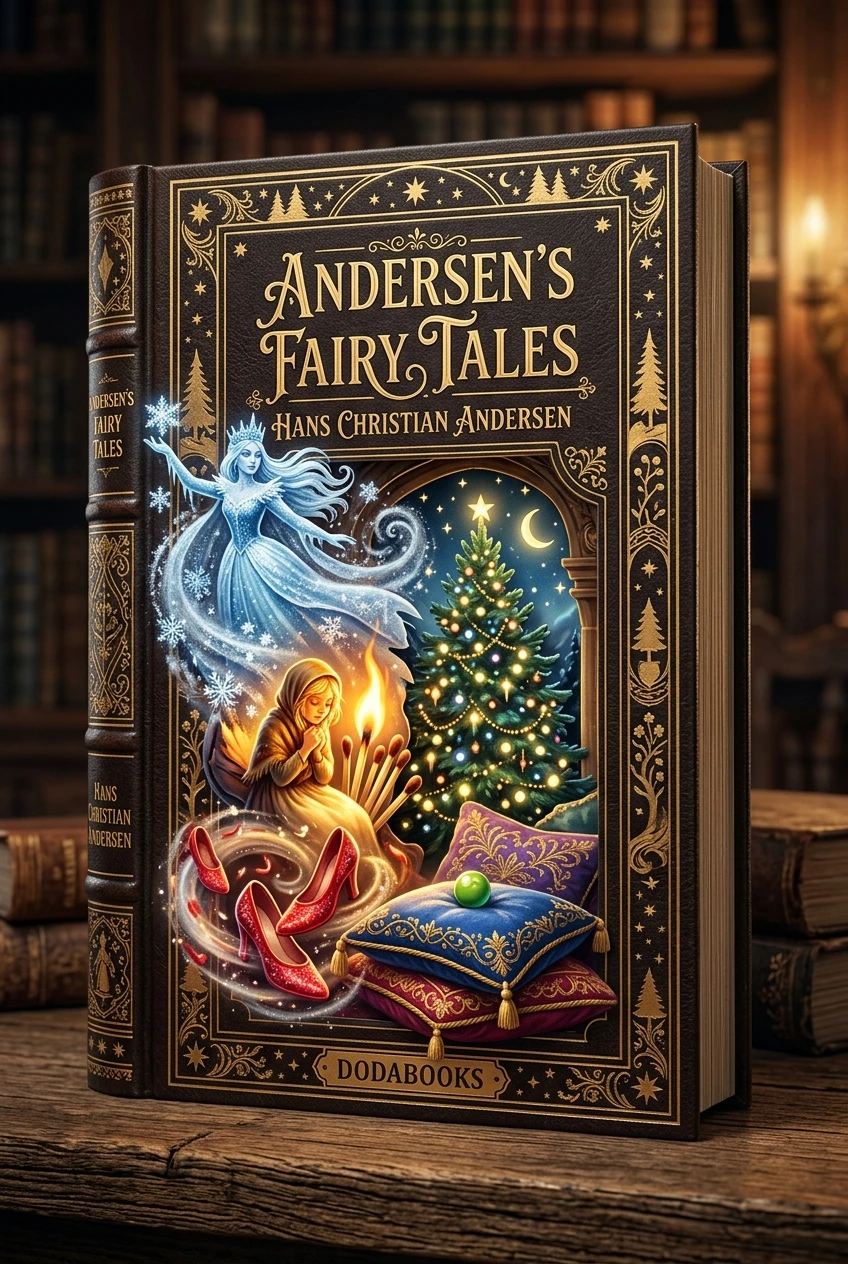
❄️ Experience the True Magic of Andersen’s Vision
Step beyond shallow cartoons and rediscover the wonder, melancholy, and spiritual beauty of the Danish master. The DodaBooks Annotated Edition of Andersen’s Fairy Tales delivers:
- ✅ Complete Unabridged Collection — The classic tales in their authentic, unedited versions
- 📜 Biographical & Cultural Footnotes — Deep insights into Danish folklore and Andersen’s life
- ✒️ Exquisite Typography — Beautiful reading layout with smart quotes and story navigation
- 🔒 100% DRM-Free Ownership — Yours forever across Kindle, Kobo, and iPad
- 📥 Instant Download — Immediate delivery in pristine EPUB format