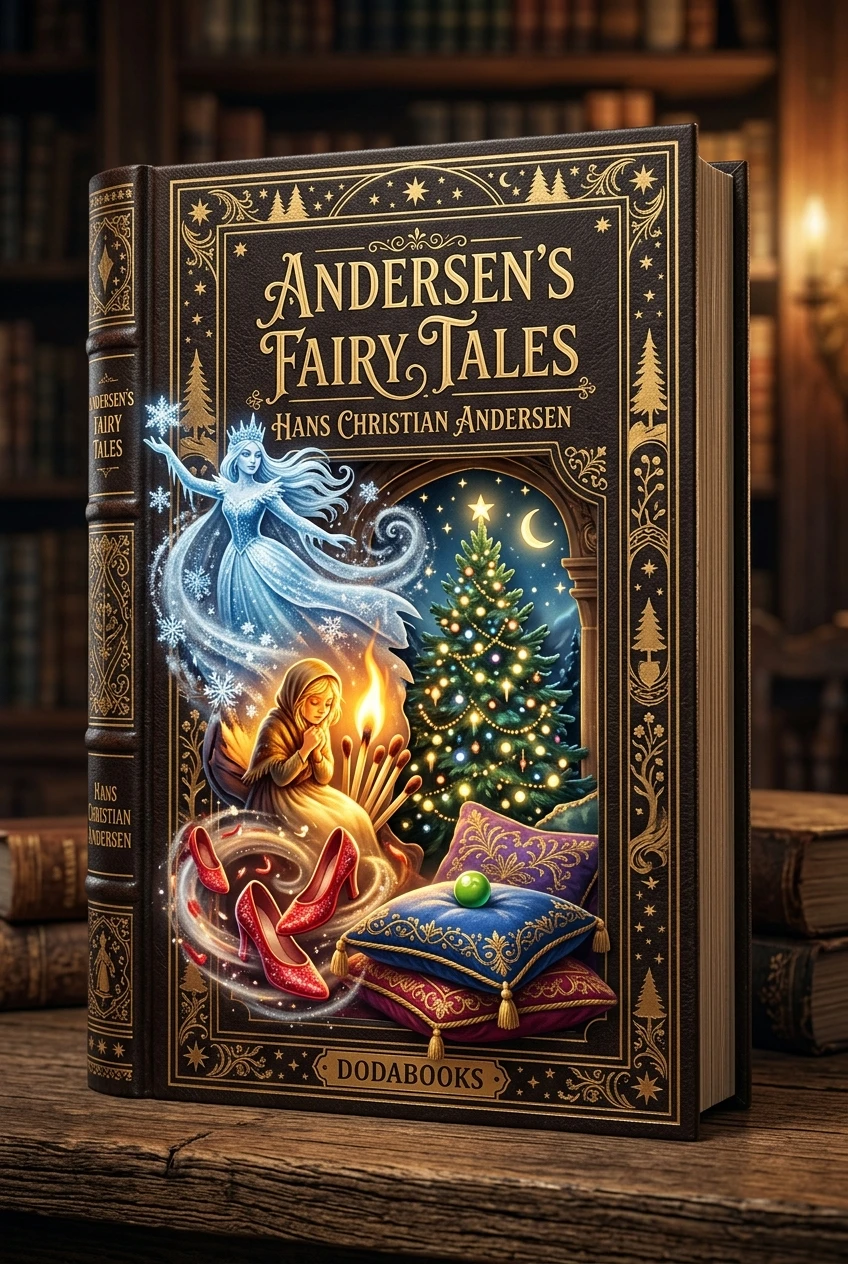
Hans Christian Andersen’s Fairy Tales (Eventyr, 1835–1872) fundamentally revolutionized world children’s literature. Unlike the Brothers Grimm, who collected existing Germanic peasant folklore, Andersen invented the modern literary fairy tale—infusing ancient magical archetypes with poignant psychological realism, biting social satire, autobiographical longing, and transcendent spiritual beauty.
❄️
Andersen's Fairy Tales
The poetic masterpieces of longing, transformation, and wonder. Explore the true, unabridged versions of The Little Mermaid, The Ugly Duckling, The Snow Queen, The Steadfast Tin Soldier, and The Emperor's New Clothes.
| Author | Hans Christian Andersen |
| Published | 1835–1872 (Copenhagen, Denmark) |
| Genre | Literary Fairy Tales, Allegory, Romantic Fantasy |
| Setting | Denmark, magical realms, underwater kingdoms, Lapland |
| Central Themes | Suffering & Spiritual Redemption, Social Hypocrisy, Outsiders & Belonging, Vanity vs. Sincerity |
| Reading Time | 6–8 hours |
| Summary Time | 22 minutes |
🦢 The Cobbler’s Son Who Dreamed of Wings
Hans Christian Andersen (1805–1875) was born in grinding poverty in the provincial town of Odense, Denmark, the son of a sickly shoemaker and an illiterate washerwoman. Awkward, tall, hypersensitive, and possessed of a vivid theatrical imagination, Andersen was relentlessly mocked by local children as a freakish outcast. At the age of fourteen, with only a few coins in his pocket, he traveled alone to Copenhagen with a desperate ambition to become an opera singer or actor.
Though laughed out of the Royal Danish Theatre due to his awkward appearance, Andersen’s unyielding determination attracted the patronage of Jonas Collin, director of the theatre, who secured a scholarship for the impoverished youth at a grammar school in Slagelse. There, the teenage Andersen endured humiliating bullying from a cruel headmaster—an experience that scarred him for life and deepened his lifelong empathy for the mocked and neglected.
When Andersen published his first slim booklet of Fairy Tales Told for Children in May 1835, critics initially warned him that fairy tales were trivial and unsuited for serious literary talent. Yet Andersen realized that the fairy tale was the supreme vehicle for universal human truth: “I seize an idea for grown-ups—and then I tell the story for the little ones while remembering that father and mother are listening, and they must have something to think about too.”
📖 Deconstructing the Flagship Tales
Andersen’s tales are famous for their emotional complexity and refusal to offer cheap Hollywood endings. Among his greatest masterpieces:
1. The Little Mermaid (Den lille Havfrue, 1837)
Far from the sanitized Disney adaptation, Andersen’s original tale is a profound Christian allegory of spiritual longing. The youngest mermaid princess does not sacrifice her voice and fins merely to win a handsome human prince; she yearns for an immortal soul, which merfolk lack (dissolving into sea foam upon death after 300 years).
Every step on her human legs feels like walking upon razor-sharp knives. When the prince marries a neighboring princess, the mermaid’s sisters give her a magic knife to kill the prince and regain her fish tail. Refusing to harm the man she loves, she flings the knife into the waves and throws herself into the sea, where she is received by the “Daughters of the Air,” who promise that through three centuries of good deeds, she will earn an eternal soul.
2. The Ugly Duckling (Den grimme Ælling, 1843)
Andersen’s most transparently autobiographical parable. Hatched in a farmyard duck’s nest, the awkward, grey bird is bitten, pecked, and ridiculed by ducks, chickens, and turkeys alike. Even his mother sighs: “I wish you were far away!” Fleeing across frozen marshes and enduring a brutal winter trapped in ice, the bird matures in secret.
When spring arrives, he approaches three majestic swans, bowing his head in expectation of death, only to see his reflection in the clear water: he is not a clumsy duckling at all, but a radiant white swan. As Andersen famously wrote:
"It does not matter in the least having been born in a duck-yard,
if only you have come out of a swan's egg!"
3. The Snow Queen (Snedronningen, 1844)
Andersen’s longest and most ambitious fairy tale, structured into seven stories. When shards of the devil’s distorted mirror pierce young Kai’s eye and heart, his perception turns cynical and cold. Kidnapped by the majestic, icy Snow Queen and held captive in her palace in Spitsbergen, Kai is frozen in emotional paralysis, trying in vain to spell the word “Eternity” with ice shards.
His loyal childhood friend, Gerda, embarks on an epic solitary journey across northern rivers, witch gardens, prince’s castles, and frozen Lapland tundras. Armed only with innocence, courage, and prayer, Gerda melts Kai’s frozen heart with her tears, restoring his sight and soul.
4. The Emperor’s New Clothes (Kejserens nye Klæder, 1837)
A brilliant satire on social conformity, vanity, and political cowardice. Two swindlers convince an image-obsessed Emperor that they can weave magical garments that are completely invisible to anyone who is stupid or unfit for their office. Ministers, courtiers, and the Emperor himself pretend to admire the nonexistent cloth out of terror of being exposed as incompetent. The collective delusion holds until an innocent child in the crowd shouts the plain truth: “But he has got nothing on!”
5. The Steadfast Tin Soldier (Den standhaftige Tinsoldat, 1838)
The tragic romance between a one-legged tin soldier and a paper ballerina. Despite being swallowed by a fish and thrown into a blazing parlor stove, the soldier remains stoic, gripping his musket and gazing steadfastly at his love until they burn together into a tiny tin heart.
👥 Archetypal Themes & Figures
🦢 THE OUTSIDER (THE UGLY DUCKLING)
The Maligned Genius
“He had been persecuted and despised for his ugliness, and now he heard them say he was the loveliest of all lovely birds.”
The outsider endures systemic abuse not because of any inherent flaw, but because he does not belong to the mundane world of the farmyard.
Why It Matters
Andersen articulated the painful isolation of creative genius and social mobility, creating the universal anthem of hope for outcasts worldwide.
❄️ THE SNOW QUEEN
The Chill of Pure Rationality
“Her eyes were like two bright stars, but there was neither peace nor rest in them.”
The Snow Queen represents sterile, detached intellect devoid of warmth, empathy, and spiritual love. Her palace of ice is a prison of cold logic.
Why She Matters
Andersen warned against the hubris of modern rationalism that divorces the intellect from the compassion of the human heart.
👑 THE EMPEROR
The Vanity of Power
“Am I a fool? Am I not fit to be emperor? That would be the most dreadful thing that could happen to me.”
The Emperor represents institutions and leaders who prioritize public image and sycophancy over reality.
Why He Matters
The tale is the world’s sharpest critique of groupthink, institutional cowardice, and the necessity of speaking truth to power.
📘 Annotated Insight — Andersen’s fairy tales were written in conversational Danish idioms rather than the stiff, formal literary language of the period. He used lively exclamation marks, spoken cadences, and playful parenthetical remarks that brought storytelling back to the warmth of the fireside.
🔍 Major Themes & Critical Analysis
1. The Value of Suffering and Spiritual Trial
In Andersen’s universe, suffering is not meaningless misfortune; it is the essential furnace that purifies the soul. The Little Mermaid, the Steadfast Tin Soldier, and Gerda all achieve spiritual nobility through patient endurance, sacrifice, and loyalty.
2. Sincerity vs. Artificiality
In “The Nightingale” (Nattergalen), the Emperor of China casts aside a living forest nightingale for a bejeweled mechanical bird. But when Death sits upon the Emperor’s chest, the clockwork bird runs down, and only the living bird’s spontaneous song can charm Death away. Andersen champions organic, sincere nature over cold technological imitation.
3. Radical Empathy for Inanimate Objects
Andersen had a genius for giving voices to overlooked, discarded objects: an old street lamp, a darning needle, a broken teapot, and a fir tree. By finding drama in the humblest corners of domestic life, Andersen taught readers that every creature has a story worthy of reverence.
📖 Explore the Annotated Edition at DodaBooks →
✨ What Makes the DodaBooks Annotated Edition Essential
Too many modern editions of Andersen are butchered Disneyfied adaptations that strip away the melancholy, adult wit, and spiritual depth of his originals.
The DodaBooks Annotated Edition restores Andersen’s original genius:
Authoritative Uncut Translations
Complete, unabridged translations preserving Andersen's dark endings, religious depth, and authentic emotional power.
Biographical Parallels
Understand the real events from Andersen's impoverished childhood and unrequited loves reflected in each tale.
Danish Folklore & Cultural Context
Notes on Scandinavian folklore creatures (nisser, trolls, bog witches) and 19th-century Danish society.
Symbolism & Allegory Decoders
Comprehensive footnotes unpacking the Christian allegories and philosophical debates embedded throughout the stories.
100% DRM-Free Freedom
Read across all your devices permanently: Kindle, Kobo, Apple Books, and Android e-readers.
Beautiful Story-by-Story Index
Easily navigate between all of Andersen's most famous tales with an interactive digital table of contents.
❓ Frequently Asked Questions
Does the Little Mermaid die in the original story?
In Andersen's original 1837 text, the mermaid does not marry the prince; he marries a human princess. Refusing to murder the prince to regain her mermaid tail, she throws herself into the ocean. Instead of dissolving into sea foam forever, she is transformed into a spiritual "Daughter of the Air," who can earn an eternal soul through three hundred years of selfless deeds.
Are Andersen's fairy tales suitable for children?
Yes, children love them for their wonder, magic, and talking animals. However, Andersen wrote his tales with dual levels of meaning: simple fantasy for children, and profound psychological, spiritual, and social satire for adults.
What inspired "The Emperor's New Clothes"?
Andersen based the tale on a medieval Spanish story from Don Juan Manuel's Tales of Count Lucanor (1335). However, Andersen added the iconic, revolutionary ending where an innocent child speaks the truth, exposing the collective folly of the adult court.
How did Andersen's own life inspire "The Ugly Duckling"?
Andersen explicitly confirmed that "The Ugly Duckling" was his own autobiography. Born poor, awkward, and widely ridiculed in Odense, he was eventually received with royal honors by the kings and queens of Europe, proving that an awkward duckling can emerge as a triumphant swan.
Why should I purchase the DodaBooks edition?
Cheap digital copies online frequently rely on censored Victorian translations that erased Andersen's dark themes or cut stories down to five-paragraph summaries. DodaBooks provides the complete, unabridged collection with rich cultural and biographical annotations, restoring the full poetic majesty of Andersen's original vision.
❄️ Experience the True Magic of Andersen’s Vision
Step beyond shallow cartoons and rediscover the wonder, melancholy, and spiritual beauty of the Danish master. The DodaBooks Annotated Edition of Andersen’s Fairy Tales delivers:
- ✅ Complete Unabridged Collection — The classic tales in their authentic, unedited versions
- 📜 Biographical & Cultural Footnotes — Deep insights into Danish folklore and Andersen’s life
- ✒️ Exquisite Typography — Beautiful reading layout with smart quotes and story navigation
- 🔒 100% DRM-Free Ownership — Yours forever across Kindle, Kobo, and iPad
- 📥 Instant Download — Immediate delivery in pristine EPUB format
For modern young readers seeking gentle, calming illustrated sleep stories with 3D dioramas, discover The Magical 3D Bedtime Treasury Guide.