Andersen's Fairy Tales Characters & Themes: The Definitive Guide
Hans Christian Andersen’s Fairy Tales (Eventyr) occupy a unique pinnacle in world literature because they transcend simple folkloric morality. While traditional folktales feature interchangeable types—the brave prince, the wicked witch, the passive princess—Andersen created vivid, psychologically vulnerable characters whose inner lives reflect the profound anxieties, longings, and contradictions of the nineteenth-century human condition.
Across tales as diverse as The Little Mermaid, The Snow Queen, The Ugly Duckling, and The Steadfast Tin Soldier, Andersen explored timeless universal themes: the agony of the social outsider, the spiritual yearning for immortality, the vanity of institutional power, and the triumph of childlike innocence over cold, cynical intellect. Furthermore, because Andersen poured his own personal suffering—poverty, awkwardness, social rejection, and unrequited love—directly into his art, his characters carry an emotional resonance that continues to captivate readers nearly two centuries later.
This comprehensive guide analyzes the primary archetypes, character dynamics, and enduring philosophical themes that define Andersen’s magical universe.
| Archetypal Figure | Exemplary Characters | Defining Psychological Conflict | Core Symbolic Meaning |
|---|---|---|---|
| The Holy Outcast / Pariah | The Little Mermaid, The Ugly Duckling, The Little Match Girl | Physical alienation; suffering mockery; enduring martyrdom | The nobility of inner virtue unrecognized by a shallow world |
| The Innocent Truth-Teller | Gerda (The Snow Queen), The Child (Emperor’s New Clothes) | Pure, uncorrupted love; fearless simplicity | Spiritual faith and direct perception that dissolve falsehood |
| The Cynical Intellectual / Tyrant | The Snow Queen, The Troll (The Mirror), The Cat & Hen | Sterile logic; cold analytical perfection; contempt for emotion | The spiritual death that occurs when intellect severs from love |
| The Vain Institutional Authority | The Emperor, Court Chamberlains, The Turkey-Cock | Terror of appearing incompetent; obsession with etiquette | The hollow hypocrisy and conformity of bourgeois society |
| The Stoic Silent Devotee | The Steadfast Tin Soldier | Unflinching loyalty; passive acceptance of cruel fate | Tragic fidelity in an indifferent, chaotic universe |
🦢 Archetype 1: The Pariah and the Transcendent Outsider
The Wound of Otherness
The quintessential Andersen protagonist is an outsider: a creature who is fundamentally misaligned with their surrounding society. Unlike fairy tales where the hero’s low status is a temporary disguise (like Cinderella in her cinders), Andersen’s pariahs suffer deep, agonizing physical and emotional alienation:
- The Little Mermaid: Possesses a soul that belongs neither to the ocean nor to the land. She lives between worlds, mutely suffering the agony of knives piercing her feet while watching the man she saved marry someone else.
- The Ugly Duckling: Is brutally mocked, bitten, and kicked by ducks, hens, turkeys, and humans alike simply because his physical appearance does not conform to barnyard standards.
- The Little Match Girl: Freezes to death in a dark alley on New Year’s Eve, surrounded by wealthy townspeople who ignore her silent agony.
Suffering as the Crucible of Spirit
In Andersen’s worldview, suffering is not a random punishment; it is a sacred crucible that purifies the soul. Andersen rejects the facile happy endings of commercial romance. The Little Mermaid does not get the prince, the Little Match Girl does not get rescued by a wealthy benefactor, and the Steadfast Tin Soldier is melted into a lump of metal.
Yet in each case, physical tragedy is elevated into spiritual transfiguration:
- The mermaid’s refusal to murder the prince elevates her to the Daughters of the Air, earning the chance to forge an eternal soul.
- The duckling’s endurance through winter ice leads to his emergence as a glorious swan.
- The match girl’s frozen death is revealed as an ecstatic ascension into the radiant presence of God.
Andersen teaches that the world’s outcasts are often the holy vessels of divine grace precisely because their earthly suffering detaches them from vanity.
❄️ Archetype 2: Faith and Innocence vs. Cold Rationalism
The Mirror of the Devil
One of Andersen’s most profound philosophical allegories appears in The Snow Queen. The devil’s looking-glass, which shatters into millions of microscopic splinters, represents cynical, hyper-rational reductionism. When a splinter enters Kai’s eye, he can see only the flaws in human beings; when it enters his heart, his heart freezes into a lump of ice.
Kai becomes obsessed with cold geometry: he admires snow crystals because they have no organic flaws, and in the Snow Queen’s palace, he sits on the frozen “Mirror of Reason,” frantically trying to assemble the word “Eternity” through pure logic. Andersen illustrates that reason without love is a frozen tomb.
Gerda’s Disarming Simplicity
Gerda represents the counter-force to Kai’s frozen intellect: the power of innocent, uncalculating love. When the Lapland reindeer begs the wise Finn woman to grant Gerda the magical power of twelve men to defeat the Snow Queen, the Finn woman delivers one of the most famous lines in Scandinavian literature:
“I cannot give her any greater power than she already possesses! Do you not see how men and beasts must serve her, and how she has walked through the world on bare feet? Her power resides in her heart, because she is a sweet, innocent child.”
Gerda conquers the Arctic waste not with weapons or magical spells, but with bare feet, hot tears, and a simple childhood hymn. Her tears melt Kai’s frozen heart, proving Andersen’s Christian Romantic thesis: childlike faith and sacrificial love can accomplish what human intellectualism can never achieve.
👑 Archetype 3: The Satire of Institutional Vanity
The Emperor and the Architecture of Social Cowardice
While Andersen is revered for his spiritual pathos, he was also one of nineteenth-century Europe’s most lethal satirists. In The Emperor’s New Clothes, Andersen deconstructs the psychological mechanism of social conformity.
The swindlers succeed not because they are master magicians, but because they exploit the universal human terror of social disapproval:
- The Bureaucratic Lie: The Prime Minister and the court chamberlains would rather lie about seeing invisible cloth than admit they see nothing and risk being labeled stupid or unfit for office.
- The Collective Delusion: The entire populace joins in the lie because each citizen assumes that everyone else must be seeing the magnificent garments.
- The Child’s Voice: It requires an innocent child—someone who has not yet been conditioned by social etiquette, career anxiety, or adult vanity—to state the blindingly obvious truth: “He has nothing on!”
Andersen shows that societal institutions often operate on shared hypocrisies that can be dismantled in an instant by a single voice of unvarnished truth.
🪞 The Autobiographical Mirror: Andersen’s Life in His Art
To fully understand Andersen’s characters, one must understand the man who created them. Hans Christian Andersen was a deeply complex, neurotic, hypersensitive artist who never felt at home in the world:
[ ANDERSEN'S PERSONAL LIFE ]              [ REFLECTED IN HIS FAIRY TALES ]
Grinding Odense Poverty ──────────────► The Little Match Girl's freezing alley
Awkwardness & Social Mockery ─────────► The Ugly Duckling pecked by barnyard fowl
Unrequited Love for Jenny Lind ───────► The Nightingale & The Little Mermaid
Unrequited Longing for Edvard Collin ─► The Mermaid's silent, unreturned sacrifice
Social Acceptance by European Kings ──► The Ugly Duckling's transfiguration into a Swan- The Ugly Duckling as Memoir: Andersen explicitly stated that The Ugly Duckling was his autobiography. The son of an impoverished shoemaker and an illiterate washerwoman, Andersen was ridiculed throughout his youth for his gangly height, high voice, and theatrical pretensions. His eventual triumph—being celebrated across the royal courts of Europe—mirrored the duckling’s ascent among the swans.
- The Little Mermaid and Forbidden Love: Biographers widely recognize that The Little Mermaid was written shortly after the marriage of Edvard Collin, the wealthy son of Andersen’s patron, with whom Andersen was deeply in love. When Edvard married a woman, Andersen felt discarded and mute—exactly like the little mermaid who surrendered her voice and stood by as her beloved prince married another.
- The Nightingale and Jenny Lind: The Swedish opera superstar Jenny Lind (the “Swedish Nightingale”) was the love of Andersen’s later life. Though she admired his talent, she gently rejected his romantic advances, viewing him only as a brother. In The Nightingale, Andersen celebrated the wild, uncapturable purity of natural song over the mechanical contrivances of the court.
📊 Major Themes Matrix
| Central Theme | Foundational Tales | Narrative Expression | Moral & Philosophical Insight |
|---|---|---|---|
| Sacrificial Love & Immortality | The Little Mermaid, The Steadfast Tin Soldier | Protagonists endure physical agony and death without seeking vengeance | True love seeks the spiritual welfare of the beloved above self-preservation |
| Spiritual Faith vs. Frozen Reason | The Snow Queen, The Red Shoes | The contrast between the cold Snow Queen / devil’s glass and Gerda’s hymns | Intellectual cleverness without heart freezes the soul into emotional death |
| Social Conformity & Vanity | The Emperor’s New Clothes, The Swineherd | Courtiers praising invisible fabric; princesses preferring mechanical toys | High society values superficial status over genuine beauty and truth |
| Transformation Through Endurance | The Ugly Duckling, The Wild Swans | Silent suffering through harsh winters; weaving stinging nettles | Noble identity is forged and revealed through patience and trial |
| Celestial Grace for the Neglected | The Little Match Girl, The Angel | Destitute, neglected children dying unnoticed on freezing streets | Earthly misery is fleeting; divine grace welcomes the innocent into eternal light |
For a full story-by-story narrative summary of each tale, read our Andersen’s Fairy Tales Summary Guide.
❓ Frequently Asked Questions
Why are Andersen's fairy tales so much sadder than other fairy tales?
Unlike traditional folktales that prioritize wish-fulfillment (a peasant becoming king), Andersen was a Christian Romantic poet writing during the aftermath of European social revolutions. He believed that life on Earth was inherently full of suffering, longing, and imperfection, and that true fulfillment was spiritual rather than material. His sadness is balanced by an intense belief in divine mercy and eternal beauty.
Did Hans Christian Andersen ever marry?
No. Andersen remained unmarried throughout his entire life. He experienced a series of intense, unrequited infatuations with both women (notably singer Jenny Lind and Riborg Voigt) and men (notably Edvard Collin). His inability to achieve romantic intimacy profoundly informed his depictions of isolated, yearning characters like the Little Mermaid and the Steadfast Tin Soldier.
What does the Tin Soldier's steadfastness symbolize?
The soldier's steadfastness symbolizes stoic duty, unyielding devotion, and moral dignity in the face of random cruelty. The soldier never cries, never complains, and never drops his musket, even when falling from a window, sailing down a sewer, or burning in a furnace. His devotion to the paper ballerina remains pure until both are consumed by fire.
How do Andersen's tales differ from the Brothers Grimm?
The Brothers Grimm were folklorists and linguists who recorded and edited existing traditional Germanic peasant tales, preserving their oral, communal structures. Andersen was a creative novelist and poet who invented original literary stories, filling them with personal psychology, social satire, and lyrical descriptions of nature.
Which edition provides the best character and thematic annotations?
We recommend the DodaBooks Annotated Edition, which pairs the complete unabridged text with extensive biographical notes, Danish cultural context, and critical analysis of Andersen's enduring themes.
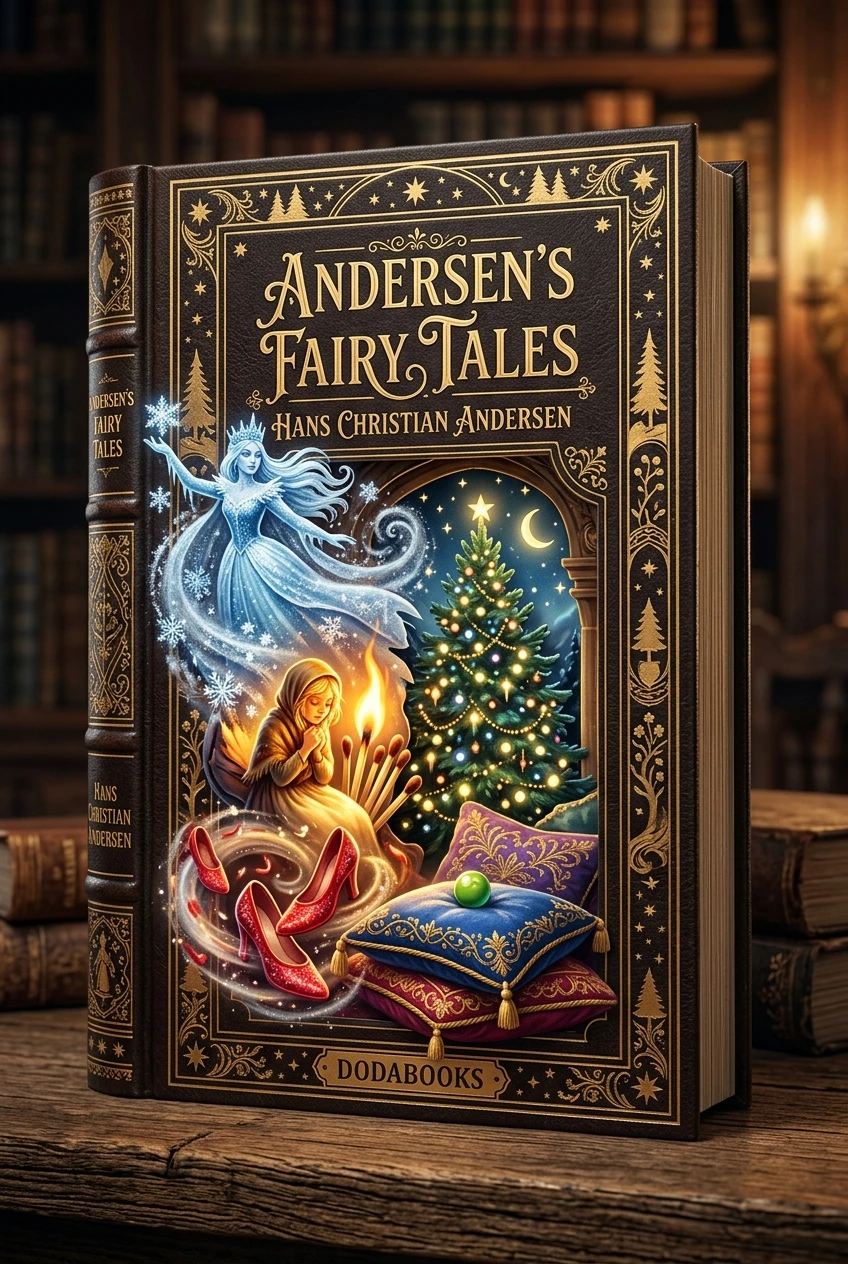
❄️ Unlock the Depth of Andersen’s Classic Tales
Explore the full emotional and spiritual resonance of the Danish master. The DodaBooks Annotated Edition of Andersen’s Fairy Tales delivers:
- ✅ Complete Unabridged Collection — Every major tale restored in its authentic narrative form
- 📜 Biographical & Thematic Notes — Unpacking Andersen’s personal relationships, Odense childhood, and Christian philosophy
- ✒️ Exquisite E-Reader Typography — Hand-crafted reading layout designed for literary enjoyment
- 🔒 100% DRM-Free Ownership — Keep your EPUB forever on Kindle, Kobo, or Apple Books
- 📥 Instant Download — Immediate delivery upon purchase