Anarchism and Other Essays: Emma Goldman’s Fire of Freedom
Denounced by J. Edgar Hoover as 'the most dangerous woman in America,' Emma Goldman synthesized anarchist philosophy, radical anti-militarism, and trailblazing feminist liberation into an immortal 1910 collection that continues to electrify world thought.
Few political thinkers in modern history have ignited as much fervent devotion, venomous state persecution, and intellectual debate as Emma Goldman (1869–1940). An immigrant from the Russian Empire who labored in Rochester sweatshops, survived imprisonment on Blackwell’s Island, and co-edited the revolutionary journal Mother Earth, Goldman was an orator of volcanic power and a theoretician of extraordinary clarity. Published in 1910 by Mother Earth Publishing Association, Anarchism and Other Essays represents the definitive distillation of her political philosophy.
Rather than presenting dry, academic blueprints for an abstract utopia, Goldman confronted the brutal realities of early twentieth-century American industrial capitalism: the violent suppression of strikes, the hypocrisy of puritanical sex laws, the prison-industrial pipeline, and the patriotic propaganda herding young workers into imperialist wars. Readers exploring our curated philosophy and classic literature collection will discover in Goldman’s essays an enduring critique of illegitimate authority and an impassioned defense of human dignity.
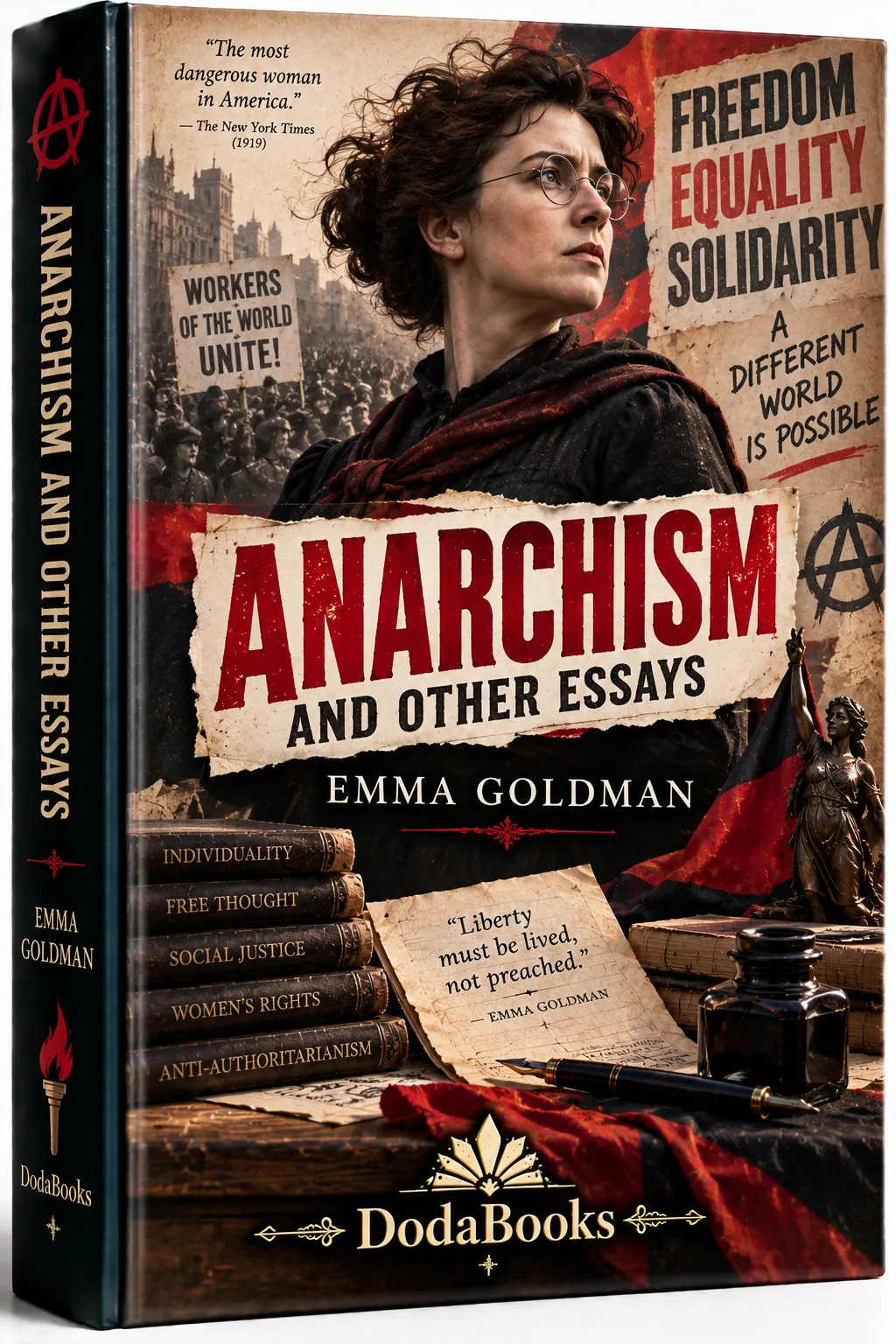
Read the Definitive Annotated Edition
Immerse yourself in Emma Goldman's revolutionary essays with extensive historical commentary on the Haymarket Affair, Progressive Era radical movements, and feminist history.
Get the Annotated eBookThe Core Manifesto: What Anarchism Really Stands For
The collection opens with Goldman’s landmark theoretical essay, “Anarchism: What It Really Stands For.” Addressing a public conditioned by sensational yellow journalism to view the anarchist as a bomb-throwing lunatic, Goldman begins by dismantling popular caricatures.
She defines Anarchism as “the philosophy of a new social order based on liberty unrestricted by man-made law; the theory that all forms of government rest on violence, and are therefore wrong and harmful, as well as unnecessary.” She identifies the three great institutional tyrannies that hold humanity in bondage:
                    THE THREE PILLARS OF HUMAN SUBJUGATION

         RELIGION (Spiritual)             PROPERTY (Economic)              THE STATE (Political)
     ┌───────────────────────────┐    ┌───────────────────────────┐    ┌───────────────────────────┐
     │ Dominates the human mind  │    │ Dominates physical needs  │    │ Dominates conduct & soul  │
     │ Enforces divine obedience │    │ Starves labor & hoards    │    │ Wields monopoly on violence│
     │ Promises reward in heaven │    │ Enforces class hierarchy  │    │ Demands sacrifice in war  │
     └─────────────┬─────────────┘    └─────────────┬─────────────┘    └─────────────┬─────────────┘
                   │                                │                                │
                   └────────────────────────────────┼────────────────────────────────┘
                                                    ▼
                                    EMMA GOLDMAN'S ANARCHIST LIBERTY:
                                   Voluntary Cooperation, Direct Action,
                                      & Total Autonomy of the Individual
To Goldman, genuine freedom cannot be granted through legislative decrees, parliamentary ballots, or judicial dispensations. True emancipation can only be seized through Direct Action—the conscious, collective refusal of individuals to cooperate with their exploiters.
Pioneering Radical Feminism: Marriage, Suffrage, and Love
Among the most revolutionary contributions of Anarchism and Other Essays are Goldman’s essays on women’s liberation, composed decades ahead of second-wave feminist theory:
1. “Marriage and Love”
In this celebrated and scandalous essay, Goldman delivers a devastating takedown of the institution of marriage under patriarchy. She asserts that marriage and love are frequently absolute opposites:
“Marriage is primarily an economic arrangement, an insurance pact… It pays for the woman’s name, her privacy, her health, her very life, until death do them part.”
Goldman argues that bourgeois society reduces woman to a parasitic dependent, selling her body and emotional labor for room and board. In contrast, she champions Free Love—the voluntary, spontaneous union of two sovereign spirits based solely on mutual affection, independent of state registries or ecclesiastical sanction.
2. “The Tragedy of Woman’s Emancipation”
Goldman took controversial issue with mainstream, middle-class suffrage movements. She argued that winning the right to vote would not liberate women if they simply traded domestic subservience for the competitive ruthlessness of capitalist offices while adopting male prejudices. True emancipation, she insisted, must begin from within: the woman’s courageous reclamation of her body, her erotic desires, and her intellectual autonomy.
                      GOLDMAN'S DUAL FEMINIST CRITIQUE

          Superficial Reformism (Suffrage)       Radical Anarchist Feminism
     ┌───────────────────────────────────┐   ┌───────────────────────────────────┐
     │ Begs the State for voting rights  │   │ Rejects the legitimacy of State   │
     │ Leaves capitalist wages untouched │   │ Demands total bodily autonomy     │
     │ Accepts patriarchal marriage laws │   │ Dissolves marriage as property pact│
     └───────────────────────────────────┘   └───────────────────────────────────┘
                       ▲                                       ▲
                       └───────────────────┬───────────────────┘
                                           ▼
                                 Authentic Emancipation:
                               Internal Sovereignty & Love
The War Machine and the Prison Complex
3. “Patriotism: A Menace to Liberty”
Writing on the eve of the First World War, Goldman deconstructed the psychological engineering of modern nationalism. Patriotism, she declared, is an artificial idol created by ruling elites to trick workers into slaughtering their brothers across national borders to secure corporate profits. While contemporary statesmen like Franklin K. Lane wrestled with wartime mobilization from within the cabinet room, Goldman exposed the blood price paid by working-class families on the home front.
4. “Prisons: A Social Crime and Failure”
Drawing upon her own personal incarceration on Blackwell’s Island, Goldman authored a searing sociological exposé of the penal system. She demonstrated that prisons do not reform criminals; they manufacture and institutionalize them. Pointing out that property crime is the direct byproduct of poverty and capitalist exploitation, Goldman called for the abolition of punitive incarceration in favor of mutual aid and restorative community support. In this regard, her insights directly parallel the underworld realities dramatized in Leroy Scott’s Children of the Whirlwind, where ex-convicts are systematically hounded back into crime by police harassment.
Major Essays in the Collection
To navigate this landmark volume, readers should explore its rich diversity of topics:
- “The Psychology of Political Violence”: A courageous, psychologically acute analysis of why individuals commit acts of political assassination, tracing their motives not to bloodlust, but to intolerable empathy for the suffering of the impoverished masses.
- “Minorities Versus Majorities”: A stinging philosophical assault on majoritarian conformity, arguing that all intellectual and social progress in human history has been initiated by courageous, nonconformist minorities.
- “The Traffic in Women”: An uncompromising investigation into sex trafficking and prostitution, exposing economic desperation and puritanical hypocrisy as the true causes.
- “The Modern Drama: A Powerful Disseminator of Radical Thought”: An examination of playwrights like Henrik Ibsen, Gerhart Hauptmann, and George Bernard Shaw, showing how the theater functions as a cultural dynamite against social illusions.
Comparative Philosophical Context
To place Emma Goldman’s radical thought in conversation with other nineteenth- and twentieth-century literary and political texts, consider these contrasts:
| Work & Author | Field & Milieu | Philosophy | Central Focus |
|---|---|---|---|
| Anarchism and Other Essays (Emma Goldman) | Revolutionary Theory (1910) | Anarcho-communism, feminist autonomy | Dissolution of state, capitalism, and marriage |
| Confessions of an English Opium-Eater (Thomas De Quincey) | Romantic Autobiography (1821) | Psychological introspection, Romanticism | The ecstatic and nightmarish terrain of addiction |
| The Letters of Franklin K. Lane (Franklin K. Lane) | Progressive Statesmanship (1922) | Democratic liberalism, conservation | Federal administration and civic reform |
| Children of the Whirlwind (Leroy Scott) | Jazz Age Crime Fiction (1921) | Social realism, underworld morality | Ex-convict redemption and police corruption |
While Progressive Era administrators like Franklin K. Lane believed that federal bureaucracy and democratic state institutions could be reformed to serve the public good, Emma Goldman insisted that the State is inherently an instrument of class coercion that must be abolished. Furthermore, where Romantic memoirists like Thomas De Quincey in Confessions of an English Opium-Eater explored private psychological suffering, Goldman directed her fierce gaze outward onto the collective suffering of the laboring masses.
Read Emma Goldman's Revolutionary Masterwork
Experience Anarchism and Other Essays in this definitive annotated edition, featuring extensive historical notes on labor struggles, anarcho-syndicalism, and free speech battles.
Read The Annotated EditionWhy Emma Goldman Matters Today
More than a century after its initial publication, Anarchism and Other Essays remains startlingly relevant. In our contemporary world of expanding state surveillance, persistent gender wage gaps, mass incarceration debates, and imperial foreign wars, Goldman’s fiery arguments resonate with prophetic power.
Goldman wrote with passion, fierce wit, and uncompromising moral conviction. She refused to dilute her principles to flatter respectable bourgeois society. For anyone who questions unjust authority, believes in the boundless creative potential of human freedom, and dreams of a society organized around solidarity rather than profit, Emma Goldman’s essays remain an essential, burning torch.
Frequently Asked Questions
Who was Emma Goldman and why was she deported from the United States?
Emma Goldman (1869–1940) was a Russian-born anarchist philosopher, writer, and orator who emigrated to the United States in 1885. She became a towering leader in the anarchist, labor, and free speech movements. In 1919, during the post-WWI Palmer Raids, she was stripped of her citizenship and deported to Soviet Russia alongside 248 other radicals under the Anarchist Exclusion Act, largely due to her fierce opposition to the military draft.
What was Goldman's relationship to feminism and the women's suffrage movement?
Goldman was a radical feminist pioneer who advocated for reproductive freedom, birth control, and economic independence decades before the modern feminist movement. However, she was critical of mainstream suffragists, arguing that the right to vote within a capitalist oligarchy was an illusion that would not free women from patriarchal exploitation or economic servitude.
Did Emma Goldman advocate for violent political terrorism?
While in her youth Goldman supported revolutionary 'propaganda by the deed' (most notably the 1892 assassination attempt on steel magnate Henry Clay Frick by her partner Alexander Berkman), in 'Anarchism and Other Essays' she analyzed political violence as a tragic symptom of extreme state oppression rather than an end in itself, focusing primarily on educational agitation, general strikes, and collective non-cooperation.
What is the difference between Anarchism and Socialism according to Goldman?
While sharing socialism's critique of private property and capitalist exploitation, Goldman fiercely rejected state socialism and Marxist central planning. She argued that creating a powerful socialist state bureaucracy would simply replace private capitalist bosses with government commissars, whereas Anarchism seeks the total abolition of all centralized state authority in favor of voluntary federation.
What features are included in the DodaBooks annotated edition?
The DodaBooks annotated edition includes comprehensive historical notes detailing Progressive Era labor strikes, biographical glossaries of contemporary anarchist and socialist figures (including Peter Kropotkin, Mikhail Bakunin, and Johann Most), contextual essays on the birth control movement, and an introductory analysis of Goldman's philosophical legacy. You can explore and download the definitive annotated edition directly from DodaBooks at https://dodabooks.com/ebook/anarchism-and-other-essays-by-emma-goldman/.
Related Classic Political and Philosophical Studies
Discover further masterworks of political philosophy, historical memoir, and classic literature: