Alice's Adventures in Wonderland Summary by Chapter: Complete Plot Breakdown
When Charles Lutwidge Dodgson—writing under the immortal pseudonym Lewis Carroll—first published Alice’s Adventures in Wonderland in November 1865, he revolutionized the entire landscape of children’s fiction. Before Alice plummeted down the rabbit-hole, Victorian children’s books were predominantly severe, didactic sermonettes engineered to frighten youngsters into moral obedience, pious humility, and unquestioning deference to adult authority.
Carroll discarded moralistic finger-wagging entirely. Instead, he constructed an astonishing linguistic kaleidoscope of mathematical logic puzzles, philosophical wordplay, subversive parodies of popular Victorian schoolroom hymns, and razor-sharp parodies of British institutions. From the absurd bureaucratic inertia of the Caucus-Race to the deranged legal proceedings of the Knave of Hearts’ trial, Alice’s Adventures in Wonderland remains one of the most layered and endlessly scrutinized masterworks in English literature.
Whether you are preparing for a university literature seminar, assisting a young reader, or returning to Wonderland with adult eyes, this definitive chapter-by-chapter summary and critical breakdown maps the narrative arc, hidden satirical targets, and thematic milestones across all twelve chapters.
⚡ Alice's Adventures in Wonderland: Story Overview
- Author: Lewis Carroll (Charles Lutwidge Dodgson, 1832–1898)
- Publication Date: November 1865 (Macmillan and Co., London)
- Structure: 12 episodic chapters following Alice's dream journey through an underground realm governed by irrational adult conventions
- Major Motifs: Physical growth and shrinking (existential identity crises), linguistic subversion and literalized idioms, authoritarian absurdity, parodies of Victorian didactic poetry, and mathematical paradoxes
- Central Climax: The trial of the Knave of Hearts in Chapter 12, where Alice outgrows the arbitrary authority of the courtroom and rejects the playing-card court as "nothing but a pack of cards!"
🐇 Complete Chapter-by-Chapter Plot Breakdown
+-------------------------------------------------------------------------------+
|                 ALICE'S ADVENTURES IN WONDERLAND: 12-CHAPTER MAP              |
+-----+-------------------------------+-----------------------------------------+
| CH. | TITLE                         | KEY EVENTS & LITERARY SATIRE            |
+-----+-------------------------------+-----------------------------------------+
| 1   | Down the Rabbit-Hole          | Following White Rabbit, Drink Me potion |
+-----+-------------------------------+-----------------------------------------+
| 2   | The Pool of Tears             | Eat Me cake, giant Alice, tear flood    |
+-----+-------------------------------+-----------------------------------------+
| 3   | A Caucus-Race & a Long Tale   | Mouse's tale, circular political race   |
+-----+-------------------------------+-----------------------------------------+
| 4   | The Rabbit Sends in a Little  | Trapped in Rabbit's house, Bill the Liz |
+-----+-------------------------------+-----------------------------------------+
| 5   | Advice from a Caterpillar     | Hookah smoker, "Who are you?", Father W |
+-----+-------------------------------+-----------------------------------------+
| 6   | Pig and Pepper                | Duchess, pepper soup, baby turns to pig |
+-----+-------------------------------+-----------------------------------------+
| 7   | A Mad Tea-Party               | Hatter, Hare, Dormouse, frozen Time     |
+-----+-------------------------------+-----------------------------------------+
| 8   | The Queen's Croquet-Ground    | Painting roses, flamingoes & hedgehogs  |
+-----+-------------------------------+-----------------------------------------+
| 9   | The Mock Turtle's Story       | Gryphon, Sea-School curriculum parody   |
+-----+-------------------------------+-----------------------------------------+
| 10  | The Lobster Quadrille         | Whimsical dance, "'Tis the voice of the |
+-----+-------------------------------+-----------------------------------------+
| 11  | Who Stole the Tarts?          | Trial begins, Hatter's incoherent test  |
+-----+-------------------------------+-----------------------------------------+
| 12  | Alice's Evidence              | Rule 42, card collapse, waking on bank  |
+-----+-------------------------------+-----------------------------------------+
Chapter 1: Down the Rabbit-Hole
The story opens on a drowsy summer afternoon beside a grassy riverbank. Seven-year-old Alice sits beside her older sister, growing intensely bored with her sister’s book because it contains “no pictures or conversations”—which Alice establishes as the foundational requirement for any book worthy of existence.
Suddenly, a White Rabbit with striking pink eyes rushes past, muttering aloud: “Oh dear! Oh dear! I shall be too late!” What shocks Alice into action is not merely the rabbit’s anthropomorphic speech, but that it reaches into its waistcoat pocket to consult an actual pocket-watch before dashing into a large subterranean burrow beneath a hedge. Burning with curiosity, Alice immediately plunges into the dark hole after it.
Rather than falling at terrifying, bone-breaking velocity, Alice drifts downward slowly through an immense vertical shaft lined with cupboards, bookshelves, maps, and hanging pictures. During this prolonged descent, Carroll cleverly establishes Alice’s polite, middle-class Victorian schoolroom education. She recites geography and physics lessons half-remembered from class—speculating whether she might plummet entirely through the Earth to the “Antipathies” (Antipodes) where people walk upside down.
Landing gently on a heap of dry leaves, Alice spots the White Rabbit disappearing down a corridor. She finds herself in a low hall illuminated by a row of hanging lamps, lined with closed doors of every size. Searching for an exit, she discovers a three-legged table made of solid glass, upon which sits a tiny golden key. The key fits none of the large doors, but unlocks a tiny fifteen-inch passage leading to a magnificent sunlit garden filled with vibrant flowerbeds and cool fountains.
Unable to squeeze her head through the tiny doorway, Alice returns to the glass table and discovers a little bottle labeled “DRINK ME” in paper lettering. Mindful of nursery warnings about poison and red-hot pokers, Alice checks that the bottle is not marked “poison” and sips the liquid, finding it tastes delightfully of cherry-tart, custard, pineapple, roast turkey, toffee, and hot buttered toast. She immediately shrinks down to a mere ten inches tall.
However, in her excitement, Alice realizes she left the golden key on the tabletop far above her reach. Unable to climb the slippery glass legs, she sits down and weeps. Underneath the table, she notices a small glass box containing a tiny cake decorated with the words “EAT ME” in currants. Hoping it will either make her grow larger so she can reach the key, or smaller so she can creep beneath the door, Alice takes a bite.
Chapter 2: The Pool of Tears
“Curiouser and curiouser!” cries Alice, her grasp on proper English syntax slipping as her body expands like an immense opening telescope. Within moments, she shoots upward until her head hits the high roof of the hall, reaching an astonishing height of nine feet.
Now able to retrieve the golden key from the table, Alice is once again frustrated: she is vastly too gigantic to fit through the garden door. Trapped between incompatible bodily dimensions and unreachable desires, Alice breaks down into a torrent of massive tears, weeping gallons until a four-inch-deep pool collects across the floor of the great hall.
The White Rabbit reappears, dressed in splendid attire, carrying a pair of white kid gloves and a large fan. When Alice timidly calls out to him for guidance, the startled Rabbit drops his fan and gloves and bolts into the darkness. Picking up the fan, Alice begins fanning herself, only to discover that the motion is causing her to shrink rapidly once more. Dropping the fan just in time to avoid shrinking out of existence entirely, she slips and plunges up to her chin in saltwater.
Initially assuming she has fallen into the sea, Alice soon recognizes the bitter truth: she is swimming in the colossal pool of her own shed tears. While paddling through the brine, she encounters a Mouse that has likewise fallen into the pool. Alice attempts to converse with the creature, first in English and then in high school French (“Où est ma chatte?”), which terrifies the Mouse, as she innocently speaks of her beloved cat Dinah and a neighborhood terrier that kills rats. Eventually, a diverse assembly of birds and animals—including a Duck, a Dodo, a Lory, and an Eaglet—falls into the salt pool, and Alice leads the dripping procession ashore.
Chapter 3: A Caucus-Race and a Long Tale
Stranded on the bank, the sodden congregation seeks a method to dry their feathers and fur. The Mouse steps forward as an authority figure, attempting to dry the company by reciting the “driest thing” he knows: an extraordinarily dull, pedantic monologue on the conquest of England by William the Conqueror and the submission of Archbishop Stigand. When this tedious historical recitation leaves the party just as shivering and wet as before, the Dodo—a satirical caricature of Lewis Carroll himself, who had a pronounced stutter that caused him to pronounce his surname “Do-Do-Dodgson”—proposes an alternative: a Caucus-Race.
The Caucus-Race is Carroll’s devastating, immortal satire of parliamentary politics and party bureaucracy:
- The racecourse is marked out in a vague circle, with no designated starting line.
- The participants begin running whenever they feel inclined and stop whenever they choose.
- There is no official timekeeper, no distance threshold, and no rules.
After running in erratic circles for half an hour, the runners are declared dry. When asked who won the race, the Dodo deliberates profoundly with one finger pressed to his forehead and declares: “Everybody has won, and all must have prizes.” The company corners Alice, demanding prizes, and she distributes comfits from her pocket to every runner, leaving herself with only an empty thimble, which the Dodo ceremoniously presents back to her.
The Mouse then agrees to tell his history, explaining why he hates cats and dogs. As the Mouse narrates his tale, Alice visualizes the story formatted physically in the undulating shape of a mouse’s tail—one of the earliest and most famous examples of concrete poetry in English literature:
“Fury said to a mouse, That he met in the house, ‘Let us both go to law: I will prosecute you… I’ll be judge, I’ll be jury,’ Said cunning old Fury; ‘I’ll try the whole cause, and condemn you to death.’”
Alice misunderstands the word “tale” for “tail,” offending the Mouse, who stalks off in a huff. When Alice laments his departure and nostalgically mentions how expertly her cat Dinah catches mice and birds, the terrified avian assembly makes hasty excuses and scatters, leaving Alice entirely alone and weeping once again.
Chapter 4: The Rabbit Sends in a Little Bill
The White Rabbit trots back into the narrative, frantically hunting for his lost kid gloves and fan, mistaking Alice for his housemaid, Mary Ann. He orders her sharply to run home and fetch his replacement accessories. Eager to be helpful and escape the melancholy bank, Alice runs to the Rabbit’s tidy little house, ascends to his bedroom, and locates the fan and gloves.
On a dressing table, Alice spots another unlabeled little bottle. Driven by the hope that it will restore her to her normal stature, she drinks it down. Instantly, her head hits the ceiling; she expands at exponential speed until her arm shoots out the window, one foot wedges up the chimney, and she is pinned horizontally across the bedroom floor like a living piece of architectural furniture.
The White Rabbit arrives at his home, finds the front door blocked by Alice’s giant elbow, and summons his servants: Pat the gardener and Bill the Lizard. The Rabbit commands Bill to climb down the chimney to investigate the obstruction. Alice waits patiently until she hears Bill rustling down the flue, then gives a mighty kick with her wedged foot, launching the unfortunate lizard into the sky like a rocket.
Outraged, the crowd of woodland creatures outside threatens to burn the house down. Alice shouts that she will set Dinah on them, temporarily halting the arson. The creatures then bombard the windows with a shower of pebbles. Alice notices that as the pebbles hit the floor, they miraculously transform into little baked cakes. Eating one of these cakes causes her to shrink rapidly down to a height of three inches, allowing her to dash out of the house and escape into the dense surrounding forest.
Chapter 5: Advice from a Caterpillar
In the woods, Alice realizes her primary goal is twofold: she must regain her proper height of four or five feet, and she must find her way back to the lovely sunlit garden. Coming upon a large mushroom, she peers over its edge and discovers a large blue Caterpillar sitting calmly on top with its arms folded, quietly smoking a long hookah pipe.
For several minutes, the Caterpillar and Alice stare at one another in total silence. Finally, the Caterpillar removes the hookah from its mouth and poses the fundamental existential question that haunts the entire book:
“Who are you?”
Alice admits that she barely knows, having changed bodily sizes so many times in a single morning that her sense of self has fractured. The Caterpillar remains dismissive and unimpressed by Alice’s complaints, demanding that she recite the famous pious schoolroom poem by Robert Southey, “The Old Man’s Comforts and How He Gained Them”.
When Alice recites, the words emerge completely altered into Carroll’s hilarious parody, “You Are Old, Father William”:
- Instead of the pious old man living moderately, Father William stands incessantly on his head, executes backward somersaults over doorways, devours whole geese including the bones and beak with his muscular jaws, and balances eels on the tip of his nose.
The Caterpillar informs Alice that her recitation was wrong from beginning to end. Preparing to depart, the creature crawls down from the mushroom into the grass, casually remarking: “One side will make you grow taller, and the other side will make you grow shorter.”
Because the mushroom is perfectly circular, Alice breaks off two opposite pieces from the edges. Testing a nibble from the right hand, she shrinks so violently that her chin strikes her feet with a sharp blow. She quickly nibbles from the left-hand piece, causing her neck to shoot upward above the forest canopy like an immense serpentine stalk. A terrified Pigeon attacks Alice’s face in the treetops, screeching that Alice is a serpent seeking to steal her eggs. Alice defends herself, asserting that she is simply a little girl. “A likely story indeed!” snorts the Pigeon. “I’ve seen a good many little girls in my time, but never one with such a neck as that!”
Carefully nibbling alternatively between the two mushroom pieces, Alice brings her height down to nine inches, ready to navigate the next quadrant of Wonderland.
Chapter 6: Pig and Pepper
Alice approaches a handsome house in the woods. Suddenly, a footman in livery with powdered hair and the face of a fish dashes out of the forest, knocking loudly at the door. Another footman with a round face and frog eyes opens it. The Fish-Footman presents an immense invitation: “For the Duchess. An invitation from the Queen to play croquet.”
Entering the house, Alice finds herself in a steamy, suffocating kitchen packed with blinding clouds of pepper. In the center sits the ugly, short-tempered Duchess, nursing a screaming infant. The cook stands over an enormous cauldron of soup, violently hurling handfuls of pepper into the air, and periodically pitching frying pans, plates, saucepans, and tongs at the Duchess and baby. Curled beside the hearth is a large cat grinning broadly from ear to ear.
When Alice inquires why the cat grins, the Duchess snaps: “It’s a Cheshire cat, and that’s why. Pig!” The Duchess then sings a violently satirical lullaby to her wailing child, shaking it furiously at the end of each line:
“Speak roughly to your little boy,
And beat him when he sneezes:
He only does it to annoy,
Because he knows it teases.”
The Duchess flings the baby at Alice as she rushes off to dress for the Queen’s croquet match. Horrified by the domestic violence, Alice carries the infant outdoors into the clean air. As she walks, the baby makes strange grunting noises, its eyes grow small, and its nose turns into a pronounced snout. Looking closely, Alice realizes the child has transformed into a literal pig. She sets the animal down, watching it trot contentedly into the brush, reflecting that while it made an extraordinarily ugly child, it makes a rather handsome pig.
Looking up into a nearby tree, Alice spots the Cheshire Cat resting on a bough. When Alice asks which way she ought to walk, the Cat delivers Wonderland’s most famous philosophical exchange:
“That depends a good deal on where you want to get to,” said the Cat.
“I don’t much care where—” said Alice.
“Then it doesn’t matter which way you go,” said the Cat.
The Cat informs Alice that a Hatter lives in one direction and a March Hare in the other, adding cheerily: “They’re both mad… We’re all mad here. I’m mad. You’re mad.” When Alice asks how he knows she is mad, the Cat retorts: “You must be, or you wouldn’t have come here.” The Cat then vanishes slowly, beginning with the tip of its tail and ending with its grin, which remains floating in the air long after the body has disappeared.
Chapter 7: A Mad Tea-Party
Under a sprawling tree outside the March Hare’s house, Alice discovers a long table set with tea. The March Hare and the Hatter sit closely packed together, resting their elbows on a sleeping Dormouse sandwiched between them like a cushion. Despite the table having dozens of unoccupied chairs, the trio shouts frantically when they see Alice approaching: “No room! No room!”
Alice indignantly sits down in a large armchair at the head of the table. The conversation that ensues is Carroll’s supreme tour-de-force of philosophical logic, semantics, and linguistic parody:
- The March Hare offers Alice wine; when Alice looks around and notes there is none, the Hare says there isn’t any. Alice calls the offer uncivil; the Hare retorts that it was uncivil of Alice to sit down without an invitation.
- The Hatter poses his famous riddle: “Why is a raven like a writing-desk?” When Alice admits she cannot guess and asks for the answer, the Hatter confesses: “I haven’t the slightest idea!”
- When Alice claims that “saying what you mean” is identical to “meaning what you say,” the party dismantles her grammar with absurd counter-examples: “You might just as well say that ‘I see what I eat’ is the same thing as ‘I eat what I see’!”
The Hatter reveals his pocket-watch, which tells the day of the month rather than the hour, complaining that the March Hare got bread-crumbs into the clockwork when greasing it with butter. Alice learns that the Hatter quarreled with Time the previous March at the Queen’s concert while singing “Twinkle, twinkle, little bat! How I wonder what you’re at!” In retaliation, Time refused to budge: it is now permanently six o’clock (tea-time) in Wonderland, leaving the trio perpetually drinking tea, with no time to wash dishes, forcing them to endlessly shift seats around the table.
The Dormouse wakes and tells a sleepy story about three little sisters named Elsie, Lacie, and Tillie who lived at the bottom of a treacle-well, drawing all things that begin with the letter M (“such as mouse-traps, and the moon, and memory, and muchness”). Frustrated by the constant rude interruptions and nonsensical contradictions, Alice walks away in disgust, vowing never to return.
In the forest, Alice notices a tree with a door carved directly into its trunk. Entering it, she finds herself back in the long hall with the glass table. Using her mushroom pieces with practiced expertise, she unlocks the golden door, shrinks to the appropriate height, and finally steps into the enchanting garden.
Chapter 8: The Queen’s Croquet-Ground
Inside the long-sought garden, Alice encounters three living playing cards—Two, Five, and Seven of Spades—furiously splashing red paint onto white rose-bushes. When Alice asks why, they explain that the tyrannical Queen ordered red roses planted; having mistakenly planted white ones, they are painting them red to escape decapitation.
Fanfares sound as the royal procession arrives. Ten card soldiers with clubs march forth, followed by ten courtiers adorned with diamonds, ten royal children dressed in hearts, and foreign guests including the White Rabbit. At the rear march the King and Queen of Hearts, flanked by the Knave of Hearts carrying the royal crown on a crimson cushion.
The Queen of Hearts, a tempestuous personification of arbitrary, uncontrollable rage, notices the painted roses and Alice standing nearby. Pointing a furious finger, she bellows her signature command:
“Off with their heads!”
Alice firmly retorts, “Nonsense!”, silencing the monarch. When the Queen discovers the painted roses, she orders the execution of the three gardeners, but Alice hides them inside a large flowerpot, and the executioners report that the heads are “gone.”
The company begins a bizarre, chaotic game of croquet:
- The croquet balls are live hedgehogs that constantly unroll and crawl away.
- The mallets are live flamingos that twist their necks upward to look into players’ faces just as they swing.
- The wickets are card soldiers bent double on their hands and feet, who frequently stand up and walk to different parts of the ground.
- The Queen storms across the lawn, incessantly screaming “Off with his head!” or “Off with her head!” at every failed shot.
The Cheshire Cat’s head materializes floating in mid-air above the lawn. When the King attempts to have the Cat executed, a ferocious dispute breaks out between the King, the Queen, and the executioner: the executioner argues that you cannot behead a body that has no neck, while the King insists that anything that has a head can be beheaded. Before the dispute is resolved, the Cat fades completely from sight.
Chapter 9: The Mock Turtle’s Story
The Duchess is released from prison and joins Alice on the croquet lawn. Having survived her violent kitchen, she is now in an unctuously sentimental mood, linking her arm into Alice’s and finding an absurd, preposterous “moral” in every single statement Alice utters (e.g., “Love, love, love, that makes the world go round!” to which Alice points out that someone said it’s done by everybody minding their own business, prompting the Duchess: “The moral of that is—‘Take care of the sense, and the sounds will take care of themselves.’”).
The Queen abruptly interrupts the Duchess, banishing her on pain of execution, and tells Alice she must visit the Mock Turtle to hear his history. The Queen conducts Alice to the Gryphon—a classical mythological creature with the body of a lion and the head and wings of an eagle, lying fast asleep in the sun.
The Gryphon leads Alice to a rocky seaside ledge where the Mock Turtle sits sighing mournfully with deep, sobbing breaths. The Mock Turtle explains that he was once a “real Turtle” who attended a grand school at the bottom of the sea.
What follows is Carroll’s celebrated satire of the 19th-century English classical curriculum:
- The headmaster was an old Turtle called Tortoise (“We called him Tortoise because he taught us”).
- The basic subjects were Reeling and Writhing (Reading and Writing), followed by the four branches of Arithmetic: Ambition, Distraction, Uglification, and Derision (Addition, Subtraction, Multiplication, and Division).
- Further subjects included Mystery (History), Seaography (Geography), Drawling, Stretching, and Fainting in Coils (Drawing, Sketching, and Painting in Oils), taught by an old conger-eel.
- School hours were ten hours the first day, nine the next, and so on—hence the name Lessons, because they “lessened from day to day.”
Chapter 10: The Lobster Quadrille
The Mock Turtle and the Gryphon introduce Alice to the Lobster Quadrille, a magnificent seaside dance in which participants line up along the seashore, advance twice, set to partners, change lobsters, and hurl the lobsters out to sea before swimming after them. The two creatures demonstrate the dance, bounding around Alice while singing the famous invitation:
“Will you walk a little faster?” said a whiting to a snail,
“There’s a porpoise close behind us, and he’s treading on my tail…”
Alice attempts to entertain them by recounting her adventures since landing in Wonderland. When she tries to recite Isaac Watts’s moralizing verse "’Tis the voice of the Sluggard", the poem mutates into a bizarre monologue about a Lobster:
"‘Tis the voice of the Lobster: I heard him declare,
‘You have baked me too brown, I must sugar my hair.’"
The Mock Turtle sings his plaintive, melancholy hymn, “Beautiful Soup”, weeping copiously as his mournful voice echoes across the waters. In the distance, a cry echoes: “The Trial’s beginning!” The Gryphon seizes Alice by the hand, rushing her back toward the courtroom.
Chapter 11: Who Stole the Tarts?
Alice arrives at the court of justice, where the King and Queen of Hearts sit upon their thrones, surrounded by an immense crowd of animals, birds, and the full deck of cards. The Knave of Hearts stands before them in chains, guarded by two soldiers. In the center of the court sits a table bearing a large dish of jam tarts that look so delicious they make Alice intensely hungry.
The King presides as judge, wearing an enormous wig topped awkwardly by his royal crown. The White Rabbit serves as herald, blowing three blasts on his trumpet and unrolling a parchment scroll to read the formal indictment:
“The Queen of Hearts, she made some tarts,
All on a summer day:
The Knave of Hearts, he stole those tarts,
And took them quite away!”
The first witness called is the Hatter, who rushes into the box in a state of nervous panic, clutching a teacup in one hand and a half-eaten piece of bread-and-butter in the other. He apologizes for bringing his breakfast into court, explaining he had not finished when summoned. When the King sternly orders him to remove his hat, the Hatter replies that it is not his: “I keep them to sell. I’ve none of my own. I’m a hatter.”
Meanwhile, Alice experiences a sudden physical sensation: she is beginning to grow larger again. The Dormouse, sitting beside her, complains that he is being squeezed and cannot breathe. Alice retorts: “I can’t help it. I’m growing.” The Dormouse fires back: “You’ve no right to grow here!”
The King interrogates the Hatter, threatening to have him executed on the spot if he remains nervous. When the Duchess’s cook is called as the next witness, carrying her pepper-pot, the entire court begins violently sneezing, and the cook flatly refuses to give evidence. The White Rabbit hurriedly calls the third witness, and to her utter astonishment, Alice hears her own name shouted out: “Alice!”
Chapter 12: Alice’s Evidence
Forgetting how colossal she has grown, Alice jumps up in a hurry and tips over the jury-box with the edge of her skirt. The jurors—small woodland animals including Bill the Lizard—tumble headfirst into the crowd below, sprawling like goldfish from an overturned bowl. Alice hurriedly collects them and sets them right-side up, putting poor Bill in upside-down with his tail waving helplessly in the air.
The King demands to know what Alice knows about the stolen tarts. Alice answers truthfully: “Nothing whatever.”
The King seizes upon this, turning to the jury: “That’s very important!” The White Rabbit respectfully interrupts: “Unimportant, your Majesty means, of course.” The King hastily corrects himself, muttering “important—unimportant—unimportant—important” as if testing which word sounds best, while the confused jurors write down both versions on their slates.
The King consults his notebook and bellows:
“Rule Forty-Two. All persons more than a mile high to leave the court.”
Everyone looks at Alice. Alice refuses to leave, pointing out that the King just invented the rule on the spot. The King insists it is the oldest rule in the book; Alice retorts that if it were the oldest rule, it would be Rule Number One, not Rule Forty-Two.
The White Rabbit produces a mysterious sheet of paper containing anonymous verses written in a rhyming, nonsensical style (“They told me you had been to her, / And mentioned me to him…”). Although the verses contain no names, no signatures, and no mention of tarts, the King declares them to be the most incriminating evidence yet.
The Queen demands the immediate verdict:
“Sentence first—verdict afterwards!”
Alice responds with furious clarity: “Stuff and nonsense! The idea of having the sentence first!” The Queen turns purple with rage, shouting her final command: “Hold your tongue! Off with her head!”
Alice, now expanded to her full adult height and seeing through the hollow mechanics of Wonderland’s oppressive theater, defiantly dismisses the entire hierarchy:
“Who cares for you? You’re nothing but a pack of cards!”
At this, the entire pack rises into the air and comes flying down upon her in a swirling, paper avalanche. Alice gives a little scream of anger and fright, tries to beat them off—and suddenly awakens to find her head resting gently in her sister’s lap on the sunny riverbank, brushing away a flurry of dead autumn leaves that had fluttered down from the overhanging trees onto her face.
Alice excitedly recounts her magnificent dream to her older sister, describing the White Rabbit, the tea-party, the Mock Turtle, and the playing cards. Her sister listens fondly and tells Alice to run in to her tea.
The book closes with the older sister remaining on the bank in the golden sunset, meditating on Alice’s dream. She visualizes the fantastical creatures herself, hearing the rattle of teacups, the bleating of the sheep, and the cry of the White Rabbit. Looking into the future, she envisions Alice growing into a mature woman, retaining through all her adult years the simple, loving heart of her childhood, gathering other little children around her, and making their eyes bright with the retelling of her wondrous adventures in Wonderland.
❓ Frequently Asked Questions
Why does the baby turn into a pig in Chapter 6?
The transformation of the Duchess’s baby into a pig is one of Carroll’s sharpest metaphors for Victorian child-rearing. Raised in an environment of suffocating domestic violence, hurled saucepans, and blinding pepper, the child grunts and snarls rather than speaking. Carroll suggests that harsh, abusive rearing strips humanity away, literalizing the idiom “acting like a pig.”
What is the answer to the Hatter's riddle: "Why is a raven like a writing-desk?"
In the original 1865 text, Carroll had no answer; it was deliberately written as an unsolvable nonsense riddle to highlight the futility of rigid logic. However, after decades of reader inquiries, Carroll offered a witty answer in the preface to the 1896 edition: “Because it can produce a few notes, tho they are very flat; and it is nevar put with the wrong end front!” (noticing that “nevar” is “raven” spelled backward).
What does "Sentence first—verdict afterwards" satirize?
The Queen of Hearts’ demand in Chapter 12 satirizes the arbitrary tyranny of autocratic legal systems. In Victorian Britain, legal trials were often praised as the pinnacle of rational jurisprudence, but Carroll exposes how institutional authority can easily degenerate into a theatrical farce where pre-determined punishment overrides factual guilt.
How do the mushroom pieces function in Alice's journey?
The mushroom given by the Caterpillar represents Alice’s first conscious control over her physical transformation. Up until Chapter 5, Alice shrinks and expands involuntarily by drinking potions or eating cakes. Once she learns to nibble the opposite sides of the mushroom, she masters her bodily scale, symbolizing the cognitive growth of a child learning to navigate adult environments.
Where can I find an annotated edition with the Victorian jokes explained?
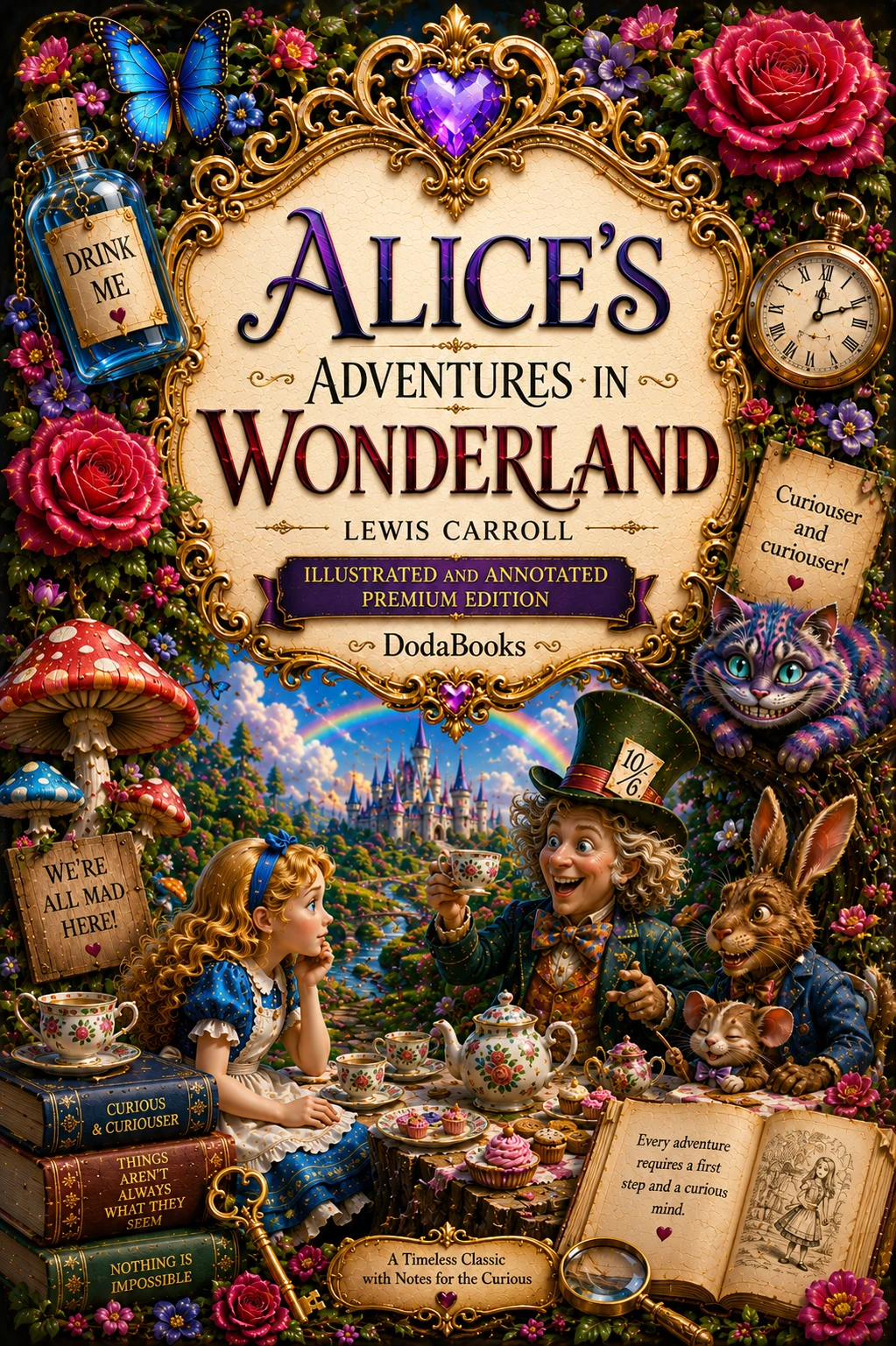
To decode all of Carroll’s mathematical puzzles, satirical schoolroom poems, and linguistic double meanings, explore the DodaBooks Annotated & Illustrated Edition, which features 20+ original artworks, interactive annotation cards, and full historical context.
📚 Related Articles
Looking for more Victorian journeys and psychological puzzles? Explore our The Strange Case of Dr. Jekyll and Mr. Hyde Guide or our The Adventures of Sherlock Holmes Guide.
🐇 Experience Wonderland With Every Hidden Puzzle Decoded
Rediscover Lewis Carroll’s timeless masterpiece in a premium, distraction-free edition:
- 🎨 20+ exclusive original illustrations — 3D cover, 12 full-page artworks, decorative dividers
- 🗺️ Full Wonderland Map & Character Gallery — track Alice’s path from the rabbit-hole to the court
- 🗂️ Color-coded annotation cards — decode Carroll’s mathematical puns, chess moves, and parodies
- 🔒 DRM-free — read on Kindle, Kobo, Apple Books, or any device
- 📥 Instant download — EPUB format delivered immediately