Alice in Wonderland Characters Explained: Mad Hatter, Cheshire Cat & Queen of Hearts
When Lewis Carroll published Alice’s Adventures in Wonderland in 1865, he populated its subterranean landscape with some of the most enduring, psychologically enigmatic, and fiercely debated figures in world literature. Unlike the moralistic stock archetypes common in Victorian nursery tales—where children were obedient angels and adults were stern beacons of Christian virtue—Wonderland’s denizens are eccentric, argumentative, neurotic, and unyieldingly obsessed with their own bizarre systems of logic.
From the manic chronophobia of the Mad Hatter to the detached metaphysical skepticism of the Cheshire Cat, and the arbitrary decapitation tantrums of the Queen of Hearts, Carroll used his characters to satirize the institutional rigidities of 19th-century British society. At the center of it all stands Alice herself: a polite, middle-class Victorian schoolgirl whose rational worldview is pushed to its absolute limits by the irrational adults surrounding her.
This comprehensive character study breaks down the psychological profiles, philosophical symbolism, historical origins, and narrative roles of every major figure in Lewis Carroll’s masterpiece.
⚡ Wonderland Characters: Core Roles & Symbolism
- Alice: The rational, polite Victorian child who must assert her intellectual sovereignty against arbitrary adult authoritarianism.
- The Mad Hatter & March Hare: Personifications of social exhaustion, trapped in perpetual tea-time through a quarrel with Father Time.
- The Cheshire Cat: The only creature in Wonderland who possesses objective self-awareness, functioning as a detached philosophical trickster.
- The Queen of Hearts: A terrifying embodiment of unrestrained, blind fury and autocratic violence, ruling through fear and decapitation threats.
- The White Rabbit: A nervous, status-anxious bourgeois functionary, terrified of his superiors and abusive toward his domestic subordinates.
🎭 The Wonderland Character Relationship Matrix
+---------------------------------------------------------------------------------------------------+
|                            ALICE IN WONDERLAND: CHARACTER DYNAMICS MATRIX                         |
+---------------------+-------------------+---------------------+-----------------------------------+
| CHARACTER           | ARCHETYPE         | CENTRAL DILEMMA     | SOCIAL & SATIRICAL FUNCTION       |
+---------------------+-------------------+---------------------+-----------------------------------+
| Alice               | Rational Seeker   | Shifting identity;  | Middle-class Victorian education; |
|                     |                   | loss of self-scale  | common sense vs. adult absurdity  |
+---------------------+-------------------+---------------------+-----------------------------------+
| Mad Hatter          | Neurotic Outcast  | Frozen at 6:00 PM;  | Industrial madness (mercurialism);|
|                     |                   | unsolvable riddles  | temporal exhaustion               |
+---------------------+-------------------+---------------------+-----------------------------------+
| Cheshire Cat        | Socratic Trickster| Detached grin;      | Metaphysical irony; exposes the   |
|                     |                   | non-corporeal logic | universal madness of social rules |
+---------------------+-------------------+---------------------+-----------------------------------+
| Queen of Hearts     | Autocratic Tyrant | Impulsive rage;     | Absolute monarchy; arbitrary rule |
|                     |                   | "Off with heads!"   | without judicial due process      |
+---------------------+-------------------+---------------------+-----------------------------------+
| White Rabbit        | Fawning Bureaucrat| Chronic tardiness;  | Bourgeois anxiety; kowtows to rich|
|                     |                   | fear of authority   | while bullying servants           |
+---------------------+-------------------+---------------------+-----------------------------------+
| Caterpillar         | Zen Interrogator  | "Who are you?";     | Eastern mysticism; transitional   |
|                     |                   | biological flux     | bodily metamorphosis              |
+---------------------+-------------------+---------------------+-----------------------------------+
| Mock Turtle         | Melancholy Dandy  | Nostalgia for sea   | Parody of Victorian classical     |
|                     |                   | grammar school      | education and sentimentality      |
+---------------------+-------------------+---------------------+-----------------------------------+
🔍 In-Depth Character Profiles & Analysis
1. Alice: The Sovereign Rationalist
Alice is one of the most remarkable child protagonists in Western literature. Modeled upon Alice Liddell—the real-life ten-year-old daughter of Henry Liddell, Dean of Christ Church, Oxford—Alice represents the product of a privileged Victorian upbringing. She is well-schooled, meticulously polite, intensely concerned with social decorum, and constantly eager to display her knowledge of geography, arithmetic, and poetry.
However, Wonderland subjects Alice to a profound existential crisis:
- Bodily Instability: Alice grows and shrinks throughout the novel, shooting from three inches to nine feet in minutes. This physical flux mirrors the disorienting physical and emotional changes of puberty. When the Caterpillar demands to know who she is, Alice poignantly replies: “I hardly know, sir, just at present—at least I know who I was when I got up this morning, but I think I must have been changed several times since then.”
- The Failure of Rote Learning: Alice attempts to stabilize her fractured identity by reciting her schoolroom lessons. Yet every time she recites a pious didactic poem (such as Isaac Watts’s hymns on industry and moderation), her tongue betrays her, transforming the verses into violent, absurd parodies about crocodiles and lobsters. Carroll demonstrates that Victorian education is merely mechanical recitation rather than genuine intellectual understanding.
- Her Growth to Sovereignty: Alice’s ultimate triumph occurs not through magical power, but through intellectual courage. In Chapter 12, when the King and Queen attempt to execute the Knave without evidence and order Alice beheaded, Alice recognizes that she has grown to her full natural stature. She sees through the terrifying facade of adult power, declaring with resounding clarity: “You’re nothing but a pack of cards!” By naming their absurdity, she breaks the spell and wakes up.
2. The Mad Hatter: The Victim of Frozen Time
The Hatter—popularly known in pop culture as the “Mad Hatter,” although Carroll always referred to him simply as “the Hatter”—is one of the book’s most tragic and psychologically layered figures.
The Historical Reality: “Mad as a Hatter”
The character’s erratic behavior is rooted in a horrifying Victorian occupational disease. Nineteenth-century hat makers used mercurous nitrate to cure felt for beaver-skin hats. Prolonged vapor inhalation caused chronic mercury poisoning (erethism or “mad hatter syndrome”), characterized by violent physical tremors, paranoid anxiety, emotional instability, slurred speech, and hallucinations. Carroll’s Hatter displays all of these clinical markers: he trembles constantly, bites pieces out of his teacup instead of his toast, and panics under the slightest legal questioning.
The Philosopher of Temporal Arrest
Beyond the historical diagnosis, the Hatter is Wonderland’s primary philosophical casualty:
- He reveals that he quarreled with Time during the Queen of Hearts’ musical concert in March. Because the Hatter was “murdering the time” with his clumsy singing of “Twinkle, twinkle, little bat”, Time took offense and froze the clock permanently at six o’clock.
- In the Victorian era, 6:00 PM was afternoon tea-time. Consequently, the Hatter, March Hare, and Dormouse are trapped in an inescapable cycle of endless tea drinking. They have no time to wash their dishes, forcing them to constantly shift seats around the table to find a clean place-setting.
- The Hatter poses the famous unsolvable riddle: “Why is a raven like a writing-desk?” The riddle reflects the absurdity of seeking mathematical symmetry in a world that operates on subjective, broken causality.
3. The Cheshire Cat: The Metaphysical Skeptic
If the Queen of Hearts represents raw, uncontrolled emotion, the Cheshire Cat represents cool, detached intellect. He is the only creature in Wonderland who never loses his temper, never participates in the absurd games, and never fears the royal family.
The Philosopher of Subjective Reality
The Cheshire Cat serves as Wonderland’s resident Zen philosopher:
- When Alice asks which way she ought to go, the Cat points out that destination dictates direction: “That depends a good deal on where you want to get to.” When Alice answers that she doesn’t much care where, the Cat delivers his masterstroke: “Then it doesn’t matter which way you go… so long as you get somewhere.”
- The Cat bluntly diagnoses the structural reality of the subterranean world: “We’re all mad here. I’m mad. You’re mad.” His proof is purely deductive: dogs growl when angry and wag their tails when pleased; cats growl when pleased (purring) and wag their tails when angry; therefore, if dogs are sane, cats are mad.
The Decoupling of Symbol and Body
The Cat’s ability to vanish gradually—culminating in a floating grin that outlasts his physical form—is one of Carroll’s brilliant mathematical jokes on abstract representation:
- As an Oxford mathematician, Charles Dodgson was fascinated by abstract systems where relations persist even when concrete objects vanish.
- Alice marvels: “I’ve often seen a cat without a grin, but a grin without a cat! It’s the most curious thing I ever saw in my life!” The floating grin represents pure signification separated from material reality.
4. The Queen of Hearts: Autocratic Rage Incarnate
The Queen of Hearts is the supreme antagonist of Wonderland. Carroll described her in his essays as an embodiment of “ungovernable passion—a blind, aimless fury.”
Satire of Arbitrary Despotism
The Queen represents the absolute antithesis of British constitutional democracy:
- Her singular solution to every social dispute, awkward silence, or sporting failure is immediate, violent decapitation: “Off with their heads!”
- Her croquet game is an absolute parody of rule of law. The equipment is living and rebellious (hedgehogs and flamingos), the wickets wander across the field, and the Queen changes the rules at whim.
- In Chapter 12, her judicial philosophy reaches its grotesque zenith when she demands: “Sentence first—verdict afterwards!” To the Queen, the purpose of a trial is not to discover truth or dispense justice, but to theatricalize the execution of state power.
The King and Gryphon’s Secret
Carroll provides a crucial satirical nuance: the Queen’s terror is largely performative. In Chapter 9, the Gryphon whispers to Alice: “It’s all her fancy, that: they never executes nobody, you know.” The King quietly pardons prisoners behind her back, exposing her blustering tyranny as a paper-thin spectacle maintained by social cowardice.
5. The White Rabbit: The Anxious Bourgeois Functionary
The White Rabbit is the catalyst for the entire story. Dressed in a waistcoat, consulting his pocket-watch, and obsessing over being late, he represents the rising class of Victorian clerks, civil servants, and middle managers who lived under the tyrannical rule of the clock.
- Class Dualism: The Rabbit exhibits the classic psychology of the petty bureaucrat: fawning, servile, and terrified when dealing with his social superiors (the Duchess and the Queen), but arrogant, demanding, and abusive toward those beneath him. He treats Alice like a common housemaid, screaming orders at her to fetch his gloves, and casually orders Bill the Lizard into danger without a second thought.
- Contrast with Alice: While Alice’s curiosity is fearless and expansive, the Rabbit’s consciousness is cramped, timid, and reactionary. He runs from shadows and drops his fan in terror when addressed.
6. The Caterpillar: The Cold Socratic Interrogator
Sitting serenely atop a giant mushroom, quietly puffing on a hookah pipe, the blue Caterpillar serves as Alice’s most rigorous intellectual inquisitor.
- The Question of Identity: The Caterpillar cuts through Alice’s nervous social chatter with a blunt, three-word inquiry: “Who are you?” When Alice tries to explain her difficulty in retaining her size, the Caterpillar remains completely unimpressed by human existential angst, reminding her that bodily transformation is the natural condition of insect metamorphosis.
- The Gift of Control: Despite his rude, sleepy demeanor, the Caterpillar provides Alice with the single most empowering tool in Wonderland: knowledge of the mushroom. By showing her that the opposite edges produce opposite effects (growth and shrinkage), he teaches her that scale is relative and manageable.
7. The Mock Turtle and Gryphon: Parodies of Academic Nostalgia
The Mock Turtle—a creature with the shell of a turtle, the head, tail, and hooves of a calf (satirizing “mock turtle soup,” a cheap Victorian imitation made from calf’s head rather than genuine green sea turtle)—is an embodiment of self-indulgent, sentimental nostalgia.
- Paired with the fierce yet comically domesticated Gryphon, the Mock Turtle weeps constantly as he reminisces about his school days at the bottom of the sea.
- Carroll uses their conversation to mercilessly parody Oxford University’s classical curriculum. All subjects are trivialized into phonetic puns: Reeling and Writhing (reading and writing), Ambition, Distraction, Uglification, and Derision (addition, subtraction, multiplication, and division), and Mystery and Seaography (history and geography).
- The Mock Turtle represents the nostalgic Victorian gentleman who looks back on his grueling boarding-school education with tearful reverence, blind to how absurd and useless its pedantic exercises actually were.
❓ Frequently Asked Questions
Why is the Hatter called the "Mad Hatter" if Carroll never used that name?
While Carroll frequently describes the Hatter as “mad” (e.g., the Cheshire Cat says “the Hatter is mad”), the character’s heading in the text is simply “The Hatter.” The phrase “mad as a hatter” was already common Victorian slang derived from occupational mercury poisoning, and popular culture naturally fused the idiom into a proper name.
Is the Queen of Hearts based on Queen Victoria?
While many critics have noted similarities between the Queen of Hearts’ imperious temperament and Queen Victoria’s stern public persona, Carroll consistently denied that the character was a direct caricature of the monarch. Rather, she represents the historical tradition of arbitrary Tudor autocracy, as well as Carroll’s psychological portrait of unchecked adult temper tantrums.
What does the Cheshire Cat represent philosophically?
The Cheshire Cat represents epistemic detachment and Socratic skepticism. Unlike other characters who take Wonderland’s rules dead seriously, the Cat views the world from an external perspective, laughing at the madness of legalism, protocol, and manners. His ability to vanish leaving only his grin reflects mathematical questions of abstraction and existence.
Why do the March Hare and Hatter treat the Dormouse so poorly?
The Dormouse represents the dormouse’s natural propensity to hibernate, as well as the working-class Victorian domestic drudge. The Hatter and Hare use him as a cushion and pinch him awake purely to extract entertainment, reflecting the casual cruelty that comfortable bourgeois gentlemen frequently exhibited toward vulnerable subordinates.
Where can I find an annotated edition detailing the real-life inspirations for these characters?
To explore the historical Oxford figures, mathematical equations, and real-life child inspirations behind Alice, the Dodo, and the Hatter, consult the DodaBooks Annotated & Illustrated Edition, which includes interactive annotation cards and a full character gallery.
📚 Related Articles
Interested in more Victorian character studies of dual identity and gothic psychology? Check out our The Picture of Dorian Gray Guide or our Jane Eyre Guide.
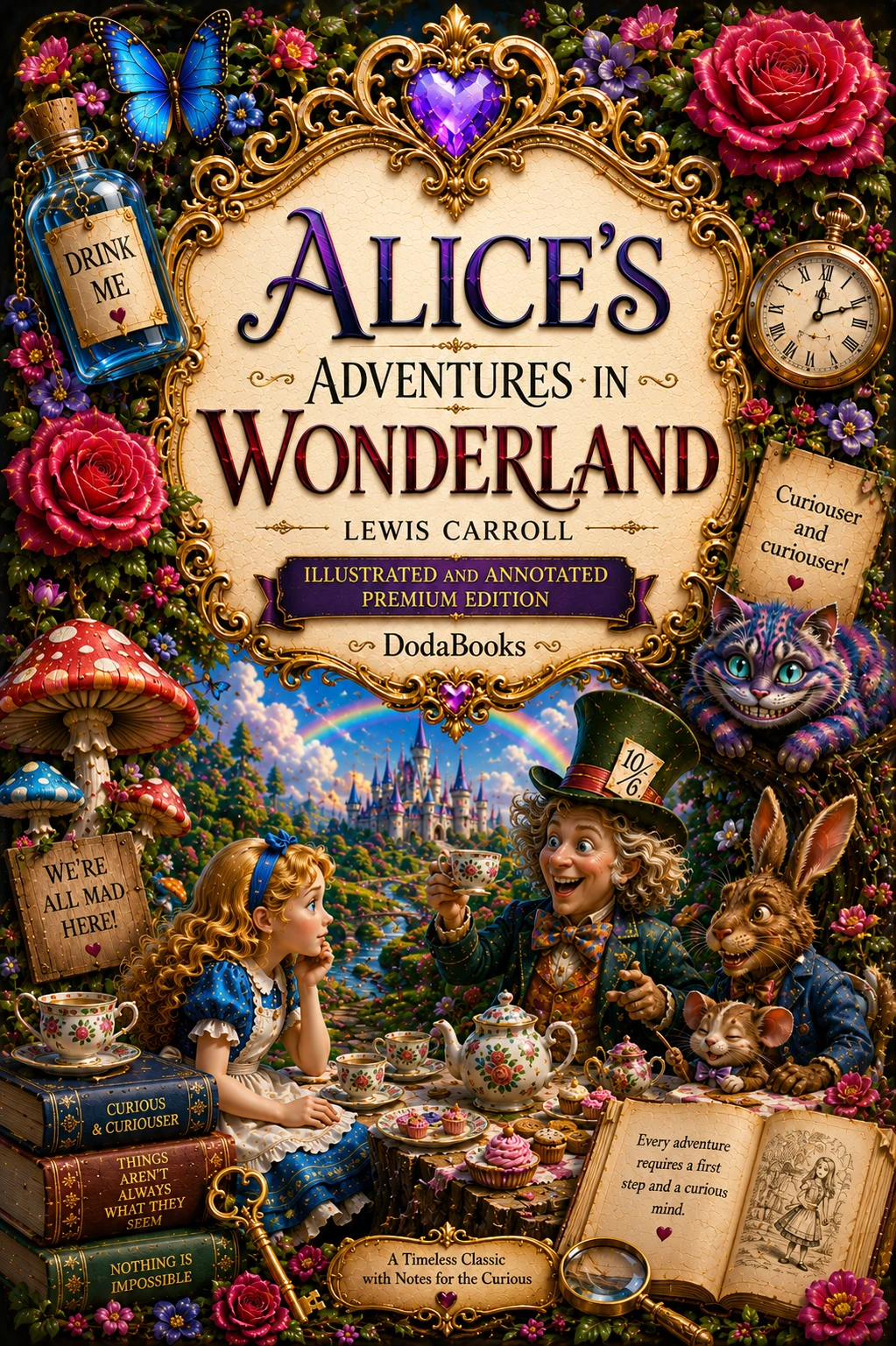
🐇 Meet Wonderland’s Eccentric Cast in Living Color
Experience Lewis Carroll’s masterpiece with every satirical character arc fully explained:
- 🎨 20+ exclusive original illustrations featuring the Hatter, Cheshire Cat, and Queen of Hearts
- 🗂️ Passage-specific annotation cards revealing the Oxford origins and hidden puns of each figure
- 🗺️ Interactive Character Gallery & Map to track Alice’s meetings across the garden
- 🔒 DRM-free format — readable on Kindle, Kobo, Apple Books, and all tablets
- 📥 Instant digital download in pristine EPUB format