A Midsummer Night's Dream Summary Act by Act: Complete Scene-by-Scene Study Breakdown
William Shakespeare’s A Midsummer Night’s Dream (c. 1595–1596) is the crowning jewel of Elizabethan romantic comedy. Composed during the same fertile lyrical period that produced Romeo and Juliet and Richard II, the play represents Shakespeare’s most joyous and structurally symmetrical masterpiece.
What makes A Midsummer Night’s Dream perpetually mesmerizing is its seamless counterpoint of four distinct narrative spheres: the daytime civic order of ducal Athens; the runaway quartet of young aristocratic lovers; the magical, shimmering fairy realm of King Oberon and Queen Titania; and the earnest, bumbling artisanal mechanicals rehearsing a theatrical production in the woods. Across five acts and nine scenes, Shakespeare explores how the “madness” of erotic love, the enchantments of folklore, and the illusions of the theater transform human reality.
Whether analyzing the play for academic study or staging a performance, this exhaustive scene-by-scene guide provides rigorous narrative breakdowns, key line analyses, and thematic commentary for every scene in A Midsummer Night’s Dream.
| Feature | Key Details |
|---|---|
| Playwright | William Shakespeare |
| Composition Date | Circa 1595–1596 (First Quarto published 1600) |
| Structure | 5 Acts, 9 Scenes (approx. 2,165 lines; one of Shakespeare’s most tightly constructed plays) |
| Setting | Ancient Athens and an enchanted neighboring forest / wood (May Day / Midsummer Eve) |
| Thematic Focus | The irrationality of erotic infatuation, patriarchal law vs. natural desire, theatrical illusion |
| Key Soliloquies & Speeches | Theseus’s “The lunatic, the lover, and the poet”, Bottom’s “Bottom’s Dream”, Puck’s “If we shadows have offended” |
| Canonical Edition | DodaBooks Annotated Edition of A Midsummer Night’s Dream |
🏛️ Act I: Civic Tyranny, Escaping Lovers, and The Rude Mechanicals
Act I, Scene 1: The Palace of Theseus and the Law of Athens
In the royal palace of Athens, Duke Theseus and Hippolyta, the conquered Queen of the Amazons, eagerly anticipate their grand wedding ceremony, scheduled in four days under the new moon. Theseus laments how slowly the old moon wanes, while Hippolyta reassures him that the four days will quickly steep themselves in night. Theseus instructs his master of revels, Philostrate, to stir up the Athenian youth to merriment and celebratory revelry.
The festive atmosphere is shattered by the arrival of Egeus, an angry Athenian nobleman, dragging his daughter Hermia alongside two young courtiers, Lysander and Demetrius. Egeus invokes the ancient, unforgiving Law of Athens: he has arranged for Hermia to marry Demetrius, but Lysander has bewitched her heart with love tokens, rhyming verses, and midnight serenades. Egeus demands that if Hermia refuses to marry Demetrius, she must suffer the full penalty of Athenian law: immediate execution or lifetime confinement to a convent.
Theseus questions Hermia, warning her that to her father she should be as a form in wax, and advises her to view Demetrius as a worthy gentleman. Hermia bravely stands her ground, asking what the worst fate is if she refuses. Theseus confirms that she must either die or take a solemn vow of perpetual celibacy as a nun of Diana, chanting faint hymns to the cold, fruitless moon.
Lysander steps forward to defend his suit, arguing that he is as well-born and wealthy as Demetrius, and that Demetrius previously seduced Helena, who still dotes on him with idolatrous passion. Unmoved, Theseus grants Hermia until the day of his own wedding to make her final choice.
Once alone, Lysander consoles the weeping Hermia with one of the most famous maxims in dramatic literature:
“Ay me! for aught that ever I could read, / Could ever hear by tale or history, / The course of true love never did run smooth.”
Lysander proposes a daring escape: he has a wealthy dowager aunt who lives seven leagues outside Athens, beyond the reach of the harsh Athenian legal code. He urges Hermia to sneak out of her father’s house the following night and meet him in the neighboring woods, where they will flee and be married. Hermia passionately swears by Cupid’s strongest bow and Venus’s doves to meet him.
Helena enters, consumed by bitter jealousy and grief because Demetrius has abandoned her to pursue Hermia. Seeking to comfort her friend, Hermia and Lysander reveal their secret plan: they will slip past Athens’ gates at tomorrow’s midnight hour and elope. Left alone, Helena meditates on the blind irrationality of erotic love:
“Love looks not with the eyes, but with the mind; / And therefore is wing’d Cupid painted blind… / For ere Demetrius look’d on Hermia’s eyne, / He hail’d down oaths that he was only mine.”
Driven by a desperate, self-destructive desire to win Demetrius’s gratitude and gaze upon him, Helena decides to betray Hermia’s escape plan to Demetrius, knowing he will pursue the runaway lovers into the forest.
Act I, Scene 2: Peter Quince’s House and the Mechanicals
In an Athenian workshop, six working-class artisans—the “rude mechanicals”—gather to prepare a dramatic entertainment for Duke Theseus’s royal wedding feast. Peter Quince, the carpenter and director, calls the roll: Nick Bottom the weaver, Francis Flute the bellows-mender, Robin Starveling the tailor, Tom Snout the tinker, and Snug the joiner.
Quince announces their play: “The Most Lamentable Comedy, and Most Cruel Death of Pyramus and Thisby.” Nick Bottom, a boisterous, energetic actor who believes he can perform every theatrical part better than anyone else, immediately takes over the meeting. When Quince casts Bottom as the tragic romantic lead Pyramus, Bottom boasts of his talent for heroic ranting (“a part to tear a cat in, to make all split”).
When Flute is assigned the female lead Thisbe, Flute protests that he has a beard coming; Bottom eagerly volunteers to play Thisbe too, offering to speak in a monstrous small, delicate voice. When Snug is cast as the Lion, Bottom volunteers to play the Lion as well, promising to roar so sweetly that the Duke will cry “Let him roar again, let him roar again!”
Quince diplomatically insists that Bottom must play Pyramus, as Pyramus is a sweet-faced, proper gentleman. Quince instructs the troupe to memorize their lines and assemble the following night in the Duke’s forest by moonlight for a secret rehearsal, ensuring their production remains a surprise for the court.
🌲 Act II: The Fairy Feud, The Purple Flower, and The Forest Sleepers
Act II, Scene 1: Robin Goodfellow and the Fairy King and Queen
On Midsummer Eve in the enchanted forest outside Athens, Robin Goodfellow (popularly known in English folklore as Puck) encounters a fairy who is strewing dew drops upon cowslips. The fairy recognizes Puck as that shrewd and knavish sprite who frightens maidens, skims milk, misleads travelers in the night, and laughs at their harm. Puck cheerfully admits his trickster identity, describing his favorite practical jokes.
Puck warns the fairy that King Oberon is holding revels in the grove tonight, and that Queen Titania must be kept away. Oberon is incandescent with rage because Titania has adopted a lovely Indian boy whose mortal mother was her devoted priestess; Oberon covets the boy to serve as his royal henchman and knight, but Titania refuses to surrender him.
Horns sound as Oberon and Titania enter from opposite sides with their fairy trains. Their confrontation is icy and venomous, with each monarch accusing the other of past erotic infidelities involving Hippolyta and Theseus. Titania delivers a magnificent ecological speech, explaining that their marital discord has disrupted the natural order of the entire Earth:
“The ox hath therefore stretch’d his yoke in vain, / The ploughman lost his sweat, and the green corn / Hath rotted ere his youth attain’d a beard… / The seasons alter: hoary-headed frosts / Fall in the fresh lap of the crimson rose… / And this same progeny of evils comes / From our debate, from our dissension.”
Titania firmly refuses to part with the changeling boy and sweeps away into the woods. Furious, Oberon vows to punish her pride before she leaves the grove. He calls Puck and recounts a mystical vision: he once saw Cupid aim a fiery shaft of love at a fair vestal throned by the west (an allegory for Queen Elizabeth I), but the maiden remained unblemished while the arrow fell upon a little western flower, turning it from milk-white to purple with love’s wound.
Oberon instructs Puck to fetch this magic flower—known as “love-in-idleness” (the wild pansy). Its juice, when dropped onto the eyelids of a sleeping person, compels them to fall madly in love with the first living creature they behold upon awakening. Oberon plans to drop the liquid into Titania’s eyes while she sleeps, hoping she will awaken to gaze upon a lion, bear, wolf, or meddling monkey, refusing to release her from the enchantment until she surrenders the changeling boy.
While waiting for Puck, Oberon overhears Demetrius and Helena entering the grove. Demetrius furiously orders Helena to stop following him, cruelly declaring that he does not and cannot love her, and threatening to abandon her to wild beasts. Helena submissively accepts his abuse: “I am your spaniel; and, Demetrius, / The more you beat me, I will fawn on you.” Seeing her humiliation, Oberon pities the maiden. When Puck returns with the flower, Oberon keeps a portion of the nectar for Titania and instructs Puck to find the disdainful Athenian youth in the forest, applying the juice to his eyes so that he awakens to adore the maiden who pursues him.
Act II, Scene 2: The Fairy Lullaby and The Crossed Eyes
In another part of the forest, Titania commands her fairy attendants to sing her to sleep with a magical lullaby, bidding spotted snakes, thorny hedgehogs, and newts to stay away from their fairy queen. Titania falls into a deep slumber on her bed of wild thyme, oxlips, and nodding violets. Oberon creeps forward and squeezes the purple flower juice onto her closed eyelids, uttering his spell:
“What thou seest when thou dost wake, / Do it for thy true-love take; / Love and languish for his sake: / Be it ounce, or cat, or bear, / Pard, or boar with bristled hair… / Wake when some vile thing is near.”
Meanwhile, Lysander and Hermia wander into the clearing, exhausted and lost in the dark woods. Lysander suggests they rest until morning. When Lysander attempts to lie beside Hermia, she modestly insists that he lie further away, preserving virtuous custom between an unmarried bachelor and maid. They fall asleep apart.
Puck scours the forest, searching for the Athenian described by Oberon. Spotting Lysander sleeping alone in Athenian garments with a maiden lying far from him, Puck assumes this must be the cruel youth who spurned his lady. Puck squeezes the flower juice onto Lysander’s eyes, commanding him to wake with burning love when the maiden appears.
Moments later, Demetrius rushes past with drawn sword, fleeing from Helena. Helena, out of breath and unable to keep pace, stops in the clearing and notices the sleeping Lysander. Fearing he is dead or wounded, Helena cries: “Lysander! if you live, good sir, awake.”
Lysander opens his eyes, looks upon Helena, and the magic potion instantly takes effect. In a flash of overwhelming infatuation, Lysander leaps to his feet, abandoning his devotion to Hermia and proclaiming his adoration for Helena:
“Content with Hermia! No; I do repent / The tedious minutes I with her have spent. / Not Hermia but Helena I love: / Who will not change a raven for a dove?”
Horrified and deeply wounded, Helena assumes Lysander is cruelly mocking her unrequited love for Demetrius. She flees in tears, and Lysander rushes after her. Hermia awakens from a terrifying nightmare where a crawling serpent ate her heart while Lysander sat smiling by. Reaching out, Hermia discovers Lysander is gone, and she cries out in terror into the empty night.
🎭 Act III: Bottom’s Metamorphosis and The Erotic Civil War
Act III, Scene 1: The Mechanicals’ Rehearsal and Titania’s Awakening
The six mechanicals assemble in the moonlit forest clearing, directly adjacent to the bower where Queen Titania sleeps. Bottom inspects the glade, declaring it a marvelous place for their rehearsal: the green plot will serve as their stage, and the hawthorn brake will serve as their tiring-house (dressing room).
Bottom immediately raises artistic censorship concerns: when Pyramus draws his sword to kill himself, the ladies in the court audience will be terrified. Bottom devises a solution: Peter Quince must write an eight-syllable prologue explicitly stating that Pyramus does not really die and that he is not Pyramus at all, but Nick Bottom the weaver.
Snout raises a second problem: will not the ladies be terrified of the Lion? Bottom agrees, commanding that the actor playing the Lion must leave half his face visible through the lion’s neck and speak directly to the audience, assuring them that he is merely Snug the joiner. Furthermore, to represent the scenery, they decide to cast a man covered in plaster and mortar to represent the chink in the Wall, and another carrying a lantern, thornbush, and dog to represent Moonshine.
Puck arrives, invisibly watching the rehearsal with cynical delight (“What hempen home-spuns have we swaggering here, / So near the cradle of the fairy queen?”).
The rehearsal begins. Flute speaks his lines as Thisbe, and Bottom steps forward as Pyramus, butchering his verse: “Thisby, the flowers of odious savours sweet…” Bottom exits into the hawthorn brake. Seizing the opportunity for chaotic mischief, Puck follows Bottom and magically transforms his head into the head of an ass (donkey).
When Bottom re-enters the stage wearing the ass’s head, the terrified mechanicals scream in horror: “O monstrous! O strange! we are haunted. Pray, masters! fly, masters! Help!” Quince, Snout, and Flute flee in terror through briers and bushes, pursued by Puck in various phantom shapes.
Left alone, Bottom suspects his companions are playing a practical joke to frighten him. To prove he is not afraid, Bottom walks up and down the clearing singing loudly in his braying voice:
“The ousel cock so black of hue, / With orange-tawny bill, / The throstle with his note so true, / The wren with little quill…”
Directly above him, Queen Titania awakens from her flower bed. The love potion takes immediate, overwhelming effect:
“What angel wakes me from my flowery bed? … / I pray thee, gentle mortal, sing again: / Mine ear is much enamour’d of thy note; / So is mine eye enthralled to thy shape; / And thy fair virtue’s force perforce doth move me / On the first view to say, to swear, I love thee.”
Bottom receives her declaration with comical equanimity, remarking with accidental philosophical genius: “Methinks, mistress, you should have little reason for that: and yet, to say the truth, reason and love keep little company together now-a-days.”
Enraptured, Titania commands Bottom to remain in her magical bower. She summons her four delicate fairy attendants—Peaseblossom, Cobweb, Moth, and Mustardseed—ordering them to wait upon him, feed him purple grapes, ripe figs, and mulberries, fan the moonbeams from his sleeping eyes with butterfly wings, and lead him to her bed.
Act III, Scene 2: The Four Lovers in the Fog
In another part of the wood, Puck reports to Oberon with gleeful triumph that Titania has fallen desperately in love with a transformed ass. However, their amusement is cut short when Demetrius and Hermia enter the clearing. Hermia is furiously accusing Demetrius of murdering the missing Lysander in his sleep. Demetrius protests his innocence, but Hermia curses him and storms into the darkness. Exhausted, Demetrius collapses on the moss and falls asleep.
Oberon turns to Puck in fury: “What hast thou done? thou hast mistaken quite, / And laid the love-juice on some true-love’s sight.” Oberon commands Puck to search the forest and lead Helena to the spot, while Oberon applies the magic nectar to Demetrius’s sleeping eyes.
Puck returns, announcing that Helena is approaching with Lysander pleading for her love. Lysander bursts into the clearing, passionately begging Helena to believe his devotion. Helena continues to rebuke him for his cruel mockery.
The commotion awakens Demetrius. Opening his eyes, Demetrius beholds Helena and instantly falls into the exact same rapturous infatuation that seized Lysander:
“O Helen, goddess, nymph, perfect, divine! / To what, my love, shall I compare thine eyne? / Crystal is muddy. O, how ripe in show / Thy lips, those kissing cherries, tempting grow!”
Now both young men, who hours earlier loved Hermia, are kneeling at Helena’s feet, competing to out-praise her beauty and threatening to duel one another for her favor.
Helena is utterly convinced that Demetrius, Lysander, and Hermia have formed a cruel, coordinated conspiracy to humiliate her (“Injurious Hermia! most ungrateful maid! / Have you conspired, have you with these contrive / To bait me with this foul derision?”).
Hermia arrives, bewildered and heartbroken, clinging to Lysander. Lysander cruelly pushes Hermia away, calling her a hated serpent and a dwarf. A furious verbal brawl erupts between the two women: Helena mocks Hermia’s short stature, calling her a puppet and a vixen, while Hermia threatens to tear out Helena’s eyes with her nails.
Lysander and Demetrius draw their rapiers and storm into the dense forest to fight to the death over Helena.
Observing the catastrophic chaos, Oberon commands Puck to avert tragedy: Puck must cast a thick, impenetrable fog over the entire forest, mimic the voices of Lysander and Demetrius to taunt and mislead each warrior in opposite directions until both collapse from exhaustion, and then apply an herbal antidote (Dian’s bud) to Lysander’s eyes. When the four lovers awake in the morning, all the night’s terrors will appear as nothing more than a harmless, fleeting midsummer dream.
Puck flies through the mist, shouting in Lysander’s voice to lure Demetrius astray, then shouting in Demetrius’s voice to lead Lysander into the bog. One by one, Lysander, Demetrius, Helena, and Hermia collapse on the forest floor, falling into a deep, magical slumber side by side. Puck squeezes the antidote onto Lysander’s eyes, promising that when they wake: “Jack shall have Jill; / Nought shall go ill; / The man shall have his mare again, and all shall be well.”
👑 Act IV: Titania Released, The Morning Hunt, and Bottom’s Dream
Act IV, Scene 1: The Reconciliation of Oberon and Titania
At dawn in the fairy grove, Queen Titania dotes tenderly upon Bottom, who sits among her fairies wearing his ass’s head. Titania strokes his hairy cheeks, binds his temples with fragrant musk-roses, and kisses his large ears. Bottom thoroughly enjoys his royal pampered status, dispatching Cobweb to kill a red-hipped bumblebee for its honey-bag, asking Peaseblossom to scratch his head, and ordering Mustardseed to assist. When Titania asks what music or delicacies he desires, Bottom requests the rustic music of the tongs and bones, followed by a peck of provender, good dry oats, and a handful of sweet hay. They cuddle together and fall asleep in the bower.
Oberon steps forward with Puck, watching the sleeping pair with gentle pity. Oberon reveals that he encountered Titania in the woods earlier and reproached her for loving an ass; humiliated, Titania willingly surrendered the changeling Indian boy to him, who is now safely dispatched to his fairy bower in fairy-land.
Having achieved his goal, Oberon decides to restore her sight. Touching her eyelids with Dian’s bud, Oberon speaks the counter-spell:
“Be as thou wast wont to be; / See as thou wast wont to see: / Dian’s bud o’er Cupid’s flower / Hath such force and blessed power. / Now, my Titania; wake you, my sweet queen.”
Titania awakens, crying in bewilderment: “My Oberon! what visions have I seen! / Methought I was enamour’d of an ass.” Oberon points to the snoring, donkey-headed Bottom sleeping beside her. Revolted by the sight, Titania embraces Oberon. Oberon commands Puck to remove the ass’s head from Bottom so that he can return to Athens with the other mortals. Hand in hand, Oberon and Titania perform a joyful dance of cosmic harmony, promising to bless Duke Theseus’s wedding feast at midnight with fertility, health, and joy.
Hunting horns echo through the morning forest. Duke Theseus, Hippolyta, Egeus, and their royal hunting party ride into the clearing to celebrate the rites of May. Theseus spots the four young aristocrats sleeping side by side on the ground. Theseus commands the huntsmen to sound their horns to awaken them.
The lovers start awake. Theseus greets them, asking how their bitter rivalries have turned into peaceful sleep. Lysander begins to explain that he and Hermia fled Athens to escape the harsh legal code. Egeus erupts in fury, demanding that the law fall upon Lysander’s head.
However, Demetrius intervenes, explaining the miracle of his transformation:
“My lord, fair Helen told me of their stealth, / Of this their purpose hither to this wood; / And I in fury hither follow’d them, / Fair Helena in fancy following me. / But, my good lord, I wot not by what power,— / But by some power it is,—my love to Hermia, / Melted as the snow… / And all the faith, the virtue of my heart, / The object and the pleasure of mine eye, / Is only Helena.”
Hearing Demetrius’s confession, Duke Theseus overrules Egeus’s objections, declaring that his harsh patriarchal will shall be set aside. Theseus decrees that all three couples—Theseus and Hippolyta, Lysander and Hermia, and Demetrius and Helena—shall be married together in a grand royal ceremony in Athens that afternoon. The court party departs for Athens.
Left alone in the clearing, the four lovers rub their eyes, marveling at how everything seems double, like distant mountains turned into clouds. They follow the Duke back to the city.
In the grass, Nick Bottom slowly awakens, thinking he is still in the middle of rehearsal: “When my cue comes, call me, and I will answer: my next is, ‘Most fair Pyramus.’ Hey-ho!” Looking around, he realizes his companions are gone. Bottom delivers his magnificent, touching soliloquy of synesthesia, attempting to articulate the transcendent beauty of his mystical transformation:
“I have had a most rare vision. I have had a dream, past the wit of man to say what dream it was: man is but an ass, if he go about to expound this dream. Methought I was—there is no man can tell what. Methought I was,—and methought I had,—but man is but a patched fool, if he will offer to say what methought I had. The eye of man hath not heard, the ear of man hath not seen, man’s hand is not able to taste, his tongue to conceive, nor his heart to report, what my dream was.”
Bottom resolves to have Peter Quince write a ballad of his vision, which shall be called “Bottom’s Dream,” because it has no bottom. He hurries off to Athens.
Act IV, Scene 2: The Reunion of the Mechanicals
At Quince’s workshop, the mechanicals are in deep despair. Starveling and Flute lament that Bottom is missing and undoubtedly transported by spirits. Flute laments that Bottom’s loss ruins their fortunes, as the Duke would certainly have granted Bottom a pension of sixpence a day for playing Pyramus. Snug rushes in to announce that the Duke is already married alongside two other noble couples at the temple.
Suddenly, Bottom bursts into the room: “Where are these lads? where are these hearts?” The mechanicals rejoice and embrace him. Bottom refuses to tell them the details of his wondrous dream, stating that if he disclosed it, he would be no true Athenian. He orders them to gather their costumes, tie good strings to their false beards, check their lines, and ensure that Thisbe wears clean linen and the Lion trims his nails. Most importantly, he commands: “eat no onions nor garlic, for we are to utter sweet breath; and I do not doubt but to hear them say, it is a sweet comedy.”
🎭 Act V: The Poet’s Eye, Pyramus and Thisbe, and The Fairy Blessing
Act V, Scene 1: The Wedding Feasts and Puck’s Epilogue
In the great hall of the Athenian palace, Hippolyta marvels at the strange and consistent story recounted by the four lovers. Theseus, the embodiment of pragmatic, daylight rationality, dismisses their tale as antique fables and fairy toys. He delivers one of Shakespeare’s most celebrated philosophical dissertations on the transformative power of human imagination:
“The lunatic, the lover, and the poet / Are of imagination all compact: / One sees more devils than vast hell can hold, / That is, the madman: the lover, all as frantic, / Sees Helen’s beauty in a brow of Egypt: / The poet’s eye, in a fine frenzy rolling, / Doth glance from heaven to earth, from earth to heaven; / And as imagination bodies forth / The forms of things unknown, the poet’s pen / Turns them to shapes and gives to airy nothing / A local habitation and a name.”
Philostrate presents Theseus with a list of available entertainments. Theseus rejects a battle of Centaurs and the riot of the drunken Bacchanals, choosing instead: “A tedious brief scene of young Pyramus / And his love Thisby; very tragical mirth.” Philostrate warns Theseus that the play is worthless and the actors unskilled, but Theseus graciously replies that noble courtesy accepts the sincere duty of humble subjects: “Our sport shall be to take what they mistake… / Love, therefore, and tongue-tied simplicity / In least speak most, to my capacity.”
The mechanicals enter to perform their play:
- Peter Quince’s Prologue: Quince delivers his prologue with terrible grammatical punctuation, pausing in the wrong places and completely inverting his intended compliments.
- Tom Snout as Wall: Snout announces that he represents the stone wall, holding up two fingers to form the “chink” through which Pyramus and Thisbe whisper.
- Bottom as Pyramus and Flute as Thisbe: Pyramus curses the wall for separating him from his love; Thisbe enters, and they kiss through the chink (“I kiss the wall’s hole, not your lips at all”).
- Snug as the Lion and Starveling as Moonshine: Snug politely reassures the ladies that he is not a fierce lion, while Starveling holds up his lantern and thornbush to represent the moon. When the courtiers mock Moonshine’s lantern, Starveling loses his temper: “All I have to say, is, to tell you that the lanthorn is the moon; I, the man in the moon; this thorn-bush, my thorn-bush; and this dog, my dog.”
- The Tragic Climax: Thisbe arrives at Ninus’s tomb, is frightened by the roaring Lion, and drops her mantle. The Lion mauls the mantle with bloody jaws. Pyramus arrives, finds the bloody garment, assumes Thisbe is devoured, and dramatically stabs himself: “Now die, die, die, die, die.” Thisbe returns, finds her dead lover, delivers her farewell, and stabs herself with his sword.
Theseus and the courtiers thoroughly enjoy the performance, laughing at its earnest bungling while praising the actors’ dedication. When Bottom offers an epilogue, Theseus gently declines: “No epilogue, I pray you; for your play needs no excuse.” Instead, the mechanicals perform a lively, stomping rustic dance—a Bergomask—before departing.
Theseus notes the late hour: “The iron tongue of midnight hath told twelve: / Lovers, to bed; ’tis almost fairy time.” The court retires, and the palace falls into total darkness.
Puck enters carrying a broom to sweep the dust behind the door:
“Now the hungry lion roars, / And the wolf behowls the moon; / Whilst the heavy ploughman snores, / All with weary task fordone… / I am sent with broom before, / To sweep the dust behind the door.”
King Oberon and Queen Titania sweep into the darkened hall leading their shimmering fairy train with glowing torches. Oberon commands the fairies to dance through every royal chamber, sprinkling sweet field-dew to consecrate the marriage beds, ensuring that the lovers remain faithful, that no deformities or blemishes touch their future children, and that peace and prosperity bless all Athens. Oberon and Titania fade into the dawn.
Puck steps forward to the front of the stage, breaking the theatrical illusion and addressing the audience directly with the most beloved epilogue in English drama:
“If we shadows have offended, / Think but this, and all is mended, / That you have but slumber’d here / While these visions did appear. / And this weak and idle theme, / No more yielding but a dream, / Gentles, do not reprehend: / If you pardon, we will mend… / Give me your hands, if we be friends, / And Robin shall restore amends.”
🧭 Visual Dramatic Architecture of A Midsummer Night’s Dream
[Daylight: The Law of Athens]
  - Act I, Sc. 1: Egeus's patriarchal ultimatum; Hermia & Lysander's escape plot; Helena's betrayal
  - Act I, Sc. 2: The Mechanicals meet; Bottom claims every role; Midnight forest rehearsal planned
            │
            ▼
[Midsummer Night: The Enchanted Forest]
  - Act II, Sc. 1: Puck meets Fairy; Oberon & Titania's cosmic quarrel; "Love-in-idleness" flower
  - Act II, Sc. 2: Titania's lullaby; Oberon enchants Titania; Puck enchants Lysander by mistake;
                   Lysander wakes loving Helena; Hermia's serpent nightmare
            │
            ▼
[The Midnight Crisis: Asses and Erotic Chaos]
  - Act III, Sc. 1: Mechanicals rehearse; Puck gives Bottom an ass's head; Titania dotes on Bottom
  - Act III, Sc. 2: Oberon enchants Demetrius; Both men pursue Helena; The four lovers fight;
                    Puck mimics voices in the fog; Herbal antidote applied to Lysander
            │
            ▼
[The Dawn Awakening: Harmony Restored]
  - Act IV, Sc. 1: Titania cured; Bottom's head removed; Theseus's hunt awakens the lovers;
                   Triple wedding decreed; Bottom's "Bottom's Dream" soliloquy
  - Act IV, Sc. 2: Mechanicals reunited; Bottom prepares troupe for royal performance
            │
            ▼
[Midnight Revels: Art, Farce, and Blessing]
  - Act V, Sc. 1a: Theseus on "The lunatic, the lover, and the poet"
  - Act V, Sc. 1b: "Pyramus and Thisbe" performed (Wall, Moonshine, Lion); Bergomask dance
  - Act V, Sc. 1c: Midnight strikes; Oberon and Titania bless bridal beds; Puck's closing epilogue
❓ Frequently Asked Questions
Why do Oberon and Titania fight at the start of the play?
Oberon and Titania are quarreling over custody of an orphaned Indian boy. The boy's mortal mother was a devoted priestess and friend of Titania who died in childbirth. Titania swore to raise the child in her memory, but Oberon covets the handsome youth to serve as his royal page and hunting knight. Their marital feud causes cosmic disharmony, altering the seasons and flooding the earth.
What does "Bottom's Dream" signify in Act IV?
Upon waking with his human head restored, Nick Bottom delivers a profound, fragmented soliloquy paraphrasing St. Paul's First Epistle to the Corinthians (*"Eye hath not seen, nor ear heard"*). Bottom recognizes that he has experienced a transcendent, magical mystery beyond the capacity of human reason or language to report. Calling it "Bottom's Dream" because it has no bottom, his speech elevates the comic weaver into a visionary poet of the unconscious.
Why does Shakespeare include the play-within-a-play of Pyramus and Thisbe?
The mechanicals' performance of Pyramus and Thisbe in Act V retells the exact same plot as Romeo and Juliet—two young lovers from feuding families who meet in secret and die in a double suicide. By presenting this tragic myth as a hilarious, bungling farce, Shakespeare provides a comic exorcism of tragedy, celebrating the joy of theatrical illusion and reassuring the audience that love's perils have been safely conquered.
How difficult is Shakespeare's language in A Midsummer Night's Dream?
A Midsummer Night's Dream is one of Shakespeare's most approachable plays (reading difficulty 5.5/10, Lexile 1020L). Its combination of lyrical rhyming fairy verse, snappy lovers' banter, and colloquial prose makes it engaging and clear. For a detailed breakdown of poetic meters and study tips, see our guide: Is A Midsummer Night's Dream Hard to Read?.
Which edition provides the best annotations for A Midsummer Night's Dream?
The best edition of A Midsummer Night's Dream is the DodaBooks Annotated Edition, featuring line-by-line Early Modern English glosses, folklore notes on Puck and fairies, and explanations of Ovidian mythology in a 100% DRM-free EPUB format.
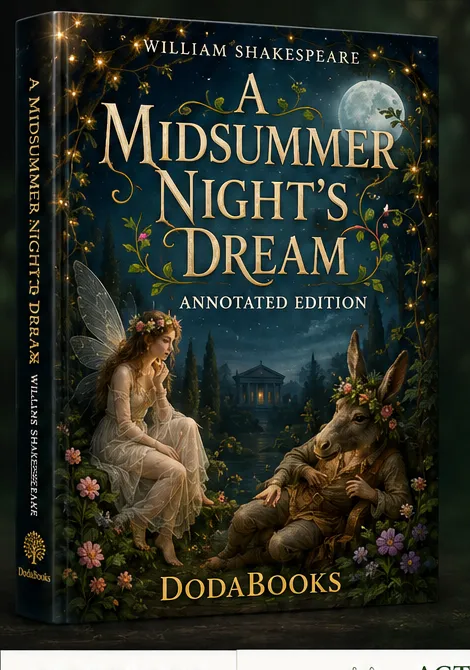
🌙 Step into Shakespeare’s Most Enchanting Woodland Fantasy
Experience the magic, verbal wit, and joyous comedy of A Midsummer Night’s Dream with the definitive DodaBooks Annotated Edition.
- 📜 Line-by-Line Early Modern Glosses — Understand every pun, Ovidian reference, and archaic word
- 🧚 Fairy Lore & Folk Commentary — Context on Robin Goodfellow, Cupid’s flower, and May Day rites
- 🎭 Theatrical Staging Apparatus — Insights into the four interlocking worlds and original performance
- 🔒 100% DRM-Free Ownership — Read effortlessly on Kindle, Kobo, iPad, and desktop
- ⚡ Instant Download — High-resolution EPUB format available immediately upon checkout
Explore our master Midsummer Guide for complete analysis of setting, themes, and Shakespeare’s pastoral vision.