A Midsummer Night's Dream Characters Explained: Puck, Bottom, Oberon & The Lovers
William Shakespeare’s A Midsummer Night’s Dream (c. 1595–1596) is unique in the Shakespearean canon for its dazzling architectural counterpoint. Rather than centering on a single dominant tragic protagonist like Hamlet or a doomed couple like Romeo and Juliet, A Midsummer Night’s Dream distributes its dramatic energy across four distinct, interlocking social and metaphysical spheres: the daylight authoritarian court of Athens, the volatile quartet of runaway lovers, the magical fairy kingdom of the enchanted wood, and the earnest artisanal mechanicals attempting to stage an amateur play.
At the intersection of these four worlds stand two of Shakespeare’s most immortal comedic creations: Puck (Robin Goodfellow), the anarchic spirit of folklore mischief, and Nick Bottom, the delightfully pompous weaver whose literal-minded enthusiasm leads him into the arms of the fairy queen. This comprehensive guide provides exhaustive character analyses, psychological explorations, and thematic breakdowns of every major figure in Shakespeare’s pastoral masterpiece.
| Character | Sphere & Archetype | Key Personality Traits | Thematic Significance |
|---|---|---|---|
| Puck (Robin Goodfellow) | Fairy Realm; Trickster Spirit | Mischevious, irreverent, observant, anarchic | The spirit of theatrical illusion; chaos as the engine of comedy |
| Nick Bottom | The Mechanicals; Pompous Artisan | Egotistical, enthusiastic, literal-minded, sincere | The transformative power of imagination; the comic visionary |
| King Oberon | Fairy Realm; Monarch of the Woods | Proud, jealous, manipulative, ultimately benevolent | Cosmic masculine authority; the restoration of natural harmony |
| Queen Titania | Fairy Realm; Queen of the Fairies | Regal, fiercely independent, sensual, loyal | Maternal fidelity; nature’s fertility and seasonal equilibrium |
| Hermia & Lysander | The Lovers; Romantic Rebels | Defiant, passionate, lyrical, easily confused | The fragility and fickleness of youthful romantic idealism |
| Helena & Demetrius | The Lovers; Unrequited & Transformed | Insecure, desperate, obsessive, magically corrected | The irrational blindness of desire; love as mental projection |
| Duke Theseus & Hippolyta | Athenian Court; Rulers of Reason | Rational, authoritative, skeptical, gracious | Civic law and order; daylight skepticism vs. poetic imagination |
🧚 Puck (Robin Goodfellow): The Jester of Anarchy
The Spirit of English Folklore
Puck—identified interchangeably by his folklore name, Robin Goodfellow—is the metaphysical heart of A Midsummer Night’s Dream. Unlike the delicate, classical fairies of continental romance, Puck is rooted in ancient English rural folklore. He is a domestic hobgoblin, a spirit of the hearth and countryside who curdles milk, misleads travelers with phantom lights in bogs, pinches lazy housemaids, and transforms into a three-footed stool to spill old gossips onto the floor.
When introduced in Act II, Scene 1, Puck takes immense pride in his reputation for harmless domestic mayhem:
“I am that merry wanderer of the night. / I jest to Oberon and make him smile / When I a fat and bean-fed horse beguile, / Neighing in likeness of a filly foal… / And ’tailor’ cries, and falls into a cough; / And then the whole quire hold their hips and laugh.”
The Detached Chorus of Human Folly
Puck serves as King Oberon’s jester and lieutenant, but his true dramatic function is that of an onstage audience and chorus. While the four young Athenian lovers weep, scream, brandish swords, and threaten suicide in the dark woods, Puck views their melodramatic suffering with cosmic amusement, delivering the play’s most famous assessment of the human condition:
“Lord, what fools these mortals be!”
To Puck, human passion is an absurd theatrical spectacle. Even his mistake in squeezing the love potion onto Lysander’s eyes rather than Demetrius’s is received not with guilt, but with delight: “And so far am I glad it so did sort, / As this their jangling I esteem a sport.”
The Master of Theatrical Illusion
Puck is the boundary-crosser between reality and fiction. He transforms Bottom into an ass, mimics the voices of Lysander and Demetrius to prevent their bloody duel in the fog, and sweeps the dust behind the door at midnight. In the play’s closing moments, it is Puck who steps forward alone to break the dramatic fourth wall, addressing the theatergoers directly. By comparing the entire performance to an insubstantial, healing dream, Puck invites the audience to become participants in Shakespeare’s magical enchantment.
🎭 Nick Bottom: The Pompous Weaver and Comic Visionary
The Egotistical Actor
Nick Bottom, the weaver of Athens, is one of the most beloved comic creations in world literature. Boisterous, supremely self-confident, and bursting with theatrical ambition, Bottom genuinely believes he is gifted with extraordinary talent in every artistic discipline.
During the casting of Pyramus and Thisbe in Act I, Scene 2, Bottom’s boundless ego drives him to volunteer for every single part:
- He wants to play Pyramus to tear a cat in and make all split with noble grief.
- He wants to play Thisbe in a delicate, falsetto voice under a mask.
- He wants to play the Lion, promising to roar so sweetly that the Duke will weep with joy.
Yet, despite his vanity, Bottom is never malicious or mean-spirited. His ego is born of pure, childlike enthusiasm and an unshakeable love for the craft of performance.
The Transformed Ass and Titania’s Bower
When Puck mischievously crowns Bottom with the head of an ass in Act III, Scene 1, Shakespeare executes a brilliant visual pun: Bottom is literally transformed into what he has always figuratively been—an obstinate, pompous, braying “ass.”
The comedy reaches transcendent heights when Queen Titania awakens under the spell of Cupid’s flower and falls passionately in love with this grotesque, donkey-headed mortal. Bottom’s reaction to being courted by the Queen of the Fairies is astonishingly calm. He is neither terrified by her supernatural power nor surprised that a divine beauty adores him; he accepts her adoration with matter-of-fact equanimity, remarking with accidental brilliance:
“Methinks, mistress, you should have little reason for that: and yet, to say the truth, reason and love keep little company together now-a-days.”
Surrounded by delicate fairies who feed him dried oats, scratch his hairy ears, and bring him bumblebee honey-bags, Bottom becomes the monarch of the bower, perfectly at home in paradise.
“Bottom’s Dream”: The Holy Fool
Bottom’s finest moment occurs in Act IV, Scene 1, when he awakens alone in the forest after his transformation has been reversed. Stumbling between sleep and waking, Bottom attempts to articulate the wonder of what he has experienced:
“I have had a most rare vision. I have had a dream, past the wit of man to say what dream it was: man is but an ass, if he go about to expound this dream… The eye of man hath not heard, the ear of man hath not seen, man’s hand is not able to taste, his tongue to conceive, nor his heart to report, what my dream was.”
In this marvelous speech, Bottom paraphrases St. Paul’s biblical description of heavenly revelation (1 Corinthians 2:9) in scrambled synesthesia. Bottom has walked with gods, rested in the bower of the fairy queen, and tasted a mystery that human language cannot define. He resolves to have Peter Quince turn it into a ballad called “Bottom’s Dream,” “because it hath no bottom.” Bottom is Shakespeare’s ultimate holy fool: literal-minded on the surface, yet open to the infinite wonders of the imagination.
👑 Oberon and Titania: The Cosmic Fairy Monarchs
The Disruption of Natural Order
Oberon and Titania, King and Queen of the Fairies, represent the primal, animistic forces of nature. When the play opens, their relationship is poisoned by sexual jealousy, pride, and an unyielding struggle for power over an orphaned Indian changeling boy.
Shakespeare emphasizes that their domestic dispute is not a trivial marital spat, but an ecological catastrophe. Because the fairy royalty embody the soul of the landscape, their discord alters the global climate: rivers overflow, the green corn rots in the fields, flocks die of the murrain, and the four seasons blur into chaos. Only the reconciliation of the fairy king and queen can restore fertility, peace, and order to the mortal world.
Oberon’s Manipulation and Benevolence
Oberon is an imperious, Machiavellian ruler who does not hesitate to use supernatural narcotics (love-in-idleness) to humiliate his queen and force her to surrender the boy. Yet Oberon is fundamentally different from a tragic tyrant:
- When he observes Demetrius cruelly abusing Helena in the forest, his heart is moved by pity, and he immediately intervenes to heal her broken heart.
- Once Titania surrenders the changeling, Oberon feels immediate remorse for her humiliation, gently releases her from the enchantment, and welcomes her back to his arms.
- In Act V, Oberon leads the fairies into Athens to dance through Theseus’s palace, bestowing blessings of fertility, health, and peace upon all three newly married couples.
Titania’s Maternal Fidelity
Titania is one of Shakespeare’s most lyrical and emotionally compelling female figures. Her refusal to surrender the Indian boy is grounded in profound maternal loyalty to his deceased mother:
“His mother was a votaress of my order: / And, in the spiced Indian air, by night, / Full often hath she gossip’d by my side… / But she, being mortal, of that boy did die; / And for her sake do I rear up her boy, / And for her sake I will not part with him.”
Even when drugged and infatuated with Bottom, Titania displays extraordinary generosity, ordering her fairies to pamper him with nature’s sweetest treasures. Her reconciliation with Oberon signifies the restoration of balance between male and female authority in the cosmos.
🏹 The Four Athenian Lovers: The Erotic Quadrille
Shakespeare intentionally designs the four young Athenian aristocrats as interchangeable, symmetrically balanced figures to dramatize the blind, arbitrary nature of erotic desire:
1. Hermia: The Fiery Rebel
Hermia is small of stature, dark-complexioned, and fiercely independent. Confronted with execution or life in a convent by Duke Theseus, Hermia defies both her father Egeus and the ancient law of Athens to flee with Lysander. When the enchanted Lysander abandons her for Helena, Hermia’s dignity is shattered, driving her to violent fury against her lifelong friend.
2. Helena: The Masochistic Devotee
Helena is tall, fair, and consumed by agonizing romantic insecurity. Rejected by Demetrius in favor of Hermia, Helena devalues her own worth, pleading to be treated as his “spaniel.” When the magic potion causes both Lysander and Demetrius to fall on their knees worshipping her, Helena’s trauma is so deep that she cannot believe they are sincere, assuming all three friends have formed a cruel conspiracy to mock her misery.
3. Lysander: The Romantic Poet
Lysander begins as an earnest, lyrical suitor who composes sonnets for Hermia and invents the midnight elopement plot. Yet the ease with which Cupid’s flower erases Hermia from his memory—causing him to awaken declaring that Hermia is a “raven” compared to Helena the “dove”—exposes how easily romantic passion can turn into callous betrayal.
4. Demetrius: The Inconstant Courtier
Demetrius is an entitled courtier who courted Helena, abandoned her for Hermia, and pursues the lovers into the woods with threats of violence. Notably, Demetrius is the only character who remains permanently enchanted at the end of the play: his eyes are never washed with Dian’s bud, leaving him happily in love with Helena forever. Shakespeare subtly hints that Demetrius’s “true love” is an enduring illusion, proving that all romance is built on a touch of magic blindness.
🏛️ Theseus and Hippolyta: The Daylight World of Reason
Theseus: The Rational Skeptic
Duke Theseus represents the supreme authority of daylight rationality, civic law, and classical order. In Act I, he enforces the patriarchal Law of Athens, but in Act IV, seeing the genuine love of the reconciled pairs, he displays executive wisdom by overruling Egeus’s harsh demands.
In Act V, Scene 1, Theseus delivers his immortal philosophical speech on the kinship of the lunatic, the lover, and the poet:
“The lunatic, the lover, and the poet / Are of imagination all compact: / One sees more devils than vast hell can hold, / That is, the madman: the lover, all as frantic, / Sees Helen’s beauty in a brow of Egypt: / The poet’s eye, in a fine frenzy rolling, / Doth glance from heaven to earth, from earth to heaven; / And as imagination bodies forth / The forms of things unknown, the poet’s pen / Turns them to shapes and gives to airy nothing / A local habitation and a name.”
To Theseus, imagination is a mild madness that invents fantasies out of airy nothing.
Hippolyta: The Intuitive Counterweight
Hippolyta, Queen of the Amazons, provides a profound counter-argument to Theseus’s skepticism. Reflecting on the lovers’ night in the woods, she points out that because all four lovers experienced the exact same supernatural transformation, their story cannot be mere hallucination:
“But all the story of the night told over, / And all their minds transfigured so together, / More witnesseth than fancy’s images / And grows to something of great constancy; / But, howsoever, strange and admirable.”
Hippolyta recognizes what Theseus cannot: that art, myth, and dreams possess their own profound, objective truth.
⚖️ The Four-World Character Interaction Matrix
| Realm / Sphere | Primary Representatives | Primary Motivation | Linguistic Medium | Thematic Role |
|---|---|---|---|---|
| The Athenian Court | Theseus, Hippolyta, Egeus | Law, social order, patriarchal control | Measured, authoritative blank verse | Daylight reality and civic discipline |
| The Four Lovers | Hermia, Lysander, Helena, Demetrius | Romantic fulfillment, erotic possession | Passionate rhymed couplets & blank verse | Youthful folly and the blindness of desire |
| The Fairy Realm | Oberon, Titania, Puck | Cosmic harmony, supernatural mischief | Lyrical, incantatory trochaic tetrameter | The unconscious, nature, and magic illusion |
| The Mechanicals | Bottom, Quince, Flute, Snug | Sincere artistic duty, social advancement | Colloquial prose & bungled doggerel | The comedy of literalism and honest human labor |
❓ Frequently Asked Questions
Why is Nick Bottom's transformation into an ass so significant?
Bottom's transformation is a layered theatrical pun: his surname is Bottom, his personality is that of an obstinate, braying ass, and his transformation literalizes his character. Furthermore, having Queen Titania fall in love with him brilliantly satirizes courtly romance, proving that erotic desire can blind even the most divine beings into worshipping ridiculous fools.
Why does Demetrius stay enchanted at the end of the play?
Shakespeare deliberately leaves Demetrius under the spell of the love potion to ensure a happy comic resolution for Helena. This detail carries profound thematic significance: it suggests that romantic love is fundamentally an enchanted state of mind rather than purely rational choice. Demetrius's enduring magic blindness allows all four lovers to live in harmony.
How does Puck differ from traditional fairies in folklore?
While traditional English folklore often depicted hobgoblins as frightening or malicious demons, Shakespeare reinvented Robin Goodfellow as a witty, playful court jester who delights in harmless practical jokes. Puck embodies the playful spirit of comedy itself, orchestrating human folly for theatrical pleasure.
What does Theseus mean by comparing the lunatic, the lover, and the poet?
Theseus argues that madmen, lovers, and artists all share an overactive imagination that distorts reality: the madman sees hallucinations of devils, the lover sees supreme beauty in an ordinary face, and the poet invents entire worlds out of "airy nothing." However, while Theseus views this as a defect of reason, Shakespeare's play proves that the poet's imagination creates truths deeper than everyday reality.
Which edition provides the best character and staging commentary?
The best edition of A Midsummer Night's Dream is the DodaBooks Annotated Edition, featuring comprehensive character studies, folklore context on Puck, and notes on Elizabethan staging at the Globe.
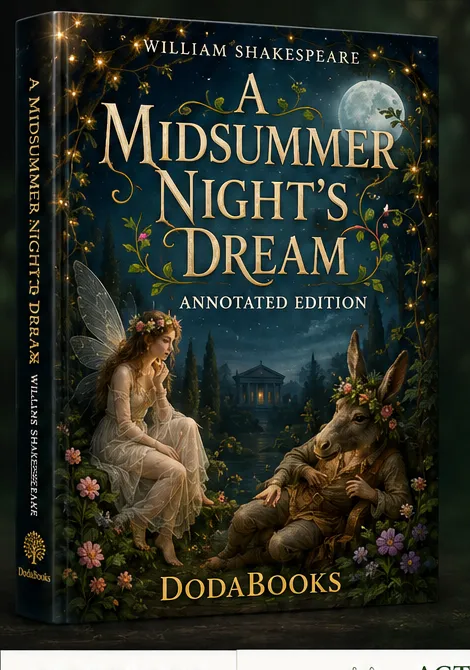
🌙 Meet the Enchanted Figures of Shakespeare’s Masterpiece
Unravel every comedic pun, mythological reference, and psychological layer of Athens and the fairy forest with the DodaBooks Annotated Edition of A Midsummer Night’s Dream.
- 📜 Line-by-Line Early Modern Glosses — Understand every pun, Ovidian reference, and archaic word
- 🧚 Fairy Lore & Folk Commentary — Context on Robin Goodfellow, Cupid’s flower, and May Day rites
- 🎭 Theatrical Staging Apparatus — Insights into the four interlocking worlds and original performance
- 🔒 100% DRM-Free Ownership — Read effortlessly on Kindle, Kobo, iPad, and desktop
- ⚡ Instant Download — High-resolution EPUB format available immediately upon checkout
Explore our master Midsummer Guide for complete analysis of setting, themes, and Shakespeare’s pastoral vision.