A Midsummer Night’s Dream: Shakespeare’s Forest of Illusion
Composed during the golden lyrical flowering of William Shakespeare’s career in the mid-1590s, *A Midsummer Night’s Dream* is a theatrical tour de force—an enchanting, multi-layered meditation on the madness of erotic desire, imagination, and the transformative power of art.
Few theatrical masterpieces in world drama possess the enduring charm, verbal virtuosity, and joyous structural symmetry of William Shakespeare’s A Midsummer Night’s Dream. Written around 1595–1596, alongside Romeo and Juliet and Richard II, the play represents Shakespeare’s supreme triumph in pastoral romantic comedy.
What elevates A Midsummer Night’s Dream above conventional romantic farces is its breathtaking polyphony of four interlocking worlds: the rigid, authoritarian court of ducal Athens; the runaway quartet of aristocratic lovers; the shimmering, supernatural realm of Celtic-British fairy royalty; and the hilarious, earnest artisanal mechanicals attempting to rehearse a play for the royal wedding. Readers exploring our distinguished Shakespearean and classic drama collection will discover in this play an eternal celebration of how imagination reshapes reality.
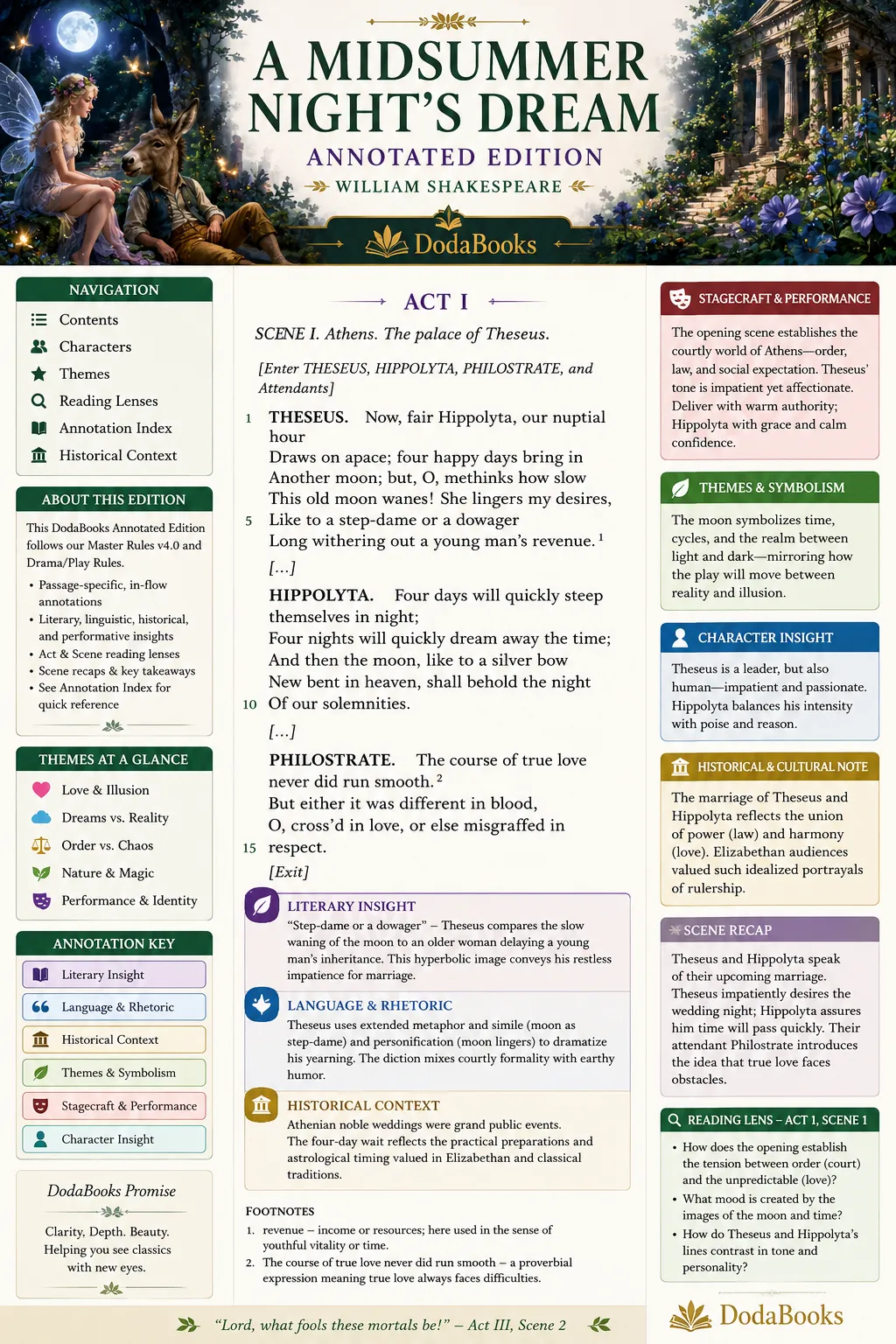
Read the Definitive Annotated Edition
Experience Shakespeare's enchanting comedy with comprehensive line-by-line annotations of Elizabethan wordplay, folklore commentary, and performance history.
Get the Annotated eBookThe Four Worlds of the Dream
Shakespeare orchestrated A Midsummer Night’s Dream through the intricate counterpoint of four distinct social and metaphysical strata, each marked by its own verse form, rhythm, and moral atmosphere:
                    THE FOUR INTERLOCKING SPHERES OF THE DREAM

       THE ATHENIAN COURT (Day / Law)               THE ENCHANTED FOREST (Night / Magic)
    ┌───────────────────────────────────┐        ┌───────────────────────────────────┐
    │ Theseus & Hippolyta               │        │ Oberon & Titania (Fairy Royalty)  │
    │ Egeus, Law of Athens & Patriarchy │ ◄────► │ Puck (Robin Goodfellow / Mischief)│
    │ Reason, Order, Strict Marriage    │        │ The Love-in-Idleness Flower Herb  │
    └─────────────────┬─────────────────┘        └─────────────────┬─────────────────┘
                      │                                            │
                      ▼                                            ▼
           THE FOUR RUNAWAY LOVERS                  THE MECHANICALS (Artisans)
         Hermia, Lysander, Helena, Demetrius       Bottom, Quince, Flute & "Pyramus"
         Erotic Confusion & Magic Blindness        Sincere, Comic Folk Theatricality
1. The Court of Athens: Law, Reason, and Patriarchal Authority
The play begins in daylight under the strict patriarchal rule of Duke Theseus and the severe father Egeus, who demands that his daughter Hermia either marry Demetrius or face execution or permanent cloistered chastity. Athens represents the daylight world of civic law, rationality, and rigid social boundaries.
2. The Four Runaway Lovers: Erotic Folly and Metamorphosis
Escaping Athens into the nearby wood, Hermia and Lysander plan to elope, pursued by Demetrius (who loves Hermia) and Helena (who desperately adores Demetrius). In the darkness of the forest, stripped of civic rules, their desires are revealed as fickle, volatile, and easily manipulated by fairy magic.
3. The Fairy Realm: Nature, Fertility, and Cosmic Discord
Ruled by King Oberon and Queen Titania, the fairies are not diminutive nursery sprites; they are elemental nature spirits whose matrimonial quarrel over a changeling boy has disrupted the global seasons, causing floods, rot, and winter frosts across the earth.
4. The Mechanicals: Folk Theatricality and Sincere Art
Led by the bombastic, enthusiastic weaver Nick Bottom and the anxious carpenter Peter Quince, this group of Athenian craftsmen assembles in the woods to rehearse The Most Lamentable Comedy and Most Cruel Death of Pyramus and Thisbe. Their humble, earnest literalism provides the comic heart of the play.
The Central Engine: The Love-in-Idleness Flower
The catalyst of the play’s chaos is the purple flower called Love-in-Idleness, struck by Cupid’s misdirected golden arrow. When its juice is squeezed onto sleeping eyelids, the sleeper awakens to fall madly, blindly in love with the first living creature they behold:
- Oberon’s Revenge on Titania: Squeezing the flower onto Titania’s eyes, Oberon causes the Fairy Queen to awaken and swoon in passionate adoration over Nick Bottom, whose head has been magically transformed into that of an ass by Puck.
- Puck’s Comic Blunders: Tasked with anointing the eyes of Demetrius to restore Helena’s love, the mischievous sprite Robin Goodfellow (Puck) mistakenly anoints Lysander, and subsequently Demetrius, turning best friends into sword-wielding rivals and leaving Hermia bewildered and abandoned.
                      THE METAMORPHOSIS OF DESIRE

          The Daylight Rationality                 The Nighttime Enchantment
     ┌───────────────────────────────┐   ┌───────────────────────────────┐
     │ Constant social contracts     │   │ Instant, irrational attraction│
     │ Predictable family duty       │   │ Blind adoration of an "ass"   │
     │ Clear-sighted vision          │   │ "Love looks not with the eyes,│
     │ Hermia loves Lysander         │   │  but with the mind"           │
     └───────────────────────────────┘   └───────────────────────────────┘
                     ▲                                   ▲
                     └─────────────────┬─────────────────┘
                                       ▼
                       The Restoration of Harmony:
                       Tripled Weddings & Fairy Blessing
Through this botanical magic, Shakespeare delivers his central psychological insight: romantic passion is a form of temporary, divine madness—blind, unreasonable, and subject to instantaneous reversals.
Major Themes in Shakespeare’s Masterpiece
1. “The Lunatic, the Lover, and the Poet”
In Act V, Duke Theseus delivers one of the most famous philosophical speeches in the Shakespearean canon, linking madness, love, and artistic creation:
“The lunatic, the lover, and the poet / Are of imagination all compact: / One sees more devils than vast hell can hold; / That is the madman. The lover, all as frantic, / Sees Helen’s beauty in a brow of Egypt: / The poet’s eye, in a fine frenzy rolling, / Doth glance from heaven to earth, from earth to heaven…”
Shakespeare suggests that while reason builds cities and enforces laws, it is imagination—the power to give airy nothing a local habitation and a name—that makes human life transcendent and meaningful.
2. Metamorphosis and Elizabethan Theater
Drawing upon Ovid’s Metamorphoses, the play is obsessed with transformation. People change their lovers, Nick Bottom is transformed into an ass, winter shifts into summer, and actors transform themselves into lions, walls, and moonshine. The play is an extended, playful celebration of the theater itself: an artificial dream created out of paint, shadow, and spoken verse that nonetheless conveys emotional truth.
3. Comic Catharsis and the Harmony of Athens
Unlike the tragic violence of Romeo and Juliet or the dark royal corruption of Hamlet, the nighttime confusion of A Midsummer Night’s Dream is benevolent. When the lovers awaken in morning light beside Theseus’s hunting horns, the madness of the night has dissolved old rivalries, enabling a harmonious tripled wedding blessed by the reconciled fairy monarchs.
Comparative Literary Context
To contextualize A Midsummer Night’s Dream within classic literature, drama, and epic poetry, consider these connections:
| Work & Author | Setting | Mode | Central Focus |
|---|---|---|---|
| A Midsummer Night’s Dream (William Shakespeare) | Athens & Enchanted Woods (1595) | Elizabethan Comedy | Erotic illusion, imagination, fairy lore |
| Hamlet (William Shakespeare) | Elsinore Castle, Denmark (1601) | Elizabethan Tragedy | Existential doubt, corruption, filial revenge |
| The Ballad of the White Horse (G. K. Chesterton) | Wessex, England (1911) | Epic Historical Poetry | Christian hope vs. pagan Viking fatalism |
| At the Sign of the Cat and Racket (Honoré de Balzac) | 1810s Paris | French Realism | Bourgeois commerce vs. Romantic artistic ego |
Where Shakespeare in A Midsummer Night’s Dream explored how nighttime confusion resolves into joy, in Hamlet he explored what happens when nighttime ghosts unleash an inescapable cycle of murder and dynastic ruin. And while G. K. Chesterton’s The Ballad of the White Horse grounded its pastoral vision in Saxon historical warfare and Christian paradox, Shakespeare celebrated the boundless, pagan mythological enchantment of ancient British woodlands.
Step Inside the Enchanted Forest
Immerse yourself in Shakespeare's magical comedy with comprehensive line-by-line annotations of Elizabethan wordplay, fairy folklore, and staging notes.
Read The Annotated EditionWhy A Midsummer Night’s Dream Captivates the World
From Elizabethan open-air stages at the Globe to modern cinematic adaptations by Max Reinhardt and Peter Brook, A Midsummer Night’s Dream remains the most frequently staged and universally beloved comedy in the English language. Its sparkling verse, hilarious slapstick, and profound reflections on love and art never grow stale.
As Puck famously steps before the audience in his final epilogue to beg for applause—“If we shadows have offended, / Think but this, and all is mended, / That you have but slumbered here / While these visions did appear”—we are reminded of the miraculous power of the theater to transport us out of the cold cares of daylight and into the shimmering, restorative magic of the dream.
Frequently Asked Questions
When was A Midsummer Night’s Dream written and for what occasion?
The play was composed around 1595 or 1596, during Shakespeare's great lyrical period. Many scholars believe it was originally commissioned for an aristocratic noble wedding—possibly the marriage of Elizabeth Carey to Thomas Berkeley in 1596—before being staged for the public at the Theatre in Shoreditch and later the Globe.
Who is Puck and what is his mythological background?
Puck (also known as Robin Goodfellow) is an ancient figure of English and Celtic folklore—a hobgoblin or domestic brownie known for playing harmless pranks on milkmaids, leading travelers astray in bogs, and laughing at human follies. Shakespeare transformed this rustic folk spirit into Oberon's mischievous royal jester and the play's master of ceremonies.
Why is Nick Bottom's transformation into an ass so significant?
Nick Bottom's transformation literalizes his character: he is an affectionate, pompous, but literal-minded 'ass' who believes he can play every role in the play. Furthermore, his romantic entanglement with Titania creates a brilliant parody of courtly love, demonstrating that passionate infatuation can make the most delicate and beautiful souls adore grotesque fools.
What is the play-within-a-play and why is it included?
The mechanicals' performance of 'Pyramus and Thisbe' in Act V is a play-within-a-play. It retells the tragic myth of star-crossed lovers (the same plot as 'Romeo and Juliet') as hilarious, bungling farce. It serves as a comic exorcism of tragedy, allowing the courtly audience and the theatergoers to laugh at the very romantic terrors the lovers escaped in the woods.
What enhancements are provided in the DodaBooks annotated edition?
The DodaBooks annotated edition provides complete line-by-line glosses of obscure Elizabethan vocabulary and sexual double entendres, historical commentary on Renaissance fairy lore and Ovidian myth, analyses of Shakespeare's blank verse and rhyming couplet structures, and essays on major 20th- and 21st-century stage productions. You can explore and download the definitive annotated edition directly from DodaBooks at https://dodabooks.com/ebook/a-midsummer-nights-dream-annotated-edition-by-william-shakespeare/.
Related Shakespearean and Classic Literary Guides
Deepen your exploration of William Shakespeare’s masterworks, classic French realism, and epic poetry: